Does Glycerin in Toothpaste Block Remineralization? What the Evidence Actually Says
Last updated: 12 July 2026
Quick answer
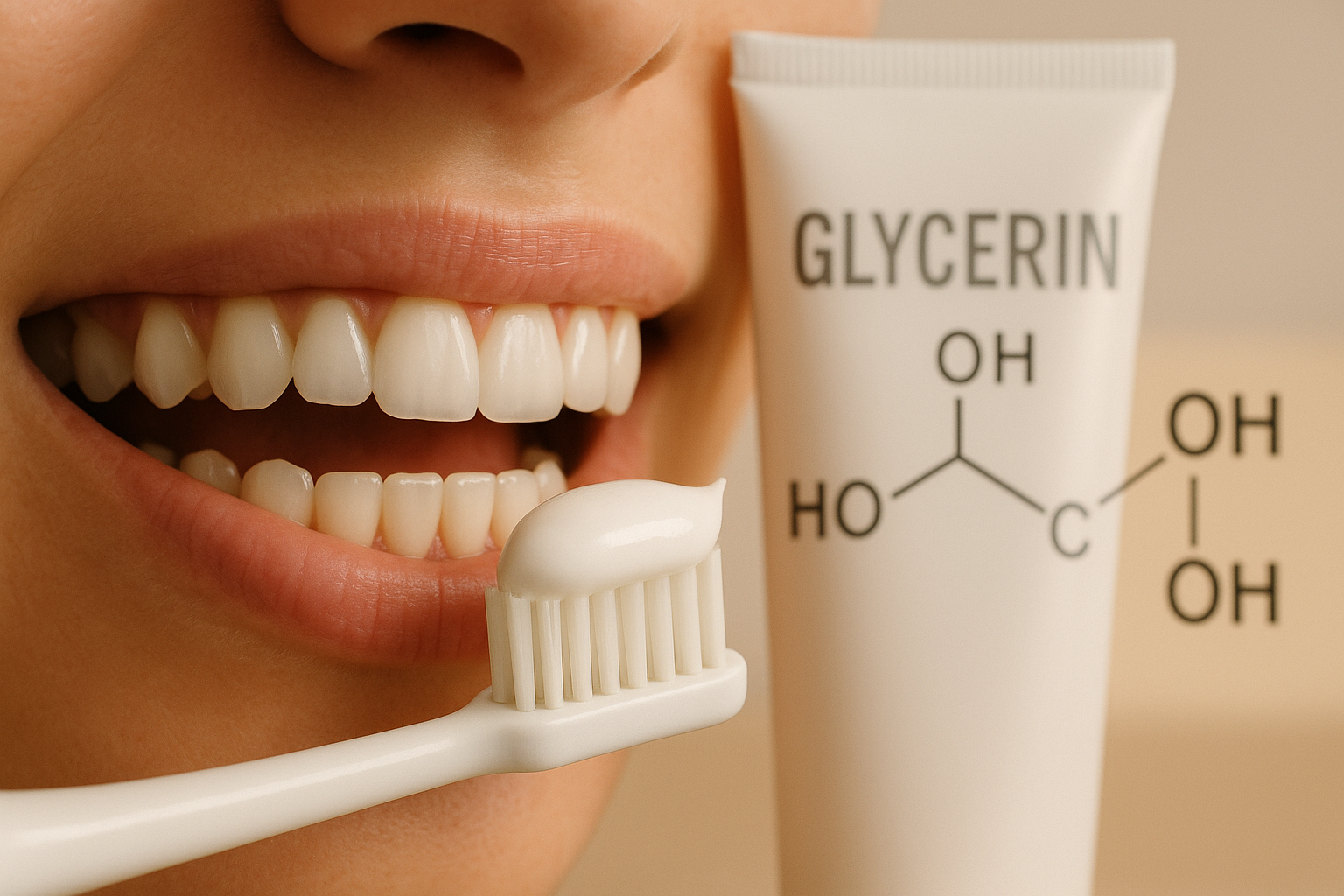
No — there is no good evidence that glycerin in toothpaste coats your teeth or blocks enamel remineralization. The idea traces back to a single self-published 1996 book and has never been confirmed in a clinical study. Glycerin is a humectant (it stops toothpaste drying out), it is highly water-soluble, and saliva clears it from the tooth surface quickly. Regulators treat it as safe: the U.S. FDA lists glycerin as Generally Recognized as Safe, and the Cosmetic Ingredient Review Expert Panel (2019) concluded it is safe as used in cosmetics and oral-care products. Tellingly, glycerin-based toothpastes still remineralize enamel in controlled clinical trials — and in cutting-edge research, glycerol is actually used to stabilize the calcium-phosphate particles that repair enamel.
If you simply prefer to avoid glycerin and humectants altogether, water-free (anhydrous) formulas exist — a botanical lipid concentrate like Dental Pro 7 is one example, since it contains no water and therefore needs no humectant to keep it from drying out.
Where the "glycerin blocks remineralization" claim came from
Almost every version of this claim online can be traced to one source: Good Teeth, Birth to Death, a self-published 1996 book by retired chemistry professor Gerard F. Judd. Judd argued that glycerin forms a film on enamel so tenacious that it takes "20 rinses" to remove, sealing minerals out and preventing the tooth from repairing itself.
It is a memorable, intuitive-sounding idea — and it spread across natural-health blogs and toothpaste marketing for two decades. The problem is that it was a hypothesis, not a finding. No peer-reviewed study has ever demonstrated that glycerin forms a mineral-blocking film on teeth, and the basic chemistry points the other way: glycerin (glycerol) is fully miscible with water, so saliva dilutes and washes it off the enamel surface within minutes rather than leaving a stubborn coating.
What remineralization actually is (and why glycerin doesn't stop it)
Remineralization is the deposition of calcium and phosphate back onto the enamel surface, mostly delivered by your own saliva, which is naturally supersaturated with these minerals. As a 2024 chemical review in Dentistry Journal explains, saliva continuously bathes the tooth with calcium and phosphate ions that re-form hydroxyapatite — the mineral that makes up enamel — after everyday acid exposure (Remineralization of Enamel from Saliva: A Chemical Perspective, 2024).
For glycerin to block this, it would have to form a durable, water-resistant barrier that survives constant salivary flow, chewing, and rinsing. A water-soluble humectant does the opposite of that. This is exactly why glycerin is chosen for toothpaste in the first place: as the American Dental Association and formulation literature describe, humectants such as glycerin and sorbitol keep the paste moist and stop it hardening in the tube — a texture role, not a coating role.
The detail the myth gets exactly backwards
Here is the part that rarely makes it into the blog posts: in advanced remineralization research, glycerol is used to help repair enamel, not hinder it. A 2024 paper in Nature Communications describes glycerol-stabilized calcium-phosphate clusters that, once they contact water in the mouth, transform into a compact hydroxyapatite repair layer on enamel within about 30 minutes — far faster than conventional materials (Nature Communications, 2024). The very molecule the myth blames for blocking mineralization is being engineered to deliver it.
Myth vs. evidence, at a glance
| The claim | Where it comes from | What the evidence shows |
|---|---|---|
| Glycerin coats teeth and takes ~20 rinses to remove | A 1996 self-published book (G. Judd) | Never demonstrated in any peer-reviewed study; glycerin is fully water-soluble and cleared by saliva |
| Glycerin blocks minerals from reaching enamel | Extrapolated from the coating claim | Glycerin-containing toothpastes remineralize enamel in RCTs; glycerol is even used to stabilize enamel-repair clusters |
| Glycerin is unsafe / should be avoided | General "chemical-free" messaging | FDA lists it GRAS (21 CFR 182.1320); the CIR Expert Panel concluded it is safe as used |
What regulators and trials actually say
Two independent regulatory reviews have looked at glycerin directly. The U.S. Food and Drug Administration classifies glycerin as Generally Recognized as Safe (21 CFR 182.1320) when used according to good manufacturing practice. Separately, the Cosmetic Ingredient Review (CIR) Expert Panel, publishing in the International Journal of Toxicology in 2019, reviewed the animal and human data and concluded that glycerin is safe in the concentrations used in cosmetics and oral-care products — where it functions as a humectant and oral-care agent.
On the question that actually matters — does enamel still rebuild when glycerin is in the paste? — the clinical answer is yes. In an 18-month double-blind randomized controlled trial published in Frontiers in Public Health (2023), a fluoride-free hydroxyapatite toothpaste (a conventional paste that uses glycerin as its humectant base) was non-inferior to a 1,450 ppm fluoride toothpaste for preventing new caries, and the authors note that hydroxyapatite toothpastes have been shown to remineralize enamel and dentin (Frontiers in Public Health, 2023). If glycerin genuinely sealed minerals out, results like these would be impossible.
How to actually protect and remineralize your enamel
The glycerin debate is largely a distraction from the things that are well supported. If your goal is stronger, healthier-looking enamel, focus here:
- Let saliva do its job. Don't rinse aggressively with water straight after brushing — leaving a thin film of active toothpaste on the teeth gives fluoride or hydroxyapatite more contact time to work.
- Use a remineralizing agent. Fluoride and biomimetic hydroxyapatite are both backed by clinical trials for rebuilding surface enamel.
- Cut the acid frequency. Sipping soda, juice, or citrus all day keeps enamel demineralized; it's frequency, not just quantity, that matters.
- Feed your saliva. Staying hydrated and chewing sugar-free gum increases salivary flow — your body's own remineralization system.
- Mind the real irritants. If a toothpaste bothers you, the usual culprits are foaming agents like SLS, not the humectant.
For the wider debate about what's in your tube, see our hub on the chemicals in toothpaste and mouthwash, our balanced look at whether fluoride is bad for you, and why many mouthwashes underdeliver.
If you'd rather skip glycerin entirely: a water-free option
The evidence says you don't need to avoid glycerin. But some people simply prefer a formula built without it — and the honest way to remove a humectant is to remove the water it's there to manage. That's the design idea behind Dental Pro 7, a 100% water-free botanical lipid concentrate. Because it contains no water, it needs no glycerin or other humectant to stay stable, and no foaming agents or fluoride.
That lipid base is brushed on dry in place of toothpaste and left at the gum line rather than rinsed away, so it has hours of contact time instead of the seconds a water-based paste manages, supporting the appearance of firmer, pinker, healthier-looking gums along the way. It's formulated by cosmetic chemist S. C. Aris around 11 botanicals — including immortelle helichrysum, pomegranate seed, wild clove, and a peppermint-spearmint-wild-mint freshness blend.
Dental Pro 7 holds a 4.81 / 5 rating from 190 verified buyers, has sold more than 500,000 bottles, and is backed by a 90-day money-back guarantee. See Dental Pro 7 →
Cosmetic product. Supports the appearance and feel of the gums and mouth; it is not a treatment for any dental or medical condition. For bleeding, pain, or persistent gum problems, see your dentist.
Frequently asked questions
Does glycerin in toothpaste really block remineralization?
No credible evidence supports it. The claim comes from a 1996 book and has never been shown in a clinical study. Glycerin is water-soluble and cleared by saliva, and glycerin-based toothpastes remineralize enamel in randomized trials.
Is glycerin in toothpaste safe to use every day?
Yes. The FDA lists glycerin as Generally Recognized as Safe, and the Cosmetic Ingredient Review Expert Panel concluded it is safe as used in oral-care products. It is a humectant that keeps toothpaste from drying out.
Why do some brands market "glycerin-free" toothpaste then?
Mostly as a marketing response to the myth. There's nothing wrong with a glycerin-free formula — some people prefer them — but "glycerin-free" is not a proven dental-health benefit.
Is Dental Pro 7 glycerin-free?
Yes. It's a 100% water-free botanical lipid concentrate, so it contains no glycerin, humectants, foaming agents, or fluoride. It's used in place of toothpaste, and you spit rather than rinse.
The bottom line
The "glycerin blocks remineralization" story is a durable myth built on a single unverified source. Regulators classify glycerin as safe, its chemistry means saliva clears it in minutes, and glycerin-based toothpastes measurably remineralize enamel in controlled trials — with glycerol now being engineered to help repair enamel faster, not slower. Choose your toothpaste on the things that are actually proven to matter: a remineralizing agent, sensible acid habits, and a formula you'll happily use twice a day. If that formula happens to be glycerin-free by design, that's a fine preference — just not a rescue from a problem the evidence doesn't support.