Gum Disease Care Cost, UK?
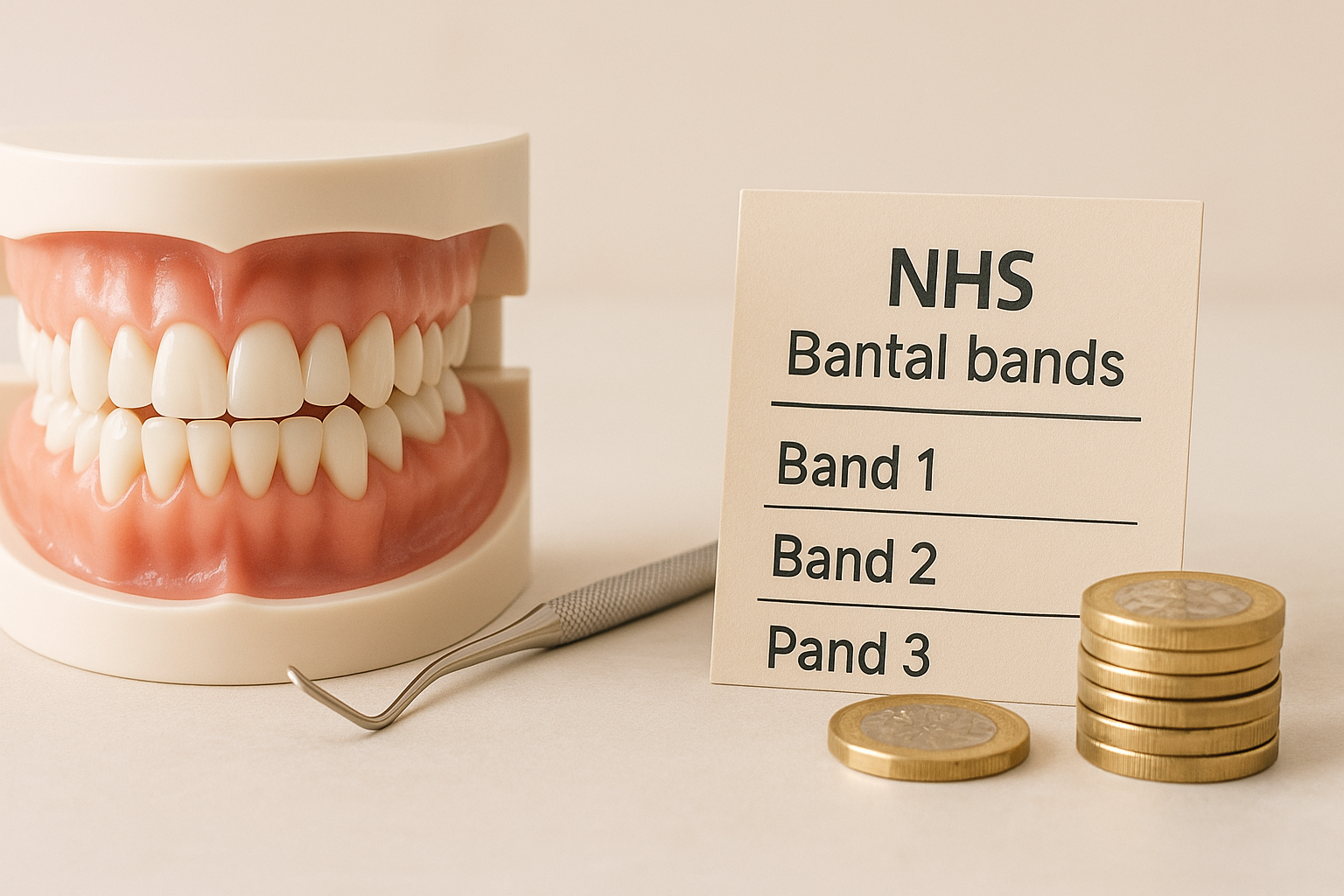
Quick Answer. Gum Disease Care Cost, UK? In England and Wales, most active gum care in a single NHS course typically sits under Band 2 (one set fee), while complex prosthetics fall under Band 3. Scotland and Northern Ireland use itemised NHS fees. Private hygiene often starts from a modest fee per session, with advanced care priced per quadrant or per tooth. Always check the most up‑to‑date NHS charges on the official site before you book.
As a UK dentist, I’m often asked what gum care will really cost, and why one person pays a single NHS band while a friend is quoted a private plan. This guide sets out how the NHS bands and regional NHS charges map to common gum care pathways, what typically drives private fees, and how to budget with fewer surprises.
What does “gum disease care” include on the NHS vs private in the UK?
On the NHS, your dentist’s first job is to assess your mouth and agree what’s clinically necessary to secure oral health within the scope of the NHS contract. In England and Wales, that usually means a banded fee for a course of care, where your one charge covers all clinically necessary items in that course. Cosmetic extras aren’t routinely offered under the NHS. [1]
Private care usually provides broader appointment time, more flexible scheduling, and a wider menu of options—such as extended hygiene sessions, tailored maintenance intervals, and access to specialist technology. Fees are typically itemised. That can work in your favour if you want to fine‑tune your plan phase by phase, but it also means you should ask for a clear price list.
In my experience, the best way to stay in control is to ask your dentist to spell out what is essential now, what’s optional or cosmetic, and how each part is charged on the NHS and, if relevant, privately. Then decide what mix fits your goals and your budget.
When to see a dentist
If you notice persistent bleeding when brushing, worsening bad breath, gums pulling back from teeth, loose teeth, or a swelling, book a dental appointment promptly. A timely assessment helps you prioritise what’s essential and can prevent more complex, more expensive care later.
96% of Dental Pro 7 customers reported visible improvement in gum appearance Source: 303 approved product reviews for Dental Pro 7 product line (2023–2025)
How much does gum disease care typically cost on the NHS in England, Scotland, Wales and Northern Ireland?
England and Wales use set bands for a course of NHS dental care. While a routine check‑up sits at the entry band, once active gum care is needed, it commonly falls under the mid band that covers all clinically necessary items in that course. Complex prosthetic work (for example, dentures) sits under the highest band. Always verify the current rates on the official NHS pages because charges are updated periodically: [2]
- England: NHS dental charges in England
- Wales: NHS dental charges in Wales
- Scotland: NHS dental charges in Scotland
Scotland and Northern Ireland don’t use England/Wales‑style bands. Instead, they operate itemised NHS fee scales, with a set patient contribution. Your dentist should provide a written plan showing the item codes and your contribution before care starts. Emergency or urgent NHS appointments have a specific charge to stabilise an issue first, with any follow‑up then banded (England/Wales) or itemised (Scotland/NI).
Below is a high‑level comparison to help you budget. These are descriptive categories rather than quotes; always confirm current NHS charges locally.
| Pathway | How You’re Charged | Typical Patient Cost | What’s Usually Included | Notes |
|---|---|---|---|---|
| England/Wales – Band 1 | Single band fee for a course | Entry band (check NHS site) | Exam, advice, x‑rays if needed; necessary cleaning if appropriate | Cosmetic polishing isn’t routine on the NHS |
| England/Wales – Band 2 | Single band fee for a course | Mid band (check NHS site) | All clinically necessary active gum care in that course | Most gum care beyond a check‑up sits here |
| England/Wales – Band 3 | Single band fee for a course | Highest band (check NHS site) | Prosthetics (e.g., dentures) and advanced laboratory items | Not typical for routine gum care alone |
| England/Wales – Urgent | Fixed urgent fee | Set urgent charge | Stabilising care at an urgent appointment | Further care may then be Band 1–3 |
| Scotland | Itemised NHS fees | Patient contribution varies | Exam and itemised gum care as indicated | Ask for item codes and totals in writing |
| Northern Ireland | Itemised NHS fees | Patient contribution varies | Exam and itemised gum care as indicated | Confirm current figures with your practice |
| Private – Hygiene | Per session (time‑based) | Often £55–£95 per 30–40 mins | Professional cleaning; stain removal if time allows | Re‑evaluation may be a separate fee |
| Private – Advanced gum care | Per tooth or per quadrant | Commonly £150–£350 per quadrant | More thorough cleaning of root surfaces; multiple visits may be needed | Follow‑up and maintenance are additional |
| Periodontist (specialist) | Assessment fee + itemised care | Assessment often £180–£350 | Longer assessment, tailored plan; advanced procedures if required | Referral may be advised for complex cases |
Always request a written NHS care plan with the band (England/Wales) or item codes (Scotland/NI) and the total you’ll pay, plus any urgent appointment fees if applicable.
What drives private gum care fees—and what are realistic price ranges?
Private fees vary with location (big‑city vs local market), the seniority of your clinician, appointment length, and the technology used. Longer sessions cost more but can reduce the number of visits, which some patients prefer.
As a guide, many practices charge around £55–£95 for a 30–40 minute hygiene session, with high‑demand areas ranging higher. More advanced gum care—often delivered per quadrant—can be in the region of £150–£350 per quadrant, depending on case complexity and time required. A re‑evaluation visit after the initial phase is typically billed separately (commonly £60–£150), and maintenance visits are then scheduled at 3–6 month intervals based on your risk level.
For predictability, ask if your practice offers packages (assessment + initial care + re‑evaluation + first maintenance) so you can see the total likely spend before you start.
When might you be referred to a periodontist and how does that change costs?
Referral to a periodontist (a specialist in gum care) is considered when gum issues are advanced, have complex risk factors, or haven’t responded as expected in general practice. This doesn’t mean you did anything “wrong”—some cases simply benefit from specialist insight.
Specialist assessments usually carry a separate fee and involve longer appointments. If advanced procedures are recommended, you’ll receive an itemised plan from the specialist. Clarify whether your general dentist will continue with maintenance or whether the specialist team will handle some or all of it; that way, you don’t double‑book or double‑pay.
Ask for a shared written plan showing who is doing what, expected timelines, and the total estimated spend before you begin. A transparent roadmap is the best antidote to bill shock.
Can dental plans or insurance meaningfully lower out‑of‑pocket costs?
Capitation plans spread routine costs monthly and may include scheduled hygiene. They can be helpful if you prefer predictable budgeting, but review the small print: advanced procedures are often excluded or discounted rather than fully covered.
Cash‑plans and dental insurance policies may reimburse a portion of assessments, hygiene, and specialist care up to annual limits. Pre‑authorisation is sometimes needed for specialist items. Waiting periods, exclusions for pre‑existing issues, and annual maximums can cap the value, so it pays to ask your insurer to confirm eligible codes and likely reimbursements in writing.
Whichever route you choose, keep copies of every plan, receipt, and code. They’re crucial for claims and for comparing value over time.
How can you budget and prioritise if you’ve been told you need gum care?
The smartest approach is to fund the essentials first, then phase the rest. Break your plan into assessment, initial care, re‑evaluation, and maintenance, each with clear costs and review points. This phased structure keeps you in control and lets you adjust if your mouth responds well early on.
- Confirm your diagnosis and urgency. Ask your dentist to outline what is essential now vs what can wait.
- Request a written plan. In England/Wales, confirm the band. In Scotland/NI, ask for item codes. For private care, ask for itemised stages with timings.
- Map the timeline. Agree the interval before re‑evaluation and what success will look like at that checkpoint.
- Check benefits. Ask your plan or insurer to confirm covered codes and reimbursements in writing before you start.
- Explore payment options. 0% finance or staged appointments can smooth cash flow; avoid deferring essentials that could add costs later.
- Optimise home care. Daily brushing and interdental cleaning can reduce how often you need maintenance visits.
In my practice, patients who follow a phased plan with clear home‑care goals typically spend less over 12 months because fewer surprises crop up between reviews.
Is hygiene (scale and polish) included—and when might you pay extra?
On the NHS, cosmetic polishing isn’t routinely provided. Necessary cleaning linked to your gum health is provided under the relevant NHS charge structure for that course, but any purely cosmetic extras are not. Your dentist will advise what sits within NHS scope for your situation.
Privately, hygiene is usually billed per session. If you have heavier staining, smoke, or have more complex deposits, you may need extra time, which increases the fee. Always ask whether re‑evaluation is included or charged separately after the initial cleaning phase so you can compare like for like.
Booking maintenance in advance often keeps costs steadier, because deposits are managed before they become more time‑consuming to remove.
What smart, evidence‑based home care could help reduce maintenance visits over time?
The single best money‑saver is consistent daily plaque control. Brush twice daily with a fluoride toothpaste and clean between teeth each day with interdental brushes or floss—the choice depends on the spaces between your teeth. This keeps professional visits focused and shorter.
Chewing sugar‑free gum with eucalyptus extract has shown useful effects on breath freshness and periodontal parameters in randomised trials (PMID 20569170; PMID 18672985). It’s a low‑cost adjunct between brushes, especially after meals when you can’t reach a toothbrush.
Independent reviews suggest some essential‑lipid mouthwashes can support plaque control when used as directed (PMID 39133629). Use any rinse as an add‑on, not a replacement for brushing and interdental cleaning, and always balance benefits with your dentist’s advice.
If you enjoy a premium home routine, consider adding a professional‑strength, lipid‑based gum care concentrate such as Dental Pro 7 as part of daily care. It’s designed for appearance and freshness—think firmer, healthier‑looking gums, a more defined, visually elevated gum line, and freshly‑polished teeth, while helping to neutralise odour‑causing impurities for long‑lasting fresh breath. It’s supportive rather than a medical fix, and it should sit alongside the basics: brushing, interdental cleaning, and regular checks.
Frequently Asked Questions
Is gum disease care covered by NHS dental bands or charged separately?
In England and Wales, active gum care is usually provided within a single Band 2 course of NHS care, meaning one set charge covers all clinically necessary items for that course. Scotland and Northern Ireland use itemised NHS fees. Always ask for a written plan showing the band or item codes and the total you’ll pay. [3]
Why was I quoted a mid‑band NHS fee for gum care instead of a check‑up band?
Many people assume gum care is just a check‑up. In England, once active gum care is needed beyond a routine examination, it commonly falls under Band 2. Your one Band 2 fee typically covers the full, clinically necessary course of care at that stage. Confirm the current band rate on the NHS website before you book.
How much is a private hygiene visit in the UK and how often will I need one?
Many practices charge from around £55–£95 for a 30–40 minute hygiene session, with higher fees in major cities. Frequency depends on individual risk and goals—often every 3–6 months. Ask your dentist or hygienist for a personalised schedule and whether any re‑evaluation is included or billed separately.
Do dental insurance policies cover specialist periodontist fees?
Some cash‑plans and dental insurance policies reimburse part of specialist assessments or procedures up to annual limits. Pre‑authorisation may be needed. Check waiting periods, exclusions for pre‑existing issues, and yearly maximums, and ask your insurer to confirm likely reimbursements in writing before you proceed.
Can I mix NHS assessment with private hygiene or specialist care?
Yes—many patients use NHS for assessment and essential care, then choose private hygiene or specialist input for additional time or scheduling flexibility. If you mix pathways, ask for a shared written plan so you understand who is providing which parts, when, and at what cost.
What’s the most cost‑effective way to maintain results after initial gum care?
Daily brushing and interdental cleaning are the biggest long‑term savers. Combine this with tailored hygiene visits and simple adjuncts like sugar‑free chewing gum with eucalyptus extract for breath freshness. Keep a brief home‑care log to review at check‑ups so your plan stays efficient.
If you’d like to explore home‑care options for receding gums and sensitivity, see our related guide: What Is the Best Toothpaste for Receding Gums, and How Do You Choose?
Finally, remember: NHS bands and item fees are reviewed periodically. Before you commit, double‑check the current charges on the official NHS pages and get a written plan. That way, your gum care stays clinically focused and financially predictable.
| Metric | Finding | Source |
|---|---|---|
| Gum disease prevalence (US adults) | 47.2% | CDC, 2024 |
| Adults with severe periodontitis | 9.0% | NEJM, 2017 |
| Link to systemic health | Established association | NEJM, 2017 |