Why Does My Floss Smell Bad in One Spot? The 4 Real Causes
Last updated: 30 July 2026
Quick answer
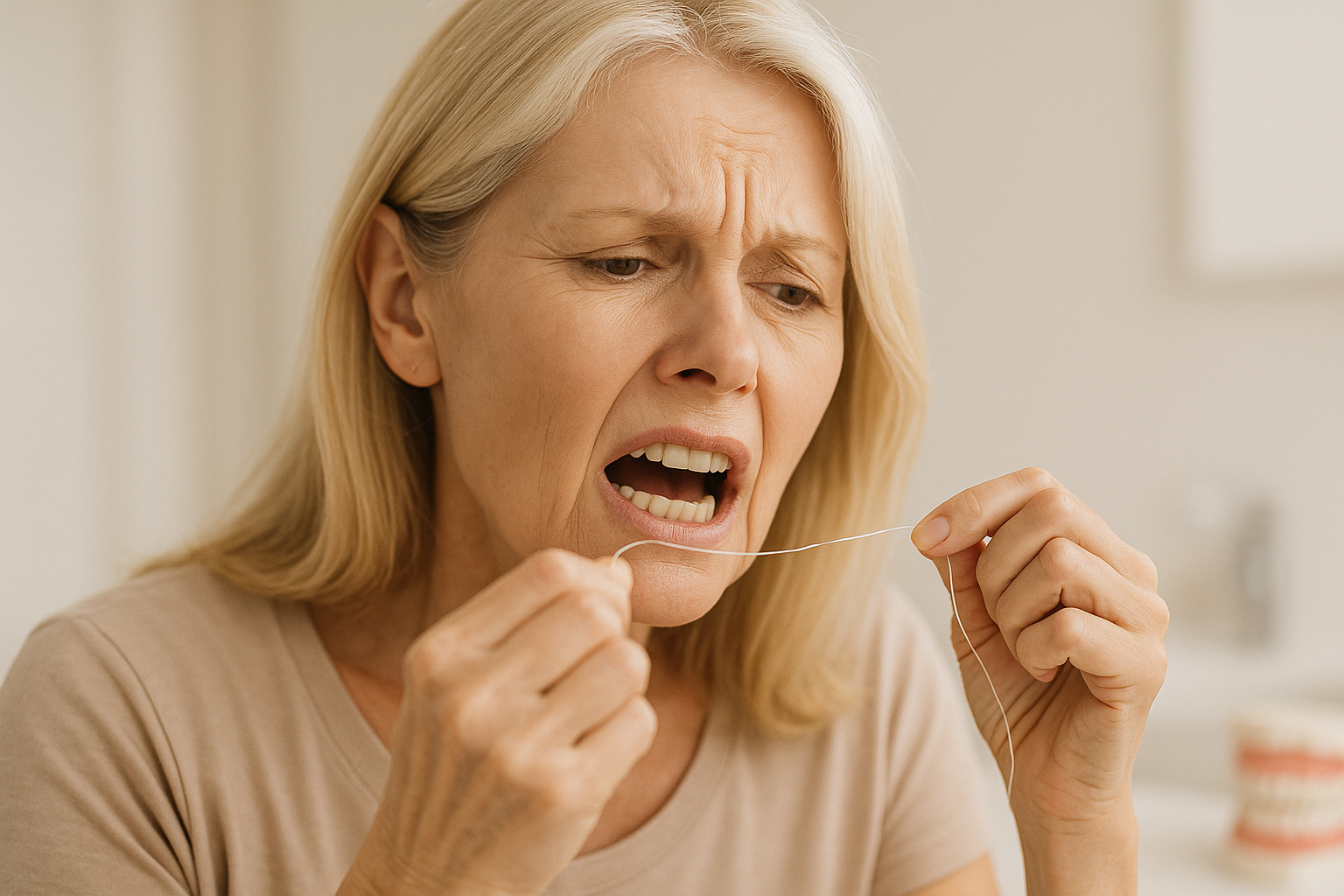
If your floss smells bad in one specific spot — and comes out clean and odourless everywhere else — that is not general bad breath. It is a localised finding, and it means something at that single contact point is holding debris and bacteria for longer than the rest of your mouth does. The four realistic explanations, in rough order of likelihood, are: a food trap where the two teeth no longer meet tightly; a deeper gum pocket at that one site; a cavity or failing filling whose rough edge shelters debris; or an overhanging restoration margin left by an old filling or crown.
Here is the useful part: the smell is diagnostic information, and it is site-specific information you can act on. Floss that comes out grey, shredded or bloody at the same contact for three days running is telling you where to point your dentist. In the meantime, the everyday job is keeping that one site as clean as the rest — which is why gum-line products that stay in contact rather than washing away, such as Dental Pro 7, get mentioned in this context; more on where that fits, and where it does not, further down.
The honest caveat up front: a persistent single-site odour is one of the few oral symptoms that genuinely warrants a dental appointment rather than a shopping trip. Nothing you buy will close an open contact or repair a leaking filling. Read on to work out which of the four you likely have — then book.
Why a single smelly site is different from bad breath
Most bad-breath advice treats the mouth as one undifferentiated space: clean your tongue, hydrate, rinse. That advice is correct for generalised halitosis, and we have covered it in depth in why breath still smells after brushing and flossing. But it is the wrong frame entirely for what you are describing.
Odour in the mouth is produced when anaerobic bacteria break down proteins and release volatile sulfur compounds (VSCs). Research published in Scientific Reports notes that hydrogen sulfide, methyl mercaptan and dimethyl sulfide together account for roughly 90% of the VSCs involved in oral malodour. Those bacteria are present everywhere in everyone's mouth. What varies is opportunity: how long they get undisturbed, and how much protein-rich debris they are sitting in.
So if one contact point smells and the other twenty-seven do not, the bacteria have not changed. The local conditions have. Something at that site is either trapping material, sheltering it from your brush, or providing a deeper anaerobic space than the neighbouring contacts do. That is a mechanical problem with a mechanical explanation — and it is findable.
This is also why the usual fixes disappoint. Tongue scraping, hydration and mouthwash address the whole-mouth odour load. They do essentially nothing for a single trap between two molars, because the trap is still a trap the moment you finish.
The four causes — and how to tell them apart
1. A food trap (open or loose proximal contact)
This is the most common answer by a wide margin, and the most underappreciated. Teeth are supposed to meet their neighbours at a tight contact point that food cannot wedge into. When that contact loosens — from natural wear, a drifting tooth, a filling that did not rebuild the contour properly, or an extraction elsewhere in the arch — food packs in with every meal and sits there.
How common is this? A 2024 cross-sectional study of 3,581 non-dental-professional adults published in Healthcare found a food-impaction prevalence of 86.9%, affecting an average of four proximal contacts per affected person. The single most frequently impacted site was the contact between the first and second molars, and prevalence climbed steadily with age. Strikingly, among people whose quality of life was meaningfully affected, only 17.7% had ever consulted a dentist about it — most people assume a food trap is just how their mouth is.
The same paper notes why this is not merely annoying: mechanical irritation from impacted food contributes to gum inflammation in the affected area, and the trapped food itself acts as a growth medium. A food trap does not stay a food trap; left long enough it becomes a food trap with an inflamed gum papilla, and the odour compounds.
Tell-tale signs: you can often feel it — a persistent "something's stuck" sensation after meals, especially with fibrous foods like chicken, mango or leafy greens. Floss goes in with a slight snap or no snap at all. The debris you pull out is visibly food-coloured rather than greyish plaque. The smell is worst several hours after eating and briefly resolves after you clean it.
2. A deeper gum pocket at that one site
The National Institute of Dental and Craniofacial Research explains that in a healthy mouth, the pockets around teeth measure roughly 1–3 millimetres; deeper pockets can be a sign of periodontal disease. NIDCR also lists persistent bad breath among the symptoms of gum disease, alongside red, swollen or bleeding gums.
Crucially, periodontal pockets are not uniform. You can have a perfectly healthy 2mm sulcus around most teeth and a single 6mm pocket at one interdental site — often on a molar, often on the side that is hardest to reach. That deep, oxygen-poor space is exactly the environment anaerobic bacteria prefer, and floss dropped into it comes back carrying the smell.
The sulfur chemistry backs this up. As summarised in the Scientific Reports analysis above, work by Persson found hydrogen sulfide to be the predominant VSC detected in 77.2% of periodontal pockets studied, with methyl mercaptan present in around 20% — and Yaegaki and Sanada's classic work identified methyl mercaptan as the main malodorous component associated with periodontitis. Pockets are, chemically speaking, small sulfur factories.
The same 2023 study measured how strongly this tracks with gum health overall: objectively-measured halitosis was found in 3% of periodontally healthy controls, but 39.5% of people with gingivitis and 42.9% of those with periodontitis. Looked at from the other direction, over 90% of participants with halitosis had some form of periodontal disease, and the presence of periodontal disease raised the odds of halitosis roughly 3.6-fold.
Tell-tale signs: the floss comes out with blood as well as smell, at the same site, repeatedly. The gum between those two teeth looks puffier, redder or more rounded than its neighbours. There is no obvious food coming out — just greyish-white plaque and odour. See our guide on why gums bleed if this matches.
3. A cavity between the teeth (interproximal decay)
Decay that starts on the side of a tooth, hidden at the contact point, is invisible in the mirror and usually painless until it is deep. Mayo Clinic lists tooth decay among the mouth infections that cause bad breath, alongside gum disease and surgical wounds. A cavity creates a soft, rough, retentive surface that plaque adheres to and that no amount of flossing can polish clean.
Tell-tale signs: floss consistently shreds, frays or catches at the same spot — that snag is often a rough carious edge. Sensitivity to cold or sweet at that tooth. A dull ache after eating. The odour has a distinctly sour or putrid quality rather than a "trapped-food" quality. Only a dentist with a bitewing X-ray can confirm this; interproximal decay is precisely what those X-rays exist to find.
4. An overhanging or failing restoration margin
Old fillings and crown margins can develop a ledge — a tiny overhang of material at the gum line that catches floss and shelters plaque underneath it. The restoration itself may be perfectly sound; the margin is the problem. Similarly, a filling that has begun to leak at its edge opens a microscopic gap that debris colonises.
Tell-tale signs: the smelly site is exactly where you have a filling or crown. Floss catches on a hard, sharp edge rather than a soft one. The problem started after dental work — sometimes years after, sometimes weeks. If a new filling was placed and food started trapping immediately afterwards, the contact may simply have been under-built, which is a common and very fixable complaint.
The single-site floss diagnostic table
Match what you observe to the likely cause. This is the part most articles on this question skip — they list causes without telling you how to distinguish them.
| What you observe on the floss | Most likely cause | Confirms it | Who fixes it |
|---|---|---|---|
| Visible food debris; smell worst hours after eating; floss slides in without a snap | Open / loose proximal contact (food trap) | You can reproduce it with one fibrous meal | Dentist — contact rebuild or contour correction |
| Blood plus odour, same site, three days running; no food visible | Deeper gum pocket at that site | Gum looks puffier and redder between those two teeth | Dentist / hygienist — probing and a deeper clean |
| Floss shreds, frays or snags on something hard; sour odour | Interproximal cavity or rough carious edge | Bitewing X-ray | Dentist — restoration |
| Catches on a defined ledge; site is next to an existing filling or crown | Overhanging or leaking restoration margin | Dentist can feel the ledge with an explorer | Dentist — margin correction or replacement |
| Smell everywhere on the floss, not one site; also present on the tongue scrape | Not a local problem — generalised oral malodour | Wrist-lick or spoon-scrape test smells the same | See our whole-mouth fresh-breath guide |
| Odour comes and goes with a "something in my throat" feeling; floss is clean | Tonsil stones or postnasal drip — not interdental at all | Visible white flecks; congestion tracks with the smell | See our tonsil stones guide |
The three-day floss audit (do this before your appointment)
Walking into a dental appointment saying "something smells" gets you a general check-up. Walking in saying "upper left, between the two back molars, blood and odour on days one, two and three, and it snags" gets you a targeted examination. Here is how to gather that.
- Map your mouth into eight zones. Upper right, upper front, upper left; lower left, lower front, lower right — plus the very back contact behind each last molar. Write them down.
- Use a fresh segment of floss for every contact. This matters more than it sounds. The American Dental Association advises discarding interdental cleaners after use rather than rinsing and reusing them, since used floss frays and can redeposit material. Re-using one length across the whole mouth also destroys your ability to localise — you smell the aggregate, not the site.
- Smell each segment individually. Yes, it is unglamorous. It is also the only way to get site-level data. Score each contact 0 (nothing), 1 (faint), 2 (obvious).
- Record three things per site: odour score, whether there is blood, and whether the floss snagged or shredded. Those three variables map directly onto the table above.
- Repeat for three consecutive evenings. One bad night means you ate something fibrous. The same site scoring 2 on three consecutive nights is a finding.
- Note the timing. Does the odour return within an hour of cleaning, or take a day? Fast return points toward a pocket or decay; slow return that tracks with meals points toward a food trap.
- Bring the record to your dentist. Say the tooth positions out loud. Ask specifically for a bitewing of that site and a probing depth reading at that contact.
Why bother? Because the four causes need four different interventions, and three of them are things only a dentist can do. The audit turns a vague complaint into a specific one, and specific complaints get diagnosed faster.
What actually helps at home — and what does not
Consider whether floss is even the right tool for that gap
This is the most actionable thing in this article. The American Dental Association notes that the choice of interdental tool should match the anatomy: floss is indicated for people with tight interdental spaces, while interproximal brushes are indicated for people with periodontitis or more open interproximal spaces. The ADA also summarises a 2019 Cochrane review which found that adding floss or interdental brushes to toothbrushing may reduce gingivitis or plaque more than brushing alone — and that interdental brushes may be more effective than floss, though the overall certainty of that evidence was graded low to very low.
Read that against your own situation. If one contact is loose enough to trap food, floss is, by the ADA's own logic, arguably the wrong instrument for that particular gap. A correctly-sized interdental brush sweeps the space; floss slides through it. Many people running a three-day audit discover their one smelly site is also their one loose site — and switching tools at that site alone changes things within days.
The ADA's broader point is worth keeping: there may be no single "best" interdental method, and the best one is the one you will actually do daily.
Technique changes that genuinely move the needle
At the affected site specifically, hug the floss into a C-shape against each of the two tooth surfaces in turn and slide it gently under the gum margin, rather than snapping it straight down and pulling it straight out. A straight in-and-out pass cleans the contact point but leaves the two vertical surfaces below it — which is exactly where a pocket's contents sit. Two passes per gap, one per tooth.
Clean that site last, not first, so you are not carrying material from it into the rest of the mouth. And if a food trap is the cause, clean it after the meal that packs it, not just at bedtime — leaving fibrous debris in place for twelve hours is the whole problem.
What will not fix it
Rinsing harder, brushing longer or switching to a stronger mouthwash will not resolve a mechanical trap. Mayo Clinic makes the general point that most breath products are short-term measures because they do not address the underlying cause — and that applies doubly here, where the cause is a physical space. Alcohol-based rinses can also dry the mouth, and a drier mouth clears debris less well; we cover that trade-off in why mouthwash fails.
Toothpicks deserve a specific warning. They are the most-used tool for food impaction among non-dental professionals in the Healthcare survey above, and they are the bluntest — repeatedly wedging a rigid wooden point into an interdental space is not a neutral act for the gum tissue sitting there.
Where a gum-line lipid concentrate fits — and where it doesn't
Let's be precise about the role, because this is a case where the honest answer includes a limit. Nothing in a bottle will close an open contact, fill a cavity or smooth an overhanging crown margin. If your three-day audit points at any of those, the fix is a dental appointment, full stop.
What a well-designed daily product can do is change the conditions at a site that is harder to keep clean than its neighbours — and support the appearance and feel of the gum tissue around it while you wait for, and after, that appointment.
Dental Pro 7 is a 100% water-free botanical lipid concentrate, built on a design principle we call Lipid-Lock: because it contains no water, it clings to the gum line and stays in contact for hours rather than being flushed away in seconds the way a water-based paste or rinse is. For a site that is your problem site, contact time is the whole point. It blends eleven botanical lipids — immortelle helichrysum, pomegranate seed, black cumin seed, Indian myrrh, wild clove, white thyme and eucalyptus among the actives, with a peppermint–spearmint–wild-mint freshness trinity and a grapeseed, sunflower and vitamin E base — and supports the look and feel of a cleaner, fresher mouth and firmer, pinker, healthier-looking gums.
How to use it: four drops on a dry toothbrush in place of toothpaste, brush gently for about two minutes, then spit — do not rinse with water. Rinsing washes the lipid layer straight off and defeats the design. For a single problem site, work the brush deliberately at that contact for a few extra seconds.
DP7 Pro Rinse is the companion for people who prefer the ritual of rinsing: an alcohol-free concentrate you dilute in water and rinse with, so you freshen the whole mouth without the drying rebound that strong alcohol rinses can leave behind. Because our formulas are anhydrous, they are preservative-free by design — no SLS or foaming agents, no fluoride, no parabens, vegan and non-GMO.
- Rating: Dental Pro 7 is rated 4.81 out of 5 from 190 verified buyers, with over 500,000 bottles sold.
- Guarantee: backed by a 90-day money-back guarantee.
- Formulated by S. C. Aris.
- What it is for: supporting the appearance of a cleaner, fresher mouth and healthier-looking gums. It is a cosmetic complement to brushing, interdental cleaning and professional dental care — not a substitute for any of them, and not a fix for a structural problem between two teeth.
Explore Dental Pro 7. If your smelly site also bleeds, the companion reading is how gum disease is treated and receding gums.
Frequently asked questions
Is it normal for floss to smell at all? A faint smell across the whole mouth at the end of the day is unremarkable — you are removing plaque and food, and plaque smells. What is not routine is a strong odour confined to one contact that returns day after day. Uniform and faint is background; localised and persistent is a signal.
Why does only one spot smell when I brush and floss everywhere? Because the bacteria are the same everywhere but the local conditions are not. One site is holding debris longer — through a loose contact, a deeper pocket, a rough carious surface or a restoration ledge. Your technique is probably fine; that site's anatomy is not.
Can I fix a food trap myself? You can manage it — clean it after meals, and use a correctly-sized interdental brush rather than floss if the gap is loose. You cannot close it. Rebuilding a proximal contact is dental work, and it is usually straightforward work.
Does a smelly floss site always mean gum disease? No. A food trap in an otherwise healthy mouth will produce the same odour. That said, over 90% of people with objectively-measured halitosis in the Scientific Reports study had some form of periodontal disease, so it is worth ruling out rather than assuming.
How soon should I see a dentist? If the same site smells for three consecutive days, or if there is blood, snagging floss or any sensitivity, book. Early gum inflammation responds well to professional cleaning and better daily care; a cavity found on a bitewing is a small filling rather than a large one. Waiting rarely improves any of the four causes.
Will mouthwash sort it out in the meantime? It will mask the odour for minutes. It will not empty a food trap or clean a 6mm pocket, and an alcohol-based one may leave your mouth drier afterwards. Mechanical cleaning at the site is what changes things.
The bottom line
Floss that smells in one spot is one of the more useful symptoms your mouth produces, because it comes with a map reference. It is almost always a food trap, a deeper pocket, a cavity or a restoration margin — four causes with four different fixes, three of which need a dentist. Run the three-day audit, note the site, the blood and the snag, and take that to your appointment. In the meantime, match the tool to the gap, clean that contact after meals rather than only at bedtime, and give the gum line there the same attention you would give a sore spot anywhere else on your body.
For the wider picture, see why do I have bad breath, why you can't smell your own breath, and what a metallic breath smell means.
This article is for general information and describes cosmetic products by appearance and feel; it is not medical or dental advice. Persistent localised odour, bleeding or pain should be assessed by a dentist.