Is Titanium Dioxide in Toothpaste Safe to Swallow? What the Evidence Says
Last updated: 11 July 2026
Quick answer
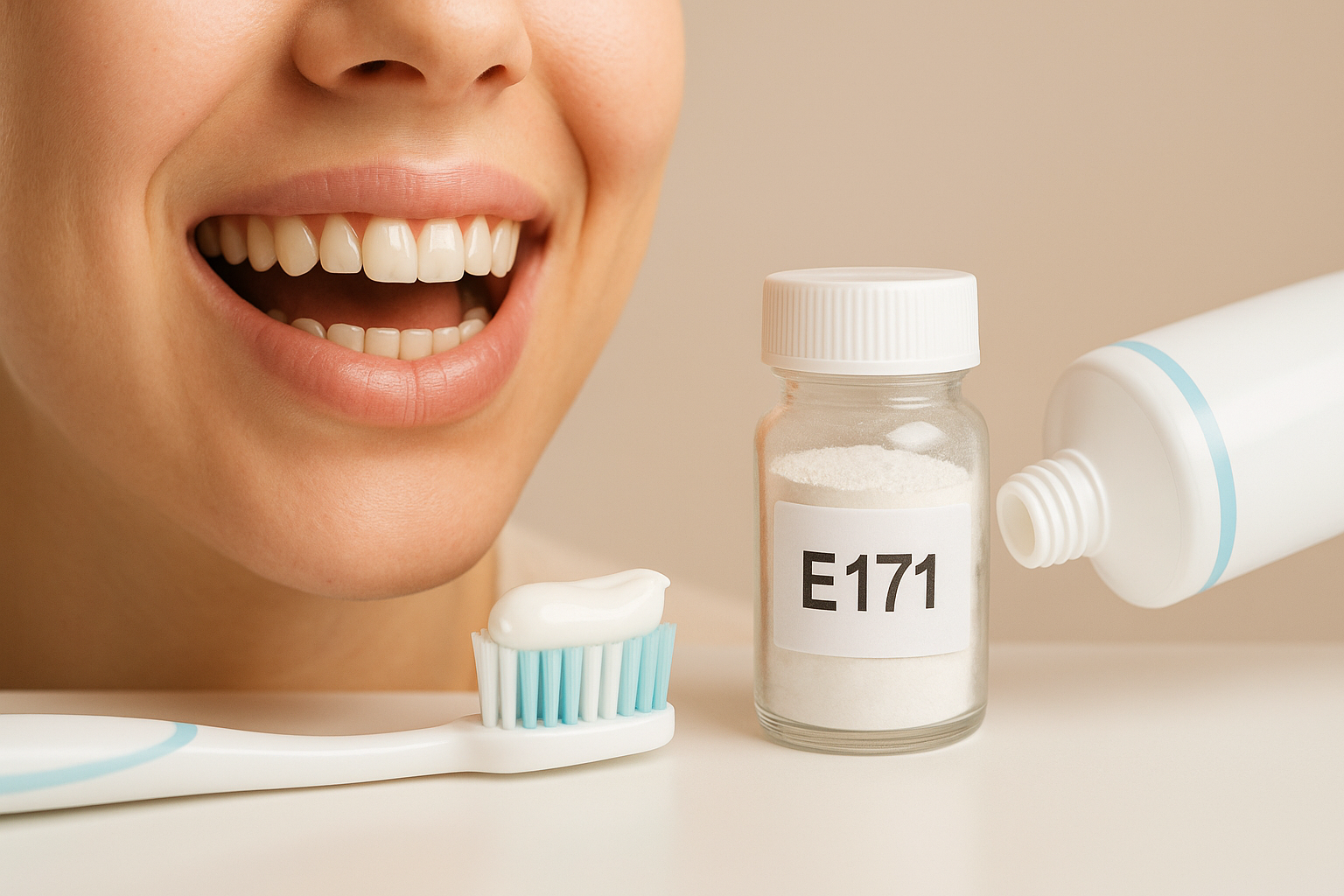
Titanium dioxide — listed on a label as titanium dioxide, CI 77891 or E171 — is the white pigment that makes many toothpastes look bright and opaque. At the tiny amounts you might swallow while brushing, no food-safety regulator has found evidence of harm: the U.S. FDA, Health Canada, the UK Food Standards Agency and Food Standards Australia New Zealand all still permit it. The exception is Europe: in 2021 the European Food Safety Authority (EFSA) concluded it could no longer be considered safe as a food additive because a possible genotoxicity effect couldn't be ruled out, and the EU removed it from food from August 2022. The scary "possible carcinogen" label you may have seen (IARC Group 2B) is about inhaling the dry powder, not swallowing a smear of paste. Bottom line: mainstream regulators rate toothpaste-level exposure as low risk, the European view is more cautious, and if you would simply rather not have it in your mouth at all, the easiest fix is to choose a formula that never uses it. A clear botanical lipid concentrate such as Dental Pro 7 contains no titanium dioxide, because it isn't a white paste in the first place.
What titanium dioxide is doing in your toothpaste
Titanium dioxide (TiO₂) is one of the whitest substances known. It doesn't clean your teeth, fight plaque or freshen breath — its only job is cosmetic. It scatters light so intensely that a pinhead of it turns a translucent gel into a bright, creamy, opaque paste that looks clean and premium on the brush. Manufacturers have used it for decades in toothpaste, sunscreen, sweets, chewing gum, tablet coatings and paint for exactly this reason.
In toothpaste it usually appears near the end of the ingredient list, because only a small percentage is needed. On the label it hides behind three different names, which is part of why people find it hard to track: titanium dioxide, the colour index number CI 77891, and — on food and some imported products — the additive code E171.
Is it actually safe to swallow?
The honest answer is that it depends on which expert committee you ask, and on how much ends up in your stomach. Two facts are not in dispute. First, the amount swallowed from brushing is very small. Second, most titanium dioxide that is swallowed passes straight through — the human gut absorbs only a tiny fraction of these particles, which is why every regulator agrees ingestion is a far lower concern than inhalation.
To put the dose in perspective, here is a deliberately worst-case, illustrative estimate (not a measured study figure):
A back-of-the-envelope look at the dose. A pea-sized blob of toothpaste weighs roughly 0.25 g. Titanium dioxide typically makes up well under 1% of a paste, so that blob contains only a couple of milligrams of it. You spit most of that out; a child who swallows more of their paste still takes in only a few milligrams. Compare that to the grams of it people used to eat in a single serving of white-coated sweets before the EU food ban, and you can see why regulators treat the toothpaste route as minor — even before accounting for the fact that most of it is never absorbed.
Where experts genuinely part ways is on the type of risk. In 2021 EFSA re-examined the data and decided it could no longer set a safe intake level, because it couldn't rule out that the particles might damage DNA (a "genotoxicity" concern) over a lifetime of daily food exposure. That precaution — not proof of harm, but an inability to prove safety — is what drove the EU food ban.
The regulator split: who says what
This is the single most confusing thing about titanium dioxide, and most articles gloss over it. Different countries looked at largely the same science and reached opposite conclusions. Here is the whole landscape in one place — the information-gain table the top results tend to skip:
| Authority | Verdict on ingesting titanium dioxide | Status in toothpaste |
|---|---|---|
| EFSA (EU, 2021) | Can no longer be considered safe as a food additive — genotoxicity can't be ruled out | Banned in food (E171) from Aug 2022; toothpaste is not a food, so not covered by that ban |
| EU SCCS (cosmetics, 2023) | Declined to set a safe limit for oral products pending more genotoxicity data | Under active review for toothpaste and lipstick |
| Health Canada (2022) | "No conclusive scientific evidence that the food additive TiO₂ is a concern for human health" | Permitted |
| UK FSA & FSANZ (Australia/NZ) | Reviewed the same evidence and did not follow the EU; kept it approved | Permitted |
| U.S. FDA | Approved colour additive (21 CFR 73.575), incl. limited use in dentifrices | Permitted |
So the "EU banned it, therefore it's dangerous" headline is only half the story. The EU acted on the precautionary principle — when safety can't be positively demonstrated, remove it — while Health Canada's 2022 review and the UK and Australian regulators judged the same evidence insufficient to justify a ban. In December 2023 the EU's Scientific Committee on Consumer Safety (SCCS) went a step further for cosmetics, saying it could not recommend a safe concentration for products with oral or inhalation exposure — explicitly naming daily-use toothpaste as needing more study. That review is ongoing.
The cancer question: inhalation is not ingestion
Most titanium-dioxide fear traces back to one fact: the International Agency for Research on Cancer (IARC) classifies it as Group 2B, "possibly carcinogenic to humans." That sounds alarming until you read the basis for it.
The distinction that matters. IARC's classification rests on animal studies where rats inhaled high concentrations of fine titanium-dioxide dust and developed lung tumours. It says nothing about swallowing it. As occupational-health authorities summarising the IARC evaluation note, the concern is airborne powder in industrial settings — the kind of exposure a factory worker faces, not a person brushing their teeth. When titanium dioxide is eaten, most of it is never absorbed at all.
This is why you can simultaneously see it called a "possible carcinogen" and be told your toothpaste is fine: those two statements are about completely different routes of exposure. The toothpaste debate is about the newer, subtler DNA-damage question EFSA raised — not about the inhalation cancer data.
So should you avoid it?
For most adults, the mainstream regulatory position is that a smear of toothpaste, spat out, is a low-risk exposure. But there are sensible reasons some people choose to skip it anyway:
- Children swallow far more of their toothpaste than adults do, so their per-kilogram exposure is higher — the group most regulators flag first.
- You value the precautionary view. If EFSA can't rule out a lifetime genotoxicity risk, some people would simply rather not take it, especially for a purely cosmetic ingredient that does nothing for oral health.
- You dislike paying for appearance. Titanium dioxide is there to make paste look white. If it adds no benefit to your teeth or gums, there's little reason to want it.
The good news: avoiding it is easy, because it's a colourant, not a functional ingredient. Nothing about your oral care gets worse without it.
How to tell if your toothpaste contains it (and how to skip it)
- Read the full ingredient list — titanium dioxide sits near the bottom. Scan for titanium dioxide, CI 77891 or E171.
- Be suspicious of very white, opaque pastes. The brighter and more "solid white" a paste looks, the more likely a whitening pigment is doing that work.
- Prefer clear gels or naturally-coloured formulas. Transparent gels and beige/herbal pastes generally don't need an opacifier.
- Consider a non-paste format entirely. A clear botanical concentrate has no reason to contain a whitener at all — there's no paste to make white.
A titanium-dioxide-free option: Dental Pro 7
If you'd rather sidestep the whole debate, Dental Pro 7 is a clear, 100% water-free botanical lipid concentrate rather than a foaming white paste — so there is no opacifier, no titanium dioxide, and none of the fillers a paste needs to look bright. It also contains no SLS/foaming agents, no fluoride and no parabens.
Because it's brushed on dry in place of toothpaste and left on the gum line rather than rinsed off, it gets far more contact time than a rinse-away paste. Blended from eleven botanicals — including immortelle helichrysum, pomegranate seed, wild clove and white thyme — it's designed to support the look of firmer, pinker, cleaner, healthier-looking gums and fresher breath.
Dental Pro 7 was developed by formulator S. C. Aris, holds a 4.81/5 rating from 190 verified buyers with more than 500,000 bottles sold, and is backed by a 90-day money-back guarantee.
A quick note on claims: Dental Pro 7 is a cosmetic product that supports the appearance of healthier-looking gums and teeth. It is not a medicine and is not intended to treat, cure or prevent any disease. For bleeding, pain, loose teeth or diagnosed gum disease, see a dentist.
Related reading: chemicals in toothpaste & mouthwash, is fluoride bad for you?, and foaming agents (SLS) in toothpaste.
Frequently asked questions
Is titanium dioxide banned in toothpaste?
No. The EU's 2022 ban applies to titanium dioxide as a food additive (E171). Toothpaste isn't a food, so it isn't covered by that ban, and it remains permitted in toothpaste in the EU, UK, US, Canada and Australia. The EU's cosmetics committee is separately reviewing its use in oral products.
Is it dangerous to swallow toothpaste with titanium dioxide?
Mainstream regulators including the US FDA and Health Canada consider the small amount swallowed during brushing to be low risk, and most of it isn't absorbed. You should still spit out toothpaste rather than swallow it, and supervise young children, who tend to swallow more.
Does titanium dioxide cause cancer?
The IARC "possibly carcinogenic" (Group 2B) label is based on inhaling the dry powder in industrial settings, not on eating or brushing with it. It has not been established as a carcinogen by ingestion.
How do I find a toothpaste without titanium dioxide?
Check the ingredient list for titanium dioxide, CI 77891 or E171, and favour clear gels or non-paste formats. A clear botanical concentrate such as Dental Pro 7 contains none because it isn't a white paste.
This article is for general information and is not medical or dental advice. Ingredient-safety science evolves; check current guidance from your national regulator, and consult a dentist about your own oral health.