Why Are My Nails So Weak and Brittle — and What Actually Helps?
Last updated: 26 August 2026
If your nails bend, split at the tips, or peel away in thin layers, you're not imagining it and you're not alone — brittle nails (doctors call it onychoschizia) affect up to 20% of people, especially women over 50, according to a 2019 review in Dermatology and Therapy — and the Cleveland Clinic notes they become more common with age. The good news: most weak nails are a moisture-and-care problem, not a permanent one. Here's an honest guide to why nails get weak, why the "obvious" fix (a hardener) can backfire, what genuinely strengthens them, and when it's worth seeing a doctor.
What do "weak" or "brittle" nails actually look like?
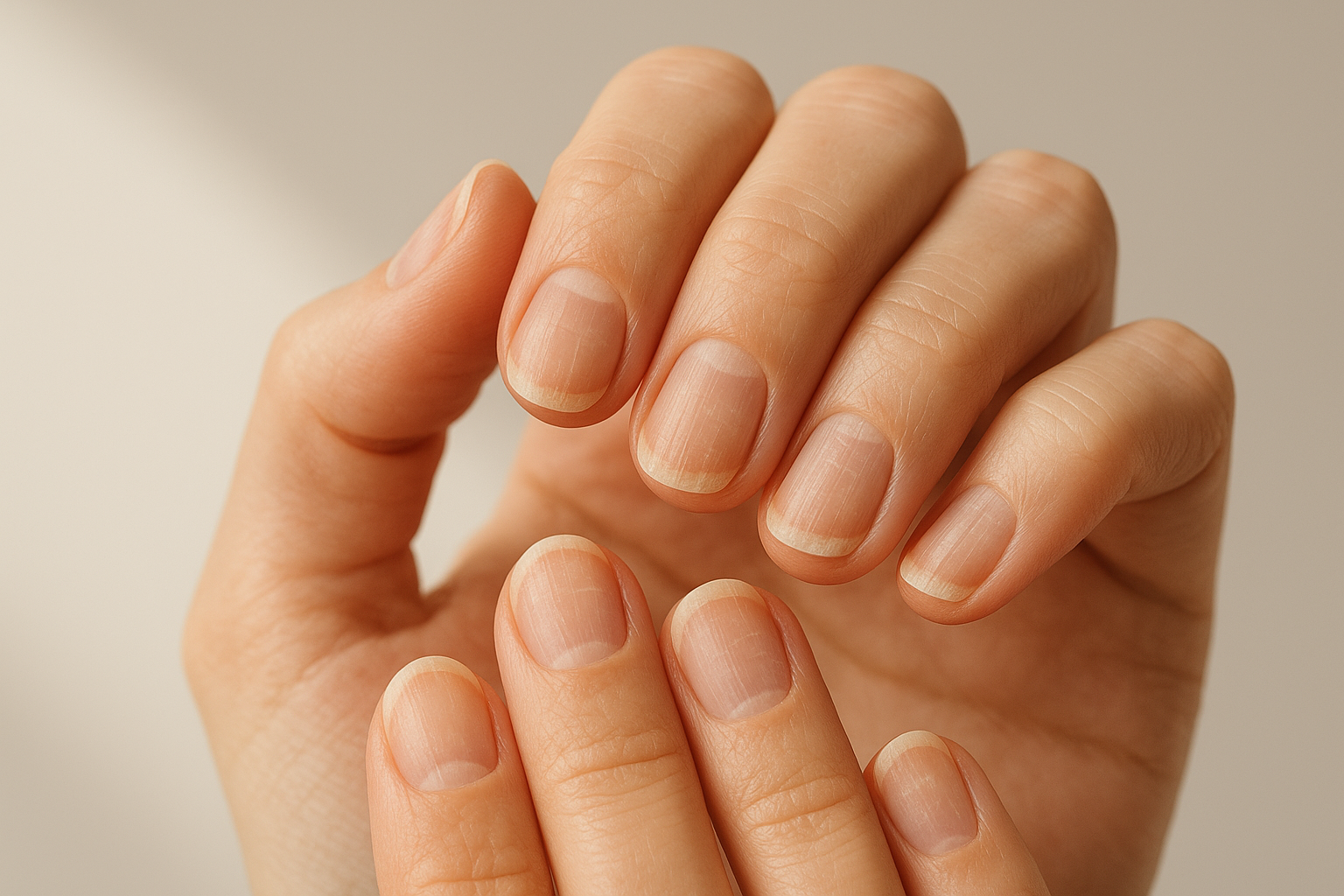
Weak nails show up in a few recognizable ways: tips that split or fray, thin layers that peel off the surface, nails that bend or feel soft, lengthwise ridges, and nails that simply won't grow past a certain length before they break. Brittle nails generally fall into two groups — dry and brittle (often from too little moisture and too much hand-washing) and soft and brittle (often from too much moisture or over-exposure to chemicals). Knowing which one you have points you to the fix.
Why are my nails so weak and brittle?
First, the mechanism — because it explains almost everything below. Your nail plate is built from layers of keratin held together by a thin "glue" of natural lipids. When water, soaps, sanitizers, or solvents strip that glue away, the layers loosen and delaminate: they lift, peel, and snap. Most causes of brittle nails are just different ways of stripping that lipid glue:
- Repeated wet-to-dry cycles — the single biggest cause. Every time nails swell with water and then dry out, the layers loosen. Frequent hand-washing, cleaning, and dishwashing without gloves is the classic culprit.
- Age — nails naturally grow more slowly and become more brittle over time.
- Harsh chemicals — acetone removers, strong soaps, and household cleaners dry the nail plate.
- Gel, acrylic, and frequent manicures — the removal process and acetone soaking thin and weaken the natural nail over time. (Already dealing with post-gel damage? Here's how to repair nails after gel or acrylic removal.)
- Low humidity and cold weather — dry air pulls moisture from nails just like it does from skin.
- Nutritional and medical factors — iron deficiency, an underactive or overactive thyroid, and other conditions can show up in the nails, per the NHS; a diet short on protein, biotin or zinc doesn't help either.
Will my nails grow back stronger — and how long does it take?
In most cases, yes — but nails are patient work. Fingernails grow only about 3 mm a month, so it takes roughly 4 to 6 months to grow out a whole new fingernail and around 12 months for a toenail, according to the American Academy of Dermatology. The nail you have today reflects how you treated it months ago, and the care you start now shows up later. Consistency, not intensity, is what works.
Do nail hardeners actually help — or make it worse?
This is the part that surprises people. Reaching for a "hardener" feels logical, but many traditional hardeners contain formaldehyde, which works by cross-linking the keratin in your nail. That makes the nail rigid — but rigid isn't the same as strong. The US FDA notes that frequent use of these hardeners can actually make nails more brittle and prone to breaking or peeling, and dermatology case reports link formaldehyde hardeners to onycholysis (the nail lifting from its bed). In other words, a rigid nail snaps under pressure like glass. What weak nails usually need isn't more rigidity — it's conditioning and flexibility, so the nail bends rather than breaks. We unpack this whole paradox in does nail hardener actually weaken your nails?
What actually strengthens weak nails?
Dermatologists are surprisingly consistent on this, and almost none of it is expensive:
- Cut water exposure and wear waterproof gloves for washing up and cleaning. This one change does more than any product.
- Condition nails and cuticles daily, especially after washing — the AAD recommends sealing the nail with a moisturizer or conditioner. Note that water-based lotions tend to bead on the plate and wash off at the next hand-wash; a lipid-based treatment penetrates the nail and stays put.
- Keep nails on the shorter side while they recover — less length means less leverage to snap.
- File in one direction with a fine file instead of sawing back and forth, which frays the layers.
- Give gels and acrylics a break, and never peel or pick them off — that takes layers of natural nail with them.
- Don't over-buff the surface; it thins the very layer you're trying to strengthen.
When should you see a doctor about your nails?
Most brittle nails are cosmetic, but some changes deserve a professional look. See your doctor, a dermatologist, or a podiatrist if you notice nails that are changing color (yellow, green, or dark streaks), lifting away from the nail bed, thickening or crumbling (which can signal a fungal infection), pitting or separating (sometimes linked to psoriasis or thyroid issues), or any new nail change alongside feeling unwell. Sudden, one-sided, or painful changes should always be checked promptly.
📋 Please note: The section below describes a daily-care cosmetic product. It is intended to support the appearance and condition of nails and cuticles, and is not medical advice, nor intended to diagnose, treat, or prevent any condition such as fungal infection.
Where does Provité Nail Elixir fit in?
Once you've cut water exposure and started wearing gloves, the next daily step is conditioning the nail and cuticle — and that's the job of Provité Nail Elixir, a 100% lipid, formaldehyde-free concentrate built on a different idea to hardeners. Instead of cross-linking the surface into rigidity, its intra-keratin blend is designed to saturate between the nail layers, conditioning the keratin throughout the plate for what the brand calls "flexible-strength" — nails that bend under pressure rather than snapping like glass. It works on bare nails or under gel and acrylic.
The blend layers hemp seed, grapeseed and sesame for structure and resilience; jojoba, avocado and coconut for flexibility and locked-in hydration; camellia tea, cucumber seed, lemon and carrot seed for a clean, glass-like shine; finished with lavender, geranium and vitamin E. Like every CallNature formula, it's audited by the patent-pending Vouchly AI system (GB2603970.1), which matches each botanical's fatty-acid ratio to the nail before production. It's rated 4.73/5 from 15 verified buyers, with a 90-day money-back guarantee.
| Formaldehyde hardener | Water-based nail product | Provité (intra-keratin lipid elixir) | |
|---|---|---|---|
| How it works | Cross-links keratin into rigidity | Sits on the surface; much evaporates or washes off | Conditions between the nail layers |
| Result aimed for | Hard but can become brittle (snaps) | Brief surface hydration | Flexible-strength (bends, not breaks) |
| Formula | Contains formaldehyde | Water-based | 100% lipid, formaldehyde-free |
Discover Provité Nail Elixir →
Frequently Asked Questions
Why are my nails so weak and brittle all of a sudden?
A sudden change is most often environmental — more hand-washing, a recent run of gel manicures, colder dry weather, or a new cleaning routine without gloves. If it appears with other symptoms like fatigue or hair changes, ask your doctor to check for iron deficiency or a thyroid issue.
Do nail hardeners strengthen nails?
Formaldehyde hardeners make nails rigid by cross-linking keratin, but the FDA notes frequent use can leave nails more brittle and prone to breaking or peeling. Weak nails usually do better with conditioning that keeps them flexible — like a lipid-based elixir such as Provité — than with added rigidity.
How can I strengthen my nails naturally?
Limit water exposure, wear gloves for wet work, keep nails short while they recover, file in one direction, and condition nails and cuticles daily with a penetrating, lipid-based treatment. Avoid acetone removers and peeling off gel polish.
How long does it take for damaged nails to grow out?
Fingernails grow about 3 mm a month, so a full new fingernail takes roughly 4 to 6 months and a toenail about 12 months. The care you start today shows up in the nail months from now.
Can weak nails be a sign of something serious?
Usually they're cosmetic, but nails that change color, lift, thicken, crumble, or pit can point to fungal infection, psoriasis, thyroid problems, or iron deficiency. New, painful, or one-sided changes should be checked by a doctor.