Are White Spots on Your Nails Really a Calcium Deficiency? What They Actually Mean
Last updated: 2026-08-03
Someone, at some point — a grandparent, a friend, a magazine — probably told you that the little white flecks on your fingernails mean you need more milk. It's one of those "facts" that gets passed along so confidently that few people ever question it. But dermatologists have questioned it, and the answer is clear: those spots almost never have anything to do with calcium. Here's what they actually are, how to read the different types (some genuinely do mean something), the 10-second test doctors use to narrow down the cause, and how long you'll be looking at them before they're gone.
What are white spots on nails, really?
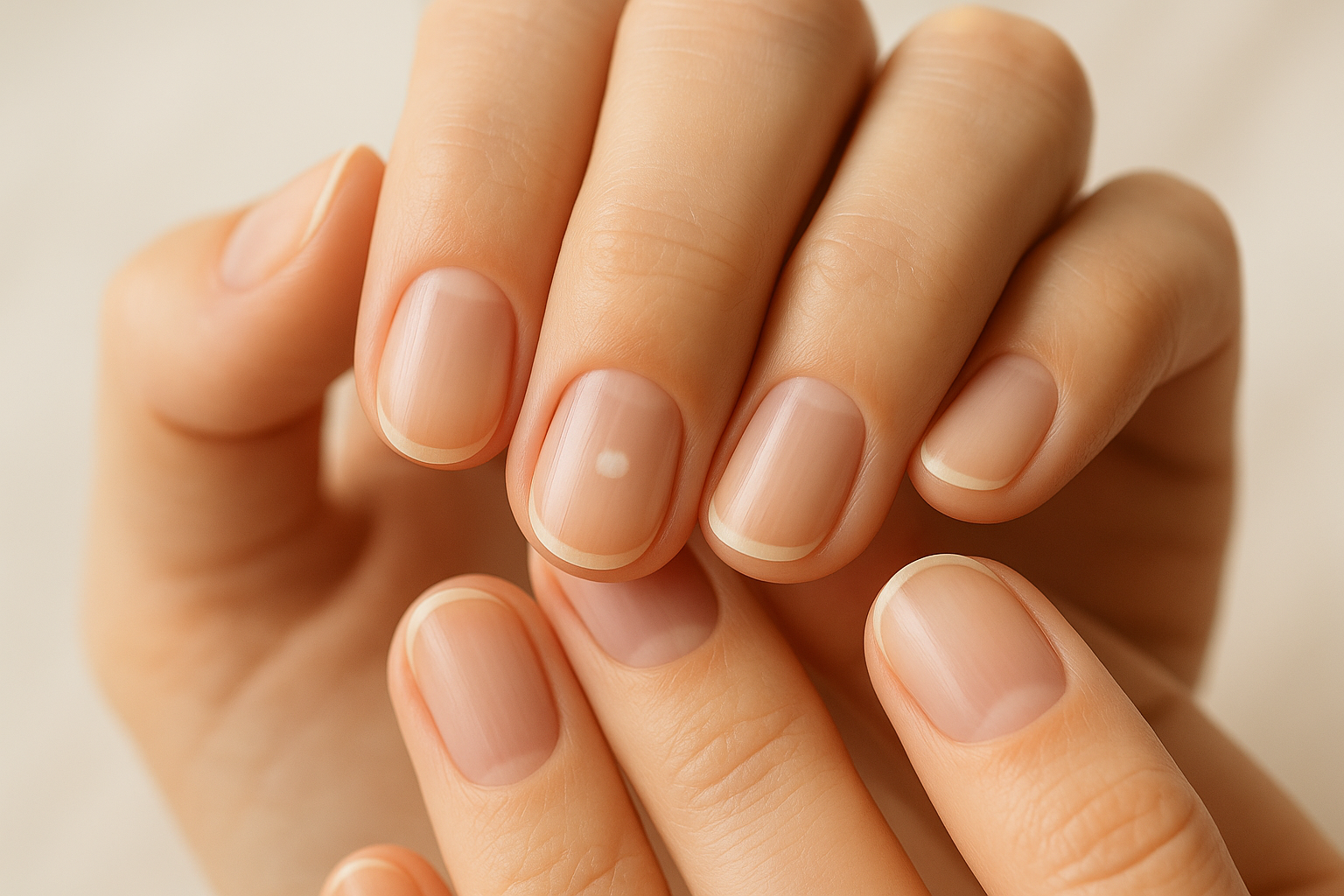
The medical name is leukonychia, and according to the Cleveland Clinic it's a common, generally harmless condition that most often appears after bumping or biting your nails. The classic small white flecks are called punctate leukonychia — described by DermNet, the dermatology reference, as the most common form: 1–3 mm solitary or grouped spots, almost always on fingernails, appearing after "nail biting, manicuring, knocks and bangs."
Why white? A healthy nail plate is transparent — it's built from roughly 196 compacted rows of flattened keratin cells that have lost their nuclei, which is what lets the pink of the nail bed show through, per StatPearls, the peer-reviewed clinical reference. When the nail's growth zone (the matrix, hidden under your cuticle) takes a minor knock, it briefly produces imperfectly keratinised cells. That flawed patch scatters light instead of transmitting it — so it reads as an opaque white fleck in an otherwise glassy nail.
Why you never remember the injury
Here's the detail that keeps the calcium myth alive: the spot appears weeks after the knock that caused it. The matrix sits under and behind your cuticle, so a new flaw in the nail plate is created out of sight — it only becomes visible once the nail has grown far enough for that section to emerge past the half-moon. Fingernails grow at roughly 3 mm per month, per StatPearls, so by the time the spot surfaces, the door you caught your finger in (or the slightly enthusiastic cuticle-pushing at your last manicure) is long forgotten. A spot with no memory of an injury feels like it must come from within — and "calcium deficiency" fills the explanatory gap. It just doesn't fit the evidence: the Cleveland Clinic notes that researchers aren't sure mineral or vitamin deficiencies cause white spots at all, with many concluding there simply isn't enough research to link them — while injury to the nail plate or matrix is the most common confirmed cause.
The 10-second press test
Dermatologists divide white nail marks into types, and there's a simple self-check that helps distinguish the two big ones. Press the tip of the affected nail firmly against a table so the nail blanches, and watch the white mark:
- Still visible under pressure → "true" leukonychia. The white is in the nail plate itself — the classic harmless trauma spot. It will grow out. Per DermNet, true leukonychia "will not be hidden by pressure application of the nail plate to the bed."
- Disappears under pressure → "apparent" leukonychia. The white is coming from the nail bed beneath, not the plate — the appearance vanishes when pressure squeezes blood flow. Whitening of this kind across most of the nail, especially on many nails at once, is the type doctors take more seriously, because DermNet associates patterns like Terry's nails and Lindsay's ("half-and-half") nails with systemic conditions such as liver, kidney, and heart disease.
A third category — pseudoleukonychia — is white colour sitting on the nail's surface, most often from fungal infection or damage left by nail cosmetics such as polish and gel wear.
Identification table: which white mark do you have?
| What you see | Likely type | Most common cause | What to do |
|---|---|---|---|
| Small white flecks (1–3 mm), one or a few nails | Punctate leukonychia | Minor knock, nail biting, manicure pressure | Nothing — it grows out. Prevent the next one. |
| Thin white line running lengthwise (base to tip) | Longitudinal leukonychia | Focal, prolonged pressure on one point of the matrix; occasionally certain skin conditions | If persistent or recurring, show a dermatologist. |
| White band(s) running side-to-side, parallel to the half-moon | Striate/transverse leukonychia (Mees' lines) | Matrix damage; can follow certain medications or, rarely, heavy-metal exposure | On several nails at once, get it checked. |
| Most of the nail white, on many nails; fades when pressed | Apparent leukonychia (Terry's/Lindsay's nails) | Nail-bed changes linked to systemic conditions | See a doctor — worth a proper work-up. |
| Chalky white patches on the surface; nail may be crumbly or thickened | Pseudoleukonychia | Fungal infection, or surface damage from polish/gel wear | Suspected fungus needs a doctor's diagnosis and treatment. |
So do deficiencies ever show up in nails?
Nutrition genuinely can affect nails — but not typically as white spots. The Cleveland Clinic's position is that healthcare providers and researchers "aren't sure" whether deficiencies cause leukonychia, and that some believe there isn't enough research to draw any conclusion. What the references do connect to nails are things like brittleness and texture changes (we cover those separately in our guide to weak, brittle nails). The practical takeaway: if your only symptom is a scattering of white flecks, supplements are solving a problem you don't have. If white nail changes come with other symptoms — fatigue, weakness, shortness of breath — that combination is what warrants a blood test, per the Cleveland Clinic.
How long until the spots go away?
White trauma spots can't be polished off, buffed out, or dissolved — the flaw is inside the plate, so the only exit is growth. The Cleveland Clinic puts the timeline at up to six to nine months for a spot on a fingernail to grow out to where you can clip it, and 12 to 18 months on toenails; DermNet gives a similar six-to-nine-month figure. (Resist the urge to buff the spot — it sits through the plate's thickness, not on top, and thinning the nail over it only weakens that section. Here's why nail experts advise against buffing imperfections generally.)
Preventing the next crop of spots
Since each spot is a little scar of past pressure on the matrix, prevention is about protecting that hidden growth zone:
- Gentler manicures. The Cleveland Clinic specifically names salon force — vigorous trimming, buffing and polishing — as a cause of matrix injury. Ask for a light touch around the base of the nail.
- Leave the cuticle alone. StatPearls notes the cuticle forms a protective seal for the matrix, and that removing it — "as commonly practiced during manicures" — leaves the nail vulnerable. Push gently after a shower if you must; don't cut.
- Stop biting and picking. Both are on DermNet's list of punctate-spot causes. (Recovering from a biting habit? See how long bitten nails take to grow back.)
- Gloves for impact work and well-fitting shoes — tight footwear is a classic cause of toenail spots, per DermNet.
- Keep nails and cuticles conditioned. Both the Cleveland Clinic and DermNet list moisturising the nail among their prevention steps — a well-conditioned, flexible plate and supple cuticle area are better equipped to absorb everyday knocks than a dry, rigid one.
When to see a doctor
Get white nail changes checked if: the whitening covers most of one or more nails; white bands cross several nails at once; the white fades when you press the nail tip down (the "apparent" pattern); the nail is also thickening, crumbling, lifting, or changing colour elsewhere; or spots come alongside symptoms like fatigue, weakness, blurred vision, or shortness of breath, per the Cleveland Clinic. Isolated flecks on a nail or two, with nothing else going on, are the harmless kind.
📋 Please note: The section below describes a daily-care cosmetic product. It supports the appearance and condition of nails and cuticles; it is not medical advice and is not intended to diagnose, treat, or prevent any condition. White spots that concern you should be assessed by a doctor or dermatologist.
While the spots grow out: where Provité Nail Elixir fits in
There's no product on earth that erases a white spot — anyone claiming otherwise is selling against the biology. What daily care can do is look after the nail the spot lives in and the cuticle zone that shields the matrix, so the plate that grows out behind it looks its best. That's the job of Provité Nail Elixir, a 100% lipid, formaldehyde-free concentrate formulated by S. C. Aris. Unlike water-based lotions that largely evaporate, its anhydrous intra-keratin blend is designed to saturate between the nail's keratin layers, conditioning the plate for what the brand calls "flexible-strength" — nails with the supple resilience to bend under everyday knocks rather than snap. It softens and conditions the cuticle area too, which makes gentle, non-traumatic manicures easier. It works on bare nails or under gel and acrylic.
The 13-botanical blend layers hemp seed, grapeseed and sesame seed for structure; jojoba, avocado and coconut for flexibility and locked-in conditioning; camellia tea, cucumber seed, lemon and carrot seed for a clean shine; finished with lavender, geranium and vitamin E. Like every CallNature formula, it's audited by the patent-pending Vouchly AI fatty-acid-ratio system (GB2603970.1). In a customer survey, 88% said their nails felt stronger and less brittle within 4 weeks. It's rated 4.73/5 from 15 verified buyers and covered by a 90-day money-back guarantee.
Frequently Asked Questions
Do white spots on nails mean calcium deficiency?
Almost never. The most common cause is minor injury to the nail's growth zone — a knock, nail biting, or manicure pressure — weeks before the spot becomes visible. Researchers haven't established any clear link between white spots and calcium, and major medical references note there isn't enough evidence to support one.
Why do white spots appear weeks after an injury?
The nail's growth zone (matrix) sits hidden under the cuticle, so the flawed patch of nail is created out of sight and only emerges as the nail grows — at roughly 3 mm per month. By then, most people have forgotten the knock that caused it.
How do I get rid of white spots on my nails?
You can't remove them — the flaw is inside the nail plate. They grow out on their own: up to 6–9 months on fingernails, 12–18 months on toenails. Buffing them only thins and weakens the nail. Prevention (gentle manicures, no biting, conditioning the nail and cuticle) stops new ones forming.
When are white nails a warning sign?
When whitening covers most of the nail on several fingers, when white bands cross multiple nails at once, when the white disappears as you press the nail down, or when nail changes come with symptoms like fatigue or shortness of breath. Those patterns can be linked to underlying conditions and deserve a doctor's assessment.
Can nail polish or gel cause white spots?
Yes, two ways: an allergic reaction to products such as polish, hardener, remover or artificial nails can trigger spots, and gel or polish wear can leave chalky white surface patches (pseudoleukonychia). Chalky patches with thickening or crumbling can also be fungal — that needs a doctor's diagnosis.
This article is general information about the appearance of nails, not medical advice. Nail changes that affect several nails at once, discolour the whole nail, appear as a dark streak, or come alongside other symptoms should be looked at by a doctor or dermatologist rather than self-assessed. Provité Nail Elixir is a cosmetic product for the appearance and condition of nails; it does not treat or prevent any condition.