Do Electric Toothbrushes Really Help With Gum Disease? What the Evidence Shows, Which Features Matter — and What the Motor Can't Do
Last updated: 27 October 2026
What does the evidence actually say about electric toothbrushes and gum disease?
Gum disease is common enough that the question matters to most households: according to the CDC, nearly half of US adults aged 30 and older show some form of it, and the everyday driver is dental plaque sitting undisturbed along the gum line. So the real question behind "do electric toothbrushes help?" is: does a motor remove that plaque better than your hand does?
The most cited independent answer is a 2014 Cochrane review — the kind of large, pooled analysis that exists to settle exactly this sort of question — covering 56 randomized trials and around 5,000 participants. Powered brushes came out ahead: plaque scores were about 11% lower after one to three months of use and about 21% lower in studies that ran longer, while gingivitis (gum-inflammation) scores were about 6% lower at one to three months and 11% lower in the longer studies.
Read those numbers honestly and two things are true at once. The advantage is real, repeated across dozens of trials, and it points in the direction that matters for gums — less plaque left behind at each session. And it is modest: an electric toothbrush is an upgrade in consistency, not a different category of care. The reviewers also noted the trials measured plaque and inflammation scores, not long-term outcomes like tooth loss — so the fair claim is "cleaner margins and calmer-looking gums," not "a cure."
One more honest boundary. Daily brushing — powered or manual — controls the plaque that drives gum trouble, and early, gum-level irritation (gingivitis) generally settles when that daily control is paired with a professional cleaning. Once disease has progressed to periodontitis, with deeper pockets and bone involvement, no toothbrush of any kind reaches the bottom of those pockets. We've laid out what's realistic at each stage in Can Gum Disease Go Away? The Honest Answer, Stage by Stage.
Why would a motor make any difference? The three things it standardizes
Plaque is soft. It doesn't need to be overpowered — it needs to be reached, gently, every day. Most people's brushing fails not from weakness but from three quiet habits: quitting early, pressing too hard, and missing the same spots every time. A good electric toothbrush is best understood as a machine for correcting exactly those three habits.
- Timing. The built-in two-minute timer — usually with a buzz every 30 seconds to move you to the next quadrant — fixes the most common shortfall of all: most unguided brushing sessions run well under two minutes.
- Pressure. A pressure sensor lights up or cuts the motor when you lean in. That matters double with tender gums, because scrubbing harder irritates the margin without removing more plaque — and over the years, a heavy hand can cost you gum height, a pattern we unpack in our guide to receding gums from brushing too hard.
- Motion and coverage. The head oscillates or vibrates thousands of times a minute on its own, so your only job is slow, accurate placement along the gum line. When the fine motor work is delegated, aim improves — especially in awkward zones like behind the lower front teeth.
Notice what's missing from that list: raw power. The motor doesn't blast plaque away; it frees your attention for placement. That's also why the technique still decides the result — angle the bristles toward the gum line, keep the touch light, and follow a fixed route. Our gumline-first brushing routine covers that method step by step, and every word of it applies with a powered brush.
Oscillating-rotating or sonic — does the head type matter for gums?
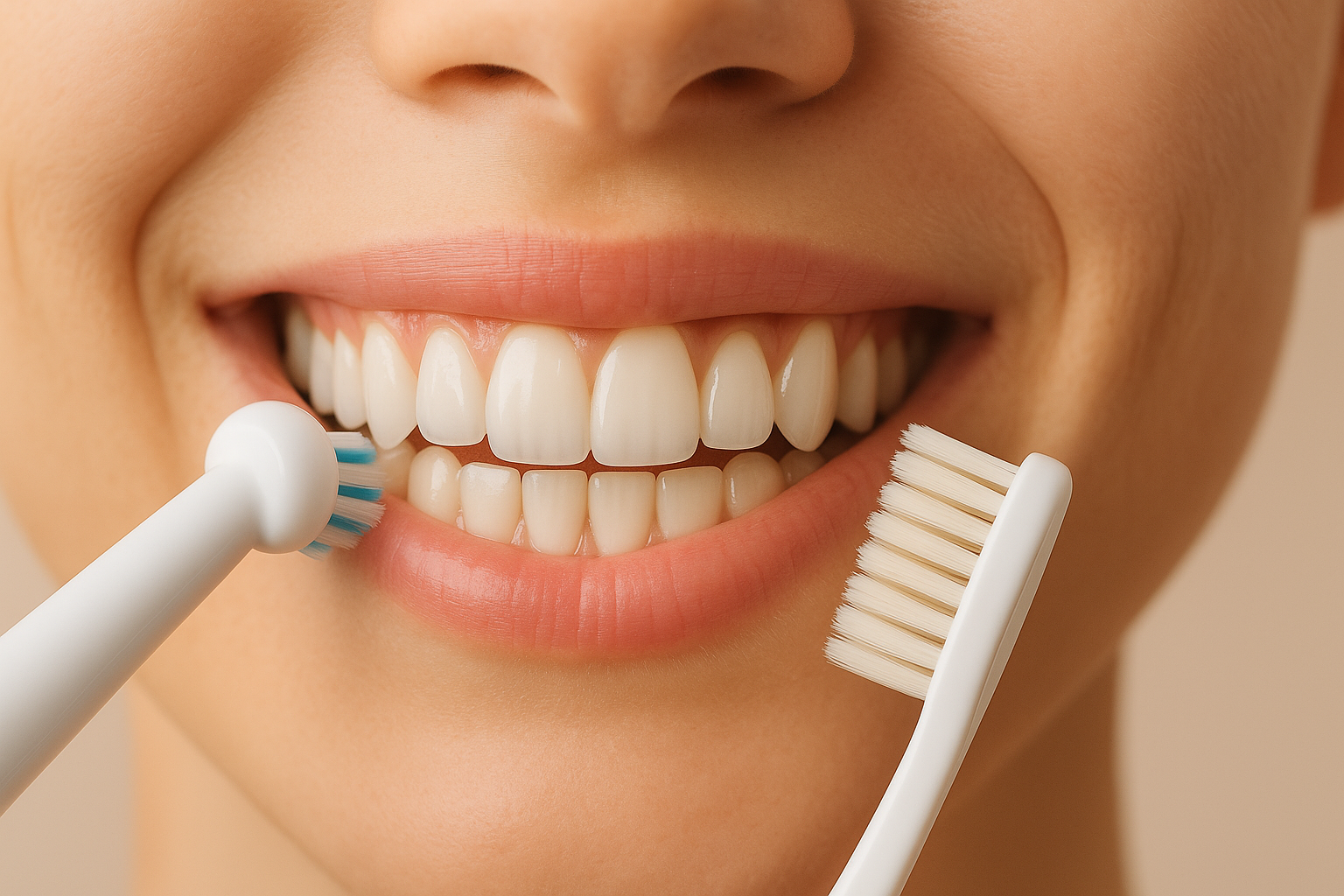
The two main designs work differently. An oscillating-rotating brush has a small round head that spins back and forth, cleaning one tooth at a time — you pause on each tooth for a couple of seconds, then move on. A sonic brush has a slimmer, more traditional-looking head that vibrates at high frequency while you sweep it slowly along, which some people find more natural at the gum line.
Which is better? Head-to-head comparisons are thinner and less consistent than the powered-versus-manual evidence, and neither design wins decisively. Some older comparisons gave oscillating-rotating heads a small edge on plaque; sonic brushes have trials of their own showing strong gum-line results. The honest summary: both comfortably beat typical manual brushing, and the differences between them are smaller than the difference good technique makes with either.
So choose by control, not by marketing. If you like the discipline of tooth-by-tooth pauses, the small round head suits you; if you prefer long, gentle passes, go sonic. What's non-negotiable is the bristle spec: soft bristles on a compact head, replaced roughly every three months or as soon as the bristles splay — the American Dental Association recommends soft-bristled brushes precisely because, at the gum line, light and accurate beats firm and fast. And if the bristles splay within a few weeks, treat it as a pressure warning, not a defective head.
Which features are worth paying for — and which can you skip?
Electric toothbrush ranges climb steeply in price, but the features that matter for gum care sit near the bottom of the ladder.
- Worth it: a pressure sensor. For gum purposes this is the single most valuable feature on any powered brush. If your gums are tender, or you've ever been told you scrub, prioritize it over everything else.
- Worth it: a timer with quadrant pacing. Standard on nearly all models now, and the quiet workhorse behind those trial results.
- Useful for tender weeks: a gentle or "gum care" mode. These run the motor at lower intensity — a comfortable way to keep cleaning thoroughly while irritated gums settle, rather than an essential for everyone.
- Nice-to-have: position tracking and app coaching. Genuinely helpful if you're a chronic spot-misser and want a map of what you skip; ignorable otherwise.
- Skip for gum purposes: stiff "deep clean" heads and aggressive intensity modes. Stiffer bristles and harder settings don't remove plaque better — they just make over-brushing easier. Soft head, standard or gentle mode, light touch.
Past the sensor-and-timer tier, extra money buys convenience — travel cases, charging glasses, subscriptions — not healthier-looking gums.
How to use an electric toothbrush when your gums are tender
The biggest switch-over mistake is brushing the old way with the new tool — scrubbing back and forth while the motor runs. Instead, guide it: place the bristle tips at about 45° into the gum line, keep your grip light (fingertips, not a fist), and let the head do the motion while you move slowly from tooth to tooth, a couple of seconds on each surface, following the same route every time. If the pressure sensor protests, ease off rather than powering through.
If a spot bleeds, don't steer around it. Bleeding usually marks a margin where plaque has been sitting, and gentle, consistent cleaning there is what lets it settle — for most people with early, plaque-driven irritation, noticeably so within one to two weeks, a pattern we've mapped in our day-by-day bleeding-gums timeline.
And remember the gap the motor can't close: no powered brush cleans between your teeth, where plaque does some of its quietest damage. Pair the brush with a once-daily interdental step — our comparison of interdental brushes vs. floss helps you pick the right tool for your gaps — and keep the rest of the routine simple; the core-four daily routine is the frame the brush slots into.
Who actually benefits most from switching?
Not everyone gains equally, and it's worth knowing which camp you're in before you spend.
- Heavy-handed brushers. If your manual brush heads splay fast or your gums look scrubbed, the pressure sensor alone can justify the switch.
- Rushers and autopilot brushers. If you suspect your two minutes is really fifty seconds, the timer and pacer close the gap without willpower.
- Anyone with limited dexterity. Arthritis, a hand injury, or any condition that makes fine wrist motion hard — the motor takes over the part your hand finds difficult, and a fatter handle is easier to hold.
- People with braces, bridges, or crowded teeth. A compact powered head traces around hardware and tight spots with less acrobatics, though interdental tools still do the between-and-under work.
- Already-meticulous manual brushers. Smallest gain. A soft manual brush with excellent technique can match the result — the trials measure averages, and the averages mostly reflect everyone else's inconsistency.
Where a gum care concentrate fits in
Whichever brush you choose, the mechanical cleaning does the heavy lifting — nothing applied afterward replaces it. But if you'd like a finishing step for the look and feel of your gum line, Dental Pro 7 is a professional-strength, 100% water-free botanical lipid concentrate designed to be brushed gently onto the gum line after cleaning — with your electric brush switched off, or a soft manual brush, either works. Because it's lipid-based rather than water-based, it clings to the gum line instead of washing away in seconds, carrying botanicals such as immortelle helichrysum, pomegranate seed, black cumin seed, Indian myrrh, and wild clove.
Used twice daily — a few drops, applied with the same light gum-line aim this article keeps coming back to, then spit without rinsing — it supports the appearance of firmer, pinker, healthier-looking gums and long-lasting fresh breath. To be clear about what it is and isn't: Dental Pro 7 is a cosmetic product. It does not treat or cure gum disease, and it's not a substitute for brushing, interdental cleaning, or professional care. It's rated 4.87 out of 5 across 303 verified buyers and comes with a 90-day money-back guarantee. Shop Dental Pro 7 →
When a better brush isn't the answer: see a dentist
A powered brush improves daily plaque control; it has no effect on what's already hardened. Tartar can't be brushed off by any motor — it needs a professional cleaning — and gums that stay inflamed despite careful home care need an exam, not another gadget. Book a dental visit promptly if bleeding or tenderness persists beyond two weeks of consistent, gentle cleaning, if gums are pulling away from teeth, if your breath stays stubbornly bad, or if any tooth feels loose. The National Institute of Dental and Craniofacial Research keeps a plain-language overview of the warning signs. Think of it as a team: the brush handles the daily film, your dental team handles everything the bristles can't reach — and the combination is what actually moves gum health.
Frequently asked questions
Are electric toothbrushes better than manual toothbrushes for gum disease?
Modestly, on average. Pooled trial data shows powered brushes leave about 11–21% less plaque and 6–11% lower gum-inflammation scores than manual brushing over months of use. The gain comes mostly from built-in timing, pressure control, and consistent motion — so a careful manual brusher with good technique can match it, and a careless powered brusher can squander it.
Which is better for gums: an oscillating-rotating or a sonic toothbrush?
Neither wins decisively. Oscillating-rotating heads clean tooth by tooth with a small round head; sonic heads sweep along the gum line with high-frequency vibration. Head-to-head evidence shows only small, inconsistent differences, so choose the style you control best — with soft bristles, a pressure sensor, and a timer — and let technique make the difference.
Can an electric toothbrush damage your gums?
Used properly, no — soft bristles moving with light contact are gentle on the margin. Damage comes from pressing hard, stiff heads, or scrubbing while the motor runs. If your brush has a pressure sensor, treat its warning seriously, and watch your brush heads: bristles that splay within a few weeks mean too much force.
How long does it take to see calmer gums after switching to an electric toothbrush?
With twice-daily two-minute sessions, light pressure at the gum line, and a daily interdental step, bleeding and puffiness from early, plaque-driven irritation usually ease noticeably within one to two weeks. If nothing has improved after about two weeks of consistent care, the brush isn't the problem — book a dental exam.
Do you still need to floss if you use an electric toothbrush?
Yes. No toothbrush — powered or manual — reaches the surfaces between teeth, and those contact points are plaque hotspots that strongly influence how gums look and feel. Clean between your teeth once a day with floss or interdental brushes, whichever fits your gaps and actually gets used.
Can an electric toothbrush get rid of gum disease on its own?
No. It improves the daily plaque control that early, gum-level irritation responds to, and that stage generally settles when thorough home care is paired with a professional cleaning. Established gum disease with deep pockets needs a dentist or periodontist — no brush reaches the bottom of those pockets.
This article is general educational information about toothbrushes and daily gum care, not dental or medical advice. Dental Pro 7 is a cosmetic product that supports the appearance of healthy-looking gums; it does not treat, prevent, or cure any disease. For diagnosis or treatment of gum disease, see a dentist or dental hygienist.