Are Interdental Brushes Better Than Floss for Gum Pockets?
Last updated: 26 August 2026
Stand in the dental aisle long enough and you'll see the standoff: string floss on one shelf, little bottle-brush packs on the other, and no one to tell you which one your gums actually need. If your dentist has mentioned pockets — or you've noticed food catching in spaces that didn't used to be there — the answer matters more than most people realize.
Here's the honest version: it isn't brushes or floss. It's brushes where they fit, floss where they don't — and knowing which is which in your own mouth. This guide covers what each tool actually does, what the research found when they went head to head, how to size a brush so it helps instead of hurts, and the nightly sequence that takes about three minutes.
What is a gum pocket — and can home tools even reach it?
Around every tooth there's a shallow groove where the gum meets the enamel. When gums are healthy, the National Institute of Dental and Craniofacial Research puts that groove at 1 to 3 millimeters deep. When plaque sits along the gum line for too long, the tissue becomes inflamed and can begin to detach, and the groove deepens into what dentists call a pocket — 4 millimeters or more can signal periodontal disease. It's far from rare: NIDCR estimates that nearly half of adults aged 30 and older show signs of gum disease.
Now the part most articles skip. Neither floss nor an interdental brush cleans the bottom of an established pocket. Once a pocket is deep, the plaque and hardened tartar down inside it are a job for a hygienist's instruments — that's what a professional cleaning is for, and it's why reaching bacteria in gum pockets is its own topic. What your daily tools can do — and it matters enormously — is keep the entrance clean: the gum-line margin and the surfaces between teeth where trouble starts, and where inflamed tissue either gets constantly re-irritated or gets a chance to settle.
So the real question isn't "which tool reaches the bottom of the pocket" — neither does. It's "which tool cleans the opening better in the spaces you actually have."
What floss does well — and where it falls short
Floss earns its place wherever teeth touch tightly. It's the only everyday tool thin enough to slip through a snug contact point, and wrapped in a C-shape against the side of a tooth, it wipes the flat and gently rounded surfaces cleanly. It's cheap, it travels well, and used correctly it cleans just below the gum edge.
Its weakness shows up when spaces open. A strand of floss is flat; the sides of back teeth are not. Near the gum line, roots curve and dip inward, and floss stretched across an open gap tends to bridge over those concavities, touching the high spots and skimming past the dips — precisely the sheltered areas where plaque collects around a pocket. Floss is also the most technique-hungry tool in the drawer, which is why the American Dental Association's advice is refreshingly practical: what matters is cleaning between your teeth once a day with an interdental cleaner — string floss, brushes, and other picks all count, and the best one is the one you'll actually use well.
What an interdental brush does well — and where it falls short
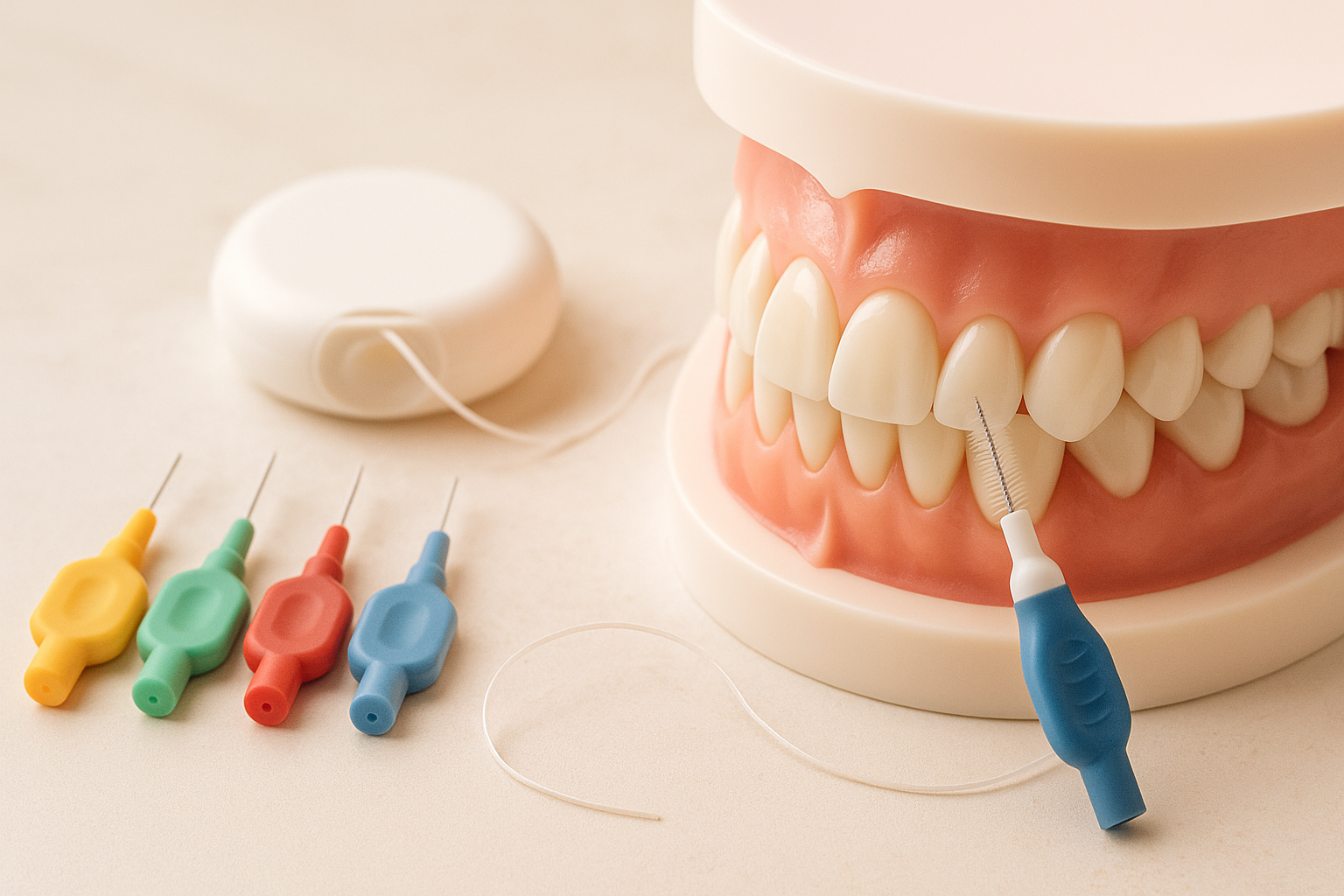
An interdental brush is a tiny bottle brush on a thin wire, and in an open space it does what floss can't: it fills the gap. The bristles splay outward to contact both tooth surfaces at once, including the curved and dished-in areas a flat strand bridges over. The technique is also far more forgiving — insert level with the gum line, glide through gently, back out — which is why many people who never stuck with flossing become surprisingly consistent with brushes.
The evidence points the same way. A 2019 Cochrane review of home interdental cleaning — the most rigorous look at these tools to date — found low-certainty evidence that interdental brushes may reduce gingivitis more than floss; for plaque, the evidence was inconsistent. That's a scientist's way of saying: the advantage is real enough to act on where a brush fits, and not dramatic enough to throw away your floss.
The brush's limits are just as clear. It cannot pass a tight contact, and it should never be forced — a wedged brush presses on the gum in the triangle between teeth, and that tissue doesn't appreciate it. One size rarely fits a whole mouth, so you'll likely need two or three. And brushes wear out: a splayed or kinked brush has stopped doing its job.
Head to head: which is better for gum pockets?
| The space | Better tool | Why |
|---|---|---|
| Open gap at the gum line — a brush passes with light resistance | Interdental brush | Bristles fill the space and sweep the concave root surfaces floss skims past |
| Tight contact — even the smallest brush needs force | Floss | Only floss slips through; the C-shape wipe cleans each side of the contact |
| A mix of both — true of most mouths | Both | Brushes in the open spaces, floss in the snug ones — mapped once, then automatic |
| Bridges, implants, braces | Depends on the site | Floss threaders or super floss reach under connectors; some brush heads fit where thread can't. Ask your hygienist to demonstrate for your specific work |
The verdict, in one line: for the widened spaces that come with gum pockets, a properly sized interdental brush is usually the stronger tool; for tight contacts, floss remains unbeatable; and a mouth with pockets typically has both kinds of space, so the winning routine uses both.
How to size an interdental brush (this is the whole game)
A brush that fits transforms the routine; a brush that doesn't either cleans nothing or hurts. The fitting rule is a snug pass with light resistance — never force.
- Start with a mixed pack. Brushes are size-coded (0 through 8 in many brands). Begin with one of the smallest in a gap and step up until the bristles brush both surfaces without the wire bending.
- Expect different sizes in different places. Front teeth usually take a smaller brush than molars. Most people land on two or three sizes for the whole mouth.
- Keep the wire level with the gum line. Insert horizontally and glide straight through where the space allows. Don't jab upward or downward into the gum.
- Two gentle passes per space is plenty. In and out, without twisting hard or sawing.
- Re-check the fit now and then. Spaces change — especially in the first weeks, as puffy tissue settles. If a size starts sliding through loosely, step up; if it starts to snag, step down.
If you're unsure, a hygienist can size your spaces in a few minutes at your next visit — it's a standard request, and ten minutes of coaching saves months of guessing.
A three-minute nightly routine that uses both
- Interdental brushes first, in every space where one passes with light resistance. Start with the back teeth — that's where most buildup hides — and work forward.
- Floss the tight contacts the brushes couldn't enter: slide through, curve into a C against one tooth, wipe up and down, then repeat against its neighbor.
- Brush for two minutes with a fluoride toothpaste. Cleaning between teeth first means the paste reaches surfaces that were covered in plaque a minute ago.
- Optional finishing step: apply a gum-line concentrate along the margins (more on that below), and don't rinse it away.
Consistency beats intensity. Done nightly, the whole sequence settles into about three minutes — and most people notice the difference in how their gum line feels within a couple of weeks.
Mistakes that quietly undo the work
- Forcing one size everywhere. Too big traumatizes the gum between teeth; too small polishes air. Map your sizes.
- Angling into the gum. The wire should travel level, parallel to the gum line — pressure belongs on the tooth surfaces, not the tissue. (The same logic applies to your toothbrush: heavy scrubbing is a classic route to receding gums from brushing too hard.)
- Only cleaning the front teeth. They're the easiest to reach and the least likely to need it. Molars first.
- Quitting when gums bleed. Early bleeding usually means the tissue is inflamed and needs more gentle cleaning, not less — see why gums bleed for the full picture, and get it checked if it hasn't settled within a couple of weeks.
- Ignoring a persistent odor from one spot. If the same gap always smells or tastes bad when you clean it, that's information — a floss smell localized to one spot often points to a food trap or a deeper problem at that site worth showing your dentist.
When to bring in your dentist
Home tools maintain; they don't measure and they don't treat. Book a visit if bleeding continues beyond a week or two of consistent gentle cleaning, if a tooth feels loose or your bite changes, if pus or a persistent bad taste appears, or if you simply don't know your pocket numbers — a periodontal chart takes minutes and tells you exactly which spaces need what. If pockets of 4 mm or more are found, professional cleaning is where treatment starts; your nightly routine is what protects the result between visits.
Where Dental Pro 7 fits into an interdental routine
Brushes and floss do the mechanical work — physically removing plaque from the surfaces around each space. What they can't do is leave anything helpful behind: toothpaste and mouthwash are water-based, so saliva dilutes them and they're gone from the gum line within moments.
Dental Pro 7 is a 100% water-free botanical lipid concentrate — built on extracts like immortelle helichrysum and pomegranate seed — brushed along the gum line in place of toothpaste and left there rather than rinsed away, so it's applied last, once the interdental brushes and floss above have done the mechanical work.
It's rated 4.81 out of 5 across 190 verified buyers, with over 500,000 bottles sold, and every order carries a 90-day money-back guarantee — long enough to run it alongside your new interdental routine and judge the difference in the mirror.
To be clear about what it is and isn't: Dental Pro 7 is a cosmetic product that supports the appearance of firmer, pinker, healthier-looking gums and fresher breath. It is not a treatment for gum disease, and it won't change what a periodontal probe measures — the brushes, the floss, and your dental team do that heavy lifting. Think of it as the finishing layer on a gum line you've just cleaned properly.
Frequently asked questions
Should I use interdental brushes before or after brushing my teeth?
Before is a sensible default: clearing plaque from between the teeth first lets your fluoride toothpaste reach those surfaces. That said, the research on ordering is thin, and consistency matters far more than sequence — the best order is the one that keeps you doing it nightly.
Do interdental brushes make the gaps between my teeth bigger?
A correctly sized brush doesn't create space. What often happens is that inflamed, puffy gum tissue shrinks back to a healthier contour once it's being cleaned properly, revealing space that was already there — the same reason black triangles sometimes appear as gums get healthier. Forcing an oversized brush, however, genuinely can damage the gum between teeth — if it takes force, size down.
How often should I replace an interdental brush?
Replace it as soon as the bristles look splayed or the wire kinks — for daily users, that's typically every one to two weeks. Rinse it after use and let it air-dry. A worn brush passes through the space without really cleaning it.
My gums bleed when I clean between my teeth — should I stop?
Don't stop; go gentler. Some bleeding is common in the first week or two when inflamed gums first get proper cleaning, and it usually fades as the tissue firms up. Bleeding that stays heavy, appears without touching the gums, or persists beyond about two weeks deserves a dental appointment.
Can interdental brushes or floss shrink a gum pocket?
They can help the shallow measurements that come from swollen, inflamed margins, because tissue that's kept clean can settle back down. They cannot clean out the depths of an established pocket or remove hardened tartar — that's what professional scaling is for. A useful division of labor: your tools own the entrance, your hygienist owns the depths.
Is a water flosser a good substitute if I hate string floss?
It's a genuinely useful add-on — especially around braces, implants, and bridges, or if dexterity is an issue — and if it's the only between-teeth cleaning you'll do daily, it's far better than nothing. It doesn't give the same wiping contact as bristles or floss on the tooth surface, though, so where you can, keep brushes for the open spaces and floss for the tight ones, and let the water flosser assist.
Educational information only — not a diagnosis or medical advice. Dental Pro 7 is a cosmetic product for appearance and freshness only. It does not replace diagnosis, professional cleaning or dental care. If you have bleeding gums, deepening pockets, loose teeth or persistent bad breath, see a dentist or periodontist.