How to Repair Damaged Nails After Gel or Acrylic Removal
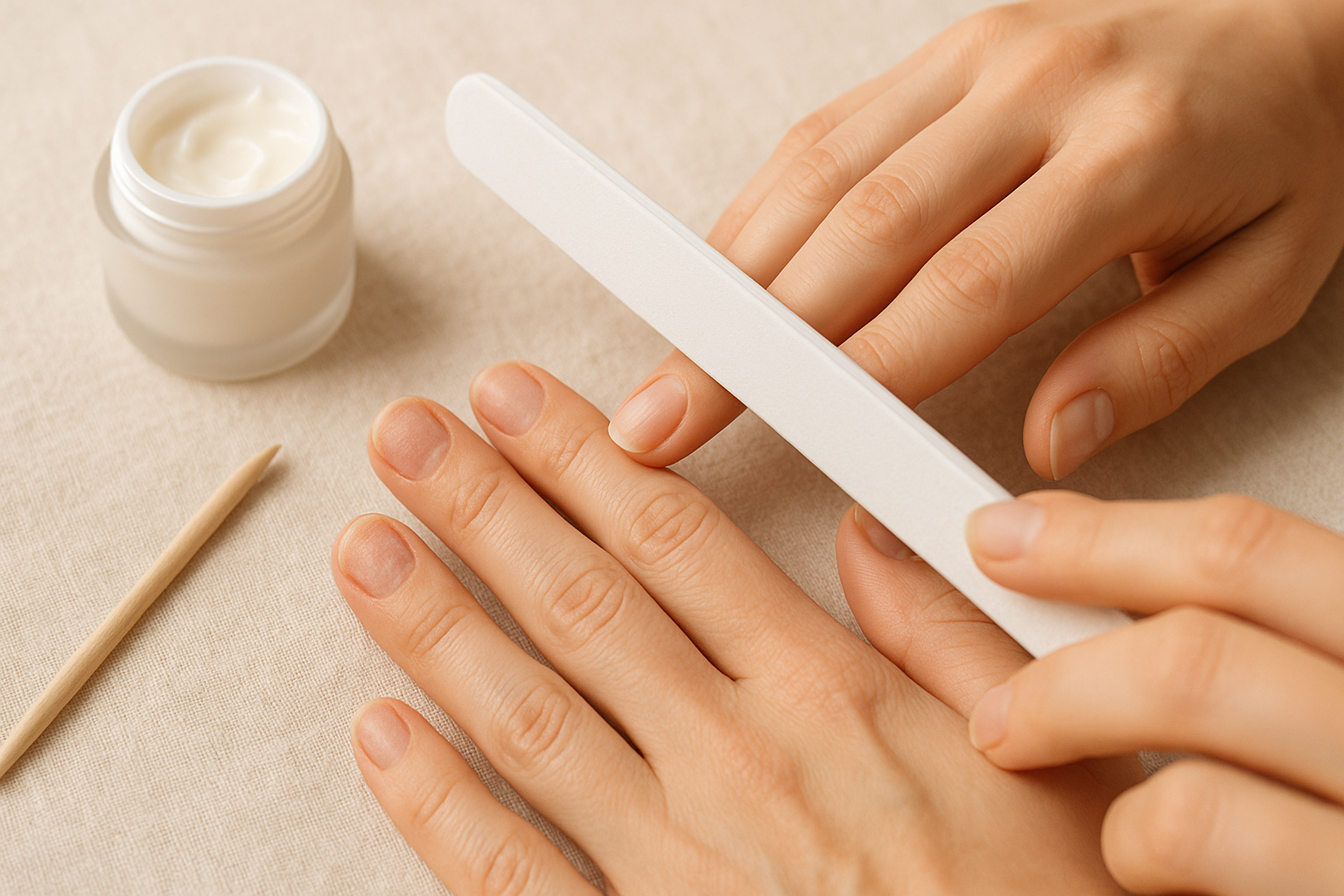
Quick answer: how to repair damaged nails after gel or acrylic removal
You can't truly "fix" keratin that's already damaged. A nail plate that has been thinned, peeled, or over-filed during gel or acrylic removal won't knit itself back together — so the real goal is to grow out a healthy new plate while protecting and conditioning the fragile nail you have now. Fingernails regrow completely in roughly three to six months, so recovery is measured in months, not days.
The fastest recoveries combine four habits: take a genuine break from coatings, minimise water and acetone exposure, keep nails short and filed in one direction, and condition the nail plate and surrounding skin every day. For that last step, a water-free, penetrating lipid conditioner — for example, Provité Nail Elixir — tends to suit fragile post-gel nails better than a hard "strengthener," because brittle nails often need flexibility, not more rigidity.
Last updated: 29 June 2026
If you've just peeled off the last of a gel or acrylic set and found thin, bendy, white-patched, peeling nails underneath, you're not imagining the damage — and you're not alone. The American Academy of Dermatology notes that gel manicures themselves "can cause nail brittleness, peeling and cracking," and most of the visible harm happens at removal, when the surface is filed, soaked in acetone, and scraped. This guide explains what's actually going on, what genuinely speeds recovery, and a realistic month-by-month roadmap so you know what to expect.
What gel and acrylic removal actually does to your nails
Your nail plate isn't a single solid sheet. It's built from layers (lamellae) of the protein keratin, held together by lipids, desmosomes and keratin-associated proteins — the "mortar" between the keratin "bricks." A review in the Journal of the American Academy of Dermatology describes how the coherence of the nail plate depends on exactly those lipid bilayers and cell-to-cell bonds. When that internal glue is disrupted, the layers separate and you get peeling and flaking.
Gel and acrylic removal disrupts it from several directions at once:
- Filing and buffing physically thin the top layers of keratin before and after the coating.
- Acetone soaks strip the natural lipids and water that keep the plate flexible, leaving it dehydrated and chalky. The Mayo Clinic specifically advises limiting acetone-based remover because it dries nails and makes them more likely to split.
- Peeling or prying off a coating tears away the surface lamellae with it — the white, rough patches you can see afterward.
- Repeated UV/LED curing is linked by the AAD to brittleness and to longer-term skin ageing on the hands.
The key takeaway: the damage is to keratin that is already dead tissue. No cream, serum, or supplement can repair a dead nail plate back to its original thickness. That sounds discouraging, but it's actually the most useful fact in this article — because it tells you exactly where to put your effort.
Can damaged nails really be "repaired"? The honest answer
The only true repair is growth. New, undamaged keratin is produced at the matrix (under the cuticle) and pushes outward. Fingernails grow about 3 mm per month — roughly 0.5–1.2 mm per week — which is why dermatology references put complete fingernail regrowth at about three to six months (toenails take far longer). Your job during that window is twofold: protect the fragile, already-grown nail so it doesn't snap or peel further before it grows out, and create the best possible conditions at the matrix and on the plate for healthy new growth.
This is also why patience matters. Brittle, fragile nails are common — one 2019 review estimates brittle nail syndrome affects around 20% of people and is roughly twice as common in women. Recovery from a coating habit follows the same biology: there are no overnight fixes, only consistent conditions repeated over a growth cycle.
Your realistic recovery timeline (week by week)
Most "how to repair your nails" articles skip the single most reassuring thing: a timeline. Here's what to genuinely expect if you follow the plan below, anchored to the ~3 mm-per-month growth rate.
| Timeframe | What's happening | What you'll notice |
|---|---|---|
| Days 1–7 | Plate is most dehydrated; lipids stripped by acetone. | Nails feel dry, chalky, bendy or papery. Daily conditioning helps them feel softer and look less white almost immediately. |
| Weeks 2–4 | ~3 mm of new, undamaged nail has grown from the base. | A healthier band appears near the cuticle. Damaged tips still peel — keep them short. |
| Weeks 5–8 | Roughly the lower third to half of the plate is new growth. | Noticeably less bending and snapping; surface looks smoother and more even. |
| Months 3–4 | Most of the visible nail is now new keratin. | The old damaged section reaches the free edge and can be trimmed away. |
| Months 5–6 | A full fingernail length has regrown. | Plate looks and feels back to baseline, assuming no re-damage in between. |
Timeline reflects average fingernail growth; individual rates vary with age, health and the season. Toenails grow more slowly.
The 5-step recovery plan dermatologists actually recommend
1. Take a real break from coatings
This is non-negotiable and the step most people skip. Going straight back into gel re-files and re-soaks the fragile new growth before it can mature. The AAD recommends treating gel manicures as an occasional, special-occasion choice rather than a continuous habit, and seeing a board-certified dermatologist for any persistent nail problem. Aim for at least one full growth cycle (a couple of months minimum) bare or in regular polish before you consider another set.
2. Keep nails short and file in one direction
Short nails have less leverage, so they catch, tear and peel far less while fragile. Both the AAD and Mayo Clinic advise trimming straight across with slightly rounded corners and using a fine file in a single direction rather than sawing back and forth, which splits softened layers.
3. Defend against water and harsh chemicals
Nails aren't waterproof. Repeated wetting and drying makes the plate swell and shrink, weakening the bonds between layers — a leading driver of peeling. The AAD's nail-care basics and the Mayo Clinic both recommend wearing cotton-lined rubber gloves for dishes and cleaning, choosing acetone-free remover, and moisturising after every hand wash.
4. Condition the plate and cuticle daily
You can't add keratin back, but you can replace the lipids and moisture acetone stripped out, which is what makes a dry, brittle plate look dull and snap. A daily conditioning step — massaged into the nail and the surrounding skin — keeps the plate flexible and the matrix area healthy while it produces new growth. Water-free, lipid-based conditioners are well suited here because they aren't diluted and aren't lost to evaporation the way watery treatments are. (See the conditioner section below.)
5. Support growth from the inside — sensibly
A balanced diet with adequate protein, iron and zinc supports normal nail formation. Biotin is the one supplement with some evidence for brittle nails, but the 2019 brittle-nail review describes the data as limited — so treat supplements as a minor helper, not a cure, and check with a doctor before starting one, especially as biotin can interfere with some lab tests.
Why a "hardener" can backfire — and what to use instead
When nails feel weak, the instinct is to reach for a "nail hardener" or "strengthener." But many traditional hardeners work by cross-linking keratin to make the plate more rigid. On an already-thinned, brittle post-gel nail, more rigidity can mean the nail snaps cleanly instead of flexing — trading bendiness for breakage. The brittle-nail literature is clear that fragile nails generally lack flexibility and moisture, not hardness.
| Approach | How it works | Best for |
|---|---|---|
| Cross-linking hardener | Stiffens the plate by bonding keratin together. | Soft nails that bend too much — can over-harden brittle nails into snapping. |
| Lipid conditioner | Replaces lost lipids/moisture so layers stay supple and bonded. | Dry, peeling, post-acetone nails that need flexibility, not rigidity. |
| Just polish + time | A regular-polish layer shields the plate while it grows out. | Anyone who can keep nails covered and protected during recovery. |
A water-free conditioner built for the recovery window: Provité Nail Elixir
If the problem with post-gel nails is stripped lipids and lost flexibility, the logical answer is to put those lipids back — without water to dilute them. Provité Nail Elixir is a 100% botanical-lipid, formaldehyde-free nail concentrate designed around a single idea its formulator calls intra-keratin saturation: the lightweight lipids settle between the keratin layers to support the look and feel of "flexible-strength" nails — the goal being steel, not glass, so nails bend rather than snap. It's designed to be used on bare nails or alongside gel and acrylic routines.
Because it's anhydrous (no water), it's preservative-free by design and isn't lost to evaporation the way watery treatments are. The blend layers 13 conditioning botanical lipids — including hemp seed, grapeseed, sesame seed, jojoba, avocado, camellia tea, carrot seed and vitamin E — chosen to condition the plate and the cuticle skin around it.
Why people trust it: Provité holds a 4.73/5 rating from 15 verified buyers, is formulated by S. C. Aris, and is backed by a 90-day money-back guarantee, so the recovery window is risk-free to try. In the brand's own customer survey, 88% reported stronger, less brittle-looking nails within four weeks, 9 in 10 said their nails looked longer and more resilient, 91% said they no longer felt self-conscious about their nails, and 94% said they would recommend it. (These are customer-survey figures, not clinical-trial results.)
Use it as the daily conditioning step in the plan above: a drop massaged into each nail and cuticle, morning and night. Pairs naturally with our wider lipid range for skin.
Keep reading in our nail-care cluster: why your nails are so weak and brittle · cuticle care and all-natural nail care.
Frequently asked questions
How long does it take for nails to recover after gel or acrylic?
Plan on a full growth cycle. Fingernails grow about 3 mm a month and take roughly three to six months to fully regrow, so the damaged section grows out and can be trimmed away over that period. You'll usually see a healthier band near the cuticle within two to four weeks.
Can I make my damaged nails grow back faster?
You can't meaningfully speed up the matrix, but you can stop slowing it down: avoid re-filing and re-soaking, protect nails from water and acetone, keep them short so they don't tear, and support growth with a balanced, protein-adequate diet. Consistency over weeks matters far more than any single product.
Should I use a nail hardener on weak post-gel nails?
Often no. Many hardeners stiffen the plate, and a brittle, thinned nail usually needs flexibility and moisture rather than more rigidity — over-hardening can make it snap. A lipid conditioner that keeps the plate supple is generally the better fit during recovery.
Is it okay to just keep getting gels if I like how they look?
Dermatologists suggest moderation rather than continuous wear. The AAD recommends treating gel manicures as occasional, protecting your hands from the UV/LED lamp, and seeing a board-certified dermatologist for any nail change that doesn't settle.
When should I see a doctor instead of just waiting it out?
Green or yellow discolouration, a nail lifting away from the bed, persistent pain, or nails that don't improve after a couple of months of good care can signal infection or another condition, and warrant a dermatologist's assessment.
This article is for general educational purposes about the appearance and condition of nails and is not medical advice. Provité Nail Elixir is a cosmetic nail-conditioning product; it does not treat, cure, or heal any medical condition. For persistent nail problems, infection, pain, or underlying health concerns, see a doctor or board-certified dermatologist.