Why Does My Breath Smell Bad With CPAP? The Leak, the Chamber or the Apnea — the 3-Source Test
Quick answer
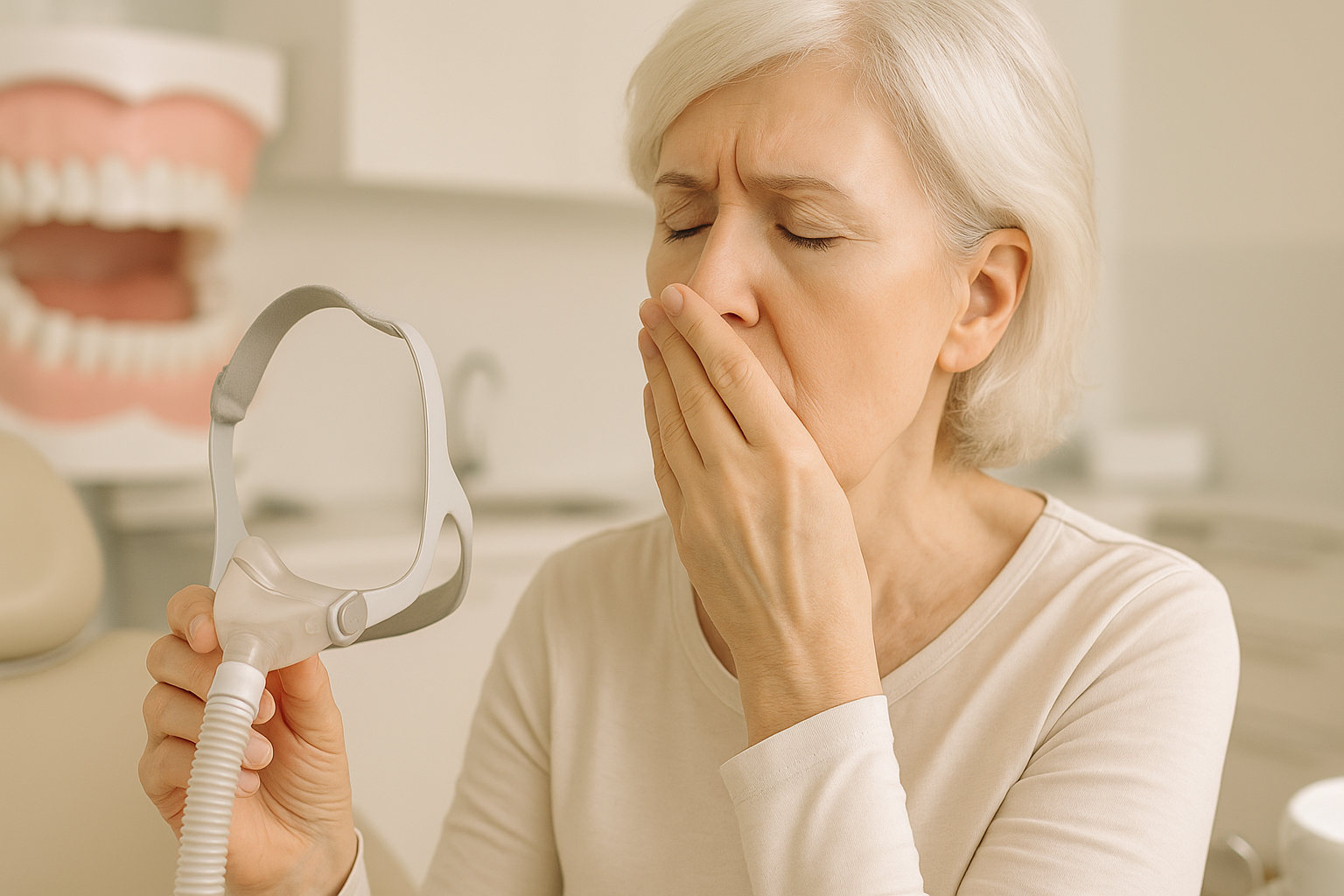
CPAP does not make breath smell by itself. What it can do is dry your mouth out overnight — and a dry mouth is the textbook set-up for morning breath. The Mayo Clinic lists dry mouth among the most common CPAP problems and names the usual routes: breathing through your mouth or sleeping with it open under a nasal mask, and air leaking from a mask that does not fit. A dry mouth smells because saliva is the mouth’s overnight cleaning crew; when it stops flowing, bacteria break down debris undisturbed until morning. There are two other explanations worth ruling out before you blame the machine: the smell may be coming from the equipment (the FDA notes that germs from your mouth, throat and lungs collect in the mask and hose), or from the sleep apnea itself, which in one case-control study left roughly 45% of apnea patients with a dry mouth on waking (against 20% of controls) and which travels with a higher rate of gum disease — a source of persistent odour that no mask setting will fix.
The practical rule: if you wake with a dry mouth, dry lips and a stale taste, the problem is a leak — from your mouth or your mask — and it is solved with a humidifier, a better fit, a chin strap or a different mask style, not with mouthwash. If the smell is on the cushion and in the hose rather than on your breath, it is a cleaning problem. If your breath is still stale after a proper clean, on a night the mask sealed well, look at your gums. For the gum-line half of the picture, a water-free botanical lipid concentrate that you spit out and do not rinse away — Dental Pro 7 is one example — is built to stay in contact with the gum line for hours rather than seconds, including the hours under the mask. It is a cosmetic product and does nothing for a mouth leak; that fix belongs to your CPAP care team.
Last updated: 17 September 2026
The morning it starts
You did the responsible thing. You got the sleep study, you got the machine, and for the first time in years you are waking up without a headache. And then, a few weeks in, a partner says something, or you catch it yourself on the first yawn: a stale, sour, almost chemical morning breath that you are fairly sure you did not have before — or at least, not like this.
The frustrating part is that the obvious answer is half right. CPAP can dry your mouth out, and a dry mouth does smell. But “CPAP causes bad breath” is not a diagnosis, it is a shrug, and it leads people to the wrong shelf: they buy a stronger mouthwash, which the American Dental Association says only “temporarily mask[s]” the smell, when the actual fix is a strap, a water chamber or a different mask.
This article sorts the problem into its three real sources, gives you a five-question morning test to work out which one is yours, and matches each source to the fix that addresses it. Everything in it comes from a named authority: the Mayo Clinic’s CPAP troubleshooting guidance, the FDA, the National Institute of Dental and Craniofacial Research, the ADA, the Cleveland Clinic, a periodontist-authored halitosis page, and four peer-reviewed papers on what CPAP and sleep apnea do to saliva — including a study that simply asked long-term CPAP users to describe their mornings. Their words turn out to be the most useful part.
The information gain: three sources, three different fixes
Most pages on this topic treat “CPAP bad breath” as one problem with one answer (buy a humidifier). It is three problems, and only one of them is fixed by humidity. The sorting table below is our synthesis of what the named authorities say; every mechanism in it is theirs.
| 1. THE LEAK — your mouth dried out | 2. THE CHAMBER — it’s the equipment, not you | 3. THE APNEA — the condition and what travels with it | |
|---|---|---|---|
| What is actually happening | Air escapes through an open mouth (nasal mask) or a poor seal (any mask); dry air and, possibly, the pressure itself reduce saliva; the mouth sits dry all night | Germs from your mouth, throat, lungs and skin build up in the mask cushion, hose and humidifier tank; the smell is in the kit | Apnea itself dries the mouth via mouth-breathing, before any mask is involved; apnea travels with a higher rate of gum disease, itself a cause of persistent bad breath |
| Who says so | Mayo Clinic: mouth-breathing, sleeping with the mouth open and air leaks “can cause dry mouth.” Ahonen et al. 2022: back-sleeping, mask leakage and “the air from the CPAP device” | FDA: “Germs from your lungs, throat, or mouth can get into the CPAP mask or hose as you breathe in and out during sleep” | Pico-Orozco et al. 2020: dry mouth on waking in 45% of apnea patients vs 20% of controls. Maniaci et al. 2024: mouth-breathing, dry mouth and periodontal disease all more common in OSA |
| What it smells like | Classic morning breath, but stronger: stale, sour, sometimes sulphurous; paired with a dry, rough or sticky mouth and a “bitter or stale” taste | Musty, sour-plastic or mildewy — and it is there when you sniff the mask with the machine off | Breath that survives a good clean and a well-sealed night; often with a constant bad taste, or gums that bleed |
| The tell | Dry mouth and lips on waking; dry eyes or nose; a partner hears air or sees your mouth open; leak flagged in the machine’s app | The smell lives on the cushion, in the hose or in the tank; your breath after brushing is fine | Still there after brushing and tongue-cleaning; was there before CPAP; bad taste; bleeding when you brush |
| Does a humidifier fix it? | Often, yes — with a better fit or a chin strap where needed | No. Cleaning does | No. A dental check does |
| Who to talk to | Your CPAP care team or supplier — within the first two weeks if it is new | The owner’s manual first, then the supplier | Your dentist — and tell them you have sleep apnea |
The five-question morning test
You cannot smell your own breath reliably (both the Mayo Clinic and the Cleveland Clinic say to ask someone you trust), so use the signs you can check. Do this for three mornings and count your yeses.
- Did you wake with a dry mouth, dry lips or a dry throat? The Mayo Clinic lists dry mouth, dry or stuffy nose and dry eyes together as consequences of an air leak. Long-term CPAP users in the Ahonen study described waking “completely dry in the mouth” and, in the morning, “a bitter or stale taste, that it feels a bit viscous.”
- Did anyone hear air escaping, or see your mouth open? A properly fitted mask, per the Mayo Clinic, should not “have any sounds of leaking air.” In the Ahonen study, being woken by a partner was how several people found out they were mouth-breathing.
- Did you sleep on your back? The same study describes exactly why it matters: “Sleeping on the back increased the oral dryness as the chin dropped, causing the mouth to open in this sleeping position, which also occurred during CPAP use.”
- Was your nose blocked? A cold or allergies force mouth-breathing; the Mayo Clinic notes nasal pillow and cradle masks “may not work as well” when you cannot breathe through your nose. For nasal-mask users in the Ahonen study, a blocked nose meant either no CPAP or “forced mouth-breathing and a longer time for recovery.”
- Does your machine or app report a leak? Many machines now do; the Mayo Clinic notes that remote monitoring “will notify your care team of an air leak without you even having to call.”
Three or more yeses: you are in source 1 — the leak — and the rest of this article tells you which kind. None, and the smell is on the equipment: source 2. None, the mask sealed, and your breath is still stale after a proper morning clean: source 3, and it is time to involve a dentist.
Source 1: the leak — how a mask dries a mouth
The Mayo Clinic’s CPAP troubleshooting guide, updated in January 2026, opens with the plain statement that “common problems with CPAP include a leaky mask; trouble falling asleep; a stuffy, runny or dry nose; and a dry mouth.” Its dry-mouth entry gives the two routes in a single paragraph: “If you breathe through your mouth at night or sleep with your mouth open, some CPAP machines may worsen dry mouth. Air leaks also can cause dry mouth.” Those are two different leaks, and they have two different fixes.
The mouth leak: a nasal mask and an open mouth
A nasal mask or nasal pillows deliver pressurised air through the nose. If your mouth falls open, that air has a second exit, and it takes the moisture in your mouth with it on the way out. This is the leak most CPAP users mean when they say the machine dried them out, and it is the one that back-sleeping makes worse: the chin drops, the lips part, and the mouth becomes a vent.
The Mayo Clinic’s answers, in order: “A chin strap may help keep your mouth closed and reduce the air leak if you wear a nasal mask. A full-face mask covering your mouth and nose may keep your mouth from becoming dry.” Full-face masks, it adds elsewhere, “can work better for people who breathe through their mouths while sleeping.” Anything that holds your mouth closed is a question for your care team rather than a do-it-yourself experiment — particularly if your nose is not reliably clear.
The air leak: a mask that does not fit
The second leak is at the seal, and it happens with every mask type. “Air leaks happen when the masks don’t fit correctly,” the Mayo Clinic says. “Air leaks can cause dry eyes, dry or stuffy nose, dry mouth, skin irritation, and pressure sores.” That cluster is your diagnostic: a dry mouth that arrives with dry eyes and a sore bridge of the nose is a fit problem. Two more tells from the same page: “If you have to tighten the straps often to prevent air leakage, the mask does not fit properly,” and mask sizes do not carry across brands — “Just because you’re a certain size in one type or brand of mask doesn’t mean you’ll be the same size in another.” The Mayo Clinic suggests a fit check with your care team every year, and sooner “particularly if your weight has changed a lot.” The long-term users in the Ahonen study fixed leaks by “tightening or changing the straps, adjusting the humidification device, or shaving one’s facial hair to improve the mask fit.”
The dry-air problem: no humidifier, or a winter bedroom
Even with a perfect seal and a closed mouth, hours of moving air are drying. “Many CPAP machines come with a heated humidifier, which attaches to the air pressure machine,” the Mayo Clinic notes, and for dry mouth specifically it recommends “a CPAP heated humidifier that attaches to the air pressure machine and a heated tube.” You can adjust the humidity level. Season matters too: in the Ahonen study, “dry air during the winter increased the problems and was less noticeable in other seasons,” and one participant noticed the dryness “this time of the year, even if the mask has worked fine during the night.” If your CPAP breath is seasonal, the bedroom air is part of the answer.
The pressure itself: a physician’s hypothesis
There is a fourth idea, and it is worth knowing because it explains a puzzle. Some people get a dry mouth even with a full-face mask, a closed mouth and a humidifier running. In a 2017 letter to the Journal of Clinical Sleep Medicine, Mauro Bortolotti, a professor at the University of Bologna, pointed out that “dry mouth also occurs when the mouth is closed with a chin strap, taping, adhesive, or bandages to force breathing through the nose,” which airflow alone cannot explain. His proposal: saliva leaves the glands through ducts at a set pressure — very low at rest, around 5.5 cm of water when stimulated — and “if the pressure in the oral cavity is higher than that of the secretion pressure at the duct outlet, the flow of saliva is blocked.” Since CPAP pressures “typically range from 6 to 14 cmH2O,” he argues “it is likely that this high pressure is impeding the flow of saliva.”
Two honest caveats. It is a letter, not a trial, and it has not been tested as a mechanism; treat it as an informed hypothesis. And it changes nothing about what you should do — you must never adjust your own pressure. Where it helps is in expectations: if a humidifier and a good seal reduce the dryness but do not abolish it, that is not a failure on your part, and it is a reason to talk to your care team rather than keep buying accessories. Bortolotti’s own list of what a saliva-less mouth produces is the reason this article exists: “an unpleasant and scratchy sensation, difficulty swallowing, bad breath.”
Why a dry mouth smells
Saliva is not just moisture. The National Institute of Dental and Craniofacial Research explains that it “washes away food particles from the teeth and gums” and that dry mouth raises the risk of decay and infection “because saliva helps keep harmful germs in check” — and NIDCR lists bad breath as a symptom of dry mouth. Overnight, even in a normal mouth, that protection is already at its weakest. The Mayo Clinic: “Dry mouth naturally occurs during sleep, leading to ‘morning breath.’ It gets worse if you sleep with your mouth open.” Denise Stepka, a registered dental hygienist writing for the Cleveland Clinic, puts it more vividly: “Your mouth at night is like a closed gym. No air flow, no cleaning crew, just bacteria growing and releasing odors.”
Now add a leak. You have taken the mouth’s driest hours and made them drier, for six or seven hours, every night. Stepka describes the trap that follows: “Dry mouth lets bacteria build up, and that buildup makes dryness worse. It’s a tough cycle to break.” The Australian & New Zealand Academy of Periodontics, on its halitosis page, names the same pairing as the leading cause of ordinary morning breath: “significantly snoring and mouth-breathing resulting in oral dryness.” A mouth leak on CPAP is mouth-breathing with a fan behind it.
The people who live with this describe the result better than any textbook. From the Ahonen interviews: “Especially in the morning, I think it tastes bad in the mouth. But during the day I do not feel anything, it’s in the morning, [it] feels a bit nasty. When I get up, that’s when I feel a bitter or stale taste, that it feels a bit viscous.” Others woke with “a confined or stale taste in the mouth, or the mouth felt rougher.” That thick, stale taste is your evidence. The Cleveland Clinic’s rule of thumb is that “if you have a bad taste in your mouth, you’ve probably got bad breath that others can smell.”
Source 2: the chamber — when the smell is not your breath
Before you overhaul your mouth, check the kit. The FDA’s consumer guidance on CPAP cleaning explains where the smell comes from: “Germs from your lungs, throat, or mouth can get into the CPAP mask or hose as you breathe in and out during sleep. Germs on your skin may get transferred to the CPAP mask or hose. Dust, mold, or other allergens may also get into the CPAP mask or hose.” A humidifier tank is a warm reservoir of standing water; the hose is a dark, damp tube. Neither needs to be visibly dirty to smell.
The test is simple and takes ten seconds. In the morning, with the machine off, smell the mask cushion, then the hose end, then the water tank. If the smell you have been calling “my breath” is on the silicone and in the tube, it is the equipment. Confirm by brushing, waiting an hour and asking someone you trust to check your actual breath.
The FDA’s advice on fixing it is reassuringly unglamorous: “Most CPAP accessories like masks, hoses and CPAP machine humidifier tanks can be cleaned with mild soap and water as described in the owner’s manual. Some manufacturers recommend using diluted vinegar. Air filters should be replaced or cleaned as often as the manufacturer recommends.” The Mayo Clinic adds a daily habit: “Washing your mask and face daily can prevent infections and skin irritations.” The long-term users in the Ahonen study said keeping the humidifier and mask clean also helped with the thick, frothy saliva some of them woke with.
One thing not to buy. The FDA states that “there are currently no FDA cleared or approved devices for cleaning, disinfecting, or sanitizing CPAP machines,” that “both UV light and ozone can break down CPAP accessories like hoses and masks,” and that it has received reports of “unexpected asthma attacks, headaches, and breathlessness” from people using ozone-gas cleaners — ozone can linger inside the equipment for hours after a cycle. It has authorised a single add-on device for reducing bacteria on specific masks and hoses, and only as an addition to, not a replacement for, the manufacturer’s soap-and-water routine. Soap and water, a soft cloth, air-drying, and a filter changed on schedule are the whole answer.
Source 3: the apnea — and what travels with it
This is the source the retailer blogs skip, because it means the machine may be the innocent party.
Apnea dries the mouth before CPAP arrives
A 2020 prospective case-control study in the Journal of Clinical and Experimental Dentistry (Pico-Orozco and colleagues) compared 60 adults recently diagnosed with sleep apnea-hypopnea syndrome against 54 healthy controls. As reported in its published abstract, 45% of the apnea group had a dry mouth on waking, against 20.4% of the controls; through the rest of the day the figures fell to 21.7% and 9.3%. People with moderate apnea reported it more often than those with mild apnea. The study also found dry mouth on waking more common among those already using CPAP than those not yet treated (57.1% versus 16.7%) — an observational finding that cannot say which way the causation runs, since CPAP is prescribed for the people whose apnea is worse.
The mechanism is the one you would guess. A 2024 literature review in Biomedicines (Maniaci and colleagues) concludes that “mouth breathing associated with OSA was a critical factor in exacerbating xerostomia,” the clinical term for dry mouth, and describes the dryness as resulting “from a decrease in salivary flow, which is a frequent occurrence in OSA patients as a result of repeated mouth breathing when the nasal airway becomes blocked during sleep episodes.” A 2025 study in Sleep and Breathing of 120 apnea patients opens with the flat statement that “dry mouth is one of the most common complaints of obstructive sleep apnea (OSA) patients,” and found the dryness tracked with how much of the night was spent with low oxygen and with tonsil size. In other words: the mouth that CPAP is now drying was probably dry before, and may have been dry for years.
This cuts the other way too, and it is the good news in this article. In the Ahonen study, several long-term users described CPAP reducing their dryness: “Beginning CPAP treatment and the use of humidification could lead to reduced physical problems with oral dryness.” Nose masks “reduced or made mouth-breathing impossible, and thereby reduced or eliminated their oral dryness,” and CPAP “could also reduce or eliminate their snoring and thereby the experiences of oral dryness.” One participant remembered the time before: “you were always dry in the throat when you woke up, the whole mouth and on the inside of your teeth ... it felt in the throat like you had been at a hockey game screaming all night.” Set up well, CPAP is often the answer to apnea breath, not its cause.
Apnea travels with gum disease
The Maniaci review reports that “patients with OSA had a higher prevalence of periodontal disease” than the general population, and that the three main markers — “deeper periodontal pockets, clinical attachment loss, and degeneration of the alveolar bone — are more common in OSA patients.” The review also notes that dry mouth itself can cause halitosis “which can be extremely debilitating for social interactions.” Why this matters for breath: the ANZ Academy of Periodontics states that “intra-oral conditions are the cause of 80–85% of bad breath,” and that gum disease “is characterised by huge increases in bacteria that produce volatile sulphur compounds (VSCs), which are responsible for the smell.” NIDCR lists “persistent bad breath” among the symptoms of gum disease. The ADA is blunter: “Bad breath that just won’t go away or a constant bad taste in your mouth can be a warning sign of advanced gum disease.”
So a person with sleep apnea who wakes with bad breath has two candidate causes that have nothing to do with the mask — a mouth that was already dry, and gums that are statistically more likely to be inflamed — and one that does. The way to tell them apart is the test above: breath that persists after a proper clean, on a night the mask sealed, with a bad taste or bleeding when you brush, is a gum-line problem. We cover how to read that in why gums bleed and why breath still smells after brushing and flossing. If there is a metallic edge to it, that is usually blood: why breath smells metallic.
The medication trap
One more thing that travels with CPAP: the decongestant. The Mayo Clinic notes that your care team “may prescribe medicines for congestion” so you can breathe through your nose under a nasal mask. But the ADA lists antihistamines, decongestants, pain medicines and diuretics among the medications that cause dry mouth as a side effect, and the Mayo Clinic’s bad-breath page confirms that “some medicines can lead to bad breath by causing dry mouth.” A tablet that opens your nose can dry your mouth from the other direction. If your breath got worse when a new allergy or congestion medicine arrived, say so to whoever prescribed it; NIDCR’s dry-mouth guidance notes that “hundreds” of medicines can be responsible, and a saline spray at bedtime — which the Mayo Clinic also suggests — does not carry the same side effect.
Match the fix to the source
This is the table the top results do not give you: what each fix actually addresses. Buying the wrong one is how people end up with a humidifier on maximum, a wet face, and the same breath.
| Fix | What it addresses | Who recommends it | Will not help if… |
|---|---|---|---|
| Heated humidifier + heated tube | Dry air; winter bedrooms; residual dryness with a good seal | Mayo Clinic (for dry mouth and for dry/stuffy nose); Ahonen et al. (humidification reduced dryness) | …your mouth is open all night — the moisture leaves with the air. Fix the leak first |
| Chin strap (nasal mask) | The mouth leak | Mayo Clinic: “may help keep your mouth closed and reduce the air leak if you wear a nasal mask” | …your nose is blocked — you need it open first. Ask your care team before adding anything that holds the mouth shut |
| Switch to a full-face mask | Habitual mouth-breathers; people who move a lot in sleep | Mayo Clinic: full-face masks “can work better for people who breathe through their mouths while sleeping” | …you feel claustrophobic in it (Mayo notes some people do) — there is a practice-while-awake routine for that |
| Mask refit / different size or brand | The air leak (dry mouth + dry eyes + skin marks) | Mayo Clinic: sizes differ between brands; yearly fit check; sooner after weight change | …the leak is from your mouth, not the seal |
| Clear the nose: saline spray at bedtime; humidifier; ask about congestion treatment | Forced mouth-breathing from a blocked nose | Mayo Clinic (saline spray, humidifier, prescribed medicines for congestion); Ahonen et al. (nose sprays “often worked immediately”) | …the medicine itself dries your mouth (ADA lists decongestants and antihistamines). Mention breath to the prescriber |
| Sleep on your side | Chin-drop mouth opening on the back | Ahonen et al.: participants avoided back-sleeping or changed sides, which was “often enough” | …you cannot stay off your back — a full-face mask “stays on your face better” for restless sleepers, per Mayo |
| Clean the kit: mask and face daily, hose and tank per manual, filter on schedule | Source 2 — equipment smell | FDA (mild soap and water; some makers suggest diluted vinegar); Mayo Clinic (wash mask and face daily) | …the smell is on your breath after brushing, not on the cushion |
| Water by the bed; hydrate by day | Overall dryness; night-time relief without removing the mask | NIDCR: 8 to 12 cups a day; Ahonen et al.: a glass by the bed “made them feel safer” | …it is replacing a fit or leak fix. Bortolotti notes night-time sips defeat the purpose of undisturbed sleep |
| Chew by day, not at night: sugar-free gum, crunchy foods | Daytime saliva; the dry-mouth carry-over into the day | ADA: “Chewing is the most efficient way to stimulate salivary flow”; NIDCR; Cleveland Clinic | …you have jaw pain — the Ahonen authors advise caution with gum where the jaw joint is sore |
| Brush and clean between teeth before bed; clean the tongue | What the bacteria have to work with overnight | Stepka/Cleveland Clinic: “Brushing and flossing before bed helps”; scrape the tongue before bed | …never. This one is unconditional |
| If you rinse, rinse alcohol-free | Avoiding adding a drying agent to a mouth that is about to be dried | ADA: “since alcohol can be drying, it may be prudent to recommend an alcohol-free mouthrinse”; Cleveland Clinic | …you expect it to fix the leak. Rinses “only have a short-term masking effect” (ANZ Academy) |
| Dental check — and say you have apnea | Source 3 — gum-driven breath | Maniaci et al.: dentists should ask about “loud snoring, daytime sleepiness, morning headaches, and dry mouth”; NIDCR lists persistent bad breath as a gum-disease symptom | …never. If breath survives a sealed night and a good clean, this is the step |
A bedtime-to-morning routine for a mouth under a mask
Every step is drawn from a named authority; the order is ours. It assumes you have already had the fit and leak conversation with your care team — if not, that comes first.
| When | Do this | Why, and who says so |
|---|---|---|
| Evening | Last caffeine early; go easy on alcohol | NIDCR: caffeine “can dry out the mouth and lead to dehydration”; tobacco and alcohol “dry out the mouth.” The Cleveland Clinic lists all three as things to avoid for breath |
| Evening | Fill the humidifier tank with fresh water; check the hose and cushion are dry and clean | FDA: clean the tank “as instructed in the owner’s manual”; Ahonen et al.: a clean chamber helped with morning froth and cough |
| Bedtime | Brush, clean between the teeth, clean the tongue — the full routine, before the mask, every night | Stepka: “Brushing and flossing before bed helps. But your mouth naturally dries out overnight, giving bacteria the upper hand” — so give them less to work with |
| Bedtime | If your nose is stuffy, saline spray; put the mask on with the seal checked and no hiss | Mayo Clinic: saline at bedtime; a properly fitting mask has no “sounds of leaking air” |
| Bedtime | Settle on your side, water within reach | Ahonen et al.: side-sleeping was “often enough”; a glass by the bed meant not getting up |
| If you wake dry | Swallow a few times, move the tongue and lips, sip — before pulling the mask off | Ahonen et al.: “licking the lips or trying to swallow more often was experienced as increasing the salivary production without having to remove the mask” |
| Morning | Water first; then the ten-second sniff of cushion, hose and tank; then brush | Stepka: water first thing; the equipment sniff sorts source 2 from the rest |
| Morning | Wash mask and face; hang the mask to dry | Mayo Clinic: “Washing your mask and face daily can prevent infections and skin irritations” |
| Daytime | Chew: sugar-free gum, apples, carrots; sip water through the day | ADA: chewing is “the most efficient way to stimulate salivary flow”; NIDCR: 8–12 cups of water |
Where a water-free gum-line concentrate fits under the mask
Notice what the routine above is doing. Everything that touches your mouth is water-based — toothpaste, rinse, the glass by the bed — and everything water-based is gone within seconds of spitting, which is fine for cleaning but leaves nothing behind for the six hours that follow. Then you strap on a device whose one reliable side effect is to move air across those surfaces all night. The last thing your gum line has on it before the mask goes on is, in most people’s routines, nothing.
Dental Pro 7 is built on the opposite principle. It is a 100% water-free botanical lipid concentrate: because lipids are not water-soluble, it clings to the gum line and tooth surfaces instead of rinsing away — the property the brand calls Lipid-Lock, which keeps it in contact with the gum line for hours rather than seconds. That is the reason the method matters. You put 4 drops on a dry toothbrush in place of toothpaste, brush gently for about two minutes along the gum line, and then spit — do NOT rinse with water. Rinsing washes the lipid layer straight off. For a CPAP user, this means the gum-line step happens once, at bedtime, and stays put under the mask; it does not add liquid to the mouth and does not need to be followed by water.
The formula carries eleven botanicals: seven actives — immortelle helichrysum, pomegranate seed, black cumin seed, Indian myrrh, wild clove, white thyme and eucalyptus — with a freshness trinity of peppermint, spearmint and wild mint, in a grapeseed, sunflower and vitamin E lipid base. There is no water, no fillers, no SLS or foaming agents, no preservatives or parabens and no fluoride; it is vegan and non-GMO. Because the formula is anhydrous it is preservative-free by design rather than by subtraction. It naturally contains eugenol, limonene and linalool, and it is made in a facility that also handles nut lipids. For a mouth that wakes dry and rough, the absence of foaming agents is a practical point rather than a marketing one.
Used daily, it supports the appearance of firmer, pinker, healthier-looking gums and a cleaner-feeling, fresher mouth — which is the honest claim, and the relevant one, because source 3 is a gum-line problem and the gum line is where this product stays.
Getting the two products the right way round:
- Dental Pro 7 (bedtime, before the mask): 4 drops on a dry toothbrush in place of toothpaste, brush gently for about two minutes, then spit — do NOT rinse with water.
- DP7 Pro Rinse (morning): the opposite — a concentrate you dilute in water and rinse with, the rinse-format option for a whole-mouth freshen-up after the mask comes off.
Both are formulated by S. C. Aris. Dental Pro 7 holds a 4.81 out of 5 rating from 190 verified buyers, with more than 500,000 units sold, and comes with a 90-day money-back guarantee — which is long enough to run a fair test: fix the leak with your care team, then compare the breath your witness reports at week twelve with the breath they reported at week one.
It is a cosmetic product, not a medicine, and it is not a treatment for dry mouth, sleep apnea or gum disease. It will do nothing for a mouth leak, a poorly fitting mask or a dirty hose — those fixes belong to your CPAP care team and your owner’s manual. If your gums bleed, ache or have pulled back from the teeth, see a dentist. A topical is an adjunct to that care, never a substitute for it.
Related reading in this cluster: Why does my breath still smell after brushing and flossing? · Why can’t I smell my own bad breath? · Why does my breath smell with clear aligners or a retainer? · Is alcohol-free mouthwash as effective as regular? · Why does my breath smell when I’m fasting? · Why does my breath smell after quitting smoking? · Why do I have bad breath?
When to call someone — and whom
In the first two weeks: your care team, not a forum
The Mayo Clinic is specific: “If you have any of these problems in the first two weeks of starting CPAP therapy, call your healthcare professional or CPAP supplier.” Its reasoning is that “getting the right fit, mask and machine early on increases your chance of long-term success with CPAP therapy.” Dry mouth is not a small thing in that calculation. Bortolotti notes it “can be the reason patients are nonadherent to CPAP therapy,” and the Ahonen study opens on the same point: “oral dryness contributes to treatment abandonment.” A stale morning is a reason to make a call, not a reason to give up on a treatment that, per the Mayo Clinic, reduces your risk of heart conditions and high blood pressure.
If the breath outlasts the fix: your dentist
Once the seal is good, the humidifier is running and you are waking with a moist mouth, breath that is still stale after brushing is no longer a CPAP question. Stepka’s line for ordinary morning breath applies exactly: “If your breath stays bad even after brushing, something more serious could be going on,” with gum disease, cavities and chronic dry mouth as the candidates. Tell the dentist you have sleep apnea and use CPAP; the Maniaci review argues that dentists should be asking, and many do not.
If the mouth is dry all day, every day: your doctor
CPAP dries the mouth at night. A mouth that is dry at three in the afternoon has another cause. NIDCR is clear that “dry mouth is not a normal part of aging,” and lists medicines, Sjögren’s syndrome, diabetes and nerve damage among the causes; the ADA calls dry mouth “not a disease, but a symptom.” The Ahonen authors make the same point about their own participants: other factors “such as medication use, older age, other systemic disease” can contribute, and were present in their group.
Frequently asked questions
Does CPAP cause bad breath?
Not directly. CPAP can dry your mouth overnight — through mouth-breathing or an open mouth under a nasal mask, through air leaking from a poor seal, through dry air, and possibly through the pressure itself — and a dry mouth is what causes morning breath. The Mayo Clinic lists dry mouth among the most common CPAP problems and recommends a chin strap, a full-face mask, or a heated humidifier and tube depending on the cause. Well set up, CPAP often reduces the mouth-breathing and snoring that were drying your mouth before treatment.
Why does my mouth taste bad in the morning with CPAP?
A bitter, stale or viscous taste on waking is the signature of a mouth that sat dry all night. Long-term CPAP users in a 2022 Journal of Sleep Research study described precisely that: “a bitter or stale taste, that it feels a bit viscous.” The Cleveland Clinic’s rule of thumb is that a bad taste usually means breath others can smell. Treat the taste as a leak detector and go through the five-question test above.
Is it my breath or is it the mask?
Sniff the equipment in the morning with the machine off. The FDA notes that germs from your mouth, throat, lungs and skin collect in the mask and hose, and that dust and mould can too. If the smell is on the cushion, in the hose or in the tank, it is the equipment: wash with mild soap and water per the manual, replace filters on schedule, and skip ozone and UV cleaners, which the FDA has not authorised and says can damage the kit.
Will a humidifier stop CPAP bad breath?
It addresses dry air, and the Mayo Clinic recommends a heated humidifier and heated tube for dry mouth. It does not fix a mouth leak — if your mouth is open, the moisture leaves with the air — and it does nothing for gum-driven breath or a dirty hose. If you turn the humidity up and wake with a wet face and the same breath, you have the wrong fix for your source.
Should I tape my mouth or use a chin strap?
The Mayo Clinic suggests a chin strap for nasal-mask wearers whose mouths fall open. Anything that holds your mouth closed is a decision for your care team, especially if your nose is not reliably clear; a blocked nose and a sealed mouth is a bad combination. Bortolotti’s letter also notes that some people stay dry even with the mouth held shut, which is one reason to involve the clinic rather than experiment.
Why is it worse in winter?
Dry bedroom air. In the Ahonen study, “dry air during the winter increased the problems and was less noticeable in other seasons.” Raise the humidifier setting, consider a room humidifier — NIDCR and the Cleveland Clinic both suggest one for dry mouth and morning breath — and keep the tank filled.
Can mouthwash fix it?
No. The ADA says over-the-counter rinses temporarily mask bad breath and are “only a temporary solution,” and the ANZ Academy of Periodontics says the evidence for rinses treating halitosis “is very limited.” If you use one, the ADA’s advice for dry mouth is to choose an alcohol-free formula, since alcohol is drying. The fix for CPAP breath is a strap, a fit, a chamber or a dentist — not a bottle.
Will my dentist know about CPAP dry mouth?
Not necessarily. The Maniaci review reports that when Swedish dental professionals were interviewed, “possible oral health problems like OSA were not always identified,” and the Ahonen participants described falling between general and dental care. Say the words “sleep apnea” and “CPAP” at your next appointment; it changes what the dentist looks for.
The bottom line
Count your morning yeses. Dry mouth, dry lips, a partner who heard air, a night on your back, a blocked nose, a leak in the app: that is source 1, and the fix is a humidifier, a chin strap, a refit or a different mask — agreed with your care team, and inside the first two weeks if you are new to this. A smell that lives on the cushion and in the hose is source 2, and soap and water solve it. Breath that survives a sealed night and a proper clean is source 3, and it was probably there before the machine: a mouth that apnea had already dried, and gums that apnea makes more likely to be inflamed. That one belongs to your dentist. The machine, meanwhile, is doing its job — and for a good many people, once the leak is fixed, it is the thing that finally gives them a moist mouth in the morning.
This article is for general information and is not a substitute for professional medical or dental advice. Never change your CPAP pressure settings yourself; talk to your care team or supplier about mask fit, chin straps, humidification and congestion. Cosmetic products support the appearance and feel of the mouth; they do not diagnose, treat or cure any condition, including dry mouth, sleep apnea or gum disease. If you have persistent bad breath, bleeding or painful gums, or a mouth that is dry throughout the day, see a dentist or doctor.
Sources
- Mayo Clinic, CPAP machines: Tips for avoiding 10 common problems (Mayo Clinic Staff; 21 January 2026).
- Ahonen H, Broström A, Fransson EI, Neher M, Lindmark U. “‘The terrible dryness woke me up, I had some trouble breathing’—Critical situations related to oral health as described by CPAP-treated persons with obstructive sleep apnea.” Journal of Sleep Research 2022;31(6):e13670 — PMC10909513 (open access).
- Bortolotti M. “The Cause of Dry Mouth During CPAP Application.” Journal of Clinical Sleep Medicine 2017;13(4):647 (letter to the editor) — DOI 10.5664/jcsm.6568. Cited as a proposed mechanism, not an established one.
- Maniaci A, Lavalle S, Anzalone R, et al. “Oral Health Implications of Obstructive Sleep Apnea: A Literature Review.” Biomedicines 2024;12(7):1382 — MDPI (open access).
- Pico-Orozco J, Carrasco-Llatas M, Silvestre FJ, Silvestre-Rangil J. “Xerostomia in patients with sleep apnea-hypopnea syndrome: A prospective case-control study.” Journal of Clinical and Experimental Dentistry 2020;12(8):e708–e712 — PMC7474945. Figures quoted as stated in the published abstract.
- Erfanian R, Zamani R, Moazeni SA, Heidari R. “Xerostomia in obstructive sleep apnea: a cross-cultural validation and utilization of the multidisciplinary salivary gland society questionnaire.” Sleep and Breathing 2025;29:228 — DOI 10.1007/s11325-025-03396-y (abstract).
- U.S. Food and Drug Administration, Do You Need a Device That Claims to Clean a CPAP Machine? (Consumer Update; content current as of 26 August 2024).
- Mayo Clinic, Bad breath — Symptoms and causes (21 December 2023).
- Cleveland Clinic Health Essentials, Wake Up Fresh: How To Stop Morning Breath (Denise Stepka, RDH; 13 February 2026); and Cleveland Clinic Health Library, Bad Breath (Halitosis) (updated 5 August 2025).
- National Institute of Dental and Craniofacial Research, Dry Mouth (last reviewed October 2024); and Periodontal (Gum) Disease (last reviewed August 2026).
- ADA MouthHealthy, Saliva; Dry Mouth; and Bad Breath: 6 Causes (and 6 Solutions). ADA Oral Health Topics, Mouthrinse (Mouthwash) (last updated 7 August 2026).
- Garraway R & Kendall K, Gum Diseases and Halitosis. Australian & New Zealand Academy of Periodontics.