Why Does My Breath Still Smell After Brushing and Flossing?
Last updated: 2 July 2026
Quick answer
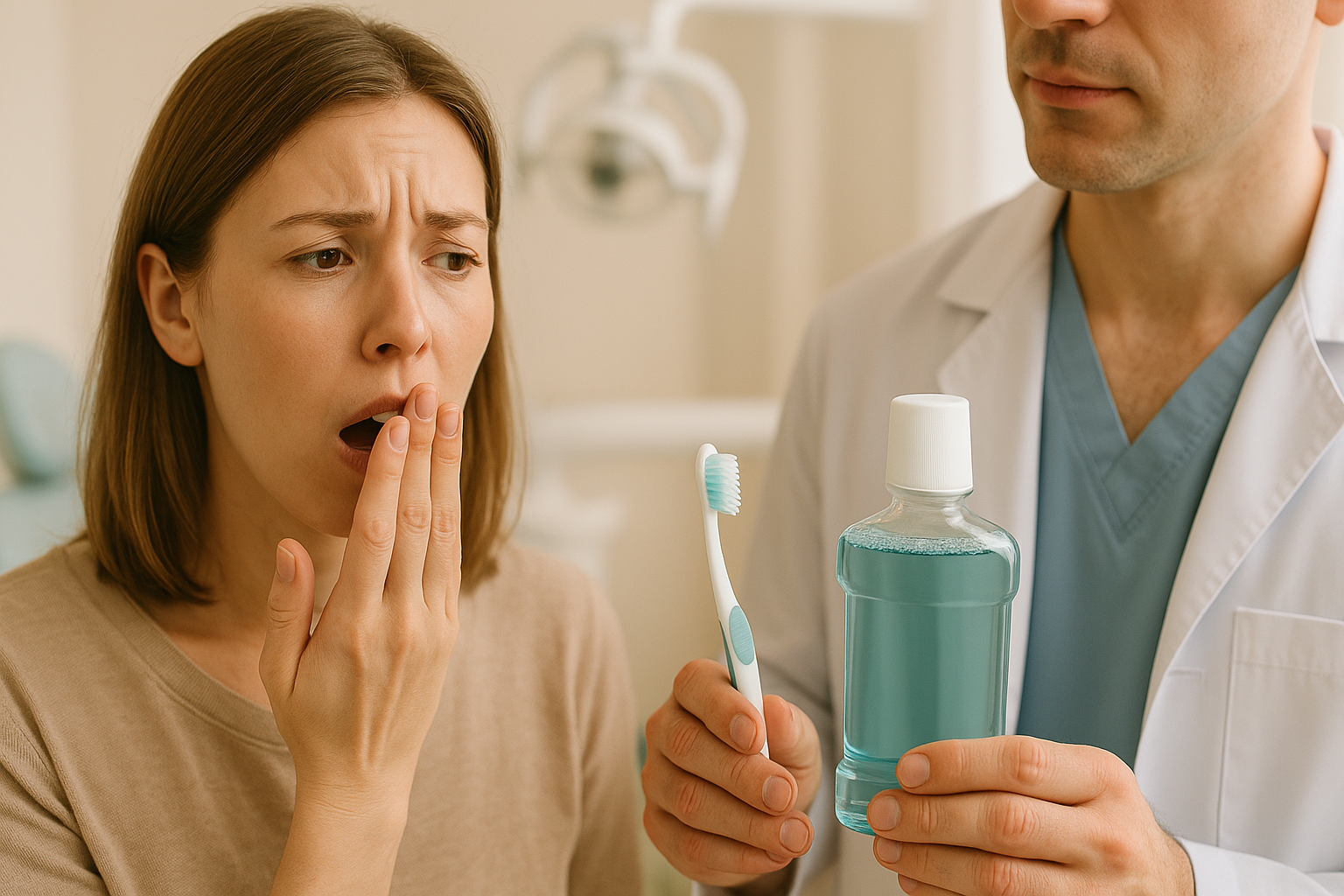
If your breath still smells after brushing and flossing, the odour is almost always coming from a place your brush and floss never actually reach. Brushing and flossing clean the surfaces of your teeth and the spaces between them — but most breath odour is produced by bacteria living on the back of the tongue, along and just under the gum line, in the tonsils, or from a dry mouth that no longer rinses itself. Those bacteria break down proteins and release volatile sulfur compounds (VSCs) — the gases responsible for that sulphur, "eggy" or sour smell. Clean teeth do not touch any of that.
The fastest fixes: clean the back of your tongue daily, keep your mouth moist (water, not alcohol-based mouthwash), give the gum line dedicated attention, and rule out tonsil stones, sinus drainage and reflux if odour persists. A gentle, alcohol-free rinse such as DP7 Pro Rinse is one example of a product built for the gum-line-and-tongue zone rather than just the tooth surfaces — more on where it fits below. If bad breath is persistent, see a dentist to rule out gum disease.
Why "clean teeth" and "fresh breath" are two different jobs
Here is the mental model that fixes most cases. Brushing removes plaque from the visible faces of your teeth. Flossing removes debris from between them. Both are essential — but together they cover maybe 60% of the surfaces inside your mouth. The soft tissues, and the tongue in particular, are left almost untouched, and that is exactly where odour is manufactured.
According to the Cleveland Clinic, the large majority of bad breath starts inside the mouth, and the coating on the tongue is one of the most common sources. Odour-causing bacteria feed on trapped proteins — from food debris, shed cells and mucus — and release volatile sulfur compounds as a by-product. Research in Scientific Reports notes that hydrogen sulfide, methyl mercaptan and dimethyl sulfide together make up roughly 90% of these compounds. Your toothbrush was never designed to reach the reservoir where they are made.
The 7 hidden reasons your breath still smells
Use this source map to find your cause. For each one: where the odour actually comes from, why brushing and flossing miss it, and what genuinely helps.
The persistent-breath source map
| Source | Where the smell is made | Why brushing & flossing miss it | What actually helps |
|---|---|---|---|
| 1. Back of the tongue | Biofilm and coating in the grooves near the throat — the single most common source of oral malodour. | A toothbrush skims the front of the tongue; the odour-rich zone is further back and rarely cleaned. | Clean the back third of the tongue daily with a scraper or brush (gag-reflex permitting). |
| 2. The gum line & just below it | Bacteria in the shallow crevice where gum meets tooth; strongly linked to gum inflammation. | Brushing cleans the tooth face; floss snaps through contacts but doesn't sit against the gum margin. | Angle brushing into the gum line; use a product that stays in contact with that zone. |
| 3. Dry mouth | Without enough saliva, bacteria and debris are never washed away and multiply. | You can brush a dry mouth spotless and it re-populates within an hour. | Water through the day, nasal (not mouth) breathing, and avoiding alcohol-based rinses. |
| 4. Tonsil stones | Hardened debris trapped in tonsil crypts — famously bad-smelling. | They sit in the throat, entirely outside the reach of brush or floss. | Gentle gargling; see a doctor for recurrent stones. |
| 5. Sinuses & postnasal drip | Mucus dripping down the throat feeds bacteria and can pool in the tonsils. | The source is in the nose and sinuses, not the mouth at all. | Treat allergies/sinus issues; stay hydrated; saline rinse. |
| 6. Stomach & reflux (GERD) | Acid and partially digested food travelling back up can carry odour. | Nothing in an oral-hygiene routine addresses the gut. | Manage reflux with your doctor; watch trigger foods. |
| 7. Diet, medication & smoking | Garlic/onion compounds circulate in blood and exit via the lungs; many meds dry the mouth; smoking lingers and dries. | These odours are exhaled or systemic — brushing can't remove what's in your bloodstream or lungs. | Time and hydration for food; review drying medications; stopping smoking. |
1. The back of your tongue (the number-one culprit)
If you only change one thing, change this. The rough surface at the back of the tongue traps a coating of bacteria, food debris and dead cells — the most common home for the bacteria that cause bad breath. A quick front-of-tongue swipe with your toothbrush doesn't touch it.
Does cleaning it actually work? A Cochrane systematic review of tongue-cleaning trials found that scrapers produced a small but statistically significant reduction in volatile sulfur compounds compared with a toothbrush. The honest caveat from the same review: the effect is short-lived, so tongue cleaning is a daily habit, not a one-off cure. Reach as far back as your gag reflex comfortably allows, use light pressure, and rinse the scraper between passes.
2. The gum line — and the "perio breath" connection
When gums are inflamed, the crevice where the gum meets the tooth harbours the very bacteria that produce the smelliest sulfur gases. Colgate calls this "perio breath," and the Scientific Reports study above found measurably higher VSC levels in people with gingivitis and periodontitis. If your gums bleed when you brush or floss, odour and inflammation are usually two symptoms of the same problem — and cleaning only the tooth surfaces leaves the source in place. (See our guides on why gums bleed and gingivitis.)
3. Dry mouth — and why alcohol mouthwash can backfire
Saliva is your mouth's built-in rinse: it washes away particles and the bacteria that create odour. When saliva drops — from dehydration, mouth-breathing, medications or sleep — odour builds fast. That's the mechanism behind morning breath, and per the Cleveland Clinic, dry mouth is one of the leading reasons breath smells despite good brushing.
Here's the trap: many strong mouthwashes are alcohol-based, and alcohol is drying. You get a minty blast for a few minutes, then a drier mouth that can leave breath worse than before. If you rinse, an alcohol-free formula avoids that rebound. This is a good moment to sip water rather than reach for a burning rinse — and see why so many mouthwashes fail in the long run.
4. Tonsil stones
Small, pale lumps of hardened debris can form in the crypts of your tonsils, and the Cleveland Clinic lists bad breath as their most common symptom. They sit in the throat, completely beyond brush and floss. If you occasionally cough up tiny white flecks or feel something stuck at the back of your throat, this may be your source.
5. Sinuses and postnasal drip
Mucus dripping down the back of the throat is a breeding ground for odour bacteria, and it can also pool in the tonsil crypts and seed the stones above. The Cleveland Clinic links postnasal drip — from allergies, infections or reflux — directly to halitosis. If your bad breath rides along with congestion or allergies, the fix is in your nose, not your toothbrush.
6. Reflux (GERD)
Acid and partially digested stomach contents can travel back up the esophagus and carry odor with them — a mechanism that has nothing to do with anything happening in your mouth. Northwestern Medicine lists acid reflux among the less-obvious causes of persistent bad breath, and it typically shows up alongside a sour taste, or odor that's worse after meals or when lying down. No amount of brushing reaches the gut, so if this is your pattern, the conversation is with a doctor, not your toothbrush.
7. Diet, medication and smoking
The remaining causes sit outside the mouth entirely and are, per Northwestern Medicine, genuinely distinct from one another. Garlic and onion compounds are absorbed into your bloodstream and released through your lungs as you breathe, which is why you can still smell of them hours after eating no matter how well you brushed. High-protein, low-carb diets produce ketones with their own distinct odor. Certain medications dry the mouth as a side effect, removing the saliva that would otherwise wash bacteria away. And smoking both dries the mouth and leaves a lingering smell of its own. None of these respond to a better brushing technique — they need their own fix: time and hydration for food odors, a medication review with your doctor or pharmacist, and quitting for smoking.
Quick self-test: what is the smell telling you?
| Clue | Most likely source |
|---|---|
| Worst first thing in the morning, improves after water & breakfast | Dry mouth / mouth-breathing at night |
| Gums bleed when brushing or flossing; smell returns quickly | Gum line / early gum inflammation |
| Odour comes and goes with a "something stuck" feeling at the throat | Tonsil stones |
| Comes with congestion, sniffing or allergies | Sinuses / postnasal drip |
| Sour taste, worse after meals or lying down | Reflux (GERD) |
| Fine after cleaning the tongue, returns without it | Tongue coating |
Not sure which of these is actually you? Your own nose adapts to your breath and stops flagging it — see our guide on how to actually check your own breath for the tests that get around that.
A 7-day fresh-breath reset
- Days 1–2 — add the tongue. After brushing, clean the back third of your tongue with a scraper. Light strokes, rinse between each. This alone resolves a large share of cases.
- Day 3 — fix the gum line. Angle your brush at 45° into the gum margin, not just across the teeth. Keep flossing — but gently, hugging each tooth in a C-shape.
- Day 4 — hydrate. Carry water; sip through the day. If you use mouthwash, switch to an alcohol-free one so you're not trading a fresh minute for a dry hour.
- Day 5 — check the throat. Look for tonsil stones; gargle gently. Note whether odour tracks with congestion.
- Day 6 — audit diet & meds. Note garlic/onion, very low-carb days, and any drying medications. Adjust what you can.
- Day 7 — reassess & escalate. Still lingering after all of the above? Book a dental visit to rule out gum disease, decay or a failing filling. Persistent odour deserves a professional look.
Where a gum-line-and-tongue routine fits: Dental Pro 7 & DP7 Pro Rinse
Most oral-care products are built for the tooth surface. The two below are built for the zone where breath odour is actually made — the gum line and the soft tissues — which is why they belong in a fresh-breath routine rather than a whitening one.
Dental Pro 7 is a water-free botanical lipid concentrate that's brushed on dry in place of toothpaste and left against the gum line rather than rinsed away, so it keeps working on breath and gum-line freshness long after a rinse would have washed off.
DP7 Pro Rinse is the companion for people who like the ritual of rinsing: an alcohol-free concentrate you dilute in water and rinse with, so you freshen the whole mouth without the drying alcohol rebound that can leave breath worse. Because our formulas are anhydrous (water-free) they are preservative-free by design — no SLS/foaming agents, no fluoride, no parabens.
- Rating: Dental Pro 7 is rated 4.81/5 from 190 verified buyers, with 500,000+ bottles sold.
- Guarantee: backed by a 90-day money-back guarantee.
- Formulated by S. C. Aris.
- What it's for: supporting the appearance of a cleaner, fresher mouth and healthier-looking gums — a cosmetic complement to brushing, flossing and regular dental care, not a replacement for them.
Explore Dental Pro 7. It pairs naturally with a gum-focused routine — see our guides on how gum disease is treated and receding gums.
Fresh-breath FAQ
Why does my breath smell even after I brush my tongue? Most people brush only the front of the tongue. The odour reservoir sits in the grooves at the back third, near the throat — reach further back (gently) with a scraper, and also check the gum line and tonsils.
Can mouthwash make bad breath worse? Alcohol-based rinses can dry the mouth, and a dry mouth breeds odour bacteria, so a strong rinse can leave you fresher for minutes and drier for hours. An alcohol-free rinse avoids that rebound.
How can I tell if my bad breath comes from my gums? If your gums bleed when brushing or flossing and the smell returns soon after cleaning, the gum line is a likely source. A dentist can confirm.
When should I see a dentist or doctor? If odour persists despite cleaning your tongue, gums and staying hydrated for a couple of weeks — or if you notice bleeding gums, a sour taste, or throat symptoms — get it checked to rule out gum disease, decay, tonsil stones or reflux.
The bottom line
Breath that smells after brushing and flossing isn't a sign you're doing it wrong — it's a sign the odour is coming from somewhere your brush and floss don't reach: the back of the tongue, the gum line, a dry mouth, the tonsils, the sinuses or the gut. Clean the tongue, mind the gum line, stay hydrated, skip the drying alcohol rinse, and rule out the throat-and-gut causes. If it lingers, a dentist can find what's left. For the fuller picture of causes, see why do I have bad breath.
This piece explains why breath can still smell after good brushing and flossing habits. Where products are named, they're described only by look, feel and scent — not as treatments — and none of this is medical or dental advice, nor a diagnosis of any cause above. A cause that doesn't clear up with home care is a job for a dentist or doctor.