Why Does My Breath Smell When I’m Fasting? The Sulphur-vs-Sweet Test
Quick answer
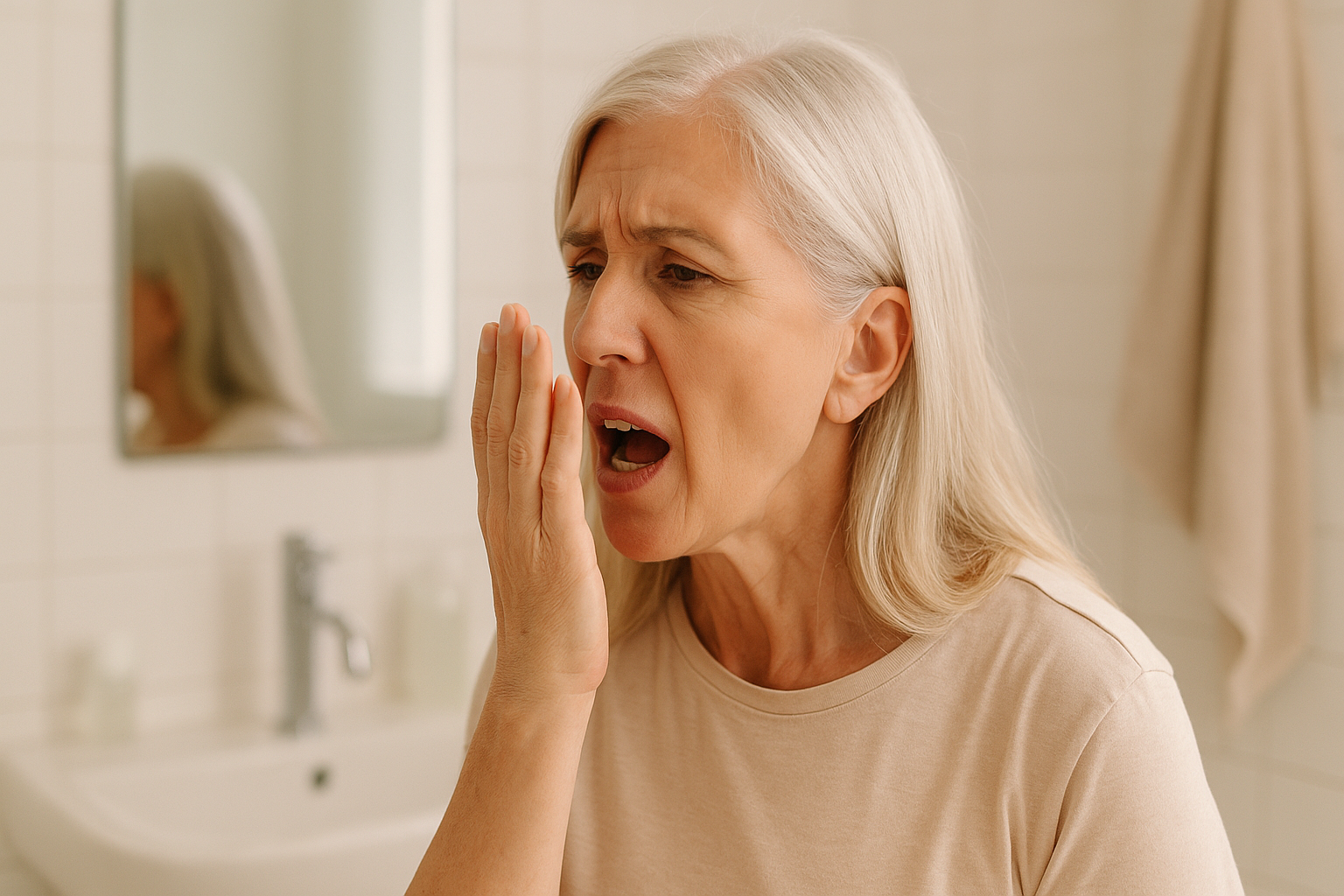
Fasting breath usually has two separate causes running at the same time, and they smell different. One is a sulphurous, stale, rotten-egg smell that comes from your mouth: not eating means not chewing, and chewing is the strongest natural trigger for saliva flow, so a fasting mouth is a drier, less-rinsed mouth. The other is a sweet, fruity, nail-polish-remover smell that does not come from your mouth at all — it comes from your lungs, because a body running on fat instead of glucose releases ketones, one of which (acetone) is volatile enough to leave on the breath.
The practical difference is everything: the sulphurous half responds to brushing, tongue cleaning, water and saliva stimulation. The sweet half does not, because there is nothing in your mouth to clean off — it fades when you eat again. If your breath is still bad hours after you break the fast, fasting was never the cause. For the mouth-side half specifically, a water-free oral concentrate that stays on the gum line rather than washing straight off — DP7 Pro Rinse is one example — is designed for exactly the low-saliva conditions a fasting window creates.
One safety point first: fruity-scented breath alongside heavy thirst, frequent urination, vomiting, belly pain, breathlessness or confusion is a possible sign of diabetic ketoacidosis, which the Mayo Clinic lists as a medical emergency. That combination is not a breath problem. Seek emergency care.
Last updated: 3 September 2026
Why almost every article on this gets it half right
Search “bad breath while fasting” and you will find dozens of pages telling you it is ketosis. You will find almost as many telling you it is dry mouth. Both are right, and both are incomplete — because they are describing two different smells with two different origins, two different timelines, and two completely different answers to the only question that matters: will cleaning my mouth fix it?
Once you can tell the two apart, you stop wasting effort. There is no point scrubbing your tongue for a smell that is being exhaled from your bloodstream, and there is no point waiting for a smell to “pass” when it is coming from a dry, unrinsed gum line that will still be there tomorrow.
The information gain: a side-by-side of the two fasting breath smells
This is the table the top results do not give you.
| Sulphur breath (oral origin) | Sweet breath (metabolic origin) | |
|---|---|---|
| What it smells like | Stale, sour, eggy, “bin-like”. The Cleveland Clinic describes chronic bad breath as smelling of “fish or rotten eggs” | Sweet, fruity, or like nail-polish remover. Cleveland Clinic notes bad-breath smells can range “from sour to unpleasantly sweet” |
| Where it is produced | In the mouth — tongue coating, between teeth, along the gum line | In the liver, carried in the blood, released through the lungs |
| What is behind it | Reduced saliva. Saliva “washes away food particles from the teeth and gums” (NIDCR); with less of it, odour-producing bacteria are less disturbed | Ketones. Cleveland Clinic: ketones are “acids your body makes when it’s using fat instead of glucose for energy”, and lists fasting among the normal triggers for ketosis |
| Does brushing help? | Yes — directly and quickly | No — nothing in the mouth is producing it |
| Does a mint or mouthwash help? | Briefly. The ADA is blunt: over-the-counter rinses “neutralize and temporarily mask bad breath. It’s only a temporary solution” | Masks it for minutes only; the source keeps exhaling |
| When it peaks | Deepest into the fast and worst on waking, when saliva flow is naturally lowest | Builds as the fast lengthens and the body leans harder on fat for fuel |
| When it clears | Within minutes of properly cleaning the mouth | Only when you eat again and the body returns to glucose |
| If it does NOT clear | Look at the gums. The ADA: “Bad breath that just won’t go away or a constant bad taste in your mouth can be a warning sign of advanced gum disease” | Fruity breath that persists, or comes with the emergency symptoms listed below, needs urgent medical assessment |
The 3-question self-test
You do not need a device. Three questions separate them in under a minute.
- Does it smell sour and stale, or sweet and solvent-like? Sour and stale points to the mouth. Sweet and acetone-like points to ketones. If you cannot judge your own breath — and most people genuinely cannot — the Cleveland Clinic offers a workable proxy: “If you have a bad taste in your mouth, you’ve probably got bad breath that others can smell.” The Mayo Clinic’s advice is simply to “ask a close friend or relative to confirm”.
- Brush, clean the tongue, and re-check ten minutes later. If it is largely gone, you were dealing with the oral half. If it is essentially unchanged, you are dealing with the metabolic half.
- Break the fast, eat a normal meal, and re-check two hours later. Ketone breath fades as the body switches back to glucose. Anything that survives a proper meal and a proper clean was never fasting breath — it is ordinary halitosis that the fast simply made you notice.
That third step is the one nobody writes down, and it is the most valuable, because it is the only test that tells you whether you have a fasting problem or an oral-health problem wearing a fasting costume.
Why not eating dries your mouth — the mechanism most articles miss
The usual explanation is “you drink less when you fast”. That is true, but it is not the main lever. The main lever is that you stopped chewing.
The American Dental Association states it plainly: “Chewing is the most efficient way to stimulate salivary flow. It causes muscles to compress the salivary glands and release saliva.” A fasting window removes every chewing event of the day. The glands are not damaged and nothing is wrong — they are simply not being asked to work.
That matters because of what saliva does. NIDCR describes saliva as moistening and breaking down food, washing away food particles from the teeth and gums, and helping with swallowing, and notes that dry mouth “increases the risk for tooth decay or fungal infections in the mouth because saliva helps keep harmful germs in check”. Bad breath appears explicitly on NIDCR’s list of dry-mouth symptoms.
Three further things stack on top during a typical fasting window:
- Black coffee. It is the default fasting-window drink, and NIDCR advises limiting caffeinated drinks because “caffeine can dry out the mouth and lead to dehydration”.
- Overnight hours. Most fasting windows include a night. The Mayo Clinic: “Dry mouth naturally occurs during sleep, leading to ‘morning breath’. It gets worse if you sleep with your mouth open.” Cleveland Clinic dental hygienist Denise Stepka, RDH, puts it memorably: “Your mouth at night is like a closed gym. No air flow, no cleaning crew, just bacteria growing and releasing odors.”
- Fewer rinsing events. No meals means no incidental flushing of the mouth with food, drink and saliva across the day.
What a research group actually measured during a 10-day fast
Almost nobody writing about fasting breath cites a measurement of it. There is one.
A 2024 single-arm interventional study published in Oral Health & Preventive Dentistry (Loumé, Grundler, Wilhelmi de Toledo, Giannopoulou & Mesnage) followed 36 people through a supervised fast of 10 ± 3 days, measuring volatile sulphur compounds in the breath every morning with a gas-chromatography device, and sampling saliva and gingival crevicular fluid before, at the end of, and after the fast. As reported in the study’s published abstract, dimethyl sulphide in the breath rose significantly during fasting, and this was correlated with a shift in the composition of the saliva microbiota; the abstract also reports a fall in the pro-inflammatory cytokine interleukin-8 in the gingival crevicular fluid.
Two things follow from that, and only two. First, fasting breath is not imaginary and not purely psychological — a sulphurous component is measurable. Second, it is not purely a ketone story either: the sulphur side moved with the oral microbiota, which is precisely the side you can do something about. (The figures above are quoted as the abstract states them; we draw no conclusions beyond it.)
Why the sweet smell cannot be brushed away
This is the part that saves people the most wasted effort.
Cleveland Clinic describes ketones as acids the body makes when it burns fat rather than glucose, produced in the liver and released into the bloodstream, and lists the normal situations in which the body enters ketosis: when you are asleep, when you are fasting, when you are exercising, and on a keto diet. One of those ketones is acetone — volatile enough that, as Cleveland Clinic notes, handheld breathalysers marketed to keto dieters work by detecting it. Cleveland Clinic names the resulting smell directly: fruity-smelling breath, “sometimes called ‘keto breath’”.
The route is the same one the Mayo Clinic describes for garlic and onions, and it explains why food odours outlast any amount of brushing: after you digest these foods, “they enter your bloodstream, are carried to your lungs and affect your breath”. A smell arriving at your mouth from the inside cannot be removed from the outside. Toothpaste, floss, scrapers and rinses all operate on surfaces that are not the source.
So if step 2 of the self-test changed nothing, stop scrubbing. Nothing you do in your mouth will shorten it. It ends when the fast ends.
A fasting-window protocol for the half you can control
Every step below is drawn from a named dental or health authority, not from fasting folklore.
| When | Do this | Why, and who says so |
|---|---|---|
| Before the window opens | Brush thoroughly and clean between the teeth | The ADA’s first line against bad breath is brushing twice daily and cleaning between the teeth daily — do it before the long unrinsed stretch, not after |
| Before the window opens | Clean the tongue | Cleveland Clinic lists cleaning the tongue with a tongue scraper among its halitosis-prevention steps, noting bacteria and food debris “can hide out there” |
| Throughout | Water, steadily — NIDCR suggests 8 to 12 cups a day (2–3 litres) for dry-mouth relief | NIDCR, “Dry Mouth” helpful tips. Cleveland Clinic likewise lists drinking plenty of water to help prevent dry mouth |
| Throughout | Go easy on the black coffee; alternate with water | NIDCR: caffeine “can dry out the mouth and lead to dehydration” |
| Throughout | Avoid alcohol and tobacco | NIDCR and Cleveland Clinic both list them as drying. Smoking, per Cleveland Clinic, “can change the balance of microbes… in your mouth” |
| Mid-window, if your protocol allows it | Sugar-free gum or a sugar-free mint | NIDCR recommends sugarless gum or hard candy to stimulate saliva flow, noting some contain xylitol; the ADA suggests the same to “keep that saliva flowing”. Whether chewing gum breaks your fast is a question for your fasting protocol, not your dentist |
| Mid-window | If you rinse, choose alcohol-free | Cleveland Clinic’s morning-breath guidance is to rinse with alcohol-free mouthwash, “which helps avoid drying out your mouth further”. Alcohol-based rinses work against you in a window where dryness is the whole problem |
| At night | Consider a humidifier; deal with mouth-breathing | NIDCR lists a night-time humidifier for dry mouth; Mayo notes morning breath “gets worse if you sleep with your mouth open” |
| Breaking the fast | Chew something that takes real chewing | The ADA’s saliva advice: eat “healthy foods that require a lot of chewing, like carrots or apples”. This is the fastest way to restart flow, because chewing is the most efficient stimulus there is |
Notice what is not on that list: more mouthwash. The ADA’s own position is that over-the-counter rinses temporarily mask odour and that “the longer you wait to brush and floss away food in your mouth, the more likely your breath will offend”. Masking is not the same as removing.
When fasting breath is not fasting breath
Three patterns mean the fast is a bystander.
1. It survives eating
If breath is still bad two hours after a normal meal and a proper clean, look elsewhere. The ADA is direct: bad breath that will not go away, or a constant bad taste, “can be a warning sign of advanced gum disease”. The Cleveland Clinic makes the same point about morning breath — if it persists after brushing, “something more serious could be going on”, with gum disease, cavities or chronic dry mouth named as candidates. That is a dentist visit, not a hydration problem.
2. It is fruity and you feel unwell
The Mayo Clinic lists the warning signs of diabetic ketoacidosis: being very thirsty, urinating often, feeling a need to throw up and throwing up, belly pain, weakness or tiredness, shortness of breath, fruity-scented breath, and confusion. Symptoms “often come on quickly, sometimes within 24 hours”, and Mayo notes that for some people they may be the first sign of diabetes at all. Mayo’s instruction is unambiguous: “It’s important to get care right away. If it’s not treated, diabetic ketoacidosis can lead to death.”
Risk is highest in type 1 diabetes, though Cleveland Clinic notes DKA can happen with type 2 as well. Cleveland Clinic also flags alcoholic ketoacidosis — dangerously high ketones in people with a history of heavy drinking, typically after binge drinking and vomiting prevents adequate nutrition — as an equally urgent emergency.
Fasting breath in a healthy person is a nuisance. Fruity breath with those symptoms is not. Do not spend time deciding which one it is; get assessed.
3. It has a character all of its own
Cleveland Clinic lists other origins for persistent bad breath that no fasting adjustment will touch: tonsil stones, infections in the nose, throat or lungs, GERD, kidney or liver disease, and head and neck cancers. The ADA adds sinus conditions and gastric reflux to the same list. If your breath has a distinctive, consistent character unrelated to your eating window, that is a conversation with a dentist first and a doctor second.
Where a water-free oral concentrate fits in a fasting routine
A fasting window is, from your mouth’s point of view, a long stretch with the rinse cycle switched off. That is exactly the situation in which most conventional oral care under-performs, because most conventional oral care is water-based: it is diluted by saliva and washed off in seconds. During a fast there is less saliva to carry actives around the mouth in the first place, and hours between cleanings.
DP7 Pro Rinse and Dental Pro 7 are built on the opposite principle. Both are 100% water-free botanical lipid concentrates. Because lipids are not water-soluble, they cling to the gum line and tooth surfaces instead of sluicing away — the property the brand calls Lipid-Lock. In practice that means contact time measured in hours rather than seconds, which is the single most useful thing you can ask of an oral product during a window when nothing else is rinsing your mouth.
Dental Pro 7’s concentrate carries eleven botanicals: seven actives — immortelle helichrysum, pomegranate seed, black cumin seed, Indian myrrh, wild clove, white thyme and eucalyptus — alongside a freshness trinity of peppermint, spearmint and wild mint, in a grapeseed, sunflower and vitamin E lipid base. There is no water, no fillers, no SLS or foaming agents, no preservatives or parabens and no fluoride; it is vegan and non-GMO. Because the formula is anhydrous, it is preservative-free by design rather than by subtraction. It naturally contains eugenol, limonene and linalool, and is made in a facility that handles nut lipids.
Used consistently, it supports the appearance of firmer, pinker, healthier-looking gums and a cleaner-feeling, fresher mouth — which is the honest claim, and the relevant one, because the mouth-side half of fasting breath is the half that responds to care at the gum line.
Getting the method right — they are used in opposite ways:
- Dental Pro 7: 4 drops on a dry toothbrush in place of toothpaste, brush gently for about two minutes, then spit — do NOT rinse with water. Rinsing washes the lipid layer straight off and defeats the point.
- DP7 Pro Rinse: the opposite — a concentrate you dilute in water and rinse with. It is the natural fit for a mid-window freshen-up when brushing is not practical.
Both are formulated by S. C. Aris. Dental Pro 7 holds a 4.81 out of 5 rating from 190 verified buyers with more than 500,000 units sold, and comes with a 90-day money-back guarantee — long enough to run several fasting cycles and judge for yourself, since the useful test is whether the smell that survives a fast is smaller than it used to be.
It is a cosmetic product, not a medicine. It is not a substitute for professional dental care, and it will do nothing whatsoever about the ketone half of fasting breath — nothing applied to your mouth can, because that smell is not made there. If your gums bleed, ache or have receded, see a dentist; a topical is an adjunct to that care, never a replacement for it.
Related reading in this cluster: Why does my breath still smell after brushing and flossing? · Why can’t I smell my own bad breath? · Why does my breath smell metallic? · Can tonsil stones cause bad breath? · Is alcohol-free mouthwash as effective as regular mouthwash? · Why do I have bad breath?
Frequently asked questions
How long does fasting breath last?
The two halves end at different times. The mouth-side, sulphurous half improves within minutes of a proper clean and returns as the dry stretch goes on. The sweet, ketone half lasts as long as the body is running on fat — Cleveland Clinic lists fasting among the normal triggers for ketosis — and fades once you eat again and glucose is available. If a smell outlives both a clean and a meal, it is not fasting breath.
Does drinking more water fix fasting breath?
It helps the oral half and does nothing for the metabolic half. NIDCR’s dry-mouth guidance suggests 8 to 12 cups of water a day, and Cleveland Clinic lists drinking plenty of water among its halitosis-prevention steps. But water does not stimulate the salivary glands the way chewing does — the ADA identifies chewing as “the most efficient way to stimulate salivary flow”. Hydration is necessary and not sufficient.
Will chewing sugar-free gum break my fast?
That is a question about your fasting protocol, not your oral health, and different protocols answer it differently. From the dental side the picture is clear: both NIDCR and the ADA recommend sugarless gum or sugar-free sweets specifically to stimulate saliva flow in a dry mouth, and NIDCR notes that some sugarless gums and sweets contain xylitol and may help prevent cavities. If your protocol permits it, it is one of the more effective things you can do mid-window.
Why is it worst in the morning during a fast?
Because two dry-mouth effects stack. The Mayo Clinic notes that dry mouth “naturally occurs during sleep, leading to ‘morning breath’”, and that it gets worse if you sleep with your mouth open. A fasting window that spans the night adds a full day without chewing on top of a night without saliva flow. Cleveland Clinic describes the same overnight mechanism: saliva production naturally slows during sleep, leaving bacteria free to multiply.
Can mouthwash cover fasting breath?
Only briefly, and only for one half of it. The ADA states that over-the-counter mouthwashes “neutralize and temporarily mask bad breath. It’s only a temporary solution.” Against ketone breath a rinse does even less, because the odour is being continuously exhaled rather than sitting on a surface. If you do rinse during a fasting window, Cleveland Clinic’s guidance is to choose an alcohol-free formula so you are not adding to the dryness that caused the problem.
Is fasting bad for my gums?
Nothing in the sources opened for this article says so, and the 2024 fasting study reported a fall in the pro-inflammatory marker interleukin-8 in gingival crevicular fluid, as stated in its abstract. What a fasting window does do is remove the incidental cleaning that eating and drinking provide across the day, so the fixed part of your routine has to carry more weight. Brush and clean between the teeth before the window opens rather than leaving it until after.
My breath smells fruity but I feel completely fine — should I worry?
A mild sweet or acetone note during a fast, with no other symptoms, is consistent with ordinary ketosis, which Cleveland Clinic describes as a normal process. The pattern that requires urgent attention is fruity breath together with heavy thirst, frequent urination, vomiting, belly pain, weakness, shortness of breath or confusion — the Mayo Clinic’s list of diabetic ketoacidosis warning signs, which can appear within 24 hours and require emergency care. If you have diabetes, or the fruity smell is new and marked, get it checked rather than reasoning it out.
The bottom line
Fasting breath is two problems wearing one name. Ask which smell you have, clean and re-check, then eat and re-check. Sulphur that clears with cleaning is a saliva problem, and the fix is chewing, water, tongue cleaning and something that stays on the gum line rather than washing off. Sweetness that survives cleaning is a lung problem in the most literal sense, and the only fix is the end of the fast. And anything that survives both was never about fasting at all — that one belongs to your dentist.
This article is for general information and is not a substitute for professional dental or medical advice. Cosmetic products support the appearance and feel of the mouth; they do not diagnose, treat or cure any condition. If you have persistent bad breath, bleeding or painful gums, or any of the emergency symptoms described above, seek professional care.
Sources
- Mayo Clinic, Bad breath — Symptoms and causes (updated 21 December 2023).
- Mayo Clinic, Diabetic ketoacidosis — Symptoms and causes (updated 25 July 2025).
- Cleveland Clinic Health Library, Ketones (medically reviewed, updated 8 August 2023).
- Cleveland Clinic Health Library, Bad Breath (Halitosis) (medically reviewed, updated 5 August 2025).
- Cleveland Clinic Health Essentials, Wake Up Fresh: How To Stop Morning Breath (Denise Stepka, RDH; 13 February 2026).
- National Institute of Dental and Craniofacial Research, Dry Mouth (last reviewed October 2024).
- ADA MouthHealthy, Saliva; and Dry Mouth.
- ADA MouthHealthy, Bad Breath: 6 Causes (and 6 Solutions).
- Loumé A, Grundler F, Wilhelmi de Toledo F, Giannopoulou C & Mesnage R, “Impact of Long-term Fasting on Breath Volatile Sulphur Compounds, Inflammatory Markers and Saliva Microbiota Composition,” Oral Health & Preventive Dentistry 2024;22 — PMC11619894. Figures quoted as stated in the published abstract.