Are UV Nail Lamps Safe? What the Gel-Manicure Studies Actually Measured — and the 5-Step Hand-Protection Routine
Last updated: 24 October 2026
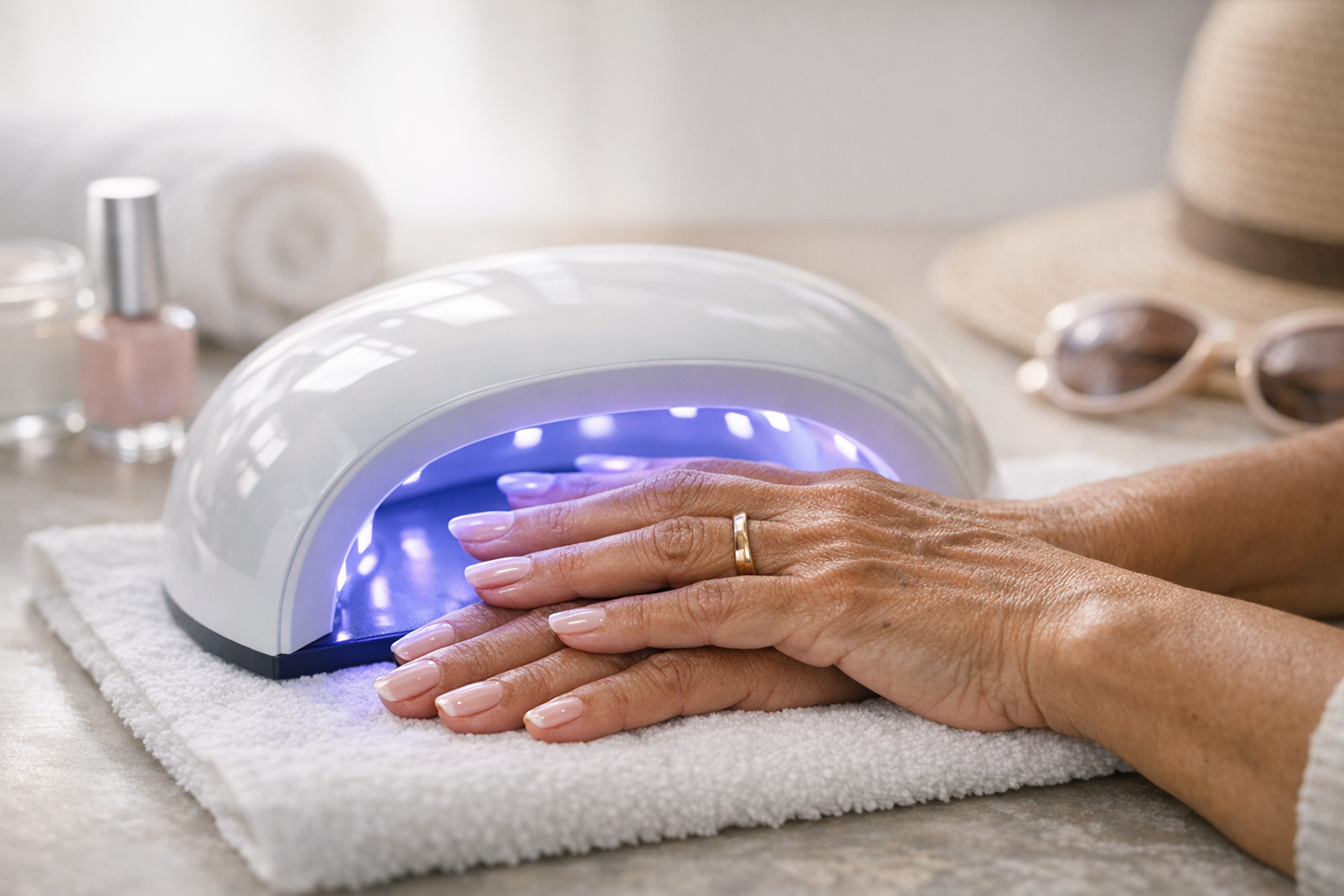
Few beauty questions have produced as many alarming headlines and as many reassuring rebuttals as this one. One week the lamp is "like a tanning bed for your hands"; the next, "no need to stop visiting the nail salon." Both headlines can be true at the same time, because they are answering different questions. This guide lines up every major study, says plainly what each one measured, and ends with a routine you can start before your next appointment.
Do UV and LED nail lamps both emit ultraviolet light?
Yes. Harvard Health Publishing, citing the American Academy of Dermatology, states that lamps sold as UV and lamps sold as LED both emit ultraviolet radiation, mainly UVA (Harvard Women's Health Watch). So "LED" on the box is not a safety claim — it describes the light source, not the absence of UV. If a salon tells you its LED lamp is "UV-free," treat that as a marketing line rather than a measurement.
UVA is the longer-wavelength part of sunlight. It penetrates deeper than UVB and is the type that contributes to skin ageing — the University of Utah Health lists "aging, brown spots, wrinkles" alongside skin-cancer risk among the effects of UV exposure (University of Utah Health, 2023). That ageing angle is worth noticing: the backs of your hands are among the first places a face-age gap shows up.
What did the 2023 "cancer" study actually find?
The study behind most of the headlines is Zhivagui and colleagues at UC San Diego, published in Nature Communications on 17 January 2023 (Zhivagui et al., Nat Commun 14:276). The team irradiated three kinds of cultured cells — mouse embryonic fibroblasts, human foreskin fibroblasts and human epidermal keratinocytes — using a commercial UV nail-polish dryer, then looked for damage.
The key results, as reported in the paper:
- A single 20-minute exposure killed roughly 20–30% of the cells; three consecutive daily 20-minute exposures killed roughly 65–70%.
- Reactive oxygen species (ROS) rose sharply, with markers of oxidative DNA damage (8-oxo-dG) rising several-fold.
- Mutations increased in a dose-dependent way, dominated by C>A changes that match two oxidative-stress mutational signatures (SBS18 and SBS36).
- The classic sunlight-type lesions (cyclobutane pyrimidine dimers and 6-4 photoproducts) were not detected — so the damage pathway is oxidative, not the same one sunburn uses.
The authors are careful about limits. Cell lines in a dish "will not perfectly emulate" what happens in living human skin, they did not test human skin directly, and in the skin-cancer genomes they re-analysed, those oxidative signatures made up only a small share of total mutations (about 12% of annotated driver mutations). It is a hypothesis-generating lab result, not proof that manicures cause cancer.
Is the dose in that study realistic?
This is where the headlines and the rebuttals split. Australia's radiation regulator ARPANSA noted that the study's exposures — 20 minutes or more, repeated — are far longer than the roughly 2–3 minutes typically spent drying polish, and advised that salon-goers shouldn't need to avoid nail salons, while still suggesting fingerless gloves or sunscreen if you are concerned (ARPANSA, "No need to stop visiting the nail salon"). ARPANSA also stresses that the sun, not lamps, remains the major cause of skin cancer.
Both readings are reasonable. The study shows the mechanism exists at high doses; ARPANSA's point is that ordinary exposure sits well below that. The honest summary is that nobody has yet measured the cumulative risk of a decade of manicures on real hands.
What do the salon-lamp measurements show?
The more directly relevant data come from measuring real lamps. Shipp and colleagues at Georgia Regents University tested 17 light units from 16 salons and published the research letter in JAMA Dermatology in 2014 (Shipp et al., JAMA Dermatol 2014;150(7):775–776). As reported by Practical Dermatology, output varied across lamps — higher-wattage units correlated with higher UVA — and the authors concluded that even with numerous exposures the risk "remains small," while still recommending physical sunscreens or UVA-protective gloves.
An earlier study by Dowdy and Sayre, published in Photochemistry and Photobiology in 2013, is summarised by an industry body, the Professional Beauty Association's Nail Manufacturers Council, as finding that lamps fall within accepted workplace UV limits for around 25 minutes a day and carry far lower non-melanoma risk than noon sunlight (SkinInc report). Because that summary comes from a group with a commercial stake in the answer, treat those numbers as reported rather than independently confirmed.
What about the cases of skin cancer on the nail?
Case reports exist, and they are worth reading precisely because they are modest. A 2024 letter in Anais Brasileiros de Dermatologia describes a 26-year-old woman with no other risk factors who had used UV nail lamps about twice a month for two years without protection; a nail-matrix biopsy showed squamous cell carcinoma in situ (Ordoñez et al., An Bras Dermatol 2024). The authors themselves write that causality cannot be established, call the link "highly suggestive," and describe the risks as "potential." Her first sign was a colour change and a nail plate that began to detach — and antifungal treatment didn't help.
One case cannot tell you how common this is. What it does is justify a simple rule: a persistent change on a single nail that doesn't respond to the obvious fixes deserves a dermatologist's eye, not another coat of polish.
What do cancer-centre dermatologists say overall?
MD Anderson's CancerWise blog, medically reviewed by dermatologist Saira George, MD, in September 2025, puts it this way: based on current information the risk from nail dryers appears low — but UV exposures add up over a lifetime, so it matters more for frequent salon-goers and for people at higher risk, such as those with fair skin, heavy past UV exposure or a prior skin cancer (MD Anderson CancerWise). Its protective advice matches everyone else's: sunscreen on the exposed skin, fingerless gloves, or choosing a service without a UV lamp.
| Evidence | What was measured | What it can tell you | What it can't |
|---|---|---|---|
| Zhivagui et al., 2023 (Nat Commun) | Cultured mouse and human cells under a nail dryer, 20-minute sessions | Lamp UVA can generate oxidative stress and mutations at high doses | Real-world risk; behaviour of intact skin |
| Shipp et al., 2014 (JAMA Dermatol) | Output of 17 salon lamps | Lamp output varies; risk judged small even with repeated visits | Long-term cumulative outcomes |
| Dowdy & Sayre, 2013 (industry summary) | Lamp emissions vs. workplace limits | Typical sessions sit within accepted limits (as reported) | Independent confirmation; unusual use |
| Ordoñez et al., 2024 (case letter) | One patient with nail-unit SCC in situ | Rare cases occur and look suspicious | Frequency; cause and effect |
| Expert reviews (MD Anderson, Harvard, ARPANSA) | Synthesis of the above | Risk appears low; protection is easy | Anything beyond current data |
Who should be more careful?
- Frequent clients — lifetime UV adds up, and the data on decades of fortnightly gel manicures simply doesn't exist yet.
- Fair skin, heavy past sun or tanning-bed use, or a personal history of skin cancer — the MD Anderson group flags these as the people for whom exposure matters most.
- Anyone on a medication that requires avoiding sunlight — the industry summary of the 2013 study lists this as a specific caution; ask your pharmacist whether it covers lamps.
- Anyone whose nails or hands already show sun damage — brown spots and crepey backs of hands are a cue to protect more, not less.
The 5-step hand-protection routine
This routine is built from the protective advice the sources above agree on, plus one habit — counting — that makes the rest stick.
- Sunscreen first. Apply broad-spectrum, water-resistant SPF 30 or higher to the backs of your hands and fingers before you leave for the appointment, as the American Academy of Dermatology advice relayed by Dermatology Times recommends. Ask the technician to keep the nail plate itself clean so the polish adheres.
- Add opaque fingerless gloves. Dark, tightly woven gloves with the fingertips exposed shield the hand while leaving the nails free for curing — the same suggestion Utah Health, Harvard Health and Dermatology Times all make.
- Keep sessions short and standard. Follow the polish brand's cure times rather than "extra" minutes; the 2023 cell study used 20-minute doses, far beyond a normal cure.
- Count your manicures. Note each gel appointment in your phone calendar. If you are above roughly a dozen a year, schedule polish-free months — the lifetime-accumulation point from MD Anderson is the one most easily forgotten. (The dozen figure is our rule of thumb, not a published threshold.)
- Use the breaks properly. Gel removal is hard on nails (see our guides on acetone remover and gel-nail allergy), so a polish-free phase is the moment to condition. If you'd rather skip lamps entirely, our comparison of dip powder vs. gel covers the main lamp-free alternative.
Where Provité Nail Elixir fits in
Provité Nail Elixir is a lamp-free step: nothing about it needs curing, so it suits the polish-free phase your routine should include. It is a 100% botanical lipid, formaldehyde-free concentrate from CallNature, formulated by S. C. Aris to condition between the keratin layers of the nail plate — an "intra-keratin" approach designed to support nails that look stronger and more flexible, rather than hardened and brittle. Its 13 botanical actives include hemp seed, grapeseed, sesame seed, jojoba, avocado and vitamin E. Because it is designed to work on clean nails, the best time to use it is exactly the polish-free phase this article recommends.
To be clear about scope: Provité is a cosmetic. It does not protect against UV, doesn't replace sunscreen or gloves, and makes no claim about skin health. What it offers is a way to look after the look and feel of your nails between manicures. It is rated 4.8 out of 5 from 26 verified reviews, every order carries a 90-day money-back guarantee, and it is sold through CallNature's official sites. Like all our botanical formulas, it contains aromatic plants (including lemon, lavender and geranium), so patch-test if you are fragrance-sensitive. Shop Provité Nail Elixir →
Frequently asked questions
Are LED nail lamps safer than UV nail lamps?
Not on the evidence available. Harvard Health Publishing, citing the American Academy of Dermatology, says both lamp types emit mainly UVA. "LED" describes the bulb technology, not an absence of ultraviolet light, so the same protection steps apply to both.
Can gel manicure lamps cause skin cancer?
That has not been proven. A 2023 lab study found oxidative DNA damage and mutations in cultured cells after long exposures, and a few case reports link nail-area cancers to repeated lamp use, but the authors of those reports say causation can't be established. Dermatologists at MD Anderson say the risk appears low for most people and matters more for frequent users and those at higher baseline risk.
Do I need gloves and sunscreen for every gel manicure?
You don't strictly need them, but they are cheap, easy and recommended by the American Academy of Dermatology, Harvard Health, University of Utah Health and MD Anderson. If you get gel manicures often, or you have fair skin or a history of skin cancer, they are worth making a habit.
How often is it safe to get gel nails?
No source gives a published safe frequency. MD Anderson notes more research is needed on decades of repeated exposure. A sensible approach is to limit lamp sessions, protect your hands each time, and build in polish-free months.
Is dip powder safer than gel because it needs no lamp?
Dip powder avoids UV exposure, but it brings its own considerations — shared jars, adhesives and removal with acetone. Our dip-vs-gel guide walks through the trade-offs so you can compare like with like.
What nail change should I show a doctor?
Any lasting change on a single nail — a new dark or coloured streak, a nail plate that lifts or detaches, or a sore that won't settle — especially if antifungal treatments don't help. Show a dermatologist rather than covering it with polish.
Educational information only — not medical advice. Provité Nail Elixir is a cosmetic product and is not intended to diagnose, treat, cure, or prevent any disease. If you notice a persistent change in a nail or a skin lesion, see a dermatologist.