Why Am I Suddenly Allergic to Gel Nails? The Threshold Nobody Warned You About — and the 4-Site Symptom Map
Last updated: 19 September 2026
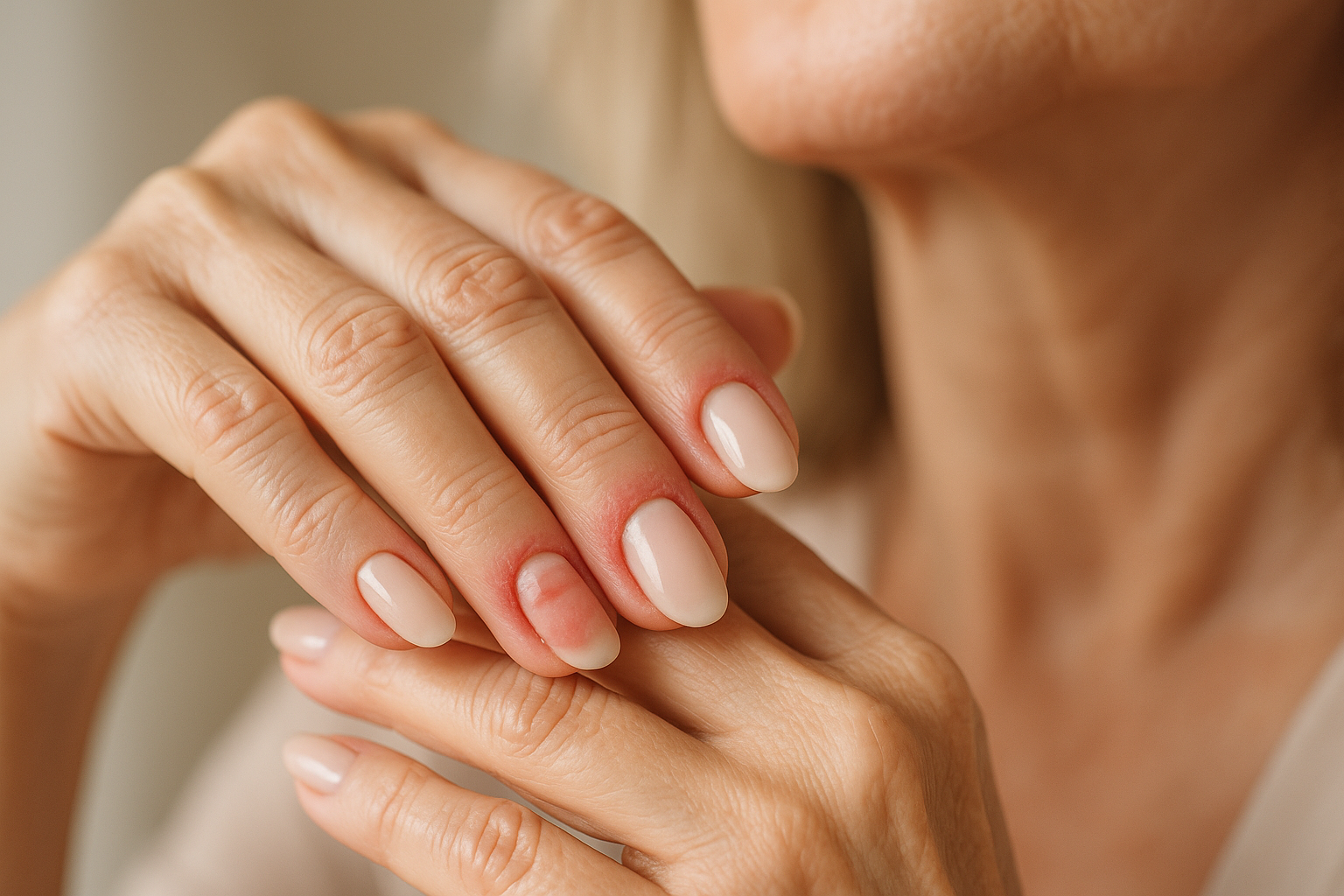
You have had gel manicures every three weeks for six years without a flicker of trouble. Then one appointment — or one weekend with a new home kit — and two days later the skin around your nails is red, swollen and maddeningly itchy, your fingertips are peeling, a nail is lifting at the corner, and your eyelids are puffy for no reason you can name. Search the question and you'll find nail-brand blogs telling you to switch to a “HEMA-free” polish and carry on. This article explains what dermatology and allergy authorities actually say: why the allergy arrives the way it does, what pushed you over the line, how to read where the rash appears, how common this has become, why “HEMA-free” is not a get-out, what a diagnosis changes for your dental and medical care later — and what to do this week.
Why it isn't sudden: the sensitisation threshold
An allergy to gel polish is not the kind of allergy that makes your throat close. The Asthma and Allergy Foundation of America's chief medical officer, allergist Matthew Greenhawt, MD, explains in the foundation's answer to a reader asking whether she is allergic to gel nails that reactions to methacrylate and acrylic nail products are allergic contact reactions, “similar to poison ivy” — a type IV, delayed reaction that “leads to delayed onset rash over the affected area without other symptoms,” unlike the immediate type I reactions of food or drug allergy.
Delayed-type contact allergy has two phases, and the gap between them is the whole explanation for the word “suddenly.” In the first, sensitisation, the immune system learns to recognise a chemical during repeated contact — and during that phase you notice nothing at all. In the second, elicitation, a now-primed immune system reacts to every further contact, typically a day or two after exposure. Years of uneventful manicures were the first phase. The manicure that “caused” your rash was simply the first one after the threshold was crossed.
The chemistry decides what the immune system is learning. DermNet's reference on allergy to acrylates is precise about it: “Acrylates in their monomer states are very strong irritants and allergens,” whereas “the polymerised states of acrylates are relatively inert (non-reactive). Polymerised acrylates are usually non-irritant and non-allergenic. It is mainly the liquid, powder or paste that should be avoided.” A fully cured gel nail is plastic; the risk is the liquid before the lamp, and any liquid the lamp didn't reach. The European Commission's Scientific Committee on Consumer Safety reached the same conclusion in its 2018 opinion on HEMA: applied only to the nail plate, which “acts as a good barrier,” the monomers “polymerise rapidly under UV curing” and are “not likely to pose a risk of sensitisation, provided that their use is restricted to the nail plate only and contact with the adjacent skin is avoided.” The committee then names the catch: HEMA and its partner monomer are “weak to moderate sensitisers and pose a risk of sensitisation from misuse of the products or from inappropriately carried out application or from unintentional contamination of the skin adjacent to the nails under normal and reasonably foreseeable conditions of use.”
That last sentence is your six years in one line. Every manicure that flooded the cuticle a little, every coat that was slightly under-cured, every wipe of the inhibition layer across the skin, was a small dose of monomer to the immune system. Nothing happened until enough had accumulated. The British Association of Dermatologists puts it plainly in its 2018 public warning: “It is when the uncured products come into contact with any part of the skin that sensitisation to the chemicals can occur.”
What usually pushes you over the line: the 5 tipping points
People rarely become allergic after a run of identical salon appointments. Something changed the dose. Read the five below against your own last few months.
- A home kit. This is the single biggest change in exposure of the last decade. A 2024 survey of online nail-allergy support groups by Guenther, Adler and colleagues in the journal Dermatitis found that of 199 respondents with skin reactions to acrylic nail cosmetics, 78% used home kits, more than half for the first time during COVID-19, most learned about them through social media (68%) and were trained by websites or online videos (74%) — and 83% of home users first developed skin reactions after starting to use home kits, with significantly earlier onset (within a year) and more nail damage than people who only had professional manicures. The BAD's own 2016–17 survey of 742 dermatology-clinic attendees found 26% applying enhancements at home and 11% saying the kit instructions were inadequate.
- The wrong lamp. Gel that doesn't fully cure stays partly monomer. Dr Deirdre Buckley, the consultant dermatologist who led the BAD's national audit, warned in 2018: “Using the wrong lamp may mean that the gel polish does not cure properly, and this means an increased chance of allergy.” In the association's 2023 restatement, as reported by Professional Beauty, she was more specific: “always use the recommended UV lamp for curing. Do not use the same lamp with other polishes purchased separately.” A bargain polish under a lamp bought for a different brand is the classic under-cure.
- Thicker coats and more layers. Builder gels, gel extensions and “BIAB”-style overlays put far more product on the nail than a thin colour coat, and the lamp cures from the top down. Whatever the light doesn't reach stays reactive, and it is the reactive fraction that sensitises.
- Gel on the skin. The SCCS opinion's whole safety case rests on the product staying on the nail plate. Flooded cuticles, gel run onto the side walls, and the sticky inhibition layer wiped across a fingertip are all skin contact with uncured monomer. The AAFA's Dr Greenhawt gives the same rule for the person at home: “Avoid direct contact with uncured gel and nail products that contain HEMA.”
- Simply more years. Even with perfect technique, cumulative exposure counts — and the population getting sensitised is getting younger. A 2025 multicentre Italian study led by the University of Perugia, published open-access in Contact Dermatitis, found the median age of women with a relevant HEMA allergy fell from 50 in 2019 to 28 in 2023, which the authors attribute to nail products being “increasingly used by young female patients.”
The 4-site symptom map: where the rash is tells you what's happening
A contact allergy to nail products has a signature distribution, and reading it is how a dermatologist connects a puffy eyelid to a manicure. DermNet's nail cosmetics allergy reference notes that fingers may be affected, but “more often than not dermatitis develops around the eyelids, in and behind the ears, around the mouth and chin, sides of the neck, and sometimes on the genitalia” — places the hands touch. The table below combines the DermNet, BAD and AAFA descriptions into one map.
| Site | What it looks like | Why there | What the sources say |
|---|---|---|---|
| 1. Nail folds and fingertip pulps | Redness and swelling of the fingertips; itching, burning; dry, cracked, peeling pulps; sometimes blisters | Direct contact with uncured gel at the cuticle, side walls and under the free edge | DermNet: reactions around the fingers “usually appear as redness and swelling of the fingertips”; AAFA: “redness, swelling, and blistering of the skin surrounding the nail” |
| 2. The nail itself | Nail lifting from the bed (onycholysis), infection of the fold (paronychia), thickening or discolouration, tingling or numbness of the fingertip | Inflammation of the nail bed and matrix under the enhancement | AAFA: “Sometimes the nail will burn and then separate or lift off the nail bed”; DermNet lists paronychia, onycholysis and “severe and prolonged paraesthesia”, and one case of permanent nail loss with no regrowth after 16 years |
| 3. Eyelids, face, ears, neck (and elsewhere you touch) | Itchy, puffy eyelids; patches of eczema on the cheeks, chin, behind the ears, sides of the neck, chest | “Ectopic” transfer — monomer residue carried on the fingers to thinner, more reactive skin | DermNet: “acrylic nails may cause dermatitis on the eyelids, face or neck”; BAD: rash “potentially anywhere on the body that has come into contact with the nails, including the eyelids, face, neck and genital region” |
| 4. Airborne sites (mainly technicians) | Facial swelling, hay-fever-like eyes and nose, wheeze | Filing dust and powder carry monomer into the air | DermNet: powdered polymer particles “may become airborne and cause… facial swelling, rhinoconjunctivitis (hay fever) and asthma”; BAD: “Very rarely, symptoms such as breathing problems can occur” |
Two practical notes. First, the timing: DermNet describes either “intense swelling and redness of the area within a few hours” or “a rash [that] may appear after a day or two after contact.” A reaction the next morning or the day after is exactly what a contact allergy does; it does not mean the salon used something unusual. Second, the eyelid clue is the one most often missed, and Dr David Orton of the BAD said why: “there will be many women out there with these allergies who remain undiagnosed, because they may not link their symptoms to their nails, especially if the symptoms occur elsewhere on the body.” If your eyelids or neck have been unaccountably itchy for months and you wear gel, that is the link.
Allergy or irritation? The quick sort
Not every sore fingertip after a manicure is an allergy. DermNet notes that polish removers and cuticle removers, with their high solvent and alkali concentrations, are far more likely to cause irritant dermatitis than allergic, and the AAD's gel manicure guidance describes the ordinary mechanical toll — “brittleness, peeling and cracking.” Irritation stings or burns during or immediately after the acetone soak or the filing, is confined to where the product or file touched, and fades as the skin recovers. Allergy is delayed by hours to a couple of days, itches more than it stings, swells, may blister, and turns up on the eyelids or neck where no acetone ever went. We use the same two-week reasoning for mouths in can you be allergic to your toothpaste? and for faces in why does my serum sting?; the principle is identical here, with one difference — do not run a home “re-challenge” with gel. DermNet's warning is explicit that acrylate monomers “should not be deliberately applied to the skin ‘as is’… as this risks sensitising the individual, causing a new allergy.”
How common is this, really? The numbers behind the word “epidemic”
“Epidemic” is not a blogger's word here; it is the title of the BAD-backed national audit. The figures below come only from sources opened for this article, and they let you see the trend in three countries at once.
| Study | Who and when | Positive to HEMA | Key findings |
|---|---|---|---|
| UK & Ireland — Rolls, Buckley et al., 13 dermatology units (reported by the BAD, 2018) | 4,931 consecutively patch-tested patients, 2017 | 1.5% (2.4% to at least one (meth)acrylate) | Next most common: hydroxypropyl methacrylate 1%, ethyl acrylate 0.9%. 60% sensitised through “recreational” use of nail enhancements or nail/eyelash glue, 33% occupationally (overwhelmingly nail technicians), 7% via medical adhesives or dental materials. 93% women. Had HEMA not been in the baseline series, 0.4% of all patients would have been missed. |
| Italy — Caroppo, Stingeni et al., 8 dermatology clinics, Contact Dermatitis 2025 | 7,133 consecutively patch-tested patients, 2019–2023 | 2.1% overall; rising from 1.6% (2019) to 2.7% (2023) | Women 2.7% vs men 0.6%. Artificial nails were the source in 72.2% of non-occupational and 75.0% of occupational cases. Median age of affected women fell from 50 to 28. The dip to 1.0% in 2020 tracked lockdown; the authors note home-kit purchases “notably increased” since the pandemic. |
| North America — as summarised by Caroppo et al. citing de Groot & Rustemeyer's 2023 clinical review | Patch-tested populations, recent years | “above 3%” | Europe-wide range given as 1.6–3.6%. HEMA was added to the British baseline patch-test series in 2018 and the European series in 2019 precisely because it had crossed the 0.5–1% threshold at which an allergen earns routine testing. |
| UK patient survey — BAD, dermatology clinics 2016–17 | 742 clinic attendees | — (self-reported effects, not patch tests) | 19% reported adverse effects from salon acrylics and 16% from salon gel polish, including nail damage and itching/swelling of hands, eyelids, cheeks and neck. |
Read those numbers with one caveat the sources themselves apply: these are percentages of people who were already referred for patch testing because of a skin problem, not of everyone who wears gel. They do not mean one in forty gel wearers is allergic. What they do show is a genuine, rising, overwhelmingly female contact allergy in which nail products are now the leading cause — ahead of the dental and industrial exposures that dominated twenty years ago. The American Contact Dermatitis Society named acrylates its Contact Allergen of the Year in 2012, DermNet notes, “because acrylates are everywhere in the environment.” The nail industry is where most people now meet them.
Why “HEMA-free” is not the fix once you're sensitised
This is the point on which the nail trade and the dermatology literature part company, and it matters. Trade bodies do recommend low-HEMA or HEMA-free systems as a way to reduce the risk of becoming allergic, and for someone who has never reacted that is reasonable advice: HEMA is the most common sensitiser, and less of it is less exposure. But for someone who already reacts, three facts from the sources change the picture.
First, HEMA is rarely alone. In the BAD audit, hydroxypropyl methacrylate and ethyl acrylate were the next most common positives, and the Italian authors write that “acrylate-containing products can release a variety of allergenic compounds, such as hydroxypropyl methacrylate, isobornyl methacrylate and trimethylolpropane triacrylate,” which can be present as impurities “or formed because of the inappropriate domestic use of UV-lamps.” Second, they cross-react: the same paper concludes that current EU rules fail partly because they “do not consider that several other acrylates cross-reacting with 2-HEMA are frequently contained in nail cosmetics.” Swapping the label does not swap the immune response. Third, the standard clinical advice is class-wide: DermNet's guidance for anyone with an acrylate allergy is to “avoid direct skin contact with them” — not to shop for a different acrylate.
The honest summary: “HEMA-free” is a prevention strategy for the un-sensitised, not a treatment for the sensitised. If you have reacted once, the question to put to a dermatologist is which (meth)acrylates you react to — DermNet notes that a panel of six (methyl methacrylate, HEMA, ethyl acrylate, ethylene dimethacrylate, triethylene glycol diacrylate and ethyl cyanoacrylate) “will identify most acrylate allergies” — and then whether any gel system avoids all of them. Many people will find the answer is none.
What a diagnosis changes later: the part nobody mentions at the salon
The reason dermatologists press for a formal diagnosis rather than a quiet switch of polish is that (meth)acrylate allergy reaches well beyond nails. Dr Orton's 2018 warning was direct: developing this allergy “can have lifelong consequences for dental treatments and surgeries where devices containing these allergens are in common use.” Dr Buckley's 2023 statement, as reported by Professional Beauty, listed them: “The same or very similar methacrylates are used in white dental fillings, enamel tooth coatings, orthopaedic bone cement, diabetic glucose sensors and insulin pumps. This can have serious consequences for future medical care.” The Italian review adds a longer list of products that have caused acrylate reactions in sensitised people, with a measured caveat that a sensitised person should use caution with implanted devices “even if not necessarily an acrylate implant causes local or systemic reactions.”
| Setting | Products named by the sources | Who to tell |
|---|---|---|
| Dentistry | White (composite) fillings, enamel coatings, denture and prosthesis materials, dental bonding (BIS-GMA, HEMA) | Your dentist, before any filling, crown, sealant or denture work |
| Orthopaedics and surgery | Acrylic bone cement (methyl methacrylate), surgical and medical glues, wound dressings | Your surgeon and anaesthetist at pre-assessment |
| Diabetes and cardiac devices | Glucose-sensor and insulin-pump adhesives, ECG electrodes, TENS pads | Your diabetes team or cardiologist when a device is fitted |
| Everyday | Hearing aids, headphones/earbuds, eyeglass frames, vape pens, nail and eyelash glues (cyanoacrylates), UV inks and adhesives | Your optician, audiologist and — if you work with resins, inks or adhesives — your employer |
DermNet's instruction covers all of it in a sentence: “Alert your doctor, pharmacist, dentist, veterinarian, and beautician to the fact that you have an allergy to acrylate.” A patch-test result is the document that makes that conversation concrete. The Italian authors also note the allergy “can influence future job choices” — dentistry, the beauty industry and manufacturing all involve the chemicals — which is one more reason a young woman with a “mild” fingertip rash deserves a proper diagnosis rather than a new polish.
The regulation gap: what the law does and doesn't protect you from
If gel-nail allergy is an acknowledged epidemic, why are the products on every shelf? Because the rules that exist were written around the salon, not the kitchen table.
| European Union | United States | |
|---|---|---|
| The rule | Since Commission Regulation (EU) 2020/1682, HEMA and di-HEMA trimethylhexyl dicarbamate are restricted in nail products to professional use only; packaging must state “For professional use only” and “Can cause an allergic reaction”. From 3 September 2021 non-compliant products were not to be made available on the EU market (as described in Caroppo et al. 2025). | Nail products are cosmetics under the FD&C Act with no pre-market approval; the FDA's nail care products page states that many “contain potentially harmful ingredients, but are allowed on the market because they are safe when used as directed.” No consumer/professional split for HEMA. |
| The reasoning | The SCCS judged the monomers safe on the nail plate when applied correctly, and unsafe when skin is contaminated — so the EU bet on trained hands. | The FDA's historic action was against 100% methyl methacrylate liquid monomer in the 1970s after injury reports, via court proceedings; it notes “no regulation specifically prohibits” MMA, and treats the nail as “a barrier, which prevents absorption.” |
| Is it working? | The 2025 Italian data say no: prevalence kept rising after 2021, products “remain widely available, particularly through online marketplaces,” and the restriction ignores cross-reacting acrylates. The BAD noted in 2023 that lockdown likely drove home-kit use up. | The 2024 Dermatitis home-kit survey ends by asking whether home acrylic kits need regulating at all; today they are sold without a professional-use restriction. |
The practical reading for a consumer in either jurisdiction is the same: the label “For professional use only” on a bottle you bought online is not a formality. It is the regulator telling you the product's safety case assumes someone trained is holding the brush. For the other side of the label — what “10-free” and similar claims do and don't mean, and the separate 2025 EU action on the photoinitiator TPO — see is “10-free” nail polish actually safer? and how do I know if my gel polish has TPO in it?.
What to do this week: the 8-step plan
- Stop applying gel now, and don't “test” another brand. Every further exposure elicits the reaction and can deepen the sensitisation. The AAFA's advice is to “remove the nail products immediately.”
- Remove it gently, not by peeling. The AAD says never pick or peel gel off; soak only the fingertips in acetone (or foil-wrap acetone-soaked cotton) for about 15 minutes, keeping the solvent off the already-inflamed skin as far as you can. If the fingertips are raw or blistered, have a professional remove it or ask your doctor first — DermNet describes cases where a hardened enhancement over a throbbing nail needed medical help to manage.
- Photograph everything, with dates. Fingertips, eyelids, neck, the polish bottle, the lamp. Contact dermatitis is diagnosed on distribution and timing, and a dated photo of a rash that appeared 36 hours after a manicure is worth more than a description.
- Calm the skin. The AAFA suggests an over-the-counter cortisone cream on the affected area, and expects symptoms to settle “once the nail polish is removed and discontinued. This can take 1 to 3 days”; DermNet says nail cosmetic dermatitis “should clear rapidly” once the allergen is gone unless infection or thickened skin has set in. Red, hot, pus-filled folds or a nail lifting with pain need a doctor, not a cream.
- Ask for patch testing, and ask for the acrylate series by name. HEMA is tested at 2% in petrolatum and is now in the British and European baseline series, but the BAD's audit found many units were still not testing routinely. Say you want (meth)acrylates included. Patch testing is done by a dermatologist or allergist over several days — it is not a blood test.
- Take the polish holiday seriously. The AAD advises no polish for one to two weeks or longer so nails can repair, and warns that “artificial nails can leave your nails thin, brittle, and parched” — and that covering already-damaged nails “can worsen existing nail problems.” For the recovery routine itself, see how to repair damaged nails after gel or acrylic removal.
- Tell your dentist and doctor, in writing. Get the allergy on your dental and medical records before the next filling or procedure, not after.
- If you ever go back, change the exposure, not just the brand. Professional application only, gel kept strictly off the skin, the lamp the manufacturer specifies for that product, thin coats fully cured, no dust, and stop at the first itch. Nitrile gloves protect technicians but, the BAD notes, “(meth)acrylates will pass directly through many glove types,” which is why it recommends technicians change nitrile gloves every 30 minutes with a no-touch technique. Many sensitised people decide the safest gel system is none.
Caring for the nails underneath while they grow out
Removal leaves a plate that has been filed thin, soaked in acetone and starved of flexibility — the AAD's “thin, brittle, and parched.” Its advice for the gap between polishes is to “rehydrate your nails” with a moisturising product on nails and cuticles several times a day. Two rules follow from everything above. The product must not need a lamp, must not contain any acrylate or methacrylate, and ideally should not add water or alcohol that evaporates and dries the plate again (the reasoning is laid out in does hand sanitizer damage your nails?). And because you have just demonstrated that your skin can develop a contact allergy, anything new goes on a patch of inner forearm for a few days before it goes near the nail folds.
📋 Please note: The section below describes a daily-care cosmetic product. It supports the appearance and condition of nails and cuticles; it is not medical advice, it does not treat or prevent allergy or any other condition, and it is not a substitute for patch testing or a dermatologist's advice. Itchy, swollen or blistered skin around the nails, or a nail lifting from its bed, should be seen by a doctor.
Where Provité Nail Elixir fits the polish holiday
Once you have stopped gel, what the nail needs is conditioning without chemistry. Provité Nail Elixir was formulated by S. C. Aris as a 100% lipid, water-free, formaldehyde-free concentrate for exactly this kind of gap: there is no acrylate or methacrylate in it, no photoinitiator, nothing that cures and therefore nothing that can be under-cured, and no lamp. Being entirely lipid, there is also no water or alcohol in the drop to evaporate and dry an already-parched plate on its way out — the same reason it suits the after-sanitizer step — and no formaldehyde to cross-link keratin into the rigid, glass-like state that snaps. The design goal is the look and feel of “flexible-strength” nails that bend and recover rather than nails that are merely hard, which is what a plate thinned by filing most obviously lacks.
Thirteen botanical lipids make up the blend: hemp seed, grapeseed and sesame seed for resilience; jojoba, avocado and coconut for suppleness at the free edge; camellia tea, cucumber seed, lemon and carrot seed for a clean, glassy finish; and lavender, geranium and vitamin E to complete the set. A single drop massaged into each nail and cuticle a few times a day leaves a lightweight lipid film across the plate, the free edge and the cuticle seal — the surfaces gel removal leaves roughest. In a customer survey, 88% reported nails that looked stronger and less brittle within four weeks, and 94% said they would recommend it. It is rated 4.73/5 from 15 verified buyers and comes with a 90-day money-back guarantee.
Two disclosures, because this article is about contact allergy and you deserve the same candour about our product as about anyone else's. Provité contains aromatic botanicals (lavender, geranium, lemon), so it is not a fragrance-free product; and it is a cosmetic conditioner, not a treatment for allergic contact dermatitis — nothing applied to the nail is. If your skin is still inflamed, let it settle first, use whatever your doctor prescribed on the skin, patch-test a drop of the elixir on the inner forearm for a few days, and then reserve it for the nail plate and cuticle once the folds are calm. It works on bare nails, which is where you'll be for a while.
| “HEMA-free” gel base or overlay | Formaldehyde nail hardener | Provité (100% lipid) | |
|---|---|---|---|
| Contains (meth)acrylates? | Yes — other monomers that may cross-react with HEMA | No | No |
| Needs a lamp / can under-cure? | Yes / yes | No | No — nothing to cure |
| Effect on a thinned plate | Covers it; AAD says covering damaged nails can worsen problems | Hardens it; FDA says frequent use may make nails more likely to break or peel | Conditions the surface for a more flexible, healthier-looking plate |
| Fragrance-free? | Varies | Varies | No — aromatic botanicals; patch-test first |
| Suitable during a polish holiday? | No | Not recommended | Yes — bare-nail use is the point |
Frequently Asked Questions
Can you suddenly become allergic to gel nails after years without problems?
Yes, and it is the normal way this allergy arrives. Contact allergy to the (meth)acrylate monomers in uncured gel develops through repeated skin exposure with no symptoms, and only once the immune system is sensitised does every further exposure react, usually a day or two later. The years without trouble were the sensitisation phase, not proof that you were safe.
What are the symptoms of a gel nail allergy?
Red, swollen, itchy skin at the nail folds and fingertips, dry peeling pulps, sometimes blistering; nails that burn and lift from the bed or become infected at the fold; and eczema on the eyelids, face, ears or neck where your fingers touch. Tingling or numbness of the fingertip and, rarely, breathing symptoms have also been reported.
Why are my eyelids itchy after getting my nails done?
Because monomer residue on your fingers is carried to the thin, reactive skin of the eyelids. Dermatology references describe eyelid, face and neck dermatitis as a more common presentation of nail cosmetic allergy than a rash on the fingers themselves, which is why many people never connect the two.
Is HEMA-free gel polish safe if I'm allergic to gel nails?
Not reliably. HEMA is the most common sensitiser, but other methacrylates in nail products can cross-react with it, and impurities can form when gel is under-cured. Once sensitised, the clinical advice is to avoid skin contact with acrylates as a class and to have patch testing to find out which ones you react to.
How do I find out for sure whether I'm allergic to gel nails?
Patch testing by a dermatologist or allergist. HEMA is tested at 2% in petrolatum and a short series of about six (meth)acrylates identifies most cases. Ask specifically for the acrylate series to be included, and never test yourself by applying the product to your skin, which can create a new allergy.
Does a gel nail allergy affect dental work or medical devices?
It can. The same or very similar methacrylates are used in white dental fillings, dental bonding, orthopaedic bone cement, glucose sensors, insulin-pump adhesives and ECG electrodes. Tell your dentist and doctors that you have a confirmed acrylate allergy so alternatives can be considered before a procedure.
Will the allergy go away if I stop using gel?
The rash should clear within days once the allergen is removed, but the sensitisation itself is generally lifelong. Avoiding uncured (meth)acrylates — in nail products and elsewhere — is the only reliable way to stay symptom-free.
What can I put on my nails while I take a break from gel?
The AAD recommends rehydrating nails and cuticles several times a day between polishes. Choose something that needs no lamp and contains no acrylates, and patch-test any new product on your forearm first. A water-free lipid conditioner such as Provité suits the bare-nail gap; it conditions the appearance of the plate but does not treat the allergy.
Sources
- British Association of Dermatologists, “Dermatologists issue warning about UK artificial nail allergy epidemic” (press release, 9 August 2018), reporting Rolls S, Buckley DA et al., “Epidemic of (meth)acrylate allergy in U.K. requires routine patch testing” (13-centre audit, 2017) and the BAD 742-person clinic survey.
- British Association of Dermatologists statement (2023), as reported by Professional Beauty, “Dermatologists issue fresh warning about safe use of gel systems following increase in allergies”.
- Caroppo ES, Casciola G, Hansel K, … Stingeni L; 2-HEMA Study Group. “The Italian Trend of Contact Allergy to 2-Hydroxyethyl Methacrylate: Is the Current European Legislation Working?” Contact Dermatitis 2025;93(3):224–233.
- Scientific Committee on Consumer Safety (SCCS), Opinion on the safety of cosmetic ingredients HEMA and Di-HEMA Trimethylhexyl Dicarbamate, SCCS/1592/17, final version adopted 21–22 June 2018.
- DermNet, “Nail cosmetics allergy” and “Allergy to acrylates”.
- Asthma and Allergy Foundation of America, Ask the Allergist (Matthew Greenhawt, MD), “Am I Allergic to Gel Nails or Nail Polish?”
- Guenther J, Norman T, Wee CP, Adler BL. “A Survey of Skin Reactions Associated with Acrylic Nail Cosmetics, with a Focus on Home Kits: Is There a Need for Regulation?” Dermatitis 2024;35(1):49–54 (abstract).
- U.S. Food and Drug Administration, “Nail Care Products”.
- American Academy of Dermatology, “Gel manicures: Tips for healthy nails” and “Artificial nails: Dermatologists' tips for reducing nail damage”.
This article is for general information and is not medical advice. Allergic contact dermatitis is diagnosed by patch testing; if you suspect a reaction to nail products, see a dermatologist or allergist, and tell your dentist and doctors about any confirmed acrylate allergy.