Is Dip Powder Worse for Your Nails Than Gel? What’s Actually in the Jar — and the Double-Dip Rule
Last updated: 11 October 2026
Quick Answer
Dip powder is not clearly worse than gel — it is a different set of trade-offs. We could not find a head-to-head trial comparing the two for nail damage, so nobody can honestly give you a ranking. What the dermatology sources do agree on is where the harm comes from: heavy buffing before the adhesive goes on, long soaks in 100% acetone to take it off, back-to-back sets with no recovery gap, adhesive reaching the skin (the usual allergy route), and fingers going into a powder jar that other people have already used. Fix those five and the choice between dip and gel matters far less. For the bare-nail break between sets, a water-free lipid concentrate such as Provité Nail Elixir is one example of a conditioning step that suits it (see the product section below).
What is actually in the jar?
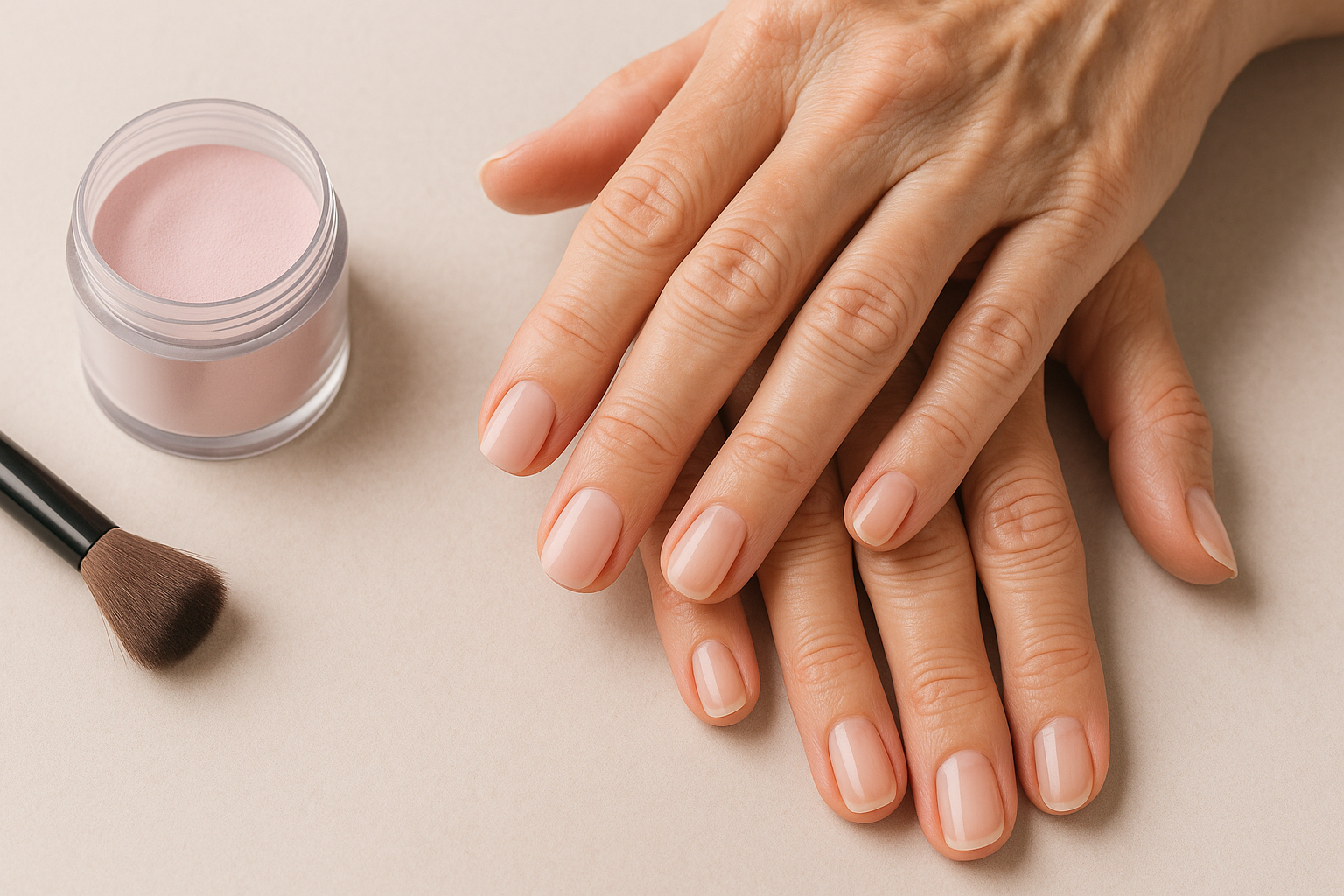
A dip manicure looks like polish but is built differently. The American Academy of Dermatology (AAD) describes a system where the base coat, the colour and the top coat all come as powders you dip into, with an adhesive holding the first layer in place. A case letter in Cutis (Sadowsky et al., 2023) puts the chemistry more precisely: a wet adhesive base coat, an acrylic powder, and an activator top coat that triggers the hardening reaction. The same letter calls acrylate “a known allergen” present in dip powders.
Cleveland Clinic dermatologist Amy Kassouf, MD, goes further and says dips tend to include methyl methacrylate, ethyl methacrylate and toluene. We could not confirm that from any product ingredient list, and it is the one claim in this article that two sources do not obviously reconcile: the FDA’s long-standing position is that liquid methyl methacrylate monomer should not be used in fingernail preparations, and the FDA’s own cosmetics Q&A page (content current as of February 2022) does not list MMA among prohibited or restricted ingredients. The practical takeaway is to ask your salon for the Safety Data Sheet of the system they use, rather than assume.
Dip vs gel vs acrylic: how the three actually differ
| Feature | Gel polish | Dip powder | Liquid-and-powder acrylic |
|---|---|---|---|
| What hardens it | A UV or LED lamp (AAFA, BAD) | An activator top coat (Cutis 2023) | Monomer liquid meets polymer powder (DermNet) |
| Shared-container risk | Low — brush from a bottle | Real if fingers go into a shared jar (AAD, Cleveland Clinic) | Low — technician works from a bowl |
| Main allergy route | Uncured gel on skin (BAD 2018) | Adhesives, per AAD; reaction can appear hours to days later | Liquid methacrylate esters, described by DermNet as strong sensitisers |
| Removal | Fingertip acetone soak, about 15 minutes (AAD gel guidance) | 100% acetone (AAD) | Soak-off or file-down by a technician |
| Prep that thins the plate | Light buff | Heavy buffing and filing so the adhesive grips (Cleveland Clinic) | Buffing and filing |
| Head-to-head damage data | None found in the sources we opened — the three are compared by mechanism, not outcome | ||
Read the table as a map of where each system can go wrong, not as a league table. The bottom row matters most: if a salon website tells you one of these is “healthier,” ask what it is based on.
Where dip-powder damage really comes from
1. Prep, not the powder
Kassouf notes that the filing and buffing needed to help the adhesive stick may weaken nails over time and make them more prone to breakage. A professional nail artist quoted by Byrdie (an editorial source, not a clinical one) advises never using files coarser than 180 grit.
2. Removal
The AAD is blunt that a dip manicure can be tough on nails: removal means 100% acetone, which it says peels off layers of nail, thins nails over time and can irritate the skin around them. Nail artists in the same Byrdie piece say soaking beats drilling or peeling, and one estimates that peeling damage takes four to five months to grow out. That fits normal growth: Cleveland Clinic gives fingernails about 3 mm a month and at least six months to regrow fully. For the acetone question in more depth, see our guide to whether acetone remover is really bad for your nails.
3. No recovery gap
The AAD’s advice is to wait one month after removing a dip manicure before getting another. The logic is simple: if the top layers of the plate were taken off with the powder, they stay gone until the nail grows out.
The allergy question nobody warns you about
The AAD says adhesives holding the powder are the main culprit for allergic reactions and that a reaction may show up hours to days after the manicure. The only dip-specific case we could open is the Cutis letter: a 58-year-old woman with an itchy, weeping fingertip rash and nail-fold inflammation after dip manicures roughly every two weeks for three to six months, on top of eight years of acrylic extensions. Her doctors diagnosed dyshidrotic-like contact dermatitis with paronychia; the rash had nearly cleared one month after she stopped. Importantly, the authors named acrylate as the likely culprit from the literature but did not report patch-test results, so the letter cannot tell you which ingredient was responsible.
Allergy to nail acrylates does not always stay on the fingers. DermNet notes that reactions more often appear on the eyelids, around the mouth and chin, and on the sides of the neck, and that polymerised (set) acrylates are relatively inert while the liquid monomers are strong irritants and allergens. Once you are sensitised, the UK dermatology audit led by Rolls and Buckley (reported by the British Association of Dermatologists in 2018) found 2.4% of 4,931 patch-tested patients reacted to at least one (meth)acrylate, with 60% sensitised through recreational exposure such as nail enhancements. The wider mechanism is covered in our post on why gel-nail allergy feels sudden.
The shared-jar problem: how worried should you be?
The AAD’s second tip is to skip the “double dip”: never put your fingers into a container someone else has already used, because anyone with a nail infection or wart before you may have left germs behind. Cleveland Clinic calls it a hygiene concern and suggests asking the technician to sprinkle powder over your nail instead. A biology professor interviewed by a California TV station (2020) believes bacteria, fungi and mould spores can survive in the powder for weeks — but she gave no infection figures, and the same report notes the state cosmetology board had received no complaints about dip powder. In short: the mechanism is plausible, the guidance is unanimous, and the actual rate of infection has not, as far as the sources we opened show, been measured. Because the fix costs nothing, treat it as a rule rather than a debate.
The 7-step dip-powder protocol
| Step | What to do | Why (source) |
|---|---|---|
| 1 | Test one nail first, wait 7 days, then do the rest | Delayed allergy can take hours to days (AAD) |
| 2 | Ask for sprinkled or single-use powder; never double dip | Shared jars (AAD, Cleveland Clinic) |
| 3 | Leave the cuticles alone | Cuticle cutting can lead to serious infection (AAD) |
| 4 | Ask for light prep and a fine file grit | Heavy buffing weakens the plate (Cleveland Clinic) |
| 5 | Keep adhesive and activator off the surrounding skin | Contact with skin is how sensitisation develops (BAD, DermNet) |
| 6 | Remove by soaking, not peeling or drilling; protect the skin around the nail | 100% acetone is harsh; peeling takes layers with it (AAD, Byrdie) |
| 7 | Look at your bare nails, then wait a month before the next set | Early warning and recovery time (AAD) |
When to stop and see a doctor
Stop having dip manicures and speak to a doctor or dermatologist if you get an itchy, weeping or blistering rash on the fingertips; swelling or redness around the nail that is getting worse; a rash on the eyelids, face or neck that appeared after a manicure; or a nail that lifts, changes colour or becomes painful. These are not signs a nail conditioner can address, and an infection or allergy needs proper diagnosis, often with patch testing.
Giving bare nails a break between sets
The recovery month the AAD recommends is the natural moment for a conditioning step. Provité Nail Elixir is a 100% lipid, water-free concentrate formulated by S. C. Aris to saturate between the keratin layers of the nail, designed to support the look of flexible, resilient-looking nails rather than hard, glassy ones. It is formaldehyde-free and combines 13 botanical lipids: hemp seed, grapeseed, sesame seed, jojoba, avocado, coconut, camellia tea, cucumber seed, lemon, carrot seed, lavender, geranium and vitamin E.
It has a 4.8/5 rating from 26 reviews and a 90-day guarantee. In a customer survey, 88% said their nails felt stronger and less brittle within four weeks (survey data, not a clinical trial). It contains aromatic botanicals (lavender, geranium and lemon), so it is not fragrance-free; patch-test on your forearm first. It is a cosmetic, not a treatment for allergy or infection — if you see any of the warning signs above, see a doctor first.
Frequently asked questions
Is dip powder worse for your nails than gel?
There is no head-to-head trial, so neither can be called worse in general. Dip tends to involve heavier prep and a harsher 100% acetone removal, while gel involves a lamp and uncured-gel skin contact. How the manicure is applied and removed matters more than the label.
Is dip powder safe to use every month?
The AAD suggests waiting a month after removal before the next dip manicure, and advises checking your bare nails between sets. If nails are splitting, thinning or breaking, take a longer break.
Can you be allergic to dip powder?
Yes. The AAD names the adhesives as the main culprit, and a Cutis case letter documents dermatitis and nail-fold inflammation after repeated dip manicures. Reactions can appear hours to days later and may show up on the eyelids or neck rather than the fingers.
Why does everyone say not to double dip?
Because a shared jar can carry germs from earlier customers, including from nail infections or warts. Asking for powder to be sprinkled onto your nail avoids the problem.
How long do nails take to recover after dip powder?
If layers of the plate were removed, they come back only as the nail grows. Cleveland Clinic gives fingernails about 3 mm of growth a month and at least six months to regrow completely.
Related reading
- Is acetone nail polish remover actually bad for your nails?
- Why am I suddenly allergic to gel nails?
- How do I know if my gel polish has TPO in it?
- Do nails really need to breathe? The truth about polish breaks
- Why do my nails go soft and bendy in water?
- Is “10-free” nail polish actually safer?
Sources
- American Academy of Dermatology, “Dip powder manicure: 5 tips to keep your nails healthy” (last updated 20 July 2021).
- Kassouf A, Cleveland Clinic Health Essentials, “Understanding the Pros and Cons of Dip Powder, Gel and Acrylic Nails” (11 December 2023).
- Sadowsky LM, Brown ME, McDonald HH, Kraus EW, “Dyshidroticlike Contact Dermatitis and Paronychia Resulting From a Dip Powder Manicure,” Cutis 2023;111(6):E10–E11.
- Ngan V, DermNet, “Nail cosmetics allergy” and “Allergy to acrylates.”
- U.S. Food and Drug Administration, “Cosmetics Safety Q&A: Prohibited Ingredients” (content current as of 25 February 2022).
- British Association of Dermatologists, “Dermatologists issue warning about UK artificial nail allergy epidemic” (9 August 2018; Rolls S, Buckley DA et al. audit).
- Asthma and Allergy Foundation of America, “Am I Allergic to Gel Nails or Nail Polish?” (Greenhawt M).
- American Academy of Dermatology, “Gel manicures: Tips for healthy nails” (aad.org).
- Cleveland Clinic, “Nails: Fingernail & Toenail Anatomy” (updated 17 September 2025).
- Balagam I, Byrdie, “How to Strengthen and Rebuild Your Nails After a Dip Manicure” (nail-artist opinion, not clinical evidence).
- KABC/ABC30 Fresno, “Nail technicians, expert warn against dip powder nails” (17 January 2020; Dr Valerie Albano, Merced College).
This article is for general information and is not medical advice. If you have a rash, swelling, pain or a changing nail, see a doctor or dermatologist.