Does Hand Sanitizer Damage Your Nails? Why “It Strips the Oils” Is the Wrong Explanation — and the After-It-Dries Rule
Last updated: 14 September 2026
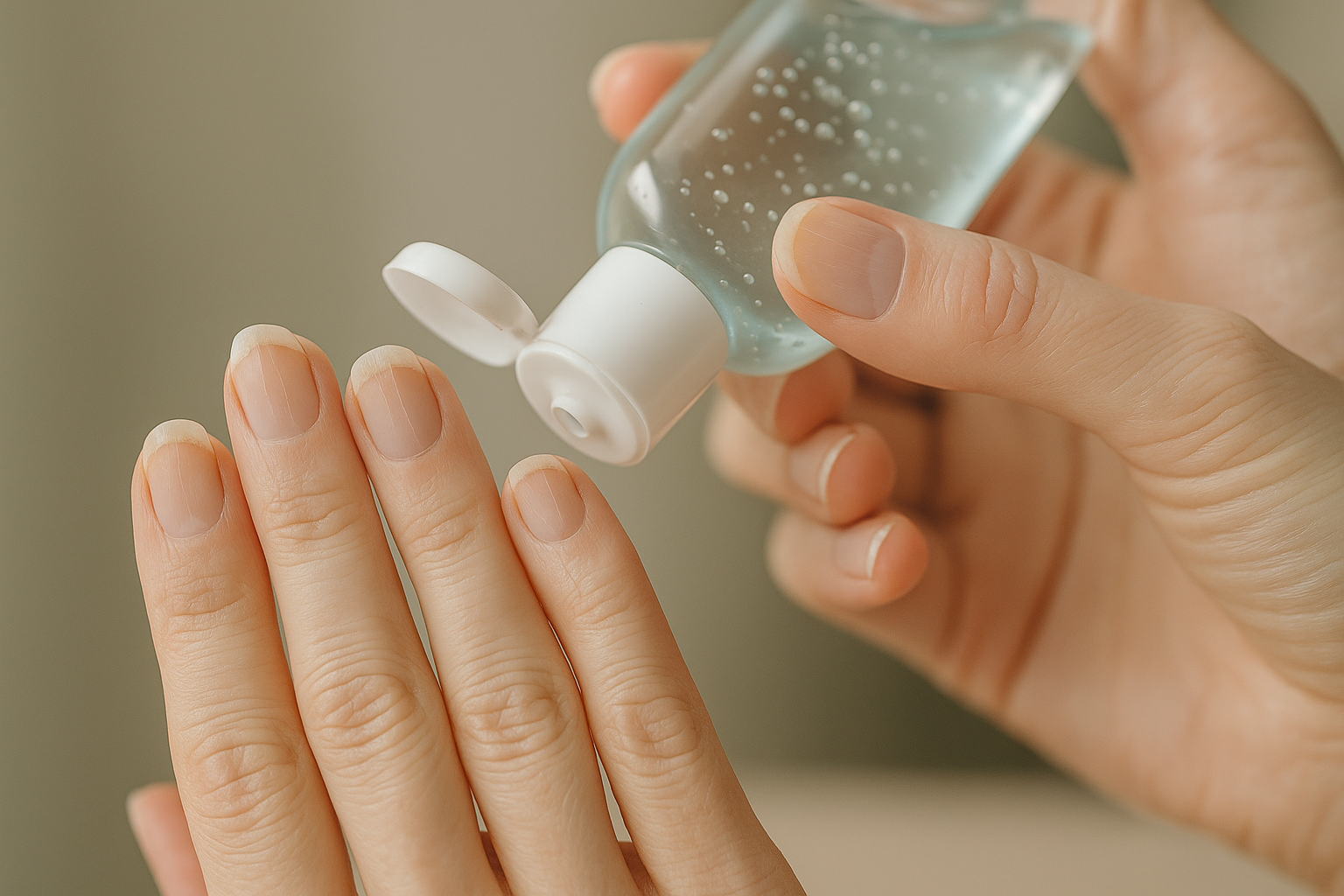
It starts in cold-and-flu season, a new job with a dispenser at every door, or a hospital stay: a few weeks of sanitising ten, twenty, thirty times a day, and then your fingernails begin to chip at the corners, peel into papery layers at the tip and catch on everything. Search the question and you'll find a wall of salon blogs telling you sanitizer “strips the natural oils” from your nails. That explanation is wrong, and because it's wrong it leads people to the wrong fix. This article explains what sanitizer actually does to a nail plate, what the dermatology authorities recommend instead, how to tell whether sanitizer really is your culprit, and the one-step habit that lets you keep sanitising without sacrificing your nails.
Does hand sanitizer really damage nails? What dermatologists say
The link is not new, and it is not a marketing invention. As far back as October 2009, Dermatology Times quoted clinical dermatologist and researcher Zoe Draelos, MD, on the rise of waterless sanitizers in its report “Cracking up: Waterless hand sanitizers, fragrances weaken nails”: “these waterless hand sanitizers dry out the nails. … They are the biggest cause of increased brittle nails.” Dr Draelos described what physicians see — nails that are “broken, with fissures at the tips” — and warned that a fractured plate can “tear into the nail bed,” opening a site for bacterial and fungal infection.
More than fifteen years on, mainstream medical guidance says the same. The Cleveland Clinic's guide to brittle nails (reviewed by dermatologist Rosemary Keskinen, MD) puts handwashing at the top of its list of causes: nails “lose water faster than skin does. The constant washing and sanitizing can cause nails to dry out and become brittle.” The American Academy of Dermatology's handwashing and dry-skin guidance (updated December 2024) is blunter still: “Hand sanitizer can be very drying.”
So the short answer is yes. The useful answer is why — because the why decides what you do about it.
Why “it strips the oils” is the wrong explanation
Almost every consumer article on this question says sanitizer damages nails by dissolving their “natural oils.” The measured composition of the nail plate doesn't support that. In their 2017 review of nail structure in the journal Mycoses, Baswan and colleagues report that the nail plate contains just 0.1–1% lipids (against roughly 10% in the skin's outer layer) and 7–12% water. More tellingly, the review notes that the uptake and loss of water through the nail is not affected by extracting its lipids — the lipid pathway plays an insignificant role in how water moves across the plate. There is almost no “oil” to strip, and stripping it wouldn't change the nail's hydration anyway.
What does govern a nail's behaviour is its water. The same review states that the nail's effective elastic modulus — its stiffness, and by extension its willingness to bend rather than snap — is directly related to its hydration level. Dr Draelos explained it in plain terms in the Dermatology Times piece: “When you flick the edge of the nail and it doesn't crack, that's the water in the nail. The water allows it to deform in a plastic fashion as opposed to a brittle fashion.”
Now look at what a squirt of sanitizer is. The CDC's hand sanitizer guidelines tell you to cover all surfaces of the hands and “rub your hands and fingers together until they are dry. This should take around 20 seconds.” In other words, every use is a complete wet-then-dry cycle compressed into twenty seconds, with a volatile alcohol as the wetting agent. Dr Draelos named the consequence directly: “The repeated wetting and drying of the nails can result in nail plate dehydration and brittleness.” The plate starts drier than skin, loses water faster than skin, and is being cycled dozens of times a day. That is the damage pathway — not a missing film of oil.
This matters practically. If the problem were “lost oils,” any greasy product would fix it. Because the problem is a dehydrated, repeatedly-cycled keratin plate, the fix is about timing (condition after each cycle, not once a day), about what you put on (nothing that adds another drying alcohol), and about reducing the number of cycles the free edge has to survive before it grows out.
Why fingernails, not toenails — and why it gets worse with age
Two patterns from the sources help you recognise sanitizer damage. First, it is almost entirely a fingernail problem. Dr Draelos noted that toenails are “less likely to be affected, because they are thicker and not as exposed to solvents, trauma and products that dehydrate.” If your toenails are fine and your fingernails are splitting, an external, hand-specific cause is likely.
Second, the same habit does more harm the older you are. Dr Keskinen explains why in the Cleveland Clinic guide: “Our nails grow slower as we get older. Since it takes longer to grow out, the nail has more exposure to dry air, water and sanitizers.” A fingernail grows at roughly 3 mm a month according to the StatPearls chapter on nail histology, and nail cells don't shed and renew in place the way skin does — whatever damage a section of plate accumulates, it carries until it is cut off. Slower growth means every millimetre of nail survives more sanitizer cycles before it reaches the free edge. Length compounds it: both Dr Draelos and the Cleveland Clinic note that longer nails split and crack more, simply because older keratin has had more exposure.
Is it the sanitizer? Five clues from the sources
None of this is a diagnosis — several medical conditions cause brittle nails, and they're covered below. But if most of these apply, the everyday explanation is the likely one:
- Fingernails, not toenails. Sanitizer damage is hand-specific (Draelos, Dermatology Times).
- Splitting and peeling at the free edge. The classic pattern is fissures at the tips and layered, papery peeling. DermNet's nail terminology reference defines this lamellar splitting, onychoschizia, as brittle nails “due to water/detergent damage.”
- The timing fits. The change began or worsened during a period of heavy sanitising — cold-and-flu season, a new workplace, a hospital stay, a new baby.
- The skin on your hands is dry too. The AAD's handwashing page describes the same product leaving skin that can “flake, itch, crack, and even bleed.” Dry hands and dry nails from the same cause usually arrive together.
- The flick test. Dr Draelos's own bedside check: flick the free edge. A hydrated nail flexes; a dehydrated one cracks or splinters.
If your nails are instead thickening, yellowing, developing grooves, pulling away from the nail bed, or the skin folds are red, swollen or sore, skip to the “when it isn't the sanitizer” section — those are the Cleveland Clinic's see-a-doctor signs.
Should you stop using hand sanitizer? No — here's why
This is where most nail articles get the balance wrong. Hand hygiene protects you from illness, and both the CDC and the FDA are clear about the tool: when soap and water aren't available, use a sanitizer with at least 60% alcohol. The FDA's consumer guidance on safely using hand sanitizer adds a detail few people know: hand sanitizers are regulated as over-the-counter drugs, which is why the bottle carries a Drug Facts label naming the active ingredient (ethyl alcohol or isopropyl alcohol) and why the FDA maintains a list of sanitizers consumers should not use. Read the label; don't try to “go easy” by rubbing it off early. The CDC's instruction is explicit: “Don't rinse or wipe off the hand sanitizer before it's dry; it may not work well against germs.”
The AAD also dismantles a myth that would otherwise tempt you to cut back: “There is no evidence that using hand sanitizer makes it easier to pick up germs. It's dry skin that increases your risk of picking up germs. Dry, cracked skin makes it easier for bacteria and other germs to get inside your body.” The lesson isn't “sanitise less”; it is “sanitise properly, then repair the dryness every time.”
Sanitizer vs soap and water: what each does to your nails
The two are not interchangeable for germs, and they are not identical for nails either. The comparison below draws only on the CDC, FDA, AAD and Cleveland Clinic guidance cited in this article.
| Alcohol hand sanitizer (≥60%) | Soap and water | |
|---|---|---|
| How it works on germs | Acts on certain germs left on the skin rather than removing them; doesn't get rid of all types (CDC) | Removes all types of germs from hands; the CDC's first choice “in most situations” |
| When it's the wrong tool | Visibly dirty or greasy hands; norovirus, Cryptosporidium, C. difficile, chemicals (CDC) | When no sink is available |
| Correct technique | Cover all surfaces, rub until dry (~20 s), never wipe or rinse early (CDC, FDA) | At least 20 seconds, lukewarm water, including between fingers and around nails (AAD, FDA) |
| What it does to nails | A 20-second wet-dry cycle with a volatile alcohol; “very drying” (AAD); dries and dehydrates the plate (Draelos) | A longer soak with detergent; repeated water exposure splits and peels nails (AAD, DermNet) |
| The after-step | Wait until fully dry, then immediately apply cream or ointment into fingertips and nails (AAD) | Pat dry leaving skin slightly damp, then apply cream or ointment into fingertips and nails (AAD) |
| Which is “worse” for nails? | The authorities don't rank them — the Cleveland Clinic names “washing and sanitizing” together. What decides the damage is the number of unrepaired cycles, not which one you choose. | |
The practical takeaway: choose the tool the CDC says the situation calls for, and treat the after-step as part of the hygiene, not an optional extra. We cover the water-and-soap side of the cycle in detail in why do my nails go soft and bendy in water? — this article is about the alcohol side.
The after-it-dries rule: the step-by-step routine
Every authority cited here converges on one instruction, stated most precisely by the AAD: “After your hand sanitizer dries immediately apply hand cream or ointment.” Here is that rule expanded into a routine you can actually keep up thirty times a day.
- Sanitise properly. Enough product to cover all surfaces, rub for about 20 seconds until dry, no wiping (CDC). Shortcutting the drying step doesn't spare your nails and does compromise how well the sanitizer works.
- Wait for “fully dry.” The AAD's rule is after it dries. Applying a conditioner over wet sanitizer just dilutes both.
- Condition, and reach the nails. The AAD specifies working moisturiser “into your fingertips and nails” — not just the backs of the hands. The Cleveland Clinic's version: “During the day, moisturize in between exposure to water or hand sanitizer.” For the nail itself, the clinic suggests a nail conditioner a few times a day and adds the one rule that most products break: “Avoid nail conditioners that contain alcohol, because that will further dry out your nails.” A water-free, alcohol-free lipid conditioner suits this slot because it adds nothing that evaporates; a thick, fragrance-free cream or ointment (the AAD's preference for chapped skin: petrolatum or mineral-oil based, from a tube rather than a pump) suits the surrounding skin.
- Bedtime is the heavy step. Cleveland Clinic: heavy hand cream at bedtime. Dr Draelos recommended bedtime creams containing urea or lactic acid, which open binding sites on nail keratin so water can attach and “temporarily rehydrate the nail plate” — with her caveat that too much urea can digest enough keratin to make the nail soft. Keep such products to the nail and follow the label.
- Cut the cycle count where you can. Cotton-lined rubber gloves for washing up and cleaning (Mayo Clinic), an acetone-free polish remover, and no fragranced lotion reapplied hourly — Dr Draelos flagged heavily fragranced lotions from body-lotion stores and aromatherapy spas as the other common culprit, precisely because they are another repeated wet-dry event.
- Shorten and protect the edge while it recovers. “If your nails are breaking, clip or file them so they're temporarily shorter,” advises Dr Keskinen. The AAD's trimming guide adds to moisturise after trimming because “dry nails split more easily.” Skip formaldehyde hardeners: the FDA notes that using them often may make nails more likely to break or peel (see why did my nail strengthener make my nails worse?).
What a conditioner can and can't do here
An honest note, because this is where marketing usually overreaches. The FDA states plainly that “the nail is a barrier, which prevents absorption,” and the Mycoses review shows lipids don't govern water movement through the plate. So a nail conditioner does not “replace lost oils” or “lock water into” the nail. What it can realistically do is sit on the plate, the free edge and the cuticle seal as a surface film that slows evaporative water loss between cycles — the same occlusive, surface-level behaviour plant lipids show on skin in the 2018 International Journal of Molecular Sciences review by Lin and colleagues — and keep the surrounding skin from cracking. That is a useful thing to do thirty times a day. It is a maintenance step, not a fix for an underlying condition, and any product that adds alcohol or water to do it is working against you.
How long until nails recover?
Because nail cells don't repair in place, the split, dehydrated section of plate has to grow out and be trimmed off. At the StatPearls figure of roughly 3 mm a month, a fingernail free edge that has been cycled for a season takes a matter of months, not days, to be fully replaced by plate that grew under the new routine — a timeline that is simple arithmetic on the growth rate, not a measured recovery study. The Cleveland Clinic gives a similar window for the one supplement it mentions: a daily biotin supplement of about 5,000 micrograms, for which “you'll have to wait about six to eight weeks for the entire nail bed to grow out.” What you should notice sooner is the new growth near the cuticle looking smoother and the peeling stopping at the edge you keep trimmed. And Dr Keskinen's myth-busting applies to the impatient: “you can't drink your way to more supple nails,” and gelatin doesn't work either.
When it isn't the sanitizer
Brittleness that doesn't fit the five clues above deserves a proper look. The Cleveland Clinic advises a doctor's visit for grooving or separation of the nail plate and for redness, swelling or soreness of the skin folds around the nail, and lists fungal infection (thickening, yellowing), nutritional deficiency (protein, iron, B vitamins), psoriasis, thyroid disorders and Raynaud's as medical causes of fragile nails. Dr Draelos's warning about a plate fracture tearing into the nail bed is the reason not to ignore a deep split: that is a wound, and wounds at the nail get infected. Chemotherapy is a further cause the Cleveland Clinic names; if that is you, ask your oncology team rather than a nail blog.
📋 Please note: The section below describes a daily-care cosmetic product. It supports the appearance and condition of nails and cuticles; it is not medical advice and is not intended to diagnose, treat or prevent any condition. Nails that thicken, discolour, groove or hurt should be checked by a doctor.
Where Provité Nail Elixir fits the after-it-dries rule
The after-step has one requirement that rules out most of what's on the shelf: it must not add another thing that evaporates. The Cleveland Clinic warns off alcohol-containing nail conditioners, and a water-based lotion is a brief wetting followed by another drying. Provité Nail Elixir was formulated by S. C. Aris for exactly this slot: a 100% lipid, water-free, formaldehyde-free concentrate for nails and cuticles. Being entirely lipid, it carries no water and no alcohol base — nothing in the drop dries the plate on its way out — and no formaldehyde to cross-link keratin into the rigid, glass-like state that snaps under load. The design goal is what this article's physics points to: the look and feel of “flexible-strength” nails that bend and recover rather than nails that are merely hard.
Thirteen botanical lipids make up the blend: hemp seed, grapeseed and sesame seed for resilience; jojoba, avocado and coconut for suppleness at the free edge; camellia tea, cucumber seed, lemon and carrot seed for a clean, glassy finish; and lavender, geranium and vitamin E to complete the set. A single drop massaged into each nail and cuticle once the sanitizer has fully dried leaves a lightweight lipid film across the plate, the free edge and the cuticle seal — the three surfaces where the wet-dry cycle does its damage. It works on bare nails and under gel or acrylic, and in a pocket or a desk drawer it is the conditioner you will actually reach for between squirts. In a customer survey, 88% reported nails that looked stronger and less brittle within four weeks and 94% said they would recommend it. It is rated 4.73/5 from 15 verified buyers and comes with a 90-day money-back guarantee.
One disclosure, in keeping with the honesty above: Provité contains aromatic botanicals (lavender, geranium, lemon), so it is not a fragrance-free product. If your hands are already cracked or you react to fragranced products, patch-test a drop on the inner forearm for a few days before using it on broken skin around the nail — and use a plain fragrance-free ointment on the skin itself, as the AAD suggests, with the elixir reserved for the nail plate and cuticle.
| Water-based hand lotion | Alcohol-containing nail conditioner | Provité (100% lipid) | |
|---|---|---|---|
| Adds another wet-dry cycle? | Yes — water that then evaporates | Yes — alcohol dries the plate further (Cleveland Clinic) | No — anhydrous, nothing to evaporate |
| Reaches the nail plate and cuticle seal? | Only if you work it in deliberately (AAD) | Yes | Yes — one drop per nail |
| Formaldehyde? | No | Sometimes — check the label | No |
| Works under gel/acrylic? | Cuticle only | Cuticle only | Yes |
| Best used for | The skin of the hands (choose thick, fragrance-free) | — (avoid per Cleveland Clinic) | The nail plate, free edge and cuticle after each sanitizer use |
Frequently Asked Questions
Does hand sanitizer make your nails brittle?
Yes. Dermatologists have linked waterless alcohol sanitizers to brittle, splitting fingernails since 2009, and the Cleveland Clinic lists constant washing and sanitizing as a leading cause. Each use is a rapid wet-then-dry cycle that dehydrates the nail plate, whose flexibility depends on its water content.
Does hand sanitizer strip the natural oils from your nails?
Not in any way that matters. The nail plate contains only about 0.1–1% lipid, and research on nail structure shows that removing those lipids doesn't change how water moves through the nail. The damage is dehydration of the keratin, not loss of oil — which is why the fix is conditioning after every use, not a one-off greasy treatment.
Is hand sanitizer or hand washing worse for your nails?
The authorities don't rank them; the Cleveland Clinic names washing and sanitizing together as causes of brittleness. Sanitizer is a short, alcohol-based wet-dry cycle; washing is a longer soak with detergent. The number of unrepaired cycles matters more than which you use. Use whichever the CDC recommends for the situation, then moisturise afterwards every time.
Should I stop using hand sanitizer to save my nails?
No. The CDC and FDA still recommend a sanitizer with at least 60% alcohol when soap and water aren't available, and the AAD notes there is no evidence sanitizer makes you more likely to pick up germs — dry, cracked skin does. Sanitise properly, let it dry fully, then apply a moisturiser worked into your fingertips and nails.
What should I put on my nails after hand sanitizer?
The AAD says to apply hand cream or ointment immediately after the sanitizer dries, working it into fingertips and nails. The Cleveland Clinic recommends moisturising between exposures, a nail conditioner a few times a day, and avoiding any conditioner that contains alcohol. A water-free, alcohol-free lipid conditioner for the nail plus a thick fragrance-free cream for the skin covers both.
How long does it take nails to recover from hand sanitizer damage?
The damaged section has to grow out, at roughly 3 mm a month for fingernails, so full replacement of a split free edge takes months. New growth near the cuticle should look smoother sooner, and keeping the damaged edge trimmed short stops the peeling from spreading.
Why are my fingernails brittle but my toenails fine?
Toenails are thicker and far less exposed to solvents, sanitizers and trauma, so brittleness confined to the fingernails points to an external hand-specific cause such as sanitizer, frequent washing or nail cosmetics rather than a whole-body one.