Can You Be Allergic to Your Toothpaste? How to Tell Allergy From Irritation — and the 2-Week Swap Test
Last updated: 12 September 2026
First, the Distinction That Changes Everything: Allergy vs Irritation
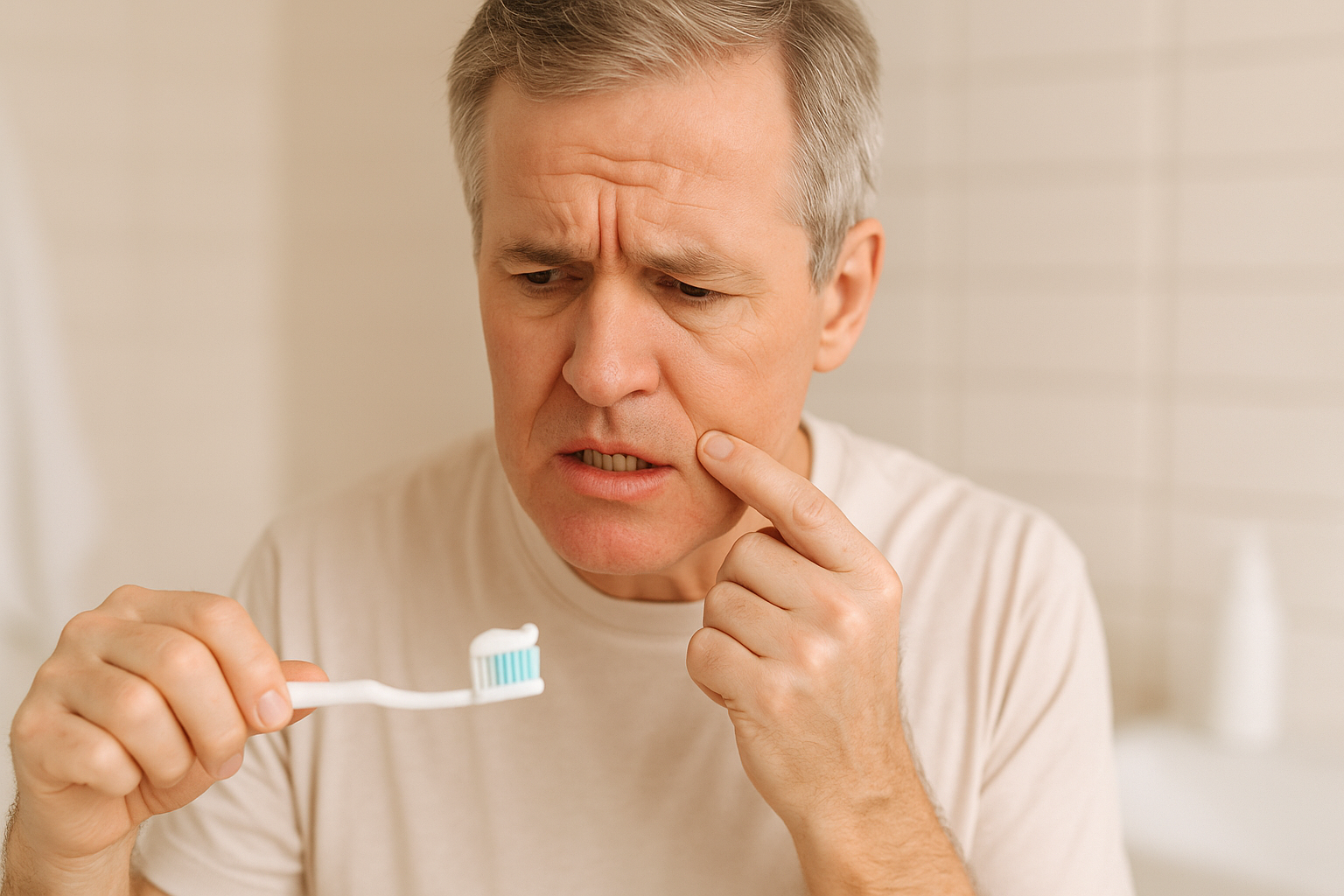
Two people can describe the same complaint — "my toothpaste is making my mouth sore" — and have completely different problems. Sorting out which one you have is the single most useful thing you can do, because the two respond to different fixes.
Irritation is a chemical insult. It needs no prior exposure, anyone can get it if the dose is high enough, and it is dose-dependent — use less, react less. DermNet describes irritant contact dermatitis as "an inflammatory response of the skin to (an) externally applied agent(s) or factor(s) without requiring prior sensitisation, i.e., it is not due to allergy." Irritant contact dermatitis accounts for roughly 80 percent of all contact dermatitis, and its timing is telling: with a strong irritant "a reaction may occur within minutes or hours of exposure," while weaker irritants may take "days or weeks of continued exposure before symptoms appear."
Allergy is an immune reaction. It is a type IV (delayed) hypersensitivity reaction, "which typically occurs 24–72 hours after exposure to an allergen" — and it has three properties that catch people out. You can be exposed for years before you become sensitised: patients "may have been in contact with the allergen for years before becoming sensitised, without it causing dermatitis." Once sensitised, dose barely matters — "contact with tiny quantities of an allergen can induce dermatitis." And sensitisation "is usually life long."
That last point explains the most common piece of confusion we hear: "I've used this toothpaste for a decade, so it can't be the toothpaste." Unfortunately it can. Years of uneventful use is entirely compatible with a new allergy.
There is also a third, quieter category worth knowing about. DermNet's sensitive skin page describes subjective or sensorineural irritation — "sensory discomfort such as itching, stinging, tingling or burning, but in the absence of any clinical or histological evidence of inflammation." Nothing to see, plenty to feel. It is generally of acute onset, and the threshold varies enormously between individuals. If your mouth burns for twenty minutes after brushing and then looks and feels completely normal, this is the likeliest explanation — and it is not an allergy. (We break the same taxonomy down for skincare in why does my serum sting?)
How Common Is a Toothpaste Allergy, Really?
Less common than the internet implies — but not vanishingly rare, and with one genuinely surprising detail.
DermNet's review of contact reactions to oral hygiene products notes that allergic reactions to these ingredients are "rare, probably due to the rinsing after use," and that such reactions are "fortunately rare considering how commonly and frequently these products are used." Roughly 30 potential allergens have been identified in toothpastes, and they are present in most products on the shelf.
The surprising detail: toothpaste is the second most common cause of contact cheilitis — inflamed lips — after lipstick, and it is the most common cause in men. Women present more often overall, which DermNet suggests may be because they become sensitised first through other fragranced products. If you are a man with stubbornly sore, scaly lips and no lipstick in your life, your toothpaste has statistically earned a look.
Which Ingredients Actually Cause It? The 80-Toothpaste Audit
Here is the piece almost every article on this subject leaves out: someone counted. In the Journal of Clinical and Aesthetic Dermatology, Sarah Otto, CNP, and Matthew J. Zirwas, MD — then of The Ohio State University's Contact and Occupational Dermatitis Center — worked through a published database of every toothpaste stocked at Walgreens pharmacies, tagged against the North American Contact Dermatitis Group screening panel, and tallied how often each known allergen appeared.
| Potential allergen | What it's doing in there | Present in |
|---|---|---|
| Flavouring (unspecified) | Taste and breath freshening; masks the bitterness of tartar-control salts | 76 of 80 |
| Cocamidopropyl betaine (CAPB) | Surfactant — the lathering agent used in place of SLS | 16 of 80 |
| Propylene glycol | Solvent and vehicle for hard-to-mix ingredients | 8 of 80 |
| Essential oils & biological additives | Flavour and marketing appeal (all also contained flavouring) | 5 of 80 |
| Parabens | Preservative | 5 of 80 |
| Peppermint (named specifically) | Flavouring | 4 of 80 |
| Spearmint (named specifically) | Flavouring | 2 of 80 |
| Vitamin E (tocopherol) | Antioxidant | 2 of 80 |
| Tea tree oil · propolis · grape extract | Botanical additives and alternative flavouring | 1 each |
Two honest caveats on this table, because they matter. First, the database is a snapshot of one US pharmacy chain's shelf at the time of the audit — the paper's references were accessed in late 2009 — so treat the proportions as a shape, not a current inventory. Second, the paper's own results and discussion sections give slightly different rankings for essential oils and parabens; we have reported the counts from the results section rather than smoothing over the inconsistency.
The shape, though, is unambiguous. Flavouring was present in 95 percent of the products. Only four of the eighty contained no flavouring of any kind. That is why the flavour is the first thing a contact dermatitis clinic looks at — and why swapping fluoride brands or buying a "natural" paste so often changes nothing.
The flavour molecules that do the damage
DermNet lists the most frequently implicated as mint-plant derivatives — spearmint, peppermint, menthol and carvone — followed by cinnamal (from cinnamon) and anethole (from star anise, fennel and anise). Otto and Zirwas name the same short list. Beyond flavouring, DermNet's reported toothpaste allergens include propolis, hexylresorcinol, azulene, dipentene, cocamidopropyl betaine, parabens, propylene glycol and fluoride salts.
One consequence people rarely anticipate: flavour allergy overlaps heavily with food. The same molecules appear in chewing gum, sweets, ice cream, soft drinks and mouthwash — which is part of how the sensitisation builds in the first place, and why a mouth that settles when you change toothpaste may flare again on a mint tea. Mayo Clinic also flags Balsam of Peru as a common allergen "used in many products, such as perfumes, toothpastes, mouth rinses and flavorings."
The Four Reaction Patterns — and What Each One Points To
Reactions to oral hygiene products don't all look alike. DermNet distinguishes four, and knowing which one you are looking at narrows the suspect list considerably.
| Pattern | What you see and feel | Where | Typical timing |
|---|---|---|---|
| Allergic contact cheilitis (the most common) | Eczema-like lips: dryness, itch, pain, scaling, sometimes blistering | Usually both lips | Delayed — building over 24–72 hours after exposure |
| Contact stomatitis | Burning pain; redness with swelling and peeling | Generalised inside the mouth — gums, tongue, inner cheeks | Acute or chronic |
| Perioral eczema / leukoderma | Eczema spreading onto the skin around the mouth; occasionally whitening of that skin (reported with cinnamic aldehyde) | Beyond the lip border | Delayed |
| Contact urticaria | Immediate lip swelling | Lips | Minutes to an hour — a different, type I mechanism |
| (Not allergy) Irritant reaction | Tightness, soreness, stinging; peeling of the perioral skin; possibly more frequent mouth ulcers | Wherever contact is heaviest | Minutes to hours for strong irritants; days to weeks for weak ones |
Two details from this list are worth pulling out. Contact stomatitis is less common than cheilitis, which is counterintuitive given the product spends its time inside your mouth rather than on your lips — the rinsing and the constant wash of saliva appear to be protective. And contact urticaria can be deceptive: DermNet notes that repeated exposure to a low concentration of the allergen can produce eczema-like cheilitis even though the underlying mechanism is the immediate type I one, with one reported case where a mint-flavoured cleaner at the dentist then triggered immediate lip swelling.
Otto and Zirwas add two clinical clues from their own practice that raise the odds a contact allergen is behind stubborn cheilitis: an asymmetrical presentation, with one side persistently worse than the other, and an obscured vermillion border — meaning the eruption has spread past the lip edge onto the skin. Their published case, an 81-year-old man with seven months of itchy, painful, right-sided cheilitis, showed both; patch testing returned reactions to fragrance mix 1, cinnamic alcohol and his own mint toothpaste, and at four weeks after switching products the rash had almost completely resolved.
The Detergent Question: SLS, "SLS-Free", and What Actually Changed
Detergents deserve their own paragraph, because the popular story about them is half right.
Sodium lauryl sulphate (SLS) is the classic foaming agent. DermNet is measured about it: as a detergent it "can cause irritant contact dermatitis, especially of the perioral skin," and "several studies suggest SLS may increase the frequency of attacks of aphthous ulcers in those prone to getting them, although one study failed to show any improvement after changing to a toothpaste not containing SLS." That is a real signal with an honest asterisk on it — the picture we set out in what causes canker sores and the role of SLS. Note the framing, though: SLS is primarily an irritant, not a classic allergen.
Here is the twist. When manufacturers moved away from SLS, the most common replacement was cocamidopropyl betaine — a coconut-derived surfactant chosen precisely because it is milder. And because CAPB use expanded so widely, reports of sensitisation to it rose with it. The catch is that CAPB is blended during manufacturing with dimethylaminopropylamine (DMAPA) and amidoamine (AA), and several studies suggest those residual companions, rather than CAPB itself, may be the real sensitisers — enough of an open question that the North American Contact Dermatitis Group now routinely tests patients with both CAPB and amidoamine. DermNet reports a 6 percent diagnosis rate in an Australian population of people suspected of having allergic contact dermatitis, more often in women, and notes that CAPB in a "2-in-1 toothpaste-mouthwash" has been reported to cause allergic cheilitis. We go deeper on the ingredient itself in is cocamidopropyl betaine in toothpaste safe?
So "SLS-free" is a genuine improvement for people whose problem is irritation — and no guarantee at all for people whose problem is allergy. It swaps one surfactant for another.
How Clinicians Actually Diagnose It (and Why the Standard Test Often Misses)
If you end up in a contact dermatitis clinic, three things about the process are worth knowing in advance, because they explain a lot of frustrating near-misses.
The standard patch test panel is often not enough. DermNet is blunt: baseline standard series "are often not helpful in diagnosing contact allergy to dental hygiene products as the common allergens present in these products are not included." An extended toothpaste series plus your own products has to be added. If you have already been patch tested and told you're clear, that may be why — ask specifically whether a toothpaste series was run.
Testing the paste "as is" cuts both ways. There is long-standing debate against applying neat toothpaste to a patch, because the detergents and abrasives produce irritant reactions that read as false positives. Dilute it, and you risk a false negative if the allergen is present at low concentration. Neither approach is clean, which is why some clinicians confirm with a start-restart test or a repeated open application test. Helpfully, toothpaste companies usually cooperate with dermatologists and disclose further formulation detail so the specific allergen can be pinned down.
Timing of the reading matters. The FDA describes standard patch testing as placing the allergen on the skin under cover for 48 hours, with the skin inspected at 72 to 96 hours — two to three office visits. CAPB specifically is tested as a 1.0 percent aqueous solution, read at 48 and 96 hours.
And one warning about DIY. The repeated open application test — applying a product to a 5 cm square of forearm twice daily for a week — is a legitimate patient-performed test for leave-on products, but DermNet's protocol for it explicitly says products known to cause irritant contact dermatitis, such as detergents, should not be tested this way, and that results are "falsely negative if the substance is applied to skin that is thicker than the skin it is intended for." Your forearm is not your lip. A negative forearm test on toothpaste tells you very little.
The 2-Week Swap Test: A Protocol You Can Run at Home
You don't need a clinic to make real progress, and DermNet names the decisive move plainly: "The ultimate test is ceasing the suspected product and noting the improvement over several weeks." Here is how to run that properly rather than by flailing.
- Write down your baseline. Before changing anything, note exactly what you have, where, and when it is worst — and photograph your lips in the same light. Two weeks from now your memory will be an unreliable witness. Note also whether the pattern is symmetrical, and whether it stops at the lip border or spreads past it.
- Change one thing. One variable, one swap. If you change paste and mouthwash and floss in the same week you will learn nothing. Start with the toothpaste, because it is the highest-probability suspect.
- Swap the flavour first, not the brand. Given that flavouring is by far the most common trigger, the highest-yield move is a genuinely flavour-free paste, or one flavoured with something outside the mint-and-cinnamon family. The Otto and Zirwas audit found only four of eighty products with no flavouring at all — but another four used alternative flavours such as grape, strawberry, orange-mango and apricot, which is enough to work with if your allergy is specifically to mint or cinnamon.
- Hold it for two to four weeks. This is where most people give up too early. Mayo Clinic's figure for contact dermatitis is that the rash "often clears up in 2 to 4 weeks" once you avoid the trigger; DermNet's guidance for oral hygiene reactions is that it "should resolve within a few weeks." Judging at day four is judging nothing.
- Drop the collateral irritants while you wait. Stop licking, stop picking at flakes, ease off strong mouthwashes, and keep a bland balm on the lip border. You are trying to read one signal; don't add noise.
- If it clears, confirm it. The start-restart approach is the confirmation step clinicians use: reintroduce the original product and see whether the problem returns. If it does, you have your answer without a single needle. If you would rather not provoke it deliberately — a completely reasonable choice — just stay switched.
- If two clean swaps change nothing, stop swapping. At that point the answer is probably not on your bathroom shelf, or it needs a proper extended patch test. Go and get one.
A note on labels while you shop: the words on the front are less help than you would hope. The FDA states plainly that "it isn't enough to check for terms like 'hypoallergenic', 'fragrance-free' or 'for sensitive skin,' as there is no federal standard or definition that governs the use of these terms in the U.S." On "hypoallergenic" specifically the agency is blunter still: "The term means whatever a particular company wants it to mean." Read the ingredient list, not the claim. The same principle we apply to "parfum" on a skincare label applies letter for letter in the toothpaste aisle.
When to Stop Experimenting and See Someone
Self-testing is appropriate for a mild, stable, low-grade problem. It stops being appropriate when any of the following apply. Mayo Clinic advises seeing a doctor when a rash is severe or widespread, when it is too uncomfortable to sleep or function, when it doesn't improve within three weeks, or when it involves the eyes, mouth, face or genitals — and to seek care immediately if you think the skin is infected, with fever or pus as clues. Add to that: bleeding or deeply fissured lips, white patches inside the mouth that don't wipe away, a sore that hasn't healed in two weeks, or any sudden swelling of the lips or tongue, which needs urgent attention rather than a product swap.
If the picture is more about bleeding, tender or receding gums than about the lips, that is a different conversation — start with why do my gums bleed? and see a dentist.
Where Dental Pro 7 Fits — and Where It Doesn't
If your swap test points at a detergent rather than a flavour, the logical next step is a product built without one. Dental Pro 7 is a 100% water-free botanical lipid concentrate designed by formulator S. C. Aris to be used in place of toothpaste: four drops on a dry toothbrush, brush gently for about two minutes, then spit — do not rinse with water, because rinsing washes the lipid layer straight off the gum line.
That no-water design is the whole point. Water-based gels and rinses thin out and wash away within minutes; the Lipid-Lock system holds the botanicals in contact with the gum line for hours instead, which is how the formula supports the appearance of firmer, pinker, healthier-looking gums and fresher breath. It also means the formula needs no preservative system at all. Dental Pro 7 contains no SLS or foaming agents of any kind, no preservatives or parabens, no fluoride, no alcohol, no water and no fillers — which takes two of the suspects in the table above, cocamidopropyl betaine and parabens, off your list in a single swap, along with fluoride and SLS. It is vegan, non-GMO, and made in the UK to GMP standards. It is rated 4.81 out of 5 from 190 verified buyers, has sold over 500,000 bottles, and carries a 90-day full money-back guarantee — which matters when the whole point of buying it is to trial it cautiously.
Now the part a less honest article would leave out. Dental Pro 7 is not flavour-free. Its botanical blend includes peppermint, spearmint and wild mint, plus wild clove — and it naturally contains eugenol, limonene and linalool. Those are precisely the molecule families at the top of the toothpaste-allergen list. So:
- If your trigger is mint, cinnamon or a fragrance-family allergen, this is not the product for you, and no amount of "natural" changes that. Look for a genuinely flavour-free paste instead.
- If your trigger is a detergent, a preservative or fluoride, it is a sound fit — and the absence of any foaming agent is the specific thing that makes it different from most "SLS-free" pastes, which simply substitute another surfactant.
- Either way, patch test first, and bear in mind that the spit-don't-rinse instruction means longer contact time than a rinsed-off paste. DermNet's observation that oral reactions are rare "probably due to the rinsing after use" cuts the other way here, and we would rather say so than not.
Dental Pro 7 is a cosmetic. It supports how your gum line looks and feels; it is not a treatment for allergic contact cheilitis, contact stomatitis, or any diagnosed condition — those belong with your dentist or dermatologist.
Ready to take the detergent out of the equation? Shop Dental Pro 7 →
Frequently Asked Questions
Can you suddenly become allergic to a toothpaste you've used for years?
Yes, and it is one of the commonest patterns. Allergic contact dermatitis is a delayed type IV reaction, and patients "may have been in contact with the allergen for years before becoming sensitised, without it causing dermatitis." Long uneventful use does not rule your toothpaste out.
What are the signs of a toothpaste allergy?
The most common presentation is allergic contact cheilitis — eczema-like lips with dryness, itch, pain, scaling and sometimes blistering, usually affecting both lips, developing 24 to 72 hours after exposure. Less commonly you may get contact stomatitis inside the mouth: burning pain with redness, swelling and peeling of the gums, tongue or inner cheeks. Two clues that raise the odds of a contact allergen specifically are an asymmetrical rash and an eruption that spreads past the lip border onto the skin.
Which toothpaste ingredient is most likely to be the problem?
The flavouring, by a wide margin. Mint derivatives — spearmint, peppermint, menthol and carvone — are the most frequently implicated, followed by cinnamal and anethole. In an audit of 80 US toothpastes, flavouring was present in 76 of them; the next most common potential allergen, cocamidopropyl betaine, appeared in 16.
Is it an allergy or just irritation?
Timing and dose are the discriminators. Irritation needs no prior exposure, tracks with how much you use, and tends to appear within minutes to hours of a strong irritant. Allergy typically appears 24 to 72 hours after contact, is triggered by tiny quantities once you're sensitised, and persists for life. Burning that comes on immediately and leaves nothing visible behind is most likely sensory irritation, which is neither.
If I switch toothpaste, how long before I know?
Give it two to four weeks. Mayo Clinic notes contact dermatitis "often clears up in 2 to 4 weeks" once the trigger is avoided, and DermNet's guidance for oral hygiene product reactions is that the reaction should resolve within a few weeks. Change one product at a time so you can interpret the result.
Does "SLS-free" mean my toothpaste is hypoallergenic?
No. SLS is mainly an irritant rather than a classic allergen, and most SLS-free pastes simply substitute a different surfactant — usually cocamidopropyl betaine, which is itself a recognised toothpaste allergen. Separately, the FDA is explicit that there is no federal standard governing terms like "hypoallergenic", "fragrance-free" or "for sensitive skin" in the US. Read the ingredient list.
Can I patch test toothpaste on my arm myself?
It is a poor test for this product. DermNet's repeated open application test protocol says products known to cause irritant contact dermatitis, such as detergents, should not be tested this way, and that results are falsely negative when the substance is applied to skin thicker than the skin it is meant for. Forearm skin is far tougher than lip and mucosal tissue. A supervised extended toothpaste patch series is the proper test.
Sources
- DermNet, "Contact reactions to toothpaste and other oral hygiene products" — Dr Delwyn Dyall-Smith FACD (2010); review and update by Dr Selene Ting, Monash Medical Centre (2024); reviewing dermatologist Dr Ian Coulson. Last reviewed July 2024.
- Otto S, Zirwas MJ. "Toothpaste Allergy Diagnosis and Management." The Journal of Clinical and Aesthetic Dermatology. The Ohio State University, Columbus, Ohio.
- DermNet, "Contact allergy to cocamidopropyl betaine" — Victoria Murphy, Greenlane Hospital Department of Dermatology, NZ.
- DermNet, "Allergic contact dermatitis" — last reviewed August 2025.
- DermNet, "Contact reactions to cosmetics."
- DermNet, "Sensitive skin" — Dr Delwyn Dyall-Smith FACD.
- DermNet, "Open application test."
- Mayo Clinic, "Contact dermatitis — Symptoms and causes."
- U.S. Food & Drug Administration, "Allergens in Cosmetics."
- U.S. Food & Drug Administration, "'Hypoallergenic' Cosmetics."
This article is for general information and is not a substitute for professional medical or dental advice, diagnosis, or treatment. CallNature products are cosmetics and are not intended to diagnose, treat, cure, or prevent any disease. If your lips or mouth stay sore, crack, bleed, spread, swell suddenly, or fail to improve over a few weeks, please see a dentist, doctor or dermatologist.