Why Is the Skin Around My Mouth So Dry? The Toothpaste Clue Most People Miss
Last updated: 5 September 2026
Why the Skin Around Your Mouth Dries Out First
The perioral zone — the ring of skin just outside your lips — works harder than almost any other patch of skin on your face. It folds and stretches thousands of times a day as you talk and eat. It gets brushed by cups, napkins, and sleeves. And unlike your forehead or cheeks, it spends its life at the edge of a wet environment.
Saliva is made for the inside of your mouth, not the outside. Repeated wet-then-dry cycles — licking your lips, letting moisture sit at the corners, wiping after every sip — strip the skin's surface lipids a little at a time, and each cycle leaves the area slightly drier than before. Dermatologists see this pattern often enough that the neat ring of irritation it produces has its own nickname: lip licker's dermatitis, a form of irritant contact dermatitis.
This is also why "just moisturize more" so often fails here. A lightweight lotion applied in the morning is licked, wiped, and stretched off the perioral zone long before lunch. What this area responds to is a two-layer approach: a humectant (glycerin or hyaluronic acid) to draw water in, then an occlusive lipid layer over the top to keep it there — occlusives like petrolatum can cut water loss through the skin by nearly 99% (NCBI StatPearls). Think of it as a rain jacket over a damp knit: the knit holds the moisture, the jacket stops it escaping. Then — and this is the part most people skip — reapply the seal after meals and after brushing, because that's exactly when it comes off.
The Toothpaste Clue: Is Your Oral Care Drying the Skin Around Your Mouth?
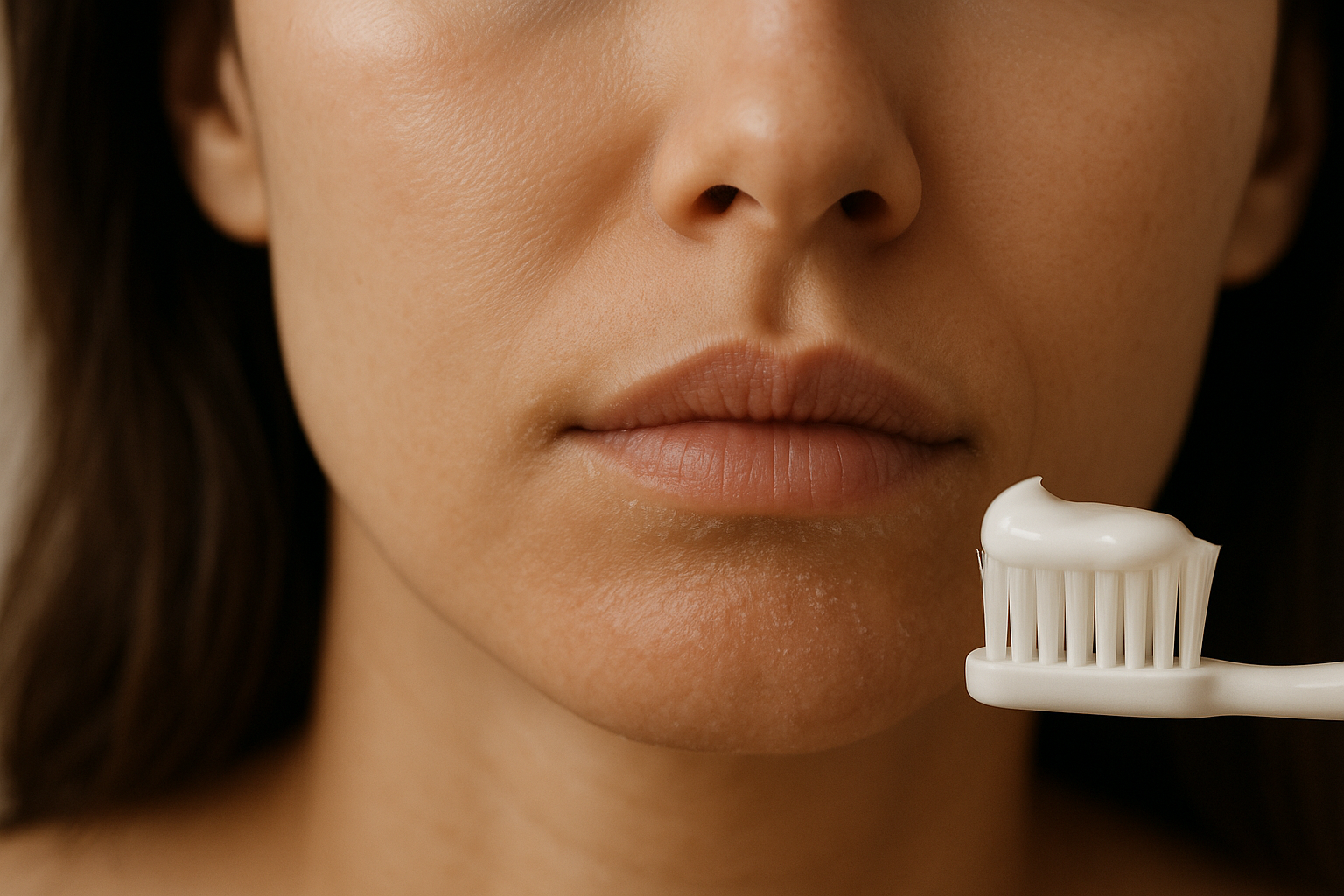
Here's the connection most dry-skin articles miss: twice a day, the skin around your mouth takes a direct hit from products designed for the much tougher environment inside it. If the dryness traces a halo around your lips — worse at the corners, tight after brushing — your bathroom shelf is the first place to look.
Four common culprits are worth checking. Strong mint and cinnamon flavorings are among the recognized triggers for irritation on the skin around the lips (DermNet). Sodium lauryl sulfate (SLS), the foaming agent in many pastes, is drying enough that we've covered what foaming agents do to teeth and gums and its link with canker sores inside the mouth — the skin just outside gets a diluted version of the same treatment. Peroxide whiteners can leave the lip line stinging and tight an hour or two after use. And high-alcohol mouthwashes dry on contact — one of several reasons alcohol-free rinses are worth a look.
| Trigger | What you might notice | Timing clue | Swap to try |
|---|---|---|---|
| Strong mint or cinnamon flavorings | Tingling that tips into tightness; a flaky halo outside the lip line | Within minutes of brushing | A mild-flavor or flavor-light paste |
| SLS (foaming agent) | Dry, tight corners that build gradually | Over days of regular use | An SLS-free, low-foaming paste |
| Peroxide whiteners | Stinging at the lip edge, then tightness | 30–120 minutes after use | Shorter contact time or alternate days |
| High-alcohol rinses | An immediate burn, then dryness | Right after rinsing | An alcohol-free rinse |
The test is simple: change one product at a time and give it two weeks — long enough to see a real difference without losing track of which change mattered. In the meantime, build one small habit: after brushing, rinse the skin around your lips with plain water, blot gently (no scrubbing), and reapply your balm or lipid layer.
The Everyday Habits That Keep It Dry
Once a trigger has roughened this area, a handful of small habits can keep it from recovering:
- Lip-licking and mouth breathing. Both keep the area in that wet-dry cycle. When you catch the urge to lick, sip water or reapply balm instead.
- Very hot drinks. Steam plus heat plus wiping is a three-part assault on the lip line. Let the coffee cool a touch.
- Over-cleansing the corners. Scrubbing after every meal strips lipids faster than skin replaces them. Lukewarm water and a blot is enough during the day; save the cleanser for once daily.
- Shaving. Razors leave micro-nicks around the mouth. Use a fresh blade, finish with an alcohol-free balm, and keep strong actives off freshly shaved skin for 24 hours.
- Weather. Cold wind outside and dry heated air inside both speed up water loss. Apply your lipid seal before heading out, and reapply after meals on long days outdoors.
- Potent actives drifting. Retinoids, exfoliating acids, and benzoyl peroxide applied nearby can migrate into the corners overnight. Buffer first (more on this below).
When It's More Than Dryness: Three Look-Alikes
Sometimes a "dry patch" around the mouth is actually a named condition — and each one needs a different plan than moisturizer alone.
Perioral dermatitis shows up as fine scaling with clusters of small red or skin-colored bumps around the mouth and sometimes the nose. Recent use of topical steroid creams on the face is a recognized trigger, so mention any to your clinician. If you're seeing bumps rather than plain flaking, start with our guide to telling dry-skin bumps apart — and let a dermatologist make the call.
Contact dermatitis — irritant or allergic — clusters wherever the trigger touches: flavorings, fragrances, even nickel from an instrument mouthpiece. Fragrance hides in more products than most people expect, including balms and mists that touch this area; here's what "parfum" on a label actually hides.
Angular cheilitis is a different pattern again: cracking, soreness, and sometimes crusting right at the corners of the mouth. Saliva pooling in the corner folds is a common contributor, and denture or appliance fit can play a role — which makes this one worth raising with your dentist as well as your doctor, since it sometimes needs targeted care rather than barrier support.
Whatever the pattern, the American Academy of Dermatology's advice on when a rash needs medical attention is a good yardstick: get seen if the area spreads quickly, blisters, becomes painful, involves the lips or eyes, comes with fever, or simply isn't improving after a few weeks of gentle care.
A Routine That Respects the Lip Line
The goal is calm and repeatable — few steps, done consistently, with the seal reapplied at the moments it gets removed.
Morning:
- Cleanse only if needed — lukewarm water and a mild, fragrance-free cleanser. No scrubbing the corners.
- Apply a humectant layer (glycerin or hyaluronic acid) while skin is still slightly damp.
- Seal the perioral ring with a lipid layer — a bland balm or a water-free serum.
- Finish with SPF 30+ on exposed skin; mineral formulas are often the most comfortable choice near the mouth.
Evening:
- Before any retinoid or acid, buffer the corners and just outside the lip line with a plain balm.
- Keep strong actives a fingertip's width away from the lip border, and increase strength slowly.
- If a product stings here, don't push through — a brief sting with nothing visible is usually sensory irritation, but the pattern matters, and we've broken down what different kinds of sting mean.
- Finish with your lipid seal to lock the routine in overnight.
Oral care:
- Switch to an SLS-free, mild-flavor toothpaste and an alcohol-free rinse.
- After brushing, rinse the lip area with plain water and blot dry.
Before anything new goes near your mouth: patch test it on the jawline for 48–72 hours first. This one habit prevents most avoidable setbacks in a sensitive zone.
Where SD7 Lipid Serum Fits In
The seal step is where a lipid serum earns its place. Plant lipids interact with the skin's surface differently than water-based lotions: rather than evaporating off, they stay where the water needs holding in — exactly what the perioral ring is missing.
SD7 Lipid Serum is a water-free (anhydrous) concentrate of eleven botanical lipids — jojoba wax esters that are structurally similar to skin's own sebum, triple-blend rosehip, cacay, camellia, and more — designed to layer over your hydrator or replace your moisturizer entirely. Because there's no water phase, there's no preservative system and no alcohol denat: fewer moving parts on skin that's already telling you it's had enough. It's rated 4.89 out of 5 from 35 verified buyers and comes with a 90-day money-back guarantee, which matters for a product you may want to trial cautiously.
Two honest notes. First, SD7 contains aromatic botanicals — sweet orange and lavender, which naturally carry limonene and linalool — so if you're running a strict fragrance elimination, patch test it on the jawline first, the same 48–72-hour rule as everything else. Second, SD7 is a cosmetic: it supports how the skin around your mouth looks and feels, and it is not a treatment for perioral dermatitis, angular cheilitis, eczema, or any other diagnosed condition — those belong with your dermatologist or dentist.
Ready to give the lip line its seal step? Shop SD7 Lipid Serum →
Frequently Asked Questions
Why is the skin around my mouth dry even when I moisturize?
Because this area sheds product faster than anywhere else on your face: talking, eating, wiping, and lip-licking remove a light moisturizer within hours. Layer a humectant under an occlusive lipid seal, and reapply the seal after meals and after brushing — the two moments it reliably comes off.
Can toothpaste or mouthwash cause dry skin around your mouth?
Yes. Strong mint or cinnamon flavorings, SLS foaming agents, peroxide whiteners, and high-alcohol rinses are all common triggers for a dry, tight halo around the lips. Change one product at a time and give each swap two weeks; rinse and blot the lip area with plain water after brushing.
Why are the corners of my mouth cracked and sore?
Persistent cracking right at the corners is the classic pattern of angular cheilitis. Saliva pooling in the corner folds contributes, and denture or appliance fit can play a role. Because it sometimes needs targeted care rather than moisturizer alone, see your dentist or doctor if the corners stay cracked or sore beyond a couple of weeks.
Is it ordinary dryness or perioral dermatitis?
Plain dryness looks like tightness and flaking that improves once you remove triggers and support the area with moisture. Perioral dermatitis adds clusters of small bumps around the mouth and nose, and often follows the use of topical steroid creams on the face. If you're seeing bumps, book a dermatologist rather than experimenting with products.
How do I use a retinoid without drying out the skin around my mouth?
Buffer first: apply a plain, bland balm to the corners and just outside the lip line before your retinoid, keep the active a fingertip's width from the lip border, and increase frequency slowly. If the area stings or flakes anyway, pause and let it recover before restarting at a lower frequency.
This article is for general information and is not a substitute for professional medical advice, diagnosis, or treatment. CallNature products are cosmetics and are not intended to diagnose, treat, cure, or prevent any disease. If dryness around your mouth persists, spreads, cracks, or comes with bumps or pain, please see a dermatologist — and for anything involving dentures, appliances, or your teeth and gums, see a dentist.