Do Old Scars Ever Fade?
Last updated: 2 September 2026
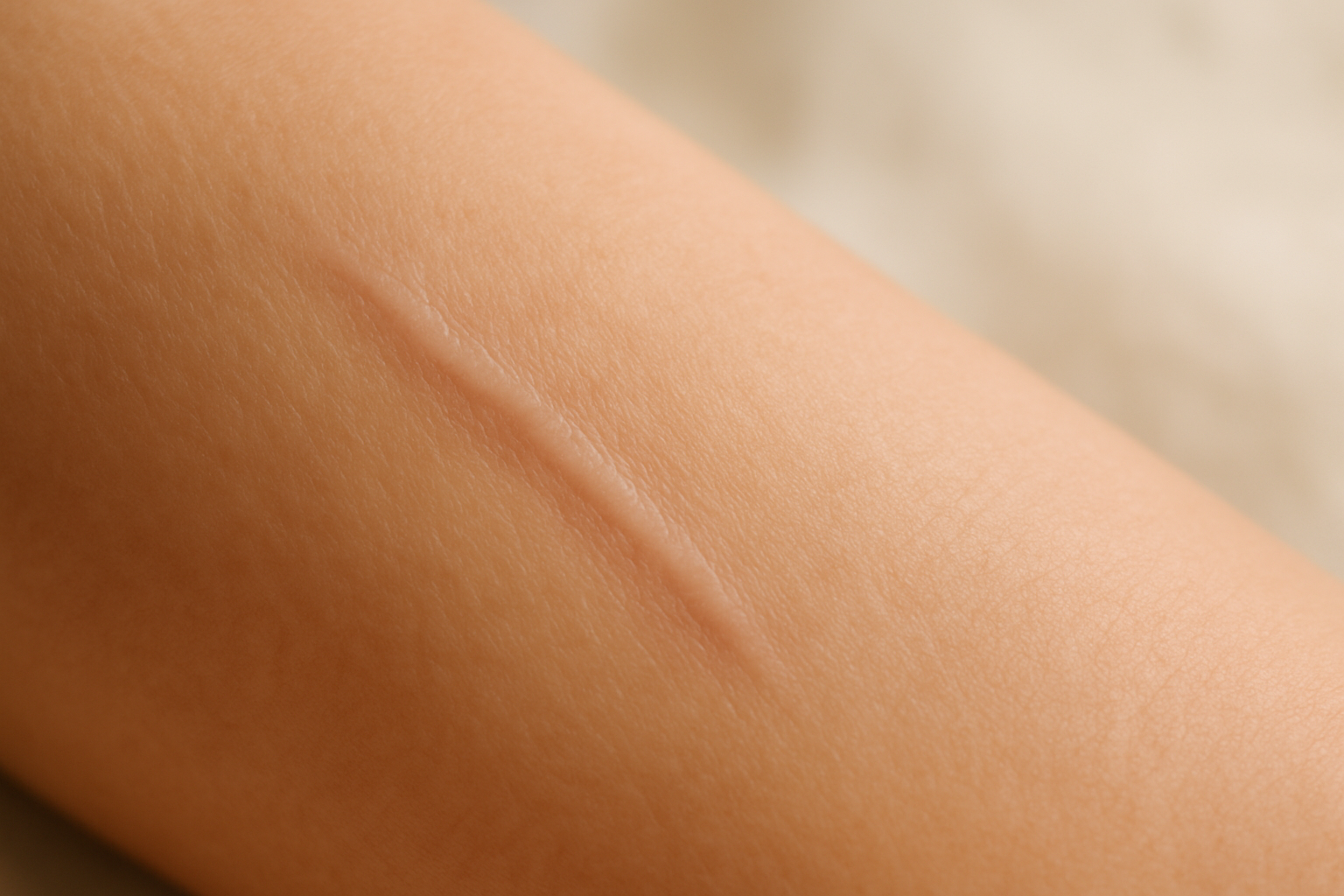
A scar that's been on your skin for a year, five, or twenty raises one specific question: is it still changing, or is this simply what it looks like now? A few-months-old scar still has a lot of changing left to do; a decade-old one has usually finished the part of the process that happens by itself — though a few things can still move the needle on how it looks.
The timeline: what actually happens to a scar over time
A new scar isn't a finished object — it's the visible surface of a repair process called maturation, running on a fairly predictable clock. A landmark 12-month observational study, published in Plastic and Reconstructive Surgery by Bond and colleagues (2008), tracked surgical scars monthly with digital photography and tissue sampling and found maturation unfolds as defined stages across that full year, with the pace differing by age — younger patients matured more slowly, older patients faster.
Redness is usually the most visible part of that process. Per a chapter on scar symptoms in the Textbook on Scar Management (NCBI Bookshelf), erythema scores "reduce significantly within 12 months" as the early inflammatory activity that made a scar look pink or red settles down — though redness and thickness don't move in lockstep, so color alone doesn't tell the whole story. The fuller redness timeline is covered separately.
Memorial Sloan Kettering's patient guidance similarly describes scars continuing to heal for 12 to 18 months post-surgery, gradually becoming "softer, smoother, and less red." Beyond that window, most guidance agrees the natural fading has largely run its course: NHS guidance from Cambridge University Hospitals notes scars can keep fading for around two years, but "it's unlikely they'll fade any more after this time."
So does an old scar ever fully disappear?
Rarely, and it helps to understand why. Per the American Academy of Dermatology, a scar can become less noticeable over time, but some types — keloids and sunken acne scars among them — don't fade on their own at all. Even scars that fade dramatically rarely vanish, because scar tissue is a genuine structural substitute for normal skin, not a repaired version of it: no hair follicles, no sweat glands, and collagen laid down in parallel bundles running one direction instead of the basket-weave pattern of unwounded skin. That architecture is permanent once a wound has closed, which is also why a scar can stay faintly visible as a change in texture or sheen even after its color has evened out. For most people, "fading" means a scar goes from raised, red, and obvious to flat, pale, and easy to overlook — a real, meaningful change, just not skin returning to exactly how it looked before the injury.
Why some old scars stay stubbornly visible
A handful of factors decide how much a scar fades, most set the day the wound happened: depth and size; location (scars over joints, the chest, and shoulders sit under more mechanical tension and stay more prominent); genetic tendency toward keloid or hypertrophic scarring; and how the wound was cared for while healing.
One factor stays within your control indefinitely: sun exposure. Both the AAD and MSKCC recommend covering scars with clothing or daily broad-spectrum SPF 30+ sunscreen, because UV exposure can darken scar tissue through the same post-inflammatory pigmentation that darkens healing skin generally. A scar left unprotected for years often looks darker than it needed to — one of the few evidence-backed, low-effort things you can do for a scar at any age.
What can help an old scar's appearance — and what it can't do
A few habits have real support behind them, though the evidence for some is thinner than the marketing suggests. Silicone-based products are the most studied topical option, but the picture is mixed: a 2021 Cochrane review of silicone gel sheeting found it may slightly improve appearance versus onion extract and reduce pain versus pressure garments — but rated its own certainty "low, or very low," citing small trials (often 10–60 participants), only 13 randomized trials total, and inconsistent reporting. That's reason to hold "proven" claims about any topical scar product to a realistic standard. More on silicone sheets and old scars is covered separately.
Massage has a more consistent, if modest, evidence base for older scars. NHS guidance from Cambridge University Hospitals describes massage — once a wound is fully closed, usually from around four weeks post-injury — as "softening and flattening scars and reducing the adhesions between the different layers of the tissue," continued several times a day for around six months. It's a mechanical effect, not a structural rebuild, and more isn't automatically better: there's a point where scar massage stops helping, and a scar changing shape rather than settling is worth a second look (see: why a scar might be getting wider). Visible change from any topical routine shows up over weeks to months, not days; a hard, thick scar slow to respond may benefit from a dedicated softening routine.
📋 Please note: ScarDerma Pro is a cosmetic product intended to improve the appearance and feel of scars and stretch marks. It does not heal, remove, or treat scars, and it cannot change a scar's underlying structure. It is not a medicine and is not intended to treat, cure, heal, or change any medical condition. Any scar that is painful, changing, infected, or causing concern should be assessed by a dermatologist or doctor.
Where a cosmetic routine fits — and where it stops
If your goal for an older scar is a smoother, softer, less noticeable appearance as part of a consistent daily routine, ScarDerma Pro is built for that job. It's a 100% water-free lipid concentrate combining immortelle helichrysum, rosehip seed, tamanu, and pomegranate seed with soothing camellia, hemp seed, calendula, and vitamin E, formulated to condition the skin and support the look of a softer, flatter, less-noticeable scar over consistent use. Being anhydrous, it's designed to work into the surface layers rather than sit on top and evaporate the way a water-based cream can. A small amount goes a long way, and it's backed by a 90-day money-back guarantee, currently rated 4.91 out of 5 from 34 verified buyers.
Be clear-eyed about what that buys you: a cosmetic like this changes appearance and feel, not architecture. It won't turn a decade-old keloid into flat skin, and it won't do what a dermatologist's needle or laser can. Where the goal is genuine structural change, that's the honest point to see a board-certified dermatologist. Laser resurfacing, per the AAD, essentially trades the existing scar for a new, less obvious one rather than erasing it, while microneedling and surgical revision physically remodel or reposition the tissue itself, per Cleveland Clinic's scar revision guidance. Even these are described as making a scar "more closely match the color and texture of your surrounding skin," not eliminating it — an honest ceiling whatever route you take.
Frequently Asked Questions
Do old scars fade on their own?
Most fading happens in the first 12 to 18 months, and some scars keep changing slowly for up to about two years, per NHS and hospital patient guidance. After that, most scars have done the bulk of their natural fading.
Can a scar that's several years old still improve?
Its natural fading has usually run its course, but sun protection, moisturizing, and gentle massage can still influence how it looks and feels. For genuine structural change, a dermatologist's laser, microneedling, or surgical revision options are the honest route.
Why do some scars never fade?
Keloid and hypertrophic scars, and sunken acne scars, often stay visible because of how the tissue itself forms, according to the American Academy of Dermatology. Depth, location, genetics, and sun exposure all influence how much a scar fades.
Does sun exposure make old scars worse?
Yes — UV exposure can darken scar tissue and make an old scar more noticeable, which is why dermatologists and hospital guidance recommend daily broad-spectrum SPF 30+ sunscreen or covering the area with clothing.
Can ScarDerma Pro remove my scar?
No. ScarDerma Pro is a cosmetic that supports the appearance and feel of scars and stretch marks — helping them look smoother and less noticeable — but it doesn't treat, heal, remove, or restructure scar tissue. For structural change or medical concerns, see a board-certified dermatologist.
This article is for general information only and is not a substitute for professional medical advice. If a scar is painful, rapidly changing, infected, or causing you concern, please see a dermatologist or doctor.