Why Don't My Stretch Marks Tan? (And Why the Sun Makes Them Show More)
Last updated: 28 July 2026
Quick answer
Your stretch marks don't tan because a mature stretch mark isn't ordinary skin — it's a dermal scar with an atrophied, flattened epidermis and reduced pigment. Dermoscopy shows decreased melanization in white stretch marks (striae albae) compared with the skin either side of them, which is why they sit out the tanning response while everything around them darkens.1 Note the wording: decreased, not zero. Broadband UV can coax some pigment back into striae albae, but the effect is temporary and fades within a few months — and it always lags behind the surrounding skin, so the practical result of a sunbathing session is a wider contrast gap, not a smaller one.1
If your goal is to make the lines less noticeable, the two levers that work are colour matching (a DHA self-tanner, which stains the dead surface layer chemically and doesn't need pigment cells at all3) and improving the texture and tone of the mark itself with consistent daily care — a water-free botanical lipid such as ScarDerma Pro is one example built for that second job. Tanning is the one approach that reliably backfires.
What a stretch mark actually is under the skin
Almost every article on this question stops at "stretch marks are scars, and scars don't tan." That's directionally right and mechanistically thin. Here is what's actually going on.
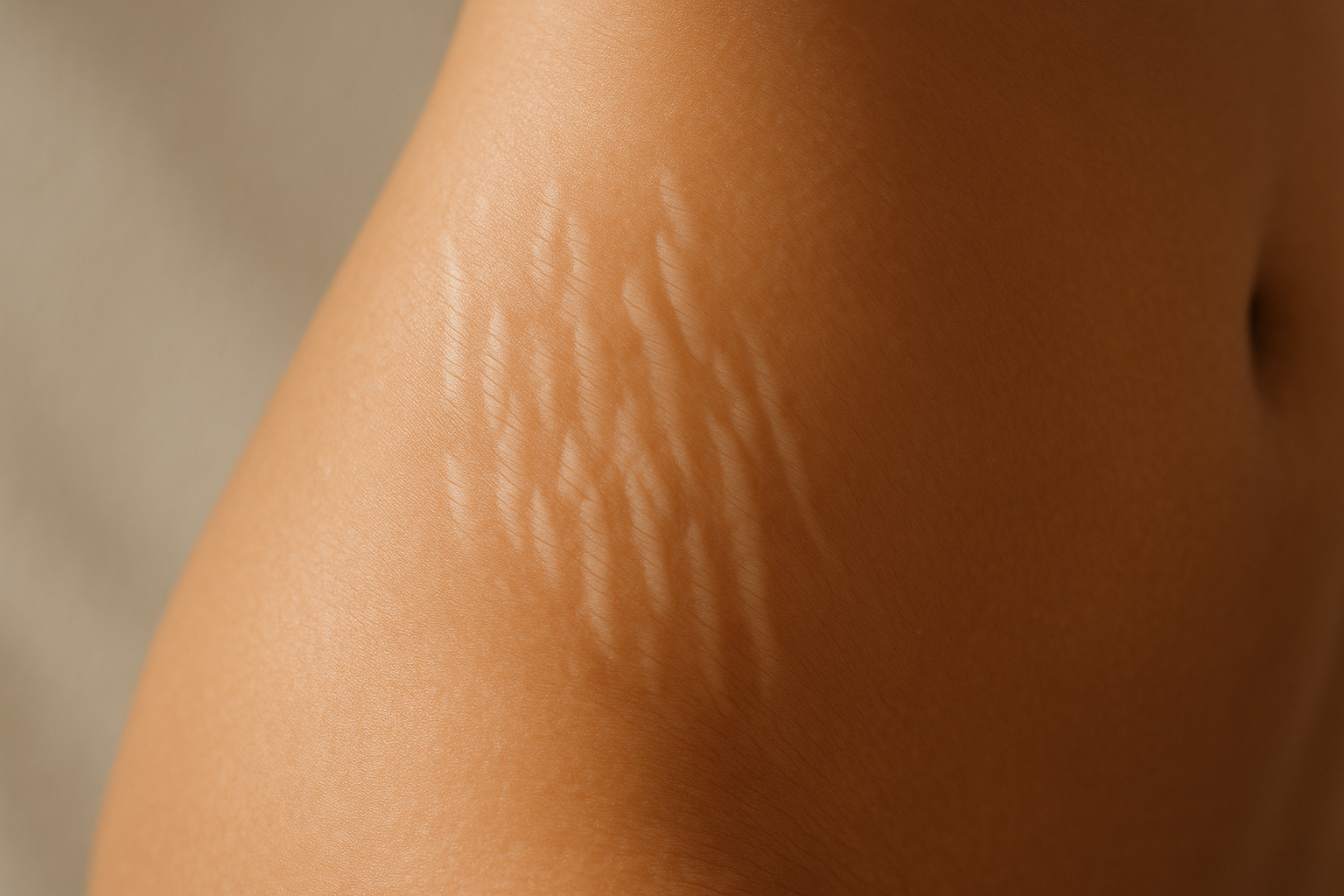
Stretch marks — medically striae distensae — are linear dermal scars formed when skin is stretched faster than its collagen and elastin can adapt. They pass through two stages. Early marks (striae rubrae) are red or purple: the dermis is inflamed and its vessels are dilated and visible through thin skin. Over months to years they mature into striae albae: pale, slightly sunken, wrinkled lines that Mayo Clinic describes as indented streaks which fade but rarely disappear completely.6
The histology of that mature stage is the whole answer to the tanning question. Biopsies of striae albae show epidermal atrophy, loss of the rete ridges, reduced vascularity, and densely packed thin horizontal collagen bundles — a structure that, as StatPearls puts it, resembles a mature atrophic scar.1
Two of those findings matter here:
- Epidermal atrophy. The epidermis over a mature stretch mark is thinner than the epidermis next door. Melanocytes — the pigment-producing cells that generate a tan — live in the basal layer of that epidermis. A thinner, flattened epidermis with fewer rete ridges is a less productive pigment factory.
- Loss of rete ridges. Rete ridges are the interlocking finger-like projections where the epidermis meets the dermis. Flatten them and you lose surface area at exactly the junction where melanocytes sit and hand pigment off to surrounding skin cells.
Put those together and you get the measurable result: high-resolution dermoscopy and colorimetry find increased melanization in striae rubrae and decreased melanization in striae albae — a finding StatPearls attributes to colorimetric work by Hermanns and Piérard.1,7 The pigment machinery isn't gone. It's diminished.
So can stretch marks tan at all? The honest answer
Yes, slightly — and temporarily. This is where the internet's blanket "stretch marks have no melanin and cannot tan" line breaks down.
StatPearls notes explicitly that exposure to broadband ultraviolet radiation can induce repigmentation in striae albae — but the effect is typically temporary, with pigmentation lost again within a few months.1 That's not a fringe observation; it's the same principle behind a medical treatment. In a randomised controlled trial published in Archives of Dermatology, Alexiades-Armenakas and colleagues treated hypopigmented scars and striae alba with a 308-nm excimer laser and achieved roughly 61–68% pigment correction by visual assessment after nine biweekly treatments, and around 100% by colorimetric measurement.2
Read the follow-up data, though, and you get the real lesson. Both measures "gradually declined toward baseline levels during the 6-month follow-up," and the authors concluded that maintenance treatment every one to four months is required to sustain the cosmetic benefit.2
If a targeted medical UV laser delivering nine controlled doses only holds its result for a few months, a fortnight on a beach is not going to permanently colour-match your stretch marks. The tissue can be nudged into making a little pigment. It does not hold it.
The contrast gap: why sun actively makes them look worse
Here's the part that catches people out. Visibility of a stretch mark is not about how pale the mark is in absolute terms — it's about the difference between the mark and the skin around it. Sun exposure moves both, but not equally.
Normal skin has a full-thickness epidermis, intact rete ridges and a normal melanocyte population, so it responds to UV briskly and holds the tan for weeks. The striae albae next to it have an atrophied epidermis and decreased melanization, so they respond weakly and lose it quickly. The surrounding skin sprints; the stretch mark limps. Every hour of sun therefore widens the gap you're trying to close — which is why so many people first really notice their stretch marks after a summer holiday, and assume the sun caused new ones. It didn't. It just turned the contrast up on marks that were already there.
And there's a burn risk nobody mentions
Melanin isn't decorative — it's UV shielding. Skin with less of it burns more readily. Guidance from the Burn Injury Model Systems (MSKTC) makes this point about healed scar tissue in general: healed burns and grafts "may be extremely sensitive to sunlight and may sunburn more severely even after short periods of time in the sun," and any tan that does develop in newly healed skin may not fade when the rest of the tan goes.5
Stretch marks are far milder than burn scars, but the principle carries: a lightly-pigmented atrophic stripe is not a good candidate for deliberate UV exposure. Deliberately tanning to hide stretch marks means burning the least-protected skin on your body in pursuit of an effect that fades in weeks.
Every way to add colour to a white stretch mark, compared
If the goal is narrowing the contrast gap, it helps to see the options side by side — including how each one produces colour, because that determines whether it needs functioning pigment cells at all.
| Method | How it makes colour | Needs working pigment cells? | Works on striae albae? | How long it lasts |
|---|---|---|---|---|
| Sunbathing / UV | Stimulates melanocytes in the basal epidermis to make melanin | Yes | Poorly — some repigmentation is possible but weak, and it lags the skin around it, so contrast widens1 | Months at best, and it fades1 |
| Sunbeds | Same melanocyte pathway, higher-intensity UV | Yes | No advantage over sun; same contrast problem plus a higher UV dose | Same — and it fades |
| DHA self-tanner | Dihydroxyacetone reacts chemically with amino acids in the skin's surface to darken it3 | No | Yes — the reaction happens in the dead surface layer, which a stretch mark still has | About a week, shedding as the surface layer turns over |
| Bronzer / body makeup | Sits on the surface as pigment; washes off, like other makeup3 | No | Yes, for an occasion — best for a single event | Until you wash |
| 308-nm excimer laser | Targeted UVB stimulates whatever pigment cells remain | Yes | Yes — ~61–68% visual pigment correction after nine sessions in an RCT2 | Declines toward baseline over ~6 months; needs maintenance every 1–4 months2 |
| Fractional laser / microneedling | Remodels the dermis; may also promote repigmentation in striae albae1 | Partly | Targets texture more than colour; standardised protocols and long-term data are still lacking1 | Longer, but variable — and carries a hypopigmentation risk in darker skin tones1 |
| Daily topical lipid care | Doesn't add colour — works on the texture, softness and evenness of the mark's appearance | No | Different job — a mark that looks smoother and less sunken catches less light and reads as less obvious | Ongoing, with consistent daily use |
The pattern is hard to miss: everything that relies on your own pigment cells underperforms on striae albae, and everything that doesn't rely on them works fine.
Why self-tanner works on stretch marks when a real tan doesn't
This is the mechanistic point that makes the whole thing click, and it comes straight from the FDA's own description of the ingredient. Dihydroxyacetone (DHA), the active in essentially every self-tanner, is a colour additive that "darkens the skin by reacting with amino acids in the skin's surface."3
It is a chemical reaction with proteins in the outermost, already-dead layer of skin. It does not involve melanocytes, melanin, the basal layer or rete ridges — the exact machinery that a mature stretch mark is short of. Which is why the one part of your skin that stubbornly refuses to tan in the sun takes self-tanner about as well as everywhere else.
Three practical caveats from the FDA worth knowing before you reach for a bottle:
- External use only. DHA is approved as a colour additive restricted to external application — not the lips, not any surface covered by mucous membrane, and not the area of the eye. Creams and lotions applied at home are the approved use case; all-over spray or mist booths are not an FDA-approved use, because it's hard to avoid exposing the eyes, lips and airway.3
- It is not sun protection. Sunless tanners only protect you from UV if they contain sunscreen ingredients and are labelled with an SPF; products without them must carry a warning stating so.3 The AAD's guidance on self-tanner ends with the same instruction: apply sunscreen every day anyway — SPF 30 or higher, broad-spectrum, water-resistant.4
- It's cosmetic camouflage, not treatment. It changes the colour of the mark, not the mark. It will also wash out over roughly a week as the stained surface cells shed.
The self-tan protocol for stretch marks specifically
Generic self-tanner advice tells you how to avoid orange palms. Stretch marks have their own failure modes — they're indented, they're often on the belly, hips and thighs where skin creases, and the skin over them is atrophic and dry, which grabs product unevenly. This protocol layers the striae-specific adjustments on top of the American Academy of Dermatology's standard method.4
- Exfoliate first, gently. Use a washcloth or an exfoliating product to lift dead cells, spending extra time where skin is thickest — elbows, knees, ankles.4 Striae adjustment: go light directly over the marks themselves. The epidermis there is already thin; scrubbing hard doesn't improve uptake, it just irritates.
- Condition the marks the night before — not on the day. Dry, flaky skin over a stretch mark grabs DHA unevenly and can leave the line looking darker than the surrounding skin, which is the opposite of colour matching. Condition the area the evening before so it's supple, then apply the tanner to clean, dry skin the next day.4
- Dry your skin completely. Applying to dry skin is what gets you even coverage.4
- Work in sections, massaging in circles. Arms, then legs, then torso; circular motion; wash your hands after each section to avoid stained palms.4 Striae adjustment: apply across the marks rather than along them. Stretch marks run perpendicular to the direction of skin tension, so sweeping along their length tends to load product into the indentation and outline them.
- Stretch the skin flat over deep marks. Indented striae — especially on the abdomen or hips — can shelter a dry pocket that the tanner skips, leaving a pale line inside a tanned patch. Gently flatten the skin with your free hand as you pass over deeper marks.
- Dilute over joints, blend at wrists and ankles. Knees, ankles and elbows absorb more product; thin them with a damp towel or a layer of lotion, and lightly extend the colour from wrists to hands and ankles to feet for a natural finish.4
- Build in two light passes, not one heavy one. Because the mark and the skin around it develop at slightly different rates, a single dark application is the most common cause of a stretch mark ending up more visible than before. Two light coats 24 hours apart lets you see where the colour has landed and correct.
- Wait, then dress loose. At least 10 minutes before getting dressed, then loose clothing and no sweating for about three hours.4
- Sunscreen daily regardless. SPF 30+, broad-spectrum, water-resistant — a self-tan gives you none.3,4
Pregnant or breastfeeding, or managing a skin condition? Run any new product past your doctor or a board-certified dermatologist first.
The other half: improving how the mark itself looks
Colour-matching hides a stretch mark. It doesn't change it. The second lever — and the one that keeps working when the self-tan washes off — is the texture and tone of the mark itself.
This is where the red-versus-white distinction decides your expectations. Striae rubrae, in their first months, are the responsive stage; striae albae are mature atrophic scars and are far less responsive to anything topical.1,8 StatPearls is candid that topical treatments for striae are widely used on thin evidence, with most trials small and low quality.1 Anyone promising to erase a ten-year-old white line from a bottle is selling you something.
What is reasonable to aim for is appearance. A stretch mark that is well-conditioned, less dry and less sharply demarcated catches light differently from one that is flaky and sunken — and that difference is visible in a mirror even when the underlying scar is unchanged. That's a cosmetic goal, and it's an achievable one.
Why water-free matters on atrophic skin
Most stretch-mark creams are largely water. On the thinned epidermis of a mature stretch mark, water evaporates and can leave the surface feeling tighter than before you started — which is precisely the dry, light-scattering texture that makes a white line stand out. A water-free (anhydrous) lipid concentrate takes the opposite approach: no water to evaporate, so what you massage in is entirely botanical lipids saturating the surface layers. That's the design principle behind ScarDerma Pro.
ScarDerma Pro — a water-free lipid concentrate for scars and stretch marks
ScarDerma Pro is a 100% water-free botanical lipid concentrate formulated to move into the surface layers of the skin and support the smoother, softer, more even-looking appearance of scars and stretch marks — rather than sitting on top like a silicone patch or evaporating like a water-based cream. Because it's anhydrous, it is preservative-free by design, and free from harsh acids, peels, drying agents and artificial fragrance — which suits the thin, atrophic skin over a mature stretch mark.
The blend leads with botanicals long studied in skin care: rosehip seed, a natural source of trans-retinoic acid (sometimes called "natural tretinoin"), which small studies suggest may modestly improve the look of texture and marks; and pomegranate seed, whose extract has been shown to encourage keratinocyte (skin-cell) renewal in laboratory research9 — relevant when the epidermis over a stretch mark is the thinned part. Alongside them sit immortelle helichrysum and tamanu, with soothing hemp seed and Japanese camellia, in a lipid base of sea buckthorn, calendula, jojoba, hazelnut and vitamin E.
ScarDerma Pro was developed by formulator S. C. Aris, holds a real customer rating of 4.91 / 5 from 34 verified buyers, and comes with a 90-day money-back guarantee — enough time to judge it properly, since appearance changes on striae are measured in weeks and months, not days. In a customer survey, 9 in 10 users reported more even-looking tone.
Used alongside the self-tan protocol above, the two do different jobs: the lipid works on how the mark looks and feels; the self-tanner narrows the colour gap on the day. Apply the lipid at night and let it absorb fully, and leave a clear 24 hours before applying self-tanner — any residual emollient on the surface will make the colour take unevenly.
ScarDerma Pro is a cosmetic product intended to support the appearance and feel of skin. It is not a medicine and does not treat, cure or prevent any condition, and it does not restore pigment. If stretch marks appear widely with no weight, growth or muscle change to explain them, see a doctor.
Frequently asked questions
Why don't my stretch marks tan?
Because a mature stretch mark is a dermal scar with an atrophied epidermis, flattened rete ridges and reduced melanization compared with the skin around it. Pigment cells sit in the basal epidermis, so a thinner, flatter epidermis produces less tan. Some repigmentation from UV is possible, but it is weak and temporary.
Will tanning make my stretch marks less noticeable?
No — the opposite. The skin around the marks tans faster and holds it longer, so the contrast between mark and skin widens. Many people first really notice their stretch marks after a holiday for exactly this reason.
Does self-tanner work on stretch marks?
Yes. Self-tanners work through DHA, which the FDA describes as darkening skin by reacting with amino acids in the skin's surface. That chemical reaction happens in the dead outer layer and doesn't need pigment cells, so it colours stretch marks about as well as normal skin. It lasts roughly a week and provides no sun protection.
Do stretch marks burn more easily in the sun?
Melanin provides UV shielding, so skin with less of it is less protected. Guidance on healed scar tissue notes it can be markedly more sun-sensitive. Cover stretch marks with broad-spectrum SPF 30 or higher rather than deliberately exposing them.
Can stretch marks ever get their colour back?
Partially and temporarily. A randomised trial of the 308-nm excimer laser achieved roughly 61–68% visual pigment correction in striae alba after nine sessions, but the effect declined toward baseline within six months and required ongoing maintenance. There is no permanent repigmentation of a mature stretch mark.
Does ScarDerma Pro make stretch marks tan?
No. It doesn't add colour or affect pigment. It's a cosmetic lipid concentrate that supports the smoother, softer, more even-looking appearance of the marks when massaged in daily.
The short version
Stretch marks don't tan because the tissue that makes a tan is exactly the tissue a stretch mark is short of — and the small, slow response they can manage is always outrun by the normal skin beside them. Chasing a tan to hide them is the one strategy guaranteed to make the contrast worse, while burning the least-protected skin you have. If you want them less visible today, use a DHA self-tanner, which bypasses pigment cells entirely. If you want them looking better in three months, work on the texture and tone of the marks with consistent daily care — and start early if the marks are still red.
Related reading
- Stretch Mark Treatment: Prevention, Causes & What Works
- Why Do I Get Stretch Marks on My Shoulders From Working Out?
- Why Do My Stretch Marks Itch When I'm Losing Weight?
- Why Is My Scar Still Red — and How Long Does Redness Last?
- Do Old Scars Ever Fade?
- How to Reduce the Appearance of a C-Section Scar
References
- Mikes BA, Oakley AM, Patel BC. "Striae Distensae." StatPearls, updated 19 May 2025. NCBI Bookshelf NBK436005
- Alexiades-Armenakas MR, Bernstein LJ, Friedman PM, Geronemus RG. "The safety and efficacy of the 308-nm excimer laser for pigment correction of hypopigmented scars and striae alba." Arch Dermatol. 2004;140(8):955–960. PubMed 15313811
- U.S. Food and Drug Administration. "Sunless Tanners & Bronzers." fda.gov
- American Academy of Dermatology. "How to apply self-tanner." aad.org
- Carrougher GJ, Gibran NS, Caceres M, Cannon C. "Sun Protection After a Burn Injury." Model Systems Knowledge Translation Center (MSKTC), 2023. msktc.org
- Mayo Clinic. "Stretch marks — Symptoms & causes." mayoclinic.org
- Hermanns JF, Piérard GE. "High-resolution epiluminescence colorimetry of striae distensae." J Eur Acad Dermatol Venereol. 2006;20(3):282–287. PubMed 16503888 (as summarised in ref. 1)
- Ud-Din S, McGeorge D, Bayat A. "Topical management of striae distensae (stretch marks): prevention and therapy of striae rubrae and albae." J Eur Acad Dermatol Venereol. 2016;30(2):211–222. PubMed 26486318
- Aslam MN, Lansky EP, Varani J. "Pomegranate as a cosmeceutical source: pomegranate fractions promote proliferation and procollagen synthesis…" J Ethnopharmacol. 2006;103(3):311–318. ScienceDirect