Why Does My Silicone Scar Sheet Itch? What's Actually In It — and What the Redness Means
Quick answer
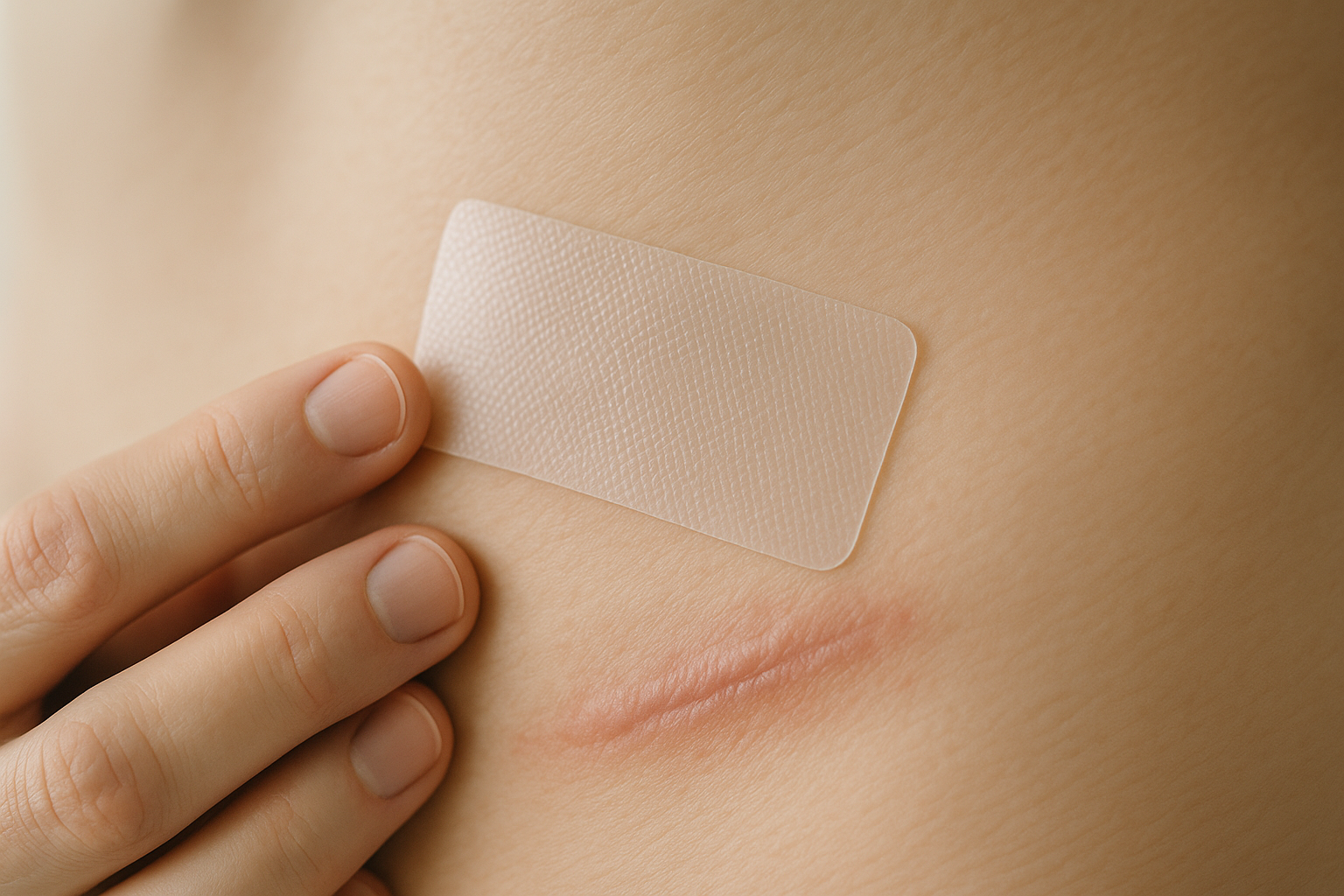
An itch under a silicone scar sheet is common, and in most cases it is not an allergy to silicone. Silicone itself sits on the surface and is not absorbed into the skin — its whole mechanism is occlusion, and occlusion is exactly what causes the trouble. Trapped sweat under a non-porous cover produces heat rash; too many hours a day produces maceration (soggy, white, fragile skin); the adhesive border or the tape holding the sheet down produces a sharply-edged square of irritation; and hypertrophic scars and keloids frequently itch on their own, sheet or no sheet. The fix is almost always mechanical rather than pharmacological: shorten the daily wear time, wash and dry both the skin and the sheet daily, take a rest day, and re-introduce slowly. If the skin under the sheet is broken, weeping, blistering or spreading, stop and see a doctor.
If occlusion simply doesn't suit your skin or your climate, a non-occlusive route is the alternative — a water-free botanical lipid concentrate such as ScarDerma Pro is one example: a few drops smoothed into the scar and left to absorb, with nothing to stick down and nothing sealing sweat against the skin. It is a cosmetic, not a medical device, and it is not a replacement for silicone therapy where a clinician has recommended it.
Last updated: 1 August 2026
First, what is actually in a silicone scar sheet?
Far less than most people assume. A silicone scar sheet is not a drug delivery system and it is not medicated. It is a soft, flexible polymer film — and according to the plastic surgeon whose laboratory established how it works, its effect has nothing to do with anything entering the skin at all. Reviewing four decades of the evidence in the Textbook on Scar Management, Thomas Mustoe notes that the original mechanistic studies specifically ruled out heat, pressure and silicone absorption, and concludes that "silicone is not absorbed into the skin and covers intact epithelium," so any benefit "must be indirect through effects on the epithelium." What the sheet does is slow water loss from a scar whose surface barrier is still immature, which in turn quietens the inflammatory signalling that drives excess collagen.
That matters for the itch question, because it means the ingredient list is short and inert, and the problems people run into come from the physics of a cover rather than the chemistry of what it's made of.
| What you'll see on the label | What it actually is | Does it go into the skin? |
|---|---|---|
| Dimethicone / polydimethylsiloxane (PDMS) | The backbone silicone polymer — the flexible, water-repellent film itself | No. It forms a surface film |
| Dimethiconol, siloxane copolymers | Related silicone polymers that adjust how soft, tacky or self-adhering the sheet is | No |
| Silica / silicon dioxide | Reinforcing filler that stops a thin sheet tearing | No |
| Adhesive border, tape or fabric backing | Not silicone at all — usually an acrylic or hydrocolloid adhesive, or the medical tape you add yourself | No, but this is the layer most likely to irritate |
| Added extras in gels (vitamin E, onion extract, fragrance, SPF filters) | Optional cosmetic ingredients some brands add to pourable silicone gels | Varies — and these, not the silicone, are the plausible allergens |
Note the pattern: the two components most people never think about — the adhesive and the added extras — are the two with any real irritation potential. The silicone is the boring part.
The regulatory reality nobody puts on the box
"Medical grade" and "FDA" appear on almost every silicone scar sheet package, and both phrases mean something narrower than shoppers assume. In a 2004 final rule, the FDA formally classified silicone sheeting intended for the management of closed hypertrophic and keloid scars as a Class I device, exempt from premarket notification (69 FR 48146, now codified at 21 CFR 878.4025). Class I is the lowest regulatory tier, and "exempt from premarket notification" means an individual product does not have to be reviewed by the agency before it goes on sale.
Three things in that rule are worth knowing before you judge your own sheet:
- The FDA itself was blunt about the evidence. Responding to a comment, the agency wrote that "the literature on this preamendments device does not demonstrate that silicone sheeting alone alleviates the symptoms or improves the appearance of hypertrophic or keloid scars," and that the literature does not address performance in specific ethnic or racial groups. It classified the device as Class I anyway, on the basis of low risk and long history of use, not proven efficacy.
- The safety record is very strong. In the same rule the FDA noted that the advisory panel "did not identify any risks to health associated with its use," and that there had been "only two medical device adverse event reports for this device over a span of several decades of use."
- The intended use is closed scars. The FDA specifically revised the wording from "intact skin" to "closed hyperproliferative (hypertrophic and keloid) scars" after the panel raised the question of open wounds. A sheet is not a wound dressing.
So: a very low-risk product, weakly evidenced, sold with essentially no product-specific review. That combination is exactly why individual experiences vary so much — and why an itch is worth investigating rather than pushing through.
How good is the evidence that they work at all?
Mixed, and worth stating honestly because it affects how much discomfort is reasonable to tolerate. The Cochrane systematic review by O'Brien and Jones pooled 20 trials involving 873 people and found that silicone gel sheeting reduced the incidence of hypertrophic scarring in scar-prone people (risk ratio 0.46) and, in treatment studies, reduced scar thickness and improved colour — but concluded that the trials were "of poor quality and highly susceptible to bias," leaving "a great deal of uncertainty."
Mustoe's counter-argument is that the early controlled studies were stronger than Cochrane credited, because each patient served as their own control and stiffness was measured objectively with an extensometer rather than rated by eye. Both points can be true. The practical translation is that silicone sheeting is a reasonable, low-risk, moderately-evidenced option — not something worth persisting with through a genuine skin reaction.
One more finding from Mustoe's own clinical work deserves flagging, because it is the single most useful expectation-setter in the literature: he saw "much more impressive results in immature scars, with minor effects or no effect on mature scars (scars older than 1 year without erythema)." If your scar is old, flat and pale, a sheet is unlikely to do much regardless of how faithfully you wear it. We cover that timeline separately in Do old scars ever fade? and Why is my scar still red?
The five reaction patterns — and how to tell yours apart
This is the part the product leaflets skip. Almost every complaint about silicone sheets falls into one of five patterns, and they need completely different responses.
| Pattern | What it looks and feels like | Why it happens | What to do |
|---|---|---|---|
| 1. Heat rash (miliaria) | Tiny itchy red bumps, 2–4 mm, scattered across the covered area — or clear pinhead blisters that break easily. Very itchy, worse in heat | Sweat ducts blocked under a non-porous cover. DermNet lists "occlusion of the skin with non-porous dressings" as a direct cause of miliaria, alongside heat, humidity and exercise | Uncover, cool the skin, shorten wear time and shift it to the coolest part of the day. Most cases settle within a day or two of cooling |
| 2. Maceration | Pale, white, wrinkled, soggy skin that looks like a long bath. Fragile, sometimes stings. May break down at the edges | Too many hours per day. Mustoe found that "24-hour treatment led to maceration and was poorly tolerated" — 12 hours a day was enough to be effective | Stop for several days until the skin is normal, then resume at a shorter daily wear. Never wear a sheet round the clock |
| 3. Adhesive or tape reaction | Itch and redness in a sharp geometric shape that matches the border, tape or edge — not the scar | The acrylic adhesive or the medical tape, not the silicone. Anyone who reacts to sticking plasters is a candidate | Switch to a self-adhering sheet with no separate tape, or hold it with a non-adhesive gauze and paper tape — the AAD suggests exactly this substitution for adhesive-sensitive skin |
| 4. Folliculitis or infection | Pustules centred on hair follicles, tenderness, spreading redness, warmth, or a persistent smell | Warm, damp, occluded skin plus a sheet that has picked up dirt and perspiration. Mustoe notes sheets "pick up dirt and perspiration which makes cleaning or using new sheets essential." DermNet lists bacterial folliculitis among the look-alikes for heat rash | Stop, wash the area, and see a clinician. Secondary bacterial infection is a recognised complication of sweat-retention rashes |
| 5. It's the scar, not the sheet | Itch that predates the sheet, or is worst at the raised, red, active part of the scar itself | Raised scars itch in their own right. The AAD notes that a keloid "can cause pain or discomfort" while it is growing, and that a hypertrophic scar appears one to two months after the injury before slowly becoming less noticeable | Nothing to correct — but don't credit or blame the sheet. Track the itch against wear days before drawing conclusions |
A quick discriminator: take the sheet off and look at the shape. Reaction confined to a crisp rectangle that matches the adhesive means the adhesive. Diffuse pinprick bumps across the whole covered zone means sweat. Soggy white skin means hours. Follicular pustules mean hygiene. Itch that ignores the sheet's outline entirely means the scar.
A ramp-up protocol that avoids most of it
Almost every reaction above is a dose problem, and the dose is hours-per-day. Packaging often says "wear for 12–24 hours" and people jump straight to the top of that range on day one. A graded start costs a week and prevents most of the trouble.
- Days 1–3: four hours a day. Evening is easiest — cooler, less sweat, less friction from clothing. Check the skin every time you remove it.
- Days 4–7: eight hours. Overnight is the practical slot for most people. If you wake up with the skin looking pale and wrinkled, you have found your ceiling — drop back.
- Week 2 onward: up to twelve hours. Mustoe's original studies found roughly 12 hours a day sufficient, and 24 hours actively counterproductive. There is no reward for exceeding it.
- Wash both sides of the equation, daily. Clean the skin with mild soap and water and dry it completely; wash the sheet as the manufacturer directs and let it dry fully before it goes back on. The AAD's guidance on silicone and hydrogel sheets is simply to follow the package instructions for changing the sheets.
- Build in a rest day. One sheet-free day a week costs almost nothing in cumulative wear hours and gives the skin a reset.
- If a reaction appears, pause — don't push. Mustoe's approach when adverse effects occurred was to interrupt treatment for about a week until the complaints disappeared, then resume with a shorter daily application. That is the correct instinct.
- Wear sunscreen on the healed scar. The AAD recommends broad-spectrum SPF 30 or higher on a healed wound, reapplied frequently, because sun protection may reduce red or brown discolouration and help the scar fade faster. Related reading: why stretch marks don't tan.
Three situations where a sheet is the wrong tool
The wound isn't closed. The FDA's intended-use statement is explicit — closed scars. Until the skin is fully sealed, follow standard wound care instead: the AAD advises keeping the area clean, using petroleum jelly to keep it moist so it does not scab, covering it with a bandage, and changing that bandage daily.
You live somewhere hot and humid, or you sweat heavily. Mustoe is direct about this: "in tropical climates with high humidity, the scar can develop a 'heat' rash due to excessive moisture underneath the gel." If that is your climate or your job, a pourable silicone gel that dries in place is the version designed around the problem — it needs no adhesive and no cover.
The scar is mature. Old, pale, flat scars responded minimally or not at all in the original clinical work. If your scar is over a year old and no longer red, comfort and appearance are a more realistic goal than remodelling. The same logic applies to older white stretch marks, which the Mayo Clinic describes as often fading over time with or without treatment but rarely disappearing completely — and which StatPearls characterises histologically as resembling mature atrophic scars.
The non-occlusive alternative: ScarDerma Pro
Everything above traces back to one thing — a cover that seals. If your skin, your climate or your patience doesn't tolerate being sealed under a sheet, the other route is a topical that absorbs and leaves the skin uncovered.
ScarDerma Pro is a 100% water-free botanical lipid concentrate, formulated by S. C. Aris, built around the opposite delivery idea. Because it contains no water, there is nothing to evaporate and no need for preservatives — the formula is preservative-free by design. The lipids are chosen for compatibility with the skin's own surface lipids, so the concentrate settles into the upper layers rather than sitting under a seal. A few drops are smoothed into the scar and left to absorb: nothing to stick down, no adhesive border, nothing to trap sweat, and no daily hour limit to titrate.
The blend leads with four actives — immortelle helichrysum, rosehip seed, tamanu and pomegranate seed — supported by Japanese camellia, geranium, English lavender and hemp seed, on a lipid base of sea buckthorn, calendula, jojoba, hazelnut and vitamin E. There are no harsh acids or peels, no drying agents, no artificial fragrance, no parabens and no fillers; it is vegan and non-GMO. It supports the appearance of smoother, softer, more even-looking scars and stretch marks. In a customer survey, 91% said their marks looked flatter and smoother within six weeks and 94% said they would recommend it.
It is rated 4.91 out of 5 from 34 verified buyers, and it is backed by a 90-day guarantee. See ScarDerma Pro →
An honest boundary: ScarDerma Pro is a cosmetic, not a medical device, and it is not a substitute for silicone sheeting where a clinician has specifically recommended it for a hypertrophic or keloid scar. If your scar is raised, growing, painful or spreading beyond the original wound, see a board-certified dermatologist first.
More from our scar cluster: reducing the appearance of a C-section scar · why stretch marks itch when you're losing weight · do old scars ever fade?
Frequently asked questions
Is it normal for a silicone scar sheet to itch?
Mild itching is common and usually reflects occlusion rather than an allergy. Trapped sweat under a non-porous cover is a recognised cause of heat rash, and raised scars often itch on their own. Persistent itching with a visible rash, pustules, soggy white skin or broken skin is not normal — stop and reassess.
Can you be allergic to silicone scar sheets?
True silicone allergy is rare, and the polymer is not absorbed into the skin. When a genuine contact reaction occurs it is far more often to the adhesive border, the tape holding the sheet on, or added ingredients in a scented or vitamin-loaded silicone gel. The give-away is a reaction shaped like the adhesive rather than the scar.
Should I stop using a silicone sheet if I get a rash?
Pause it. The approach used in the clinical literature is to interrupt for about a week until the complaint resolves, then resume with a shorter daily wear time. If the skin is broken, weeping, blistering, spreading or painful, see a clinician rather than restarting.
How many hours a day should I wear a silicone scar sheet?
Around 12 hours a day was sufficient in the original controlled studies, and 24-hour wear led to maceration and was poorly tolerated. Build up over a week or two rather than starting at the maximum, and always follow your product's instructions.
Can I put a silicone sheet on a wound that hasn't fully closed?
No. The FDA's intended use for silicone sheeting is the management of closed hypertrophic and keloid scars. Until the skin is sealed, use standard wound care — keep it clean, keep it moist with petroleum jelly, and keep it covered.
Do silicone sheets work on old scars?
Much less well. In the original clinical work, immature scars responded impressively while mature scars — older than about a year and no longer red — showed minor effects or none. Expectations should be set accordingly.
This article is for general information and is not medical advice. ScarDerma Pro is a cosmetic product intended to support the appearance of skin; it is not intended to diagnose, treat, cure or prevent any condition. If a scar is raised, growing, painful, infected or changing, see a doctor or board-certified dermatologist.
Sources
- Mustoe TA. Silicone Gel for Scar Prevention. In: Téot L, Mustoe TA, Middelkoop E, et al., eds. Textbook on Scar Management. Springer; 2020, ch. 23. NCBI Bookshelf NBK586090
- O'Brien L, Jones DJ. Silicone gel sheeting for preventing and treating hypertrophic and keloid scars. Cochrane Database of Systematic Reviews 2013, Issue 9, CD003826. Cochrane
- US Food and Drug Administration. General and Plastic Surgery Devices; Classification of Silicone Sheeting. Final rule, 69 FR 48146 (9 August 2004); 21 CFR 878.4025. Federal Register
- American Academy of Dermatology. Minimize a scar: Proper wound care tips from dermatologists. aad.org
- American Academy of Dermatology. Keloid scars: Overview. aad.org
- DermNet. Miliaria (heat rash). Oakley A, Eshraghi A. dermnetnz.org
- Mayo Clinic. Stretch marks. mayoclinic.org
- Mikes B, Oakley AM, Patel BC. Striae Distensae. StatPearls, updated 19 May 2025. NCBI Bookshelf NBK436005