Can You Use Scar Oil and Silicone Gel Together? The Order That Actually Works
Quick answer
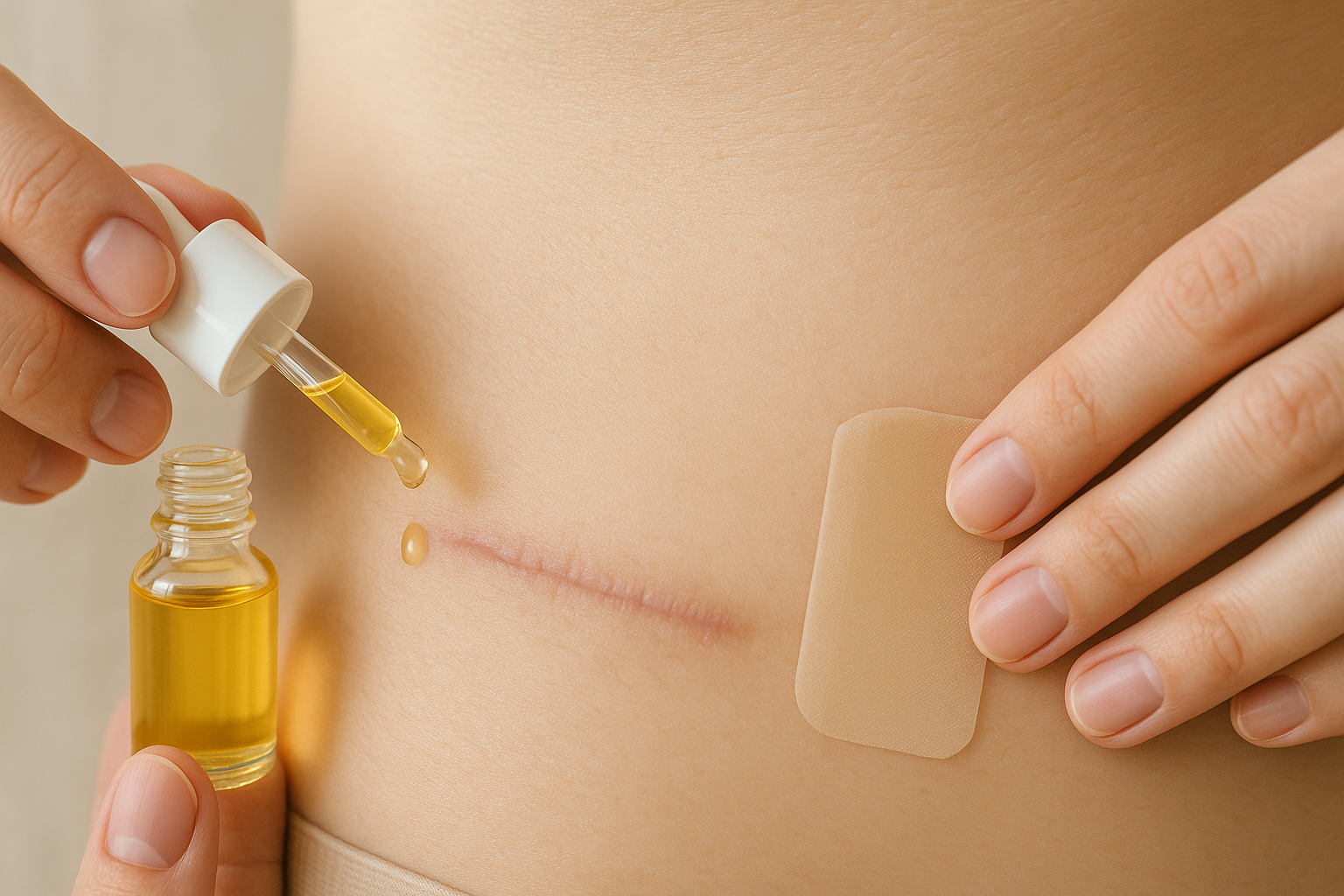
Yes — but not stacked on top of each other in the same moment. Silicone gel and silicone sheeting don't work by being absorbed; they work by sitting in direct contact with the scar and slowing water loss from its surface. Anything you put underneath — a scar oil, a body butter, an emollient cream, even yesterday's residue — sits between the silicone and the skin, and a sheet also needs bare, clean skin to stay put at all. So the rule isn't "which one first," it's "which one now." Put them in different parts of the day: silicone for a continuous block of about 12 hours, and your massage-and-conditioning step in the hours the silicone is off, with the skin washed and dried in between.
That off-silicone window is a real slot in the routine, not a consolation prize — hospital scar protocols ask for massage with a lubricating medium two or three times a day, and something has to do that job. A water-free lipid concentrate such as ScarDerma Pro is one example of a product built for exactly that slot: enough slip to massage with, no water to flash off, and no reason to be anywhere near your silicone.
Last updated: 4 August 2026
Why this question has no good answer online
Search it and you'll get a wall of contradictory advice, almost all of it published by companies that sell one of the two products. Some say apply the oil and let it absorb, then apply the sheet. Some say never layer anything. Some say alternate mornings and evenings. Some say moisturiser after, never before. None of them explain why, which is the only thing that lets you work out the answer for your own routine.
The why is simple, and once you have it the whole question resolves itself.
The mechanism: silicone is a cover, not a treatment that soaks in
This is the single fact that decides everything. Silicone sheeting does not deliver anything into the skin. Reviewing four decades of evidence in the Textbook on Scar Management, the plastic surgeon Thomas Mustoe — whose laboratory ran the original mechanistic work — records that the early studies specifically ruled out heat, pressure and absorption, and concludes that "silicone is not absorbed into the skin and covers intact epithelium," so any benefit "must be indirect through effects on the epithelium." What it does is reduce water loss through a scar whose surface barrier is still immature.
Cambridge University Hospitals' plastic surgery unit describes the same idea in patient language: silicone "creates a protective barrier over the scar," and "the silicone layer also assists with hydration of the scar therefore helping to relieve itching and discomfort" (CUH NHS Foundation Trust, "Scar massage information").
A barrier only works where it touches. Three consequences follow, and they're the whole article:
- Anything underneath is in the way. An oil or cream film between the silicone and the scar is a second, leakier barrier occupying the exact interface the silicone needs.
- A sheet needs clean, dry skin to stay on. Mustoe notes that sheets are not completely self-adhering and generally need tape or clothing to hold them in place. Add a slick of oil and you are asking an already-marginal adhesive to grip a lubricated surface.
- Sealing an oil against skin is a different thing from applying it. A non-porous cover over an occlusive film traps sweat as well. DermNet lists "occlusion of the skin with non-porous dressings" as a direct cause of miliaria — the itchy 2–4 mm bumps of heat rash (DermNet, "Miliaria"). That's the mechanism behind most "my silicone sheet suddenly started itching" complaints, which we unpack separately in why silicone scar sheets itch.
Silicone gel — the pourable kind that dries in place — has the same requirement for a different reason. Memorial Sloan Kettering's patient guidance is simply to "apply it to your scar and let it dry" (MSKCC, "Caring for Your Scars After Skin Surgery"). A film that has to dry down into a continuous layer cannot do that on top of an emollient.
The compatibility matrix
Here is every pairing people actually ask about, with a verdict and the reason behind it. Nothing here is a brand rule; it all falls out of the mechanism above.
| Combination | Verdict | Why |
|---|---|---|
| Scar oil or cream under a silicone sheet | No | Blocks the contact the barrier depends on, defeats an adhesive that is already weak, and seals an oily film plus sweat against the skin — the classic recipe for heat rash and maceration |
| Scar oil or cream under silicone gel | No | The gel has to dry down onto skin to form a continuous film. It cannot set properly over an emollient layer |
| Silicone gel under a silicone sheet | No benefit, real downside | You are already getting occlusion from the sheet; the wet gel underneath only compromises adhesion. The documented effective dose is hours of contact, not layers of product |
| Sunscreen or makeup over fully dried silicone gel | Yes | MSKCC explicitly notes silicone products can be used "under your makeup and clothing." Let the gel dry first, then apply SPF over the top |
| Scar oil or cream in the hours the silicone is off | Yes — this is the answer | Both jobs get done, neither interferes. This is what "using them together" should mean |
| Massage with an emollient, then wash, dry, then apply silicone | Yes | CUH's protocol already includes washing the area to remove previous moisturiser. Do that step and the silicone meets bare skin |
| Silicone sheet worn 24 hours a day to "make up" for a shorter routine | No | Mustoe found 24-hour wear "led to maceration and was poorly tolerated," with roughly 12 hours a day sufficient. More is not better |
| Either product on a wound that isn't fully closed | No | The FDA's intended use for silicone sheeting is closed hypertrophic and keloid scars, and CUH's massage precautions begin "do not massage open wounds" |
The step almost nobody mentions: wash the emollient off
If you take one practical thing from this article, take this. CUH's scar massage instructions open not with the massage but with the clean-up: "Wash and dry the area with soap to rinse off any previous moisturiser. This is to stop the pores of the skin becoming clogged." The same discipline is what makes a silicone-plus-emollient routine work at all — the silicone goes onto skin that has been washed and fully dried, not onto a scar that had oil massaged into it an hour ago.
The sheet needs the same treatment. Mustoe notes that sheets "pick up dirt and perspiration which makes cleaning or using new sheets essential," and both MSKCC and CUH confirm sheets can be washed and reused. So there are two washes in a well-run day, not one: the skin, and the sheet.
The 24-hour schedules
The reason people try to layer in the first place is that the two protocols look mathematically incompatible. Silicone wants around 12 hours a day for at least three months (CUH). Massage wants two to three sessions a day of about five minutes, for roughly six months, using a lubricating medium (CUH again; MSKCC's version is gentler at one to two minutes, one to three times a day). Stack those naively and you conclude you must be putting one thing on top of the other.
You don't. Twelve hours of silicone leaves twelve hours free. Here are three schedules that fit everything in — pick the one that matches your scar and your climate, and always defer to your own surgeon's instructions.
Plan A — sheet overnight (suits most body scars)
| Time | What you do |
|---|---|
| 7:00 | Remove the sheet. Wash the skin with mild soap, dry completely. Wash the sheet and leave it to air-dry for the day |
| 7:15 | Massage session one — around five minutes with your lipid or emollient: small circles, then along the scar, then across it |
| 8:00 | Broad-spectrum SPF 30+ on any part of the scar clothing won't cover |
| 13:00 | Optional second massage session, same medium |
| 20:00 | Final massage session |
| 21:30 | Wash the area with soap, dry it thoroughly — no residue, no dampness |
| 22:00 | Apply the dry sheet. Roughly nine hours' contact overnight; add a two- to three-hour block in a cool part of the day if you want the full twelve |
Plan B — gel by day, lipid by night (suits faces, hot climates, sweaty jobs)
| Time | What you do |
|---|---|
| 7:00 | Wash and dry the scar. Apply a thin layer of silicone gel and let it dry fully — a few minutes, until it isn't tacky |
| 7:10 | SPF 30+ over the dried gel; makeup over that if you wear it |
| Through the day | Reapply the gel as its instructions direct. No oils or creams over the scar while the gel is on |
| 21:00 | Wash the gel off with soap and dry the skin |
| 21:15 | Massage with your lipid concentrate and leave it uncovered overnight — nothing sealed, nothing to macerate |
Plan C — no silicone at all (mature scars, or skin that won't tolerate occlusion)
If your scar is over a year old, pale and flat, silicone's returns fall off sharply — Mustoe reported "much more impressive results in immature scars, with minor effects or no effect on mature scars (scars older than 1 year without erythema)." And if occlusion reliably gives you heat rash, forcing it is pointless. In that case the routine collapses to the two things that still apply: massage two to three times a day with a lubricating medium for as long as the scar is still changing, and sun protection. CUH advises sunscreen of SPF 30 or greater plus protective clothing, keeping the scar out of the sun for at least a year after surgery.
Timing: when either product should start at all
Both MSKCC and CUH put the start line at roughly the same place, and it is later than most people expect. MSKCC says most people can begin scar care about four weeks after surgery, after checking with their surgeon; CUH says start massage when the wound is completely closed, "usually around 4 weeks post-injury or surgery." Before that, standard wound care applies instead — the American Academy of Dermatology's guidance is to keep the wound clean, use petroleum jelly to keep it moist so a scab doesn't form, cover it with a bandage and change that daily (AAD, "Minimize a scar: proper wound care tips").
It's also worth knowing how long the window stays open. MSKCC notes a scar continues to mature for 12 to 18 months after surgery; CUH puts the outer limit at around two years, after which further fading is unlikely. That's the period your routine is actually working in — which makes it worth building one you can sustain rather than one you abandon in week three.
How strong is the evidence for silicone, honestly?
Worth knowing before you rearrange your day around it. The Cochrane review by O'Brien and Jones pooled 20 trials involving 873 people, finding that silicone gel sheeting reduced the incidence of hypertrophic scarring in scar-prone people (risk ratio 0.46) and reduced thickness and improved colour in treatment studies — while concluding the trials were "of poor quality and highly susceptible to bias." The FDA, when it classified silicone sheeting as a Class I device exempt from premarket notification, went further, stating that the literature "does not demonstrate that silicone sheeting alone alleviates the symptoms or improves the appearance" of these scars (69 FR 48146, codified at 21 CFR 878.4025). It classified the device as low-risk, not as proven.
So: a sensible, low-risk, moderately-evidenced option that is worth doing properly if you're going to do it — and not worth mangling your whole routine, or your skin, to squeeze in. That is exactly why the scheduling answer beats the layering answer.
Five mistakes that make the combination fail
- Applying the sheet over a freshly oiled scar. It slides, it lifts at the edges, and the barrier never makes proper contact.
- Skipping the wash. Residue is invisible and still counts as a layer.
- Applying silicone to damp skin. "Dried with a towel" and "dry" are not the same thing; give it a couple of minutes.
- Wearing the sheet round the clock to compensate for a missed massage. The two aren't interchangeable, and 24-hour wear is where maceration comes from.
- Massaging hard enough to redden the skin. CUH's precautions are explicit: don't rub to cause friction, and stop if the skin becomes sore, inflamed, blistered or rashy, or if the wound reopens.
What to use in the silicone-free hours: ScarDerma Pro
Every protocol above has the same gap in it: massage needs a medium, and the leave-on hours need something conditioning that isn't going under a seal. CUH suggests an un-perfumed, oil-based cream for the massage itself. A concentrated botanical lipid does the same job with less bulk and no water content.
ScarDerma Pro is a 100% water-free (anhydrous) botanical lipid concentrate, formulated by S. C. Aris, and it fits the off-silicone slot precisely. Because there is no water in it, nothing flashes off the surface mid-massage — the lipids stay where you put them, giving steady slip for the full five minutes and remaining as a leave-on conditioning layer afterwards. Being anhydrous also means it is preservative-free by design. Its purpose is cosmetic: supporting the appearance of smoother, softer, more even-looking scars and stretch marks while the scar matures on its own timetable.
The blend leads with four actives — immortelle helichrysum, rosehip seed, tamanu and pomegranate seed — supported by Japanese camellia, geranium, English lavender and hemp seed, on a lipid base of sea buckthorn, calendula, jojoba, hazelnut and vitamin E. Rosehip seed is a natural source of trans-retinoic acid, sometimes called "natural tretinoin," which small studies have linked to modest improvement in the look of skin texture; pomegranate seed has been shown to stimulate keratinocyte renewal in the epidermis (Aslam et al., J Ethnopharmacol, 2006). There are no harsh acids or peels, no drying agents, no artificial fragrance, no parabens and no fillers; it is vegan and non-GMO.
In a customer survey, 91% said their marks looked flatter and smoother within six weeks and 94% said they would recommend it. It is rated 4.91 out of 5 from 34 verified buyers and backed by a 90-day guarantee, which comfortably covers the three-month block a silicone course is usually run for. See ScarDerma Pro →
An honest boundary: ScarDerma Pro is a cosmetic, not a medical device, and it is not a substitute for silicone therapy where a clinician has recommended it. It is the other half of the day, not a replacement for the silicone half.
More from our scar cluster: why silicone scar sheets itch · why is my scar still red? · reducing the appearance of a C-section scar · do old scars ever fade?
Frequently asked questions
Can I put scar oil under a silicone sheet?
No. Silicone is not absorbed — it works by sitting in direct contact with the scar and slowing water loss from its surface, so an oil film underneath occupies the interface it needs. It also lubricates a surface the sheet has to stick to, and seals an oily layer plus sweat against the skin, which is a common route to heat rash and soggy, macerated skin. Use the oil in the hours the sheet is off.
Which goes on first, silicone gel or moisturiser?
If they have to be in the same session, the silicone goes on first, onto clean dry skin, and is allowed to dry completely — then sunscreen or makeup can go over the top. But the better answer is not to put them in the same session at all: silicone during its wear block, moisturiser or lipid during the off hours, with a wash and full dry in between.
How long should I wait after applying silicone gel before putting anything else on?
Until it is properly dry rather than tacky — patient guidance is simply to apply it and let it dry, which takes a few minutes. Sunscreen and makeup over a dried silicone film are fine; silicone products are routinely used under both.
Can I use a silicone sheet and silicone gel at the same time?
There is no documented benefit to layering them, and the wet gel undermines the sheet's already-limited adhesion. What matters is hours of contact, not layers of product — around 12 hours a day was sufficient in the original controlled work, with 24-hour wear causing maceration.
Do I really need to wash the moisturiser off before the silicone goes on?
Yes, and it's an explicit step in NHS scar protocols: wash and dry the area with soap to remove any previous moisturiser before working on the scar. Residue you can't see still sits between the silicone and the skin, and damp skin under an occlusive cover is its own problem.
When can I start using scar oil and silicone after surgery?
Typically around four weeks, once the wound is completely closed, and after checking with your own surgeon — that is the point given by both Memorial Sloan Kettering and Cambridge University Hospitals. Until then, follow standard wound care: clean, moist, covered, bandage changed daily.
Is it too late if my scar is old?
For silicone specifically, returns drop off a lot on mature scars — the original clinical work found minor effects or none on scars older than a year with no redness. Massage, conditioning and sun protection still apply, but expectations should be set around comfort and appearance rather than remodelling.
This article is general information, not medical advice, and does not replace your surgeon's or dermatologist's instructions for your specific wound. ScarDerma Pro is a cosmetic product intended to support the appearance of skin; it is not intended to diagnose, treat, cure or prevent any condition. If a scar is raised, growing, painful, infected or changing, see a doctor or board-certified dermatologist.
Sources
- Mustoe TA. Silicone Gel for Scar Prevention. In: Téot L, Mustoe TA, Middelkoop E, et al., eds. Textbook on Scar Management. Springer; 2020, ch. 23. NCBI Bookshelf NBK586090
- Cambridge University Hospitals NHS Foundation Trust, Plastic Surgery. Scar massage information. Approved 30 May 2023. cuh.nhs.uk
- Memorial Sloan Kettering Cancer Center. Caring for Your Scars After Skin Surgery. Last updated 28 June 2024. mskcc.org
- O'Brien L, Jones DJ. Silicone gel sheeting for preventing and treating hypertrophic and keloid scars. Cochrane Database of Systematic Reviews 2013, Issue 9, CD003826. Cochrane
- US Food and Drug Administration. General and Plastic Surgery Devices; Classification of Silicone Sheeting. Final rule, 69 FR 48146 (9 August 2004); 21 CFR 878.4025. Federal Register
- American Academy of Dermatology. Minimize a scar: Proper wound care tips from dermatologists. aad.org
- DermNet. Miliaria (heat rash). Oakley A, Eshraghi A. dermnetnz.org
- Aslam MN, Lansky EP, Varani J. Pomegranate as a cosmeceutical source. J Ethnopharmacol 2006;103(3):311–8. ScienceDirect