Is It Dry Skin or Eczema? The 5 Clues That Tell Them Apart — and the One-Week Test
Last updated: 11 September 2026
Why Dry Skin and Eczema Are So Easy to Confuse
Both start at the same place: the skin barrier. The outermost layer of skin, the stratum corneum, is built like brickwork — corneocytes as the bricks, a mortar of lipids between them. As StatPearls’ review of moisturizers sets out, the major lipids in that mortar are ceramides, cholesterol and free fatty acids, and healthy stratum corneum holds only 10–30% water compared with 75–85% in the living layer beneath it. That steep gradient is the barrier. Below a critical water concentration, the enzymes that normally dissolve the links between skin cells stop working, cells pile up instead of shedding, and you get the familiar result: flaking, roughness, tightness after washing.
This is also why moisturizers work at all. Occlusives sit on top and slow evaporation — petrolatum, the most effective of them, reduces water loss through the epidermis by nearly 99%. Humectants such as glycerin and hyaluronic acid pull water into the surface, though StatPearls adds a caveat worth knowing: some humectants can increase water loss and make dryness worse if they are not paired with an occlusive.
Ordinary dry skin is that barrier problem and nothing more — a state your skin is in, usually because of weather, water or products. Eczema is different in kind, not just degree. The NHS describes atopic eczema as a condition that “cannot be cured, but treatment can help manage the symptoms,” with a clear familial pattern and a list of triggers that runs well beyond weather: soaps and detergents, pets, certain fabrics, pollen, house-dust mites, heat and temperature swings, skin infections, stress and hormonal changes. Dryness is one of its features, which is exactly why the two get mistaken for each other — but dryness is the whole story in one case and only a symptom in the other. The same flaky-looking patch can need nothing more than a better moisturizer on one person, and a doctor’s care on another.
The 5 Clues That Tell Dry Skin From Eczema
No single sign settles it. Together, these five behave very differently in the two situations.
1. Which came first — the itch or the flakes?
With ordinary dryness, you usually notice the look and feel first — tightness, flaking, rough patches — and any itch is mild and occasional. Eczema tends to run the other way. The AAD puts it plainly: atopic dermatitis “is often called the ‘itch that rashes’… It tends to start suddenly with very itchy skin. Scratching the itchy skin often causes a rash.” Itch that is intense, hard to ignore, or reliably worse in the evening is an eczema-pattern clue rather than a dryness one — and the AAD notes that trouble sleeping is common in people who have it.
2. Where it shows up — and whether it keeps coming back there
Dry skin follows exposure: shins after hot showers, cheeks after a windy walk, hands in winter. Eczema follows a body map, and the map shifts with age (the table below sets out what the authorities actually say, because most articles get this part wrong). The more telling half of this clue is recurrence. The AAD notes that eczema flare-ups “can come and go for years” and “can also occur in the same place again and again.” A patch that keeps reappearing in one spot while the rest of your skin behaves normally points away from simple dryness.
3. How fast moisturizer works — and whether it lasts
This is the most practical clue. Ordinary dry skin responds to consistent moisturizing within days, and stays better as long as you keep up the basics. An eczema-prone patch often improves only partially, and rebounds quickly when you pause the routine — which is why the NHS advice for eczema is to moisturize at least twice a day and to “continue to moisturise even if your eczema improves.” Short-term comfort followed by the same patch flaring again is a pattern worth taking seriously.
4. What it looks like up close
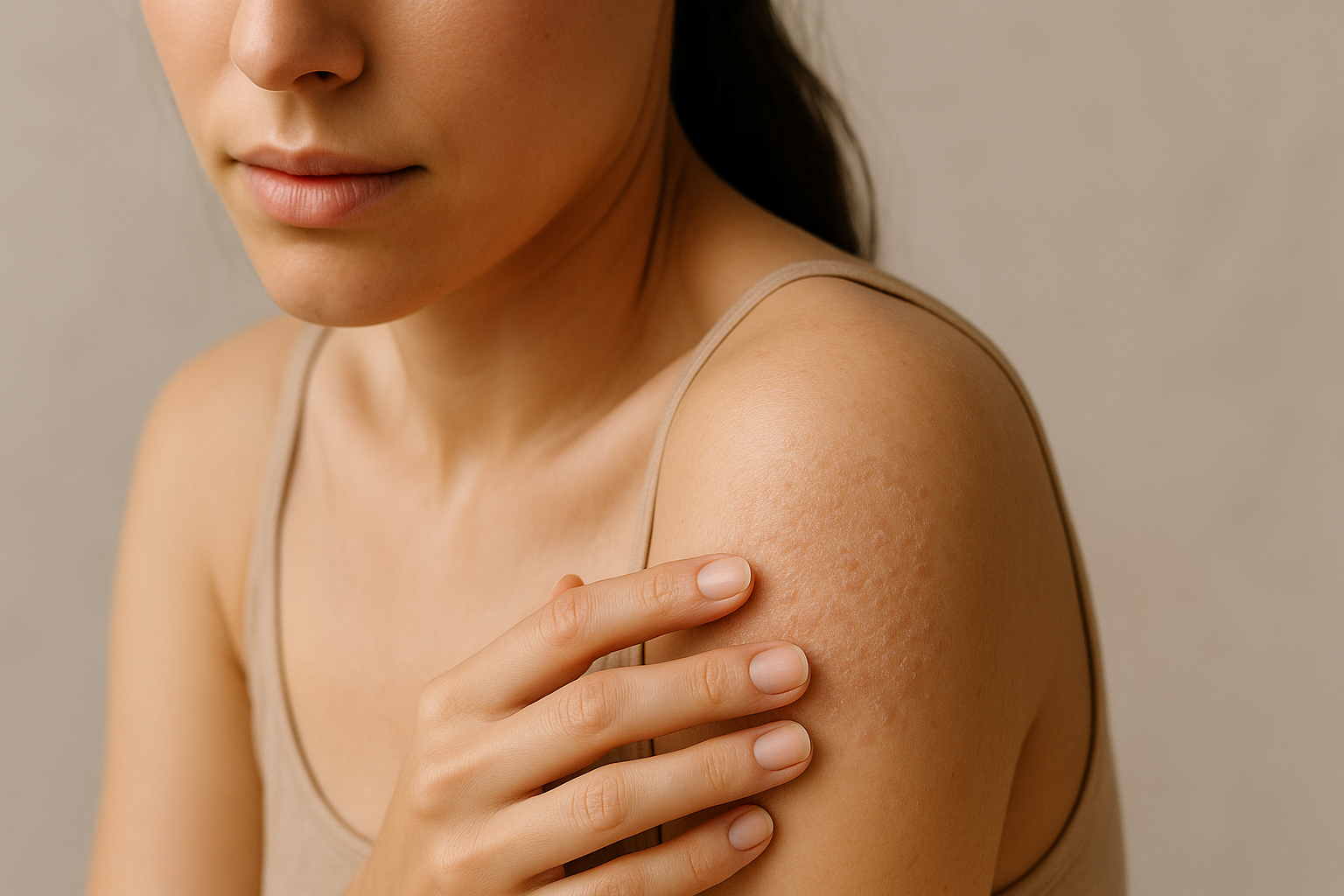
Dryness tends to produce fine, fairly even flaking over a wider area. Eczema produces defined patches that look and feel different from the skin around them. The AAD’s symptom list includes scratch marks, raw skin from scratching, bumps or rashes leaking fluid, and blisters that ooze and crust over; over time, skin can become “thickened, scaly, and leathery” and cracked, and that thickened skin “tends to itch most of the time,” even between flares.
Colour is a less reliable guide across skin tones, and this is where a lot of self-diagnosis goes wrong. The AAD lists red rash as typical of lighter skin tones, but on darker skin tones the more common presentations are “small, rough bumps” and “dark brown, purple, or grayish areas of skin.” The NHS says much the same: eczema can look red, white, purple or grey, or simply lighter or darker than the surrounding skin. If you are looking for redness and not finding it, that is not evidence against eczema.
5. Your history
Ordinary dryness usually has an obvious trigger and a season. An eczema pattern usually has a family tree. The NHS is specific about who is more likely to have atopic eczema: people with one or both parents who have it, and people who — or whose close family members — have asthma or hay fever. It also notes that symptoms usually start in babies and young children and tend to improve with age, and that flares track stress and hormonal changes as much as weather. None of this proves anything on its own. A yes to several, alongside the clues above, makes a professional opinion worthwhile.
| What to watch | Ordinary dry skin | Eczema-prone pattern |
|---|---|---|
| Itch | Mild, occasional; rarely affects sleep | Often the first sign; can be intense; trouble sleeping is common |
| Location | Exposure areas: shins, cheeks, hands in winter | Elbows, knees and hands (see the by-age table below); returns to the same spots |
| Moisturizer response | Clear improvement in days; holds with basic care | Partial improvement; rebounds fast when the routine lapses |
| Up close | Fine, even flaking over a wide area | Defined patches; scratch marks; thickened, leathery skin; may weep or crust in flares |
| Colour | Normal skin tone, just dull or ashy | Red on lighter skin; rough bumps or brown, purple or grey patches on darker skin |
| Pattern over time | Seasonal or situational, with an obvious trigger | Flares come and go for years; family history of eczema, asthma or hay fever |
Where Eczema Actually Shows Up — by Age
Almost every article on this question gives one body map and implies it applies to everyone. It does not, and getting this wrong is the single most common reason people talk themselves out of an eczema pattern. Here is what the authorities actually say.
| Age | Where it typically appears | Source |
|---|---|---|
| Babies & young children | Cheeks, forehead or scalp first; later the trunk, legs or arms | AAD; NHS (face is common in babies and toddlers) |
| Age 2 to puberty | Creases of the elbows and backs of the knees on lighter skin; fronts of the knees, elbows and backs of the hands on darker skin. Also neck, wrists and ankles. Children with brown or black skin are more likely to have it on the trunk | AAD |
| Adults | Hands — and the AAD notes the hands may be the only place adults have it. Also thickened, discoloured skin around the eyes, which adults get more often than children. For some people the childhood crease pattern simply carries on | AAD; NHS (common on elbows, knees and hands) |
The takeaway: the elbow-and-knee-crease picture that dominates search results is mostly the childhood pattern. If you are an adult with a stubborn, recurring, itchy patch on your hands or around your eyes and clear creases, that does not rule eczema out — it is the classic adult presentation. Atopic dermatitis can also begin for the first time in adulthood.
The One-Week Test You Can Run at Home
A short, structured week is often enough to sort one from the other. The idea is to remove every variable except basic barrier care, then watch how your skin responds. The steps below follow the AAD’s published tips for relieving dry skin.
- Simplify. One gentle cleanser, used only where you need it — the AAD advises applying enough to remove dirt and oil but not so much that you see a thick lather. Then a plain moisturizer, applied several times a day. Pause scrubs, peels and new actives for the week.
- Go fragrance-free, not “unscented.” The AAD recommends products labelled fragrance-free, and warns that “unscented” products can contain chemicals that neutralize or hide the odour of other ingredients — chemicals which can themselves irritate dry, sensitive skin. It also advises dropping alcohol and retinoids from the routine while skin is overly dry. (More on what that word hides: what “parfum” on a label actually means, and what alcohol denat does to skin.)
- Shower smart. The AAD says to limit baths and showers to five to ten minutes using warm — not hot — water, then “gently pat your skin dry and immediately apply your fragrance-free moisturizer” while the skin is still damp. Rubbing dry can irritate very dry skin.
- Choose a cream or ointment over a lotion. The AAD is direct on this: ointments and creams add more moisture and are more effective than lotions. Its list of ingredients worth looking for includes jojoba, glycerin, hyaluronic acid, lactic acid, dimethicone, shea butter and petrolatum.
- Cut friction. Loose cotton clothing rather than tight leggings or body-hugging jeans; a cotton or silk layer under anything rough; gloves for wet work; nails kept short.
- Track three things each evening. Itch (0–10), where any rough or discoloured patches sit, and whether last night’s sleep was disturbed. Photos of the same areas on day 1 and day 7, in similar light, beat memory.
Reading the result. Steady, visible improvement that holds — you were most likely dealing with ordinary dryness; keep the gentle routine and adjust with the seasons. Patches that persist in the signature spots, itch that stays frequent or disturbs sleep, or a quick rebound the day you skip moisturizer — that is an eczema-type pattern, and a doctor or dermatologist is the sensible next step. The AAD sets the threshold simply: if dry skin continues after you have tried the tips dermatologists recommend, it is time to see a board-certified dermatologist, because the dryness may be driven by an underlying condition such as atopic dermatitis, psoriasis or kidney disease.
One more thing to watch during the week. If any product — moisturizer included — causes burning, stinging or irritation, the AAD says to tell your dermatologist rather than push through it. Our guide to why serums sting explains how to read that reaction and time it.
Does Dry Skin Cause Eczema — or Just Set It Off?
A common worry sits behind this question: if I let my skin stay dry, will it turn into eczema? The honest answer is no. Dryness alone does not create eczema. The predisposition is largely inherited — which is why the NHS frames the risk in terms of parents and family history of asthma and hay fever — and no amount of dryness rewrites that.
What dryness does do is lower the threshold. When the barrier is depleted, water escapes faster and everyday irritants reach living skin more easily. For someone who is not predisposed, that means tightness and flaking. For someone who is, it means ordinary exposures are more likely to tip a quiet patch into a visible flare — and soaps, detergents and certain fabrics sit at the top of the NHS trigger list. That is why the standard advice for eczema-prone skin starts with the same unglamorous basics as dry-skin care, even though those basics manage the terrain rather than change the underlying condition. StatPearls puts the stakes plainly: in conditions with impaired barrier function such as atopic dermatitis, diligent moisturizer use is “a fundamental component” of treatment, and consistent use has been shown in randomized trials to reduce symptoms and the frequency of flares. You cannot choose your genes; you can choose how much extra load your barrier carries.
One specific warning worth repeating, because it catches people out: the NHS advises against using aqueous cream, “as it can irritate the skin and make eczema worse.” It is still sold and still widely assumed to be the gentle option.
When It’s Neither: The Look-Alikes
Two other patterns are worth ruling out before you settle on either answer.
Contact dermatitis. A rash that appears after touching something specific — a new detergent, a nickel watch back, a fragranced product — and stays confined to where the contact happened is more consistent with contact dermatitis. Mayo Clinic notes that it “shows up on skin that has been directly exposed to the substance causing the reaction,” can develop within minutes to hours, and typically lasts two to four weeks — and that if you identify and avoid the cause, the rash usually clears in that window. Common culprits on Mayo’s list include nickel, formaldehyde in preservatives, personal care products, and Balsam of Peru, which turns up in perfumes, toothpastes and mouth rinses. Avoiding the trigger is the main fix.
Texture rather than itch. If your main complaint is small rough bumps on the upper arms or thighs rather than itchy patches, that is a different sorting job — covered in our guide to what dry-skin bumps actually are. And dryness concentrated around the lips and chin has its own usual suspects, starting with your toothpaste: see why the skin around your mouth gets so dry.
When to See a Doctor
Do not finish the one-week test first if any of the following apply. The AAD’s list of signs a rash needs medical attention is short and worth memorising: a rash over most of your body; a rash that blisters or turns into open sores or raw skin; fever or illness with a rash; a rash that spreads rapidly; a painful rash; or a rash involving the eyes, lips, mouth or genital skin.
The NHS adds an urgent-care trigger specific to eczema: seek an urgent GP appointment or NHS 111 help if eczema is “blistered, crusty, leaking fluid or has spots filled with pus,” is “painful, swollen or feels warm,” suddenly gets worse or bigger, or comes with a high temperature or feeling generally unwell. These can be signs of infection or of eczema herpeticum, which needs treatment. Golden or yellowish crusting is a specific flag — the AAD advises contacting a dermatologist’s office, as it often indicates a staph infection.
Beyond the urgent signs, two quieter thresholds matter: itch that regularly disturbs your sleep, and a consistent run of gentle basic care with nothing to show for it. Eczema is common, very manageable, and much easier to live with once it is actually diagnosed. There is no prize for toughing it out with moisturizer alone.
Where SD7 Lipid Serum Fits In — and Where It Does Not
It is worth being blunt about what a cosmetic can and cannot do here, because this is precisely the question where skincare marketing tends to overreach.
If your skin is showing an eczema pattern — intense or sleep-disturbing itch, defined patches that keep returning to the same places, weeping or crusting — the right next step is a doctor, not a skincare purchase. No cosmetic treats eczema, and SD7 Lipid Serum is no exception. It should not be applied to broken skin or to anything that looks like an active flare.
Where dryness really is just dryness — flaking and tightness that track the weather and your wash routine, with none of the eczema clues above — a lipid-based serum has a rational place in the routine, and the reasoning follows straight from the barrier science at the top of this page. The mortar between your skin cells is made of lipids. SD7 is a 100% anhydrous formula: no water phase at all, which means no preservative system is needed, and every drop is botanical lipid rather than the water that makes up the bulk of a conventional serum. Instead of evaporating off the surface, an anhydrous lipid concentrate saturates the stratum corneum, supporting the look and feel of smoother, plumper-looking skin. Its base leans on jojoba wax esters — structurally close to the skin’s own surface lipids, and the first ingredient on the AAD’s own list of what to look for in a moisturizer for dry skin — alongside argan, sunflower, triple-blend rosehip seed, black cumin seed, pomegranate seed, Japanese camellia, virgin sea buckthorn, calendula, coriander and bakuchiol as 99.9% pure Sytenol® A.
Now the honest caveat, because this article would be worth nothing without it. SD7 is not fragrance-free and we will not claim it is. It contains sweet orange and lavender as aromatic botanicals, and those naturally carry compounds — limonene and linalool among them — that appear on the EU’s list of individually labelled fragrance allergens. The AAD explicitly advises people with overly dry, sensitive skin to avoid fragrance. If your skin is reactive, if you are mid-way through an elimination routine, or if you suspect eczema at all, take that seriously: patch-test a small area first, and read how to time a reaction before committing to it.
What we can tell you about the formula is verifiable. SD7 Lipid Serum is developed by formulator S. C. Aris, and its fatty-acid ratios are audited using the patent-pending Vouchly AI system (GB2603970.1). It is rated 4.89 out of 5 from 35 verified buyers, is vegan and made in the UK to GMP standards, and is backed by a 90-day money-back guarantee — which, for a product you should be trialling cautiously on a small area first, is the part that actually matters. See the full SD7 Lipid Serum formula.
SD7 Lipid Serum is a cosmetic product. It supports the appearance of smoother, more supple-looking skin. It does not treat, cure or prevent eczema, dermatitis or any other medical condition. If your skin is reacting, or a rash is not settling, see a doctor or dermatologist.
Related reading: do face oils actually absorb, or just sit on top? · reading preservative doses off a label · why pores get bigger with age
Frequently Asked Questions
Can dry skin turn into eczema?
No. Dryness alone does not create eczema, which involves an inherited predisposition and an overactive inflammatory response — the NHS frames the risk in terms of whether a parent has eczema, or whether you or a close family member has asthma or hay fever. But in people who are prone to it, persistently dry skin lowers the threshold, so everyday irritants become more provocative. Consistent moisturizing is worthwhile either way; it just is not a guarantee against eczema.
How can I tell eczema from dry skin on darker skin tones?
Rely on behaviour more than colour. The AAD notes that on darker skin tones, eczema more commonly shows up as small, rough bumps and as dark brown, purple or grayish areas of skin rather than a red rash. The clues that hold across all skin tones are itch that arrives first, patches that return to the same spots, thickened or leathery texture, and quick rebound after stopping moisturizer.
Where does eczema appear in adults?
Most often on the hands — the AAD notes the hands may be the only place adults have it — and around the eyes, where adults are more likely than children to develop thickened, discoloured skin. The elbow-and-knee-crease pattern that dominates search results is mainly the childhood presentation, though it carries on into adulthood for some people. Atopic dermatitis can also start for the first time in adulthood.
How long should I try moisturizer before seeing a doctor?
A week or two of consistent, gentle care is a fair trial for ordinary dryness. The AAD’s own threshold is simpler: if dry skin continues after you have tried the tips dermatologists recommend, see a board-certified dermatologist, because an underlying condition may be driving it. Go sooner if skin weeps, crusts or cracks painfully, if a rash spreads, blisters or hurts, or if itch is disrupting your sleep.
Do I need fragrance-free products if I think I am eczema-prone?
It is the safer default. The AAD recommends products labelled fragrance-free for dry, sensitive skin, and warns that “unscented” is not the same thing — unscented products can contain masking chemicals that irritate. Cutting fragrance also removes a variable while you work out what your skin is doing. If a product stings or burns on application, stop using it on that area and tell your dermatologist.
Is a cream better than a lotion for dry skin?
Generally yes. The AAD states that ointments and creams add more moisture to skin and are more effective than lotions, and suggests looking for ingredients such as jojoba, glycerin, hyaluronic acid, lactic acid, dimethicone, shea butter or petrolatum. One caution from the NHS: avoid aqueous cream, which can irritate the skin and make eczema worse.
Is SD7 Lipid Serum suitable for eczema?
No. SD7 Lipid Serum is a cosmetic for ordinary dry, rough-feeling skin, designed to support the look and feel of the skin’s surface lipid layer. It is not a treatment for eczema or any diagnosed skin condition, and it should not be applied to broken skin or active flares. If your skin is reactive, patch-test first — the formula contains aromatic botanicals including sweet orange and lavender, and is not fragrance-free.
Sources
- Harwood A, Nassereddin A, Krishnamurthy K. “Moisturizers.” StatPearls [Internet], updated 12 February 2024 (PMID 31424755) — ncbi.nlm.nih.gov
- American Academy of Dermatology, “Eczema types: Atopic dermatitis symptoms” (reviewed by Kaye, Moshiri & Peebles; last updated 10 October 2023) — aad.org
- American Academy of Dermatology, “Dermatologists’ top tips for relieving dry skin” (last updated 2 January 2026) — aad.org
- American Academy of Dermatology, “Signs your rash needs medical attention” — aad.org
- NHS, “Atopic eczema” (page last reviewed 6 September 2024) — nhs.uk
- Mayo Clinic, “Contact dermatitis — Symptoms and causes” (2 May 2024) — mayoclinic.org
This article is for general information and is not a substitute for professional medical advice, diagnosis or treatment. SD7 Lipid Serum is a cosmetic product. If you are concerned about persistent dryness, itching, rashes or any other skin change, please consult a doctor or dermatologist.