Can You Reduce Gum Pocket Depth Naturally? What Moves the Numbers — and What Doesn't
Last updated: 29 August 2026
If your dentist has read out numbers — "three… three… five here… four" — and you've gone home wondering how to make them smaller without anything drastic, this guide is for you. "Reduce pocket depth naturally" is one of the most searched gum-health questions, and most answers either promise too much or explain too little.
Here's the honest version: some of what the probe measures responds to daily habits, and some of it only responds to professional care. Knowing which is which saves you months of guessing. (If you first want the basics of what a pocket actually is and how dentists clean one, start with our guide to gum pockets and how they're really cleaned — this article is about the measurements and what genuinely moves them.)
What the probe is measuring — and what counts as deep
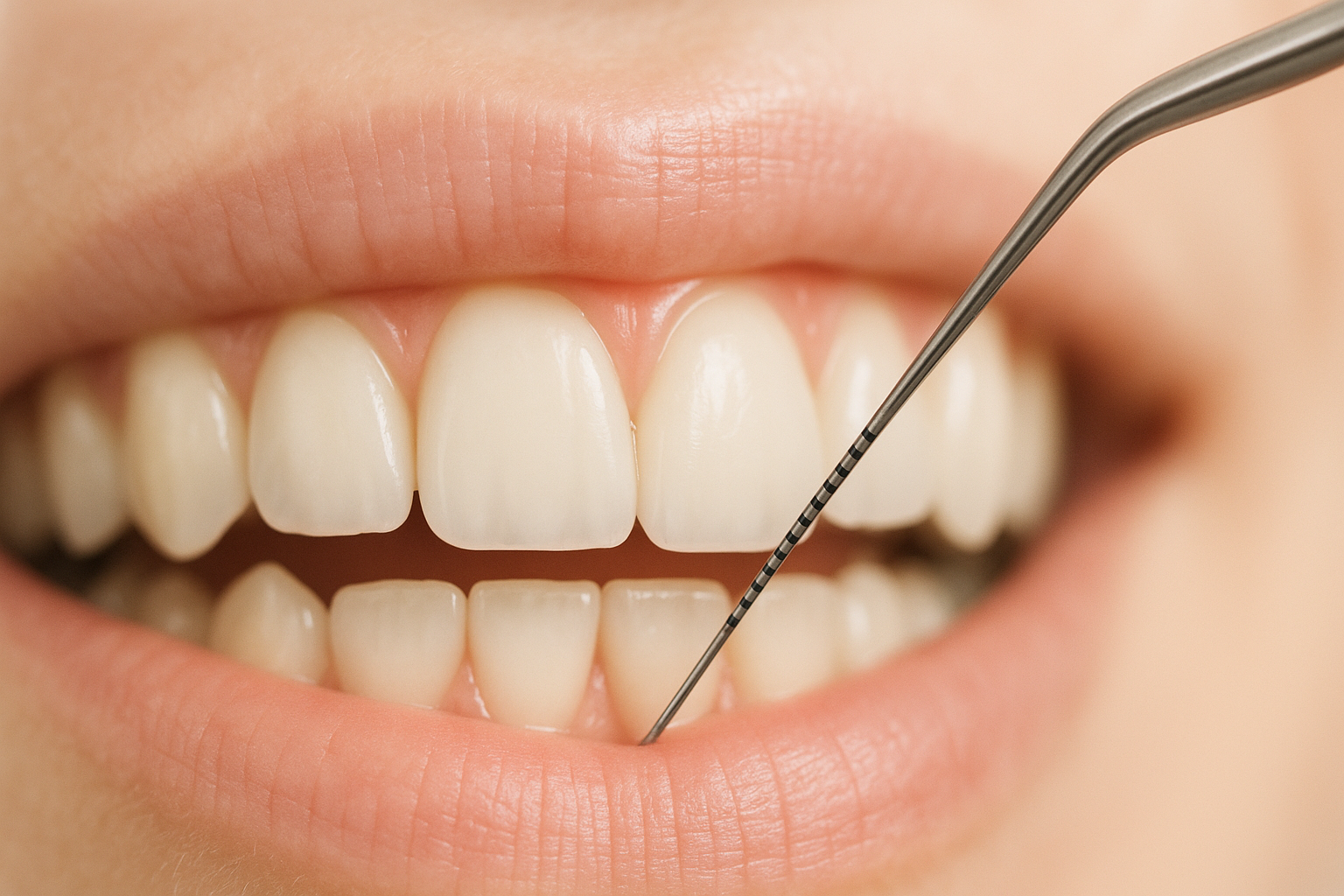
At a periodontal exam, a thin probe with millimeter markings slides gently into the groove where your gum meets each tooth, and the depth at which it stops is recorded — usually at several points per tooth. In healthy gums, the National Institute of Dental and Craniofacial Research puts that natural groove at 1 to 3 millimeters. Readings of 4 mm or more suggest the gum has begun to detach and a pocket has formed — one of the signs of periodontal disease, which NIDCR estimates affects nearly half of adults aged 30 and older in some form.
Those recorded numbers are the backbone of how your dentist tracks your gums over time — the full picture, including how charting and x-rays fit together, is covered in the "how your dentist confirms the stage" section of our guide to how gum disease is treated. For this article, one thing matters: the number is a measurement, not a verdict. And measurements have moving parts.
Why the same pocket can measure differently
Probing depth blends two different things into one number: where the gum's attachment to the tooth actually sits, and how swollen the tissue above it is on the day you're measured.
That second part matters more than most people realize. An inflamed gum margin puffs upward and outward, so the probe travels further before it stops — the reading deepens. Calm that inflammation with consistent plaque removal, and the margin shrinks back down; the probe stops sooner, and the reading improves. The attachment underneath didn't move — the swelling did.
This is why "my pockets went from 4 to 3" after a few good weeks is both real and worth celebrating, and also why it isn't the same as rebuilding lost support. A smaller number can mean calmer tissue, genuinely healthier gums, and a mouth that's easier to keep clean — without meaning the deeper structures regrew. Both kinds of change matter; they're just different things, and an honest routine plans for both.
The two levers that actually lower the numbers
Everything that legitimately improves probing depths comes down to two levers, and they work best in order.
Lever one: professional cleaning below the gum line. Once a pocket is established, plaque hardens into tartar (calculus) on the root surface inside it — and no home tool reaches it. Scaling and root planing removes those deposits and smooths the root so the tissue can settle and tighten against the tooth; deeper or stubborn sites may need more, which your dentist will map out. This is the lever that moves genuinely deep readings, and there's no natural substitute for it.
Lever two: daily disruption of plaque at the entrance. This is the natural part, and it's not a consolation prize — it's what decides whether the margin stays calm, whether shallow sites stay shallow, and whether the results of a professional cleaning hold between visits.
| What your chart shows | What realistically moves it |
|---|---|
| Healthy 1–3 mm sites | Daily care keeps them there — this is prevention working |
| 3–4 mm sites with bleeding or puffiness | Often settle over a few weeks of consistent gentle cleaning, ideally alongside a professional clean |
| Established 4–5 mm pockets | Scaling and root planing first; daily care maintains the result |
| 6 mm and beyond | Periodontist territory — deeper cleaning, sometimes surgical access; home care supports, never substitutes |
The daily routine that does the natural part
- Brush gently twice a day with a soft brush angled toward the gum line — light, short strokes for two minutes. Pressure is not the point; reaching the margin is.
- Clean between your teeth once a day, with tools that fit. Interdental brushes where spaces allow, floss where contacts are tight — a large 2019 Cochrane review found brushes may reduce gum inflammation more than floss, though the evidence is low-certainty. Sizing is the whole game, and we've covered it in detail in interdental brushes vs floss for gum pockets.
- Clean your tongue back to front — it helps with the freshness side of the equation.
- Spit, don't rinse after brushing, so fluoride stays in contact with your teeth.
- Starve the plaque between cleanings. Frequent sugary snacks and all-day acidic sipping feed the film you're working to remove; water and fewer grazing hits make the same routine go further.
- Deal with the multipliers. Smoking is one of the strongest drivers of worsening gum health — the CDC covers the link and quitting support — and conditions like diabetes and dry mouth from medications change how your gums respond, so make sure your dental team knows about them.
What doesn't move the numbers
Just as useful is knowing where effort gets wasted. Rinses on their own — salt water, mouthwash, or oil pulling — can soothe and freshen, but liquid swishing doesn't remove the attached plaque and tartar that drive the readings; they're extras on top of mechanical cleaning, never the engine. Scrubbing harder doesn't clean deeper — it damages the gum edge you're trying to protect (see what brushing too hard does to gums). Products that claim to clean out deep pockets deserve real skepticism: as we explain in our gum-pockets guide, the base of a deep pocket is beyond every home tool and topical, whatever the label says. And skipping the hygienist while pockets are active quietly caps your progress — tartar that stays put keeps the margin irritated no matter how well you brush.
A realistic timeline — and how to verify it
With a consistent routine, bleeding on brushing or interdental cleaning typically eases within the first one to two weeks — that's the margin calming down. Puffiness settles over the following weeks. The honest way to confirm what it did to your numbers is repeat charting: keep the routine steady for four to six weeks or more, then ask your dental team to re-measure so you're comparing like with like. If you've had scaling and root planing, your dentist will usually re-check the treated sites after healing and may recommend maintenance visits every three to four months to keep them stable.
When "naturally" isn't the answer
Some findings mean the home-care window has passed for those sites: several readings of 5 mm or more, bleeding that persists beyond a couple of weeks of good care (see why gums bleed), a tooth that feels loose, a change in your bite, pus, or a persistently bad taste. None of these are reasons for despair — they're reasons for a periodontal evaluation, where treatment works best. And if you're at the other end of the curve and just noticing the first signs, our guide to early gum disease shows you what to look for while everything is still easy to change.
📋 Please note: Dental Pro 7 is a daily-care cosmetic concentrate that supports the appearance of healthy-looking gums. It does not treat gum conditions, does not clean gum pockets, and will not change probing measurements — it complements professional dental care, never replaces it.
Where Dental Pro 7 fits
Everything above is mechanical: tools and professionals physically removing plaque and tartar. What none of it does is leave anything behind — toothpaste and mouthwash are water-based, so saliva dilutes them and they're gone from the gum line within moments.
Dental Pro 7 is designed for that last step. It's a 100% water-free botanical lipid concentrate — built on extracts including immortelle helichrysum, pomegranate seed, black cumin seed, Indian myrrh, and wild clove — formulated so the lipid base clings to the gum line for hours rather than rinsing away in seconds. After brushing and interdental cleaning, put a few drops on a wet toothbrush, brush gently along the gum line, then spit — and don't rinse.
To be precise about its role: Dental Pro 7 is a cosmetic. It supports the look and feel of firmer, pinker, healthier-looking gums and fresher breath as part of a well-run routine — and it won't move what a periodontal probe measures; your daily cleaning and your dental team do that. It's rated 4.81 out of 5 across 190 verified buyers, with over 500,000 bottles sold and a 90-day money-back guarantee — long enough to run it alongside the routine above and judge the look in the mirror for yourself.
Frequently asked questions
Can gum pockets shrink on their own?
Shallow, inflamed sites often measure smaller once daily plaque control becomes consistent, because the swollen margin settles. Established deep pockets don't clean themselves out — the tartar inside them needs professional scaling and root planing, after which good daily care helps keep the improvement.
What does a 4 mm or 5 mm pocket reading mean?
Healthy gum grooves measure 1–3 mm. A 4 mm reading suggests early detachment and inflammation — the range where consistent care plus a professional clean makes the most difference. Readings of 5 mm or more usually call for professional treatment of those sites; your dentist reads the whole chart, not one number, before deciding.
Can salt water rinses or oil pulling reduce pocket depth?
Not by themselves. Rinsing and swishing can soothe irritated tissue and freshen the mouth, but they don't remove the attached plaque and hardened tartar that drive probing readings. Treat them as comfortable extras layered on top of brushing, interdental cleaning, and professional care.
How long does it take to see lower pocket readings?
Bleeding usually eases within one to two weeks of consistent gentle cleaning, and puffiness settles over the following weeks. Give a steady routine four to six weeks, then ask your dental team to re-chart so the comparison is fair. Sites treated professionally are re-checked after healing on your dentist's schedule.
Does Dental Pro 7 reduce gum pocket depth?
No. Dental Pro 7 is a cosmetic concentrate that supports the appearance of firmer, pinker, healthier-looking gums as a finishing step in daily care. Probing numbers change through plaque control and professional periodontal treatment, not through any topical product.
Educational information only — not a diagnosis or medical advice. Dental Pro 7 is a cosmetic product for appearance and freshness only; it does not treat gum disease or change periodontal measurements, and it does not replace professional cleaning or dental care. If you have bleeding gums, deepening pockets, loose teeth or persistent bad breath, see a dentist or periodontist.