Why Do My Nails Go Soft and Bendy in Water? The Wet-Dry Cycle Explained — and the Trim-While-Soft Rule
Last updated: 7 September 2026
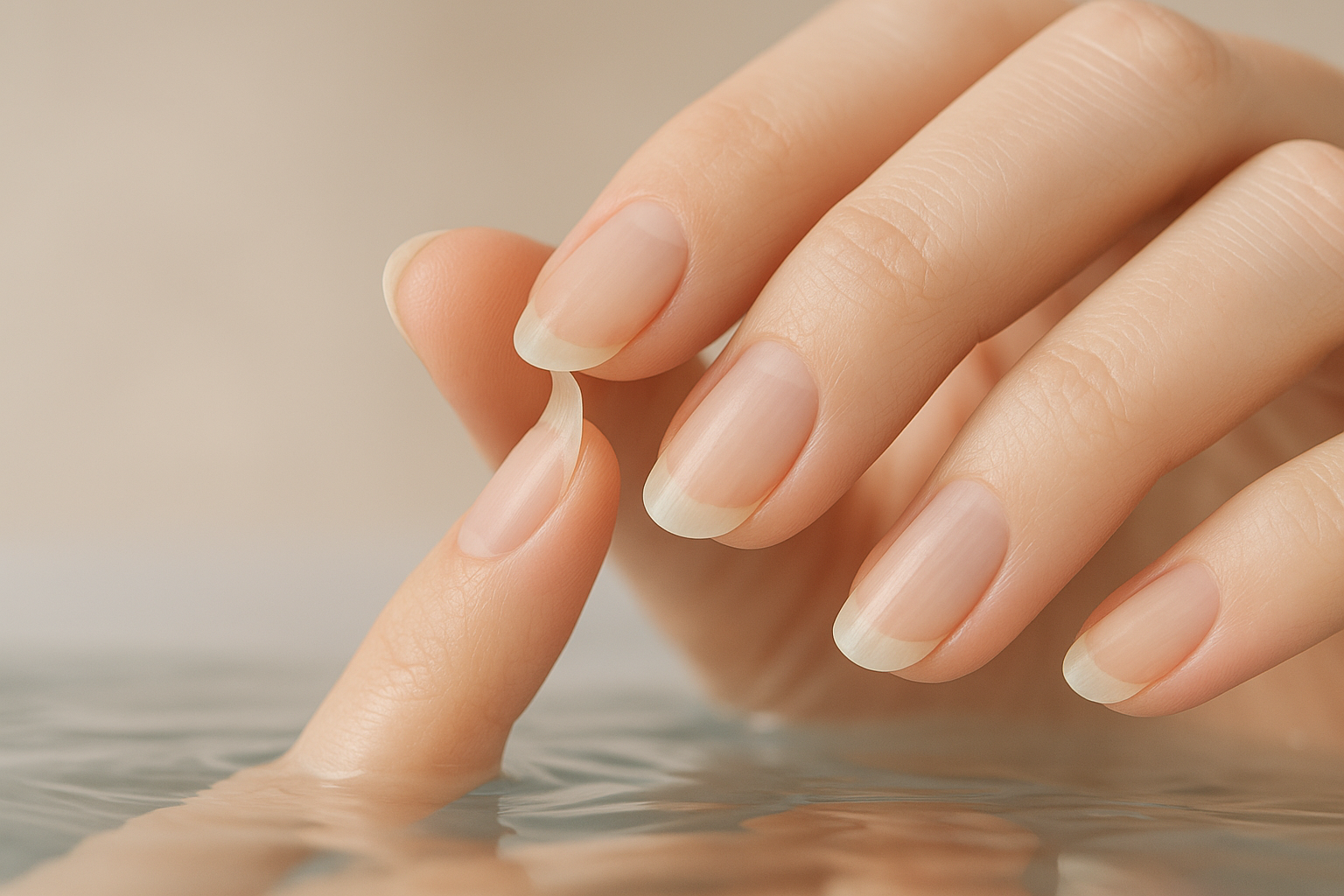
You step out of the bath, press a thumbnail against your finger, and it folds like card. A little while later it's rigid again — and by the weekend the tip has peeled into a thin, papery layer. If that sounds familiar, you've just watched the single most common cause of brittle nails in action. This article explains what water actually does inside the nail plate (with the measured numbers, not salon folklore), why the drying half of the cycle does the damage, how to tell a water problem from a medical one, and the small routine changes that stop the cycle.
Why do nails go soft in water? The short physics
Your fingernail is built from roughly 196 rows of flattened, nucleus-free keratin cells (onychocytes) stacked into three tightly bound layers — dorsal, intermediate and ventral — according to the StatPearls chapter on nail histology. Compared with the stratum corneum of skin, the plate has less water, less fat and far more cysteine, which forms the strong disulfide bonds that give a nail its hardness.
The important word there is less water, not no water. In a 2017 review of nail microstructure in the journal Mycoses, Baswan and colleagues report that the nail plate contains only 0.1–1% lipids and 7–12% water (varying with relative humidity), against roughly 10% lipids and 20–40% water in skin's outer layer. Yet a fully hydrated nail plate can hold 0.3–0.5 g of water for every gram of dry nail — several times its everyday water content. Water passes through a fully soaked nail almost 6.5 times faster than through a dry one. Put simply: the nail is a dense keratin sponge that spends most of its life fairly dry, and a long bath fills it up.
And when it fills up, it softens. The same review notes that the nail's effective elastic modulus — its stiffness — is directly related to its hydration level, alongside how its keratin fibres are arranged and bonded. In lab measurements, a nail's electrical resistance drops significantly after two hours of soaking, a marker of just how much water has moved in. That drop in stiffness is what you feel as a bendy, rubbery nail after a swim or a long washing-up session.
Why the intermediate layer matters
Not every layer swells equally. Baswan's review describes the intermediate (middle) layer as the thickest of the three (the layers sit in roughly a 3:5:2 thickness ratio) and the one where disulfide-bonded cystine is concentrated. That higher cross-linking limits how much it can swell. The outer dorsal layer carries fewer of those disulfide bonds, and the review also notes that the upper layers provide most of the nail's resistance to tearing — consistent with water damage showing up as surface peeling and edge splitting rather than the whole nail turning to mush.
Why warm water and soap make it worse
Two everyday variables change how fast a nail takes on water, and both are in your control:
- Temperature. The Mycoses review reports that water permeability through the nail plate rises significantly as temperature rises (tested at 37, 47 and 57 °C). The energy needed for water to move through nail is closer to that of skin with its lipids stripped out than to intact skin — in other words, a nail behaves like a barrier that has already lost its lipid defence. A hot bath is a faster soak than a cool rinse.
- Detergents. DermNet's nail terminology reference defines onychoschizia — layered splitting at the free edge — as brittle nails “due to water/detergent damage.” Washing-up liquid, cleaning sprays and hand sanitiser add chemical stress on top of the water itself.
The Cleveland Clinic's dermatology team adds the reason nails suffer more than the hands around them: nails “lose water faster than skin does,” so constant washing and sanitising dries them out and leaves them brittle, per dermatologist Rosemary Keskinen, MD, in the clinic's brittle-nails guide. Fast in, fast out — that's the cycle.
The wet-dry cycle: where the real damage happens
A soft nail is not a damaged nail. Softness after water is normal, temporary and expected. The damage comes from doing it repeatedly, because each cycle strains the bonds between the layers:
- Swell. Water enters the plate and the nail expands and softens.
- Bend. While soft, the nail flexes far more easily under everyday load — scrubbing a pan, wringing a cloth, prising open a lid. Layers that were flat now shear against each other.
- Shrink. As the nail dries (fast, because nails lose water quickly), it contracts. Layers that shifted while wet don't settle back perfectly.
- Split. After enough cycles the distal layers separate, giving the papery peel of onychoschizia. The American Academy of Dermatology puts it plainly in its nail-health tips: “Too much water exposure can weaken your nails, causing them to split, peel, or break.”
The Mayo Clinic's nail-care guidance says the same in one line: “Repeated or long contact with water can split fingernails.” Notice that both authorities blame repetition and duration, not a single bath.
Nail vs skin: the numbers behind the softening
Most articles on this topic never show the figures. Here they are, from the sources above, so you can see why the nail behaves so differently from the skin around it.
| Property | Nail plate | Skin (stratum corneum) | What it means for you |
|---|---|---|---|
| Water content at rest | 7–12% (varies with humidity) | 20–40% | Nails start dry, so a soak is a big relative change |
| Fully soaked | 0.3–0.5 g water per g dry nail | — | Several times the everyday water load |
| Lipid content | 0.1–1% | ~10% | Almost no built-in water-resistant layer |
| Water flux, wet vs dry | ~6.5× faster once hydrated | — | The longer you soak, the faster it keeps soaking |
| Effect of heat | Permeability rises significantly with temperature | — | Hot baths and hot washing-up water are the fastest soaks |
| Stiffness | Directly related to hydration level | — | Wet nail = bendy nail, by design |
| Structure | ~196 cell rows, 3 layers, high cystine cross-linking | Cells shed continuously | Nail cells don't shed — damage grows out instead |
Sources: Baswan et al., Mycoses 2017; StatPearls, “Histology, Nail” (2023). Nail-plate figures are laboratory values and vary between people, digits and conditions.
Which everyday water exposures matter most?
Because duration, temperature and detergent each push water into the nail faster, some habits count for far more than others. The ladder below is our synthesis of the authorities cited in this article — it ranks exposures by how many of those three factors they combine, not by any single measured value.
| Exposure | Long? | Hot? | Detergent? | Simple fix |
|---|---|---|---|---|
| Washing up by hand, no gloves | Yes | Yes | Yes | Cotton-lined rubber gloves (Mayo Clinic) |
| Household cleaning | Yes | Varies | Yes | Gloves; moisturise after (AAD) |
| Long hot bath | Yes | Yes | Some | Use the soft window to trim, then dry and condition |
| Swimming | Yes | No | Pool chemicals | Rinse, dry thoroughly, condition |
| Frequent hand-washing / sanitiser | No, but repeated | Varies | Yes | Moisturise between exposures (Cleveland Clinic) |
| Quick cool shower | No | No | Little | Dry nails; no other action needed |
The pattern is obvious once it's laid out: the classic culprit — hot, soapy, hands-in-the-sink work several times a day — ticks every box. It is also the easiest one to fix, because a pair of gloves removes all three factors at once. The Cleveland Clinic's hangnail guidance lists the same triggers (frequent washing, harsh soaps and cleaning products, wet work such as dishes, chlorinated pools) for the skin around the nail, so gloves protect the nail folds too.
The trim-while-soft rule
Here is the one place the soft phase works for you. The American Academy of Dermatology's trimming guide opens with it: “The best time to trim your nails is immediately after taking a bath or shower,” and if that isn't possible, soak them in lukewarm water for a few minutes to soften them first. A softened nail cuts cleanly instead of cracking along the layers. The rest of the AAD sequence:
- Soften — trim straight after bathing, or after a brief lukewarm soak.
- Cut fingernails almost straight across, then slightly round the corners with a file so the edge doesn't catch on clothing.
- Smooth rough edges with a file, always in the same direction — filing back and forth weakens the nail.
- Leave the cuticle alone; it protects the nail root, and cutting it lets germs in.
- Moisturise after trimming — in the AAD's words, “to help keep your nails flexible. This is especially important when the air is dry, as dry nails split more easily.”
Two things follow from the physics. First, cut while soft, but don't put a soft nail to work — the bend-and-shear step in the cycle happens under load, so wringing out a cloth with freshly softened nails is the worst-timed job in the house. Second, the AAD's advice to file in one direction matters most at the free edge, where the layers are already the loosest.
Soft when wet vs soft when dry: when it's not the water
A nail that softens in water and firms up again once it has dried is behaving normally. A nail that is soft, thin or bendy when dry is a different question. The Cleveland Clinic lists brittleness as a possible sign of fungal infection (with thickening or yellowing), nutritional deficiency (protein, iron, B vitamins), psoriasis, thyroid disorders and Raynaud's, and advises a doctor's visit for grooving or separation of the nail plate or redness, swelling or soreness of the skin folds. The Mayo Clinic's red-flag list adds colour change or a dark streak, curled or otherwise reshaped nails, nails that get thinner or thicker, pits or grooves, the nail pulling away from the skin, bleeding, pain, or nails that fail to grow.
A rough home check (a guide, not a diagnosis): press a fully dry nail gently against a hard surface. Normal nails resist and spring back; if a dry nail folds easily, or the change is sudden, one-sided or paired with other symptoms, book an appointment rather than reaching for another product. And if the softness comes with white flaky patches on the surface, the stain-vs-fungus guide explains how to tell polish damage from something that needs a diagnosis.
What actually helps: a routine built around the cycle
Every piece of authoritative advice on water and nails reduces to breaking the cycle at one of its four steps.
- Shorten the soak. Gloves for washing up and cleaning (Mayo Clinic, AAD), cooler water where practical, and a proper dry afterwards — the AAD's first tip is simply “Keep nails clean and dry.”
- Don't load a soft nail. Save the heavy jobs for when nails have firmed up; use tools, not nails, to open and prise things (AAD).
- Slow the shrink. Condition straight after water. The Cleveland Clinic recommends moisturising between exposures during the day and a heavy hand cream at bedtime, and specifically warns to avoid nail conditioners that contain alcohol, which dry the nail further. The AAD's gel-manicure guidance suggests an occlusive such as petroleum jelly on nails and cuticles several times daily between polishes to minimise brittleness. (Whether to take that to its logical extreme is covered in does nail slugging actually work?)
- Protect the split-prone edge. Keep nails shorter while they recover, file one way, and skip formaldehyde hardeners — the FDA notes that using them often may make nails brittle and more likely to break or peel, a paradox we unpack in why did my nail strengthener make my nails worse?
One honest caveat that most brand copy skips: the Mycoses review found that stripping the nail's own tiny lipid fraction did not change how fast water moves in or out, so lipids inside the plate are not what governs hydration. What a conditioner realistically does is sit on the surface and free edge as a film, slowing water loss and keeping the outer layer supple — the same occlusive, surface-level mechanism plant lipids show on skin in the 2018 International Journal of Molecular Sciences review by Lin and colleagues. That is a real, useful effect; it is just not “feeding” the nail, whatever the label says. Because nail cells don't shed or repair in place — damage only ever grows out — patience is also part of the routine: fingernails grow at roughly 3 mm a month (StatPearls), so an edge damaged by months of unprotected wet work takes months to replace, a timeline we map in why won't my nails grow past a certain length?
📋 Please note: The section below describes a daily-care cosmetic product. It supports the appearance and condition of nails and cuticles; it is not medical advice and is not intended to diagnose, treat or prevent any condition. Nails that stay soft, thin or discoloured when dry should be checked by a doctor.
Where Provité Nail Elixir fits in the wet-dry routine
The “slow the shrink” step needs something that stays on a nail that is about to be washed again, without adding water or alcohol to a plate that has just lost both. That is the job Provité Nail Elixir was formulated for. It is a 100% lipid, water-free, formaldehyde-free concentrate for nails and cuticles — there is no water in the bottle to evaporate and no formaldehyde to cross-link the keratin into the rigid, glass-like state that snaps under load. Formulator S. C. Aris built it around the “flexible-strength” idea this article's physics points to: a nail that bends and recovers, rather than one that is merely hard.
The blend layers hemp seed, grapeseed and sesame seed for resilience; jojoba, avocado and coconut for suppleness at the free edge; camellia tea, cucumber seed, lemon and carrot seed for a clean, glassy finish; and lavender, geranium and vitamin E to complete the thirteen botanicals. A drop massaged into each nail and cuticle after your last hand-wash of the day, and again after wet work, leaves a lightweight lipid film on the plate and the cuticle seal — the surface where wet-dry damage begins. It works on bare nails and under gel or acrylic. In a customer survey, 88% reported nails that looked stronger and less brittle within four weeks, and 94% said they would recommend it. It is rated 4.73/5 from 15 verified buyers and comes with a 90-day money-back guarantee.
| Water-based hand lotion | Alcohol-containing nail conditioner | Provité (100% lipid) | |
|---|---|---|---|
| Adds water to a wet nail? | Yes — then evaporates | Often; alcohol dries the plate (Cleveland Clinic) | No — anhydrous by design |
| Survives the next hand-wash? | Mostly rinses off | Varies | Anhydrous lipid film — nothing water-based to rinse away |
| Formaldehyde? | No | Sometimes (check the label) | No |
| Under gel/acrylic? | Cuticle only | Cuticle only | Yes |
Frequently Asked Questions
Is it bad that my nails go soft in water?
No — it's normal. The nail plate holds only about 7–12% water at rest and takes on several times that when soaked, and its stiffness is directly tied to hydration. The harm comes from repeating the swell-and-shrink cycle many times a day, which loosens the layers at the free edge.
Should I cut my nails wet or dry?
The American Academy of Dermatology recommends trimming immediately after a bath or shower, or after a few minutes' lukewarm soak, because softened nails cut cleanly rather than cracking. File in one direction, and moisturise afterwards to keep nails flexible.
Why do my nails peel after swimming or washing up?
Long, warm or soapy exposures push water into the nail fastest; as it dries the layers shrink back unevenly and, after enough cycles, separate at the tip. Dermatologists call this onychoschizia and attribute it to water and detergent damage. Gloves and after-water conditioning break the cycle.
How long does it take nails to harden again after a bath?
Fairly quickly once dry, because nails lose water faster than skin does (Cleveland Clinic). There's no published stopwatch figure for the full return to normal stiffness; the practical rule is to avoid heavy-handed jobs until the nail feels firm again.
Does drinking more water make nails less bendy?
No. Cleveland Clinic dermatologist Rosemary Keskinen, MD, is direct: you can't drink your way to more supple nails. Nail flexibility is about the water moving in and out of the plate from outside, and the routine around it.
When should soft nails be seen by a doctor?
If nails are soft, thin or bendy when dry, or you notice thickening, yellowing, grooves, separation from the nail bed, colour change, pain, swelling or redness around the nail, see a doctor or dermatologist. These can point to fungal infection, psoriasis, thyroid or nutritional problems rather than water exposure.