Should You Buff the Ridges Out of Your Nails? Why Nail Experts Say Don't
Last updated: July 6, 2026
Quick Answer
No — routinely buffing ridges out of your nails is a mistake. What look like raised ridges are actually shallow grooves where the nail matrix produces fewer cells. A buffer can't fill a groove; it can only grind the rest of the nail down to the depth of the deepest one, thinning the entire plate and making peeling and edge-cracking more likely. The expert-recommended alternative is to fill, condition, and investigate: camouflage grooves with a ridge-filling base coat, keep the nail and cuticle conditioned daily (a lipid-based conditioner such as Provité Nail Elixir is one example), and rule out the handful of medical causes — because horizontal ridges, unlike vertical ones, can signal a health issue.
Run a thumbnail across your fingernails and you'll probably feel them: fine lines running from cuticle to tip. Somewhere around your thirties they start showing up, and by your fifties they're hard to ignore. The instinct — and, for decades, the standard salon move — is to buff them smooth. This article explains why the top nail-science educators now advise against that, what your ridges are actually telling you, and the three-part routine that improves how ridged nails look without sanding away their strength.
What nail ridges actually are (hint: they're not ridges)
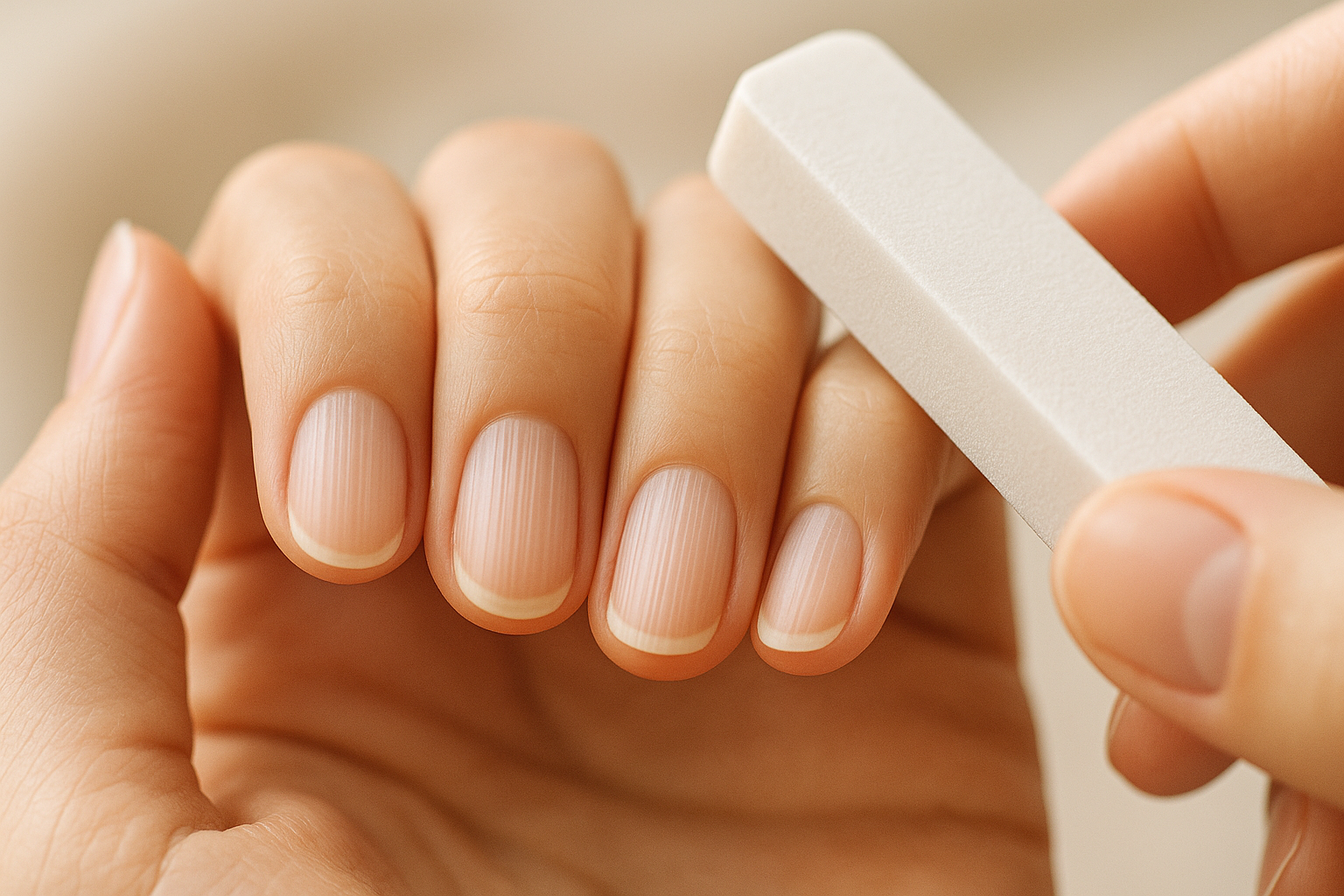
The surprise, according to nail chemist Doug Schoon — whose explanation was published by NAILS Magazine — is that "there are no ridges on the nail plate to be removed." The nail matrix (the growth zone hidden under your cuticle) can't suddenly start producing raised lines. What it can do, as it ages or gets damaged, is work less efficiently in certain spots, producing fewer new nail cells there. The result is shallow grooves running the length of the plate. The "ridges" you feel are simply the normal-thickness nail standing either side of those grooves.
Dermatologists call vertical ridging onychorrhexis, and per WebMD it most often "isn't concerning and is just a cosmetic annoyance." The Mayo Clinic is equally reassuring: vertical nail ridges are "fairly common and nothing to worry about," becoming more numerous and prominent with age because of changes in cell turnover within the nail. Schoon notes shallow grooves are normal on the nails of anyone over thirty — a sign of healthy aging, not disease.
Vertical vs. horizontal ridges: the 30-second triage
Direction matters more than depth. This is the check most articles on buffing skip entirely:
| Vertical ridges (cuticle → tip) | Horizontal ridges (side → side) | |
|---|---|---|
| Medical name | Onychorrhexis / longitudinal ridging | Beau's lines |
| Most common cause | Normal aging of the nail matrix; also very dry skin or eczema | Something interrupted nail growth: injury, severe illness with fever, chemotherapy, long-term gel/acrylic damage |
| Nutrient link | Iron deficiency can cause vertical ridging (sometimes with spoon-shaped nails) | Zinc deficiency can cause Beau's lines and white spots |
| Usual verdict | Cosmetic; manage the appearance | See a healthcare provider — especially if lines keep appearing |
That triage comes straight from the Cleveland Clinic's guide to nail ridges, which also lists thyroid disease as a cause of thick, brittle, vertically ridged nails, and from the Mayo Clinic, which advises consulting your provider if nails change color or develop horizontal ridges. If your ridges run side to side, stop reading about buffers and book an appointment — treating the underlying cause is what lets smoother nail grow in.
Why buffing backfires: the geometry problem
Here's the part that changed professional practice. A buffer works by abrasion — it can only remove material, never add it. So to make a grooved surface flat, it has to grind the entire nail plate down to the level of the deepest groove. As Schoon puts it in the NAILS Magazine piece: "Buffing away these so-called 'ridges' will just thin the nail plate down to be as thick as the bottom of the deepest groove on the plate… That's a lot of nail plate being removed."
And a thinner plate is a weaker, less useful plate. The documented knock-on effects:
- Poor polish adhesion. Nail coatings, including ordinary polish, don't adhere well to overly thin nail plates — so the buffing you did "for a smoother polish finish" can make your manicure chip faster.
- Surface peeling. Excessive thinning can cause the nail's surface to peel — which many people then mistake for a new nail problem and buff again, repeating the cycle.
- Cracking at the free edge. The thinned plate flexes more than it's built to, and splits where it's least supported.
Worse, the grooves come back. Buffing does nothing to the matrix that's producing them, so the same pattern regrows on a now-thinner nail. WebMD's dermatologist-reviewed take is blunt: "Buffing won't remove fingernail ridges" — and over-buffing "could cause too much trauma to your nails, which could worsen the problem."
If you're going to buff anyway
The Cleveland Clinic allows a gentle buffer as part of home care, and there's a defensible middle ground for a special occasion. Harm-reduction rules: use the finest-grit buffer you can find, a few light passes in one direction only, never until the nail is fully flat (leave the grooves partially visible), no more often than every few weeks, and never on nails that are already peeling, splitting, or recently freed from gel or acrylic. If that describes yours, start with our guide to repairing nails after gel or acrylic removal first.
What to do instead: fill, condition, investigate
1. Fill the grooves (instant fix)
Schoon's professional recommendation is the opposite of removal: keep the plate thick and fill the grooves with an opaque ridge-filling base coat, which levels the surface optically and physically while maintaining the nail's integrity. A thin overlay coating achieves the same camouflage while actually reinforcing the plate. Same smooth finish as buffing — zero nail sacrificed.
2. Condition the nail and matrix area (the long game)
Ridged nails are usually also dry nails — the Cleveland Clinic pairs vertical ridging with "very dry skin," and its first home-care instruction is to moisturize your nails and cuticles daily. Conditioning won't erase grooves, but it changes how they look and behave: flexible, conditioned keratin reflects light more evenly, feels smoother, and resists the splitting that makes ridges snag and tear. The cuticle area deserves the most attention, because that's the skin sealing the matrix, where next month's nail is being made right now. Cleveland Clinic's other home rules are worth adopting wholesale: don't cut your cuticles, don't bite your nails, take breaks from gel and acrylics, wear gloves for cleaning chemicals, and trim fingernails in a curve.
3. Investigate if anything else is off (the health check)
Per the Cleveland Clinic, see a provider about ridging plus any of: color changes (white, green, yellow or dark marks), nail pitting, redness or swelling around a nail, shape changes like clubbing or spoon nails — or any horizontal lines. WebMD adds sudden unexplained nail changes, pain, or accompanying fatigue to that list. Iron, zinc and thyroid issues are all checkable with simple tests, and treating the cause usually lets smoother nail grow in — though a nail takes several months to fully replace itself, so be patient with the timeline.
A 4-week smoother-looking-nails protocol
| Week | Do this | Why |
|---|---|---|
| 1 | Retire the buffer. Triage your ridges with the table above. Start conditioning nails + cuticles every night; gloves for dishes and cleaning. | Stops ongoing thinning and dehydration — the two things making ridges look worse. |
| 2 | Add a ridge-filling base coat (worn alone or under polish). Book a doctor's visit if you spotted any red flags. | Immediate smooth finish with no plate loss; medical causes get months of head start if ignored. |
| 3 | Keep nails trimmed in a curve, filed in one direction. Pause gel/acrylic sets if you use them. | Short, sealed edges can't catch and propagate splits along ridge lines. |
| 4 | Assess: smoother feel and fewer snags is on-track. Remember full nail replacement takes ~4–6 months. | The nail you conditioned at the matrix in week 1 is only just becoming visible. |
A note on conditioning: why we formulate with lipids, not water
Most "nail moisturizers" are water-based creams — and water is precisely what ridged, brittle nails handle badly (it swells and contracts the plate with every wash). That's why I formulated Provité Nail Elixir as a 100% water-free, formaldehyde-free botanical lipid concentrate. Its thin-viscosity lipids — a 13-botanical blend including hemp seed, jojoba, grapeseed, camellia tea, avocado and vitamin E — are designed to saturate between the nail's keratin layers ("intra-keratin" conditioning) rather than sitting on top, supporting the look and feel of smoother, more flexible nails: the "bends, doesn't snap" quality we call flexible strength. It's the opposite philosophy to formaldehyde hardeners, which cross-link keratin harder but more brittle — and unlike a buffer, it asks you to give up none of your nail plate.
- Rated 4.73/5 from 15 verified buyers — and in a customer survey, 88% reported stronger, less brittle-feeling nails within 4 weeks.
- Works on bare nails or under gel, acrylic and polish (apply to the cuticle area and any exposed nail).
- Formulated by S. C. Aris; vegan, non-GMO, no water, fillers or preservatives — and every bottle is covered by a 90-day money-back guarantee.
Provité is a cosmetic product: it supports the appearance and feel of nails and cuticles and does not treat, cure or prevent any medical condition. For horizontal ridges, discoloration, pain or sudden nail changes, see a doctor or dermatologist.
Related reading
- Why are my nails so weak and brittle — and what actually helps?
- How to repair damaged nails after gel or acrylic removal
- Cuticle care and all-natural nail care
Frequently asked questions
Can you permanently get rid of vertical nail ridges?
Usually not, if they're age-related — the ridging pattern comes from the nail matrix itself, so it regrows with the nail. You can, however, make ridges much less visible with a ridge-filling base coat and daily conditioning, and if a deficiency or thyroid issue is the cause, treating it typically lets smoother nail grow in over several months.
Does buffing make nail ridges worse?
Buffing doesn't deepen the grooves, but it thins the whole nail plate, which makes peeling, splitting and polish chipping more likely — and the ridges regrow anyway. Dermatologist-reviewed guidance from WebMD warns that over-buffing traumatizes the nail and "could worsen the problem."
Which vitamin deficiency causes ridges in fingernails?
Iron deficiency is the one most associated with vertical ridges (sometimes with spoon-shaped nails), while zinc deficiency is linked to horizontal Beau's lines and white spots, per the Cleveland Clinic. Don't self-prescribe supplements: a simple blood test tells you whether you're actually low, and ridges alone — without other symptoms — are most often just normal aging.
Are ridges in nails a sign of something serious?
Vertical ridges alone are almost always harmless. The patterns worth a doctor's visit are horizontal ridges (Beau's lines), ridges plus color changes, pitting, pain, swelling, shape changes, or ridges that appear suddenly — those can point to thyroid disease, nutrient deficiency, or an illness that interrupted nail growth.
Do ridge-filling base coats damage nails?
No — they're the expert-preferred option precisely because they add material instead of removing it. Nail educator Doug Schoon calls filling grooves with an opaque base coat "a far superior method" to buffing, since it smooths the surface while keeping the plate at full thickness.
This article is for general information and reflects cosmetic nail care, not medical advice. Nail changes can occasionally signal underlying health conditions — if you notice horizontal lines, discoloration, pain, or sudden changes, consult a doctor or dermatologist.