Why Do I Keep Getting Hangnails? The Real Causes — and How to Break the Cycle
Last updated: 2026-08-10
Some people go years without a hangnail. Others clear one, and two more appear on different fingers within the week. If you're in the second group, the frustrating part isn't the pain — though a snagged hangnail hurts absurdly for its size — it's the feeling that they come out of nowhere. They don't. Hangnails have a short, predictable list of causes, almost all of them daily habits, which means recurring hangnails are one of the most fixable nail complaints there is. Here's what's actually going on, the safe way to deal with the one you have now, and the reset that stops the next one forming.
A hangnail isn't nail — and that's why it hurts so much
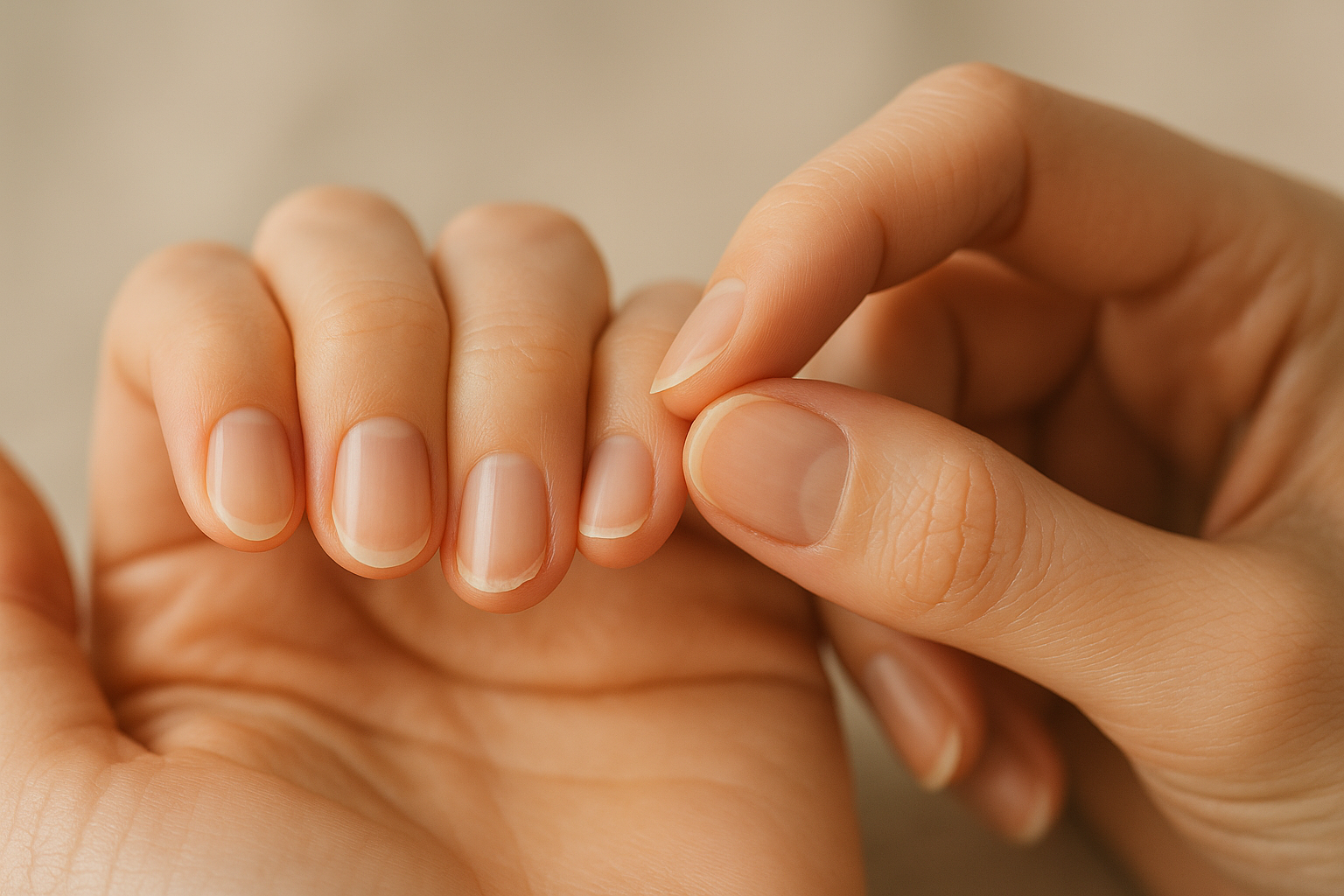
Despite the name, a hangnail is a piece of dry or damaged skin that sticks up along the edge of a nail — almost always on the fingers, only rarely on the toes, according to the Cleveland Clinic. That little flap belongs to the nail fold, the frame of skin that hugs the nail plate on three sides. Family medicine specialist Dr. Neha Vyas explains why something so small can hurt so much: "the skin around your nails has lots of nerve endings, so even a tiny tear can feel very noticeable."
That frame of skin isn't just decorative. The cuticle forms a seal that protects the nail matrix — the hidden factory under the base of your nail where new nail plate is made — and removing or damaging it leaves the area vulnerable, as described in StatPearls' histology of the nail unit. The Mayo Clinic puts it plainly: cuticles "seal the skin to the nail plate," which is why it advises never letting them be cut away during a manicure. A hangnail is what it looks like when that band of skin dries out, stiffens, and splits.
Why you keep getting hangnails: find your trigger
Hangnails "might seem like they come out of nowhere, but they're typically tied to the wear and tear of daily life," notes the Cleveland Clinic — usually several small stresses stacking up on the same thin band of skin. Run down this table and you'll almost certainly recognise yours:
| Trigger | How it creates hangnails | Telltale sign it's yours |
|---|---|---|
| Frequent washing & sanitiser | Each wash strips the skin's natural, protective oils; sanitiser adds drying alcohol on top | Hands feel tight after washing; worse during work weeks |
| Wet work without gloves | Dishes, cleaning and swimming (especially chlorinated pools) leach moisture and irritate the nail fold | Worst on the hand you scrub with |
| Harsh soaps & cleaning products | Strong detergents dry and crack the skin edge | Flare after deep-clean days |
| Picking, biting, chewing | Tears the skin around the nail and leaves ragged edges that split again | Hangnails cluster on your "worry" fingers |
| Aggressive cuticle work | Cutting or hard pushing damages the skin seal around the nail | Flare in the week after a manicure |
| Acetone polish remover | Acetone dries out the skin around the fingernails, not just the polish | Flare after removal days, not polish days |
| Cold weather & wind | Cold, dry air makes the skin around nails more brittle | Seasonal pattern, worse in winter |
| Small injuries | A papercut or knock near the nail leaves a raised edge that stiffens into a flap | One-off hangnail on one finger, not a pattern |
Notice what's not on the list: for most people, recurring hangnails are not a vitamin problem. The documented drivers are dryness and mechanical damage. (If your nails themselves are also changing — splitting, crumbling, changing colour — that's a different question; see our guide to weak and brittle nails, and mention it to your doctor.)
Why ripping it off always backfires
A hangnail begs to be bitten or yanked. Both are the worst options, for the same reason: the flap is still attached to living skin. The Mayo Clinic's warning is blunt — pull off a hangnail and "you might rip live tissue along with the hangnail." The Cleveland Clinic's Dr. Vyas agrees: "aggressively taking off a hangnail could lead to bleeding, infection and more pain."
The infection risk is specific and well documented. The torn corner of a nail fold is precisely the kind of skin break that lets bacteria in. DermNet notes that acute paronychia — infection and inflammation of the nail fold, usually with Staphylococcus aureus — typically follows "a break in the skin, especially between the proximal nail fold/cuticle and the nail plate," with nail biting, habitual picking of the nail fold, and manicuring among the classic triggers. It can develop within hours. And ripping feeds the loop even when it doesn't get infected: a torn edge heals ragged, ragged edges snag, and snagged edges get picked again.
The 60-second safe-removal protocol
This is the Cleveland Clinic's recommended method, with the reasoning spelled out:
- Wash your hands. You're about to trim right next to broken skin — start clean to cut the infection risk.
- Soak the finger in warm water for a few minutes. This is the step everyone skips, and it's the one that matters: soaking softens the stiff flap so it clips cleanly instead of tearing deeper when the clipper catches it.
- Clip — don't pull. With sanitised nail clippers or cuticle nippers, trim the hangnail as close to its base as you can without pressing into the skin. No tugging at any point.
- Seal and protect. Apply an antibiotic ointment or a moisturiser, and cover with a small plaster if the spot keeps catching on things.
That's the whole job. Total time, about a minute — most of it soaking.
Hangnail or infection? How to tell the difference
Most hangnails settle without drama. The one situation you shouldn't wait out is an infected nail fold. Here's how to tell them apart:
| Simple hangnail | Acute paronychia | |
|---|---|---|
| What it is | A flap of dry or damaged skin at the nail edge | Infection/inflammation of the nail fold, usually bacterial |
| Feels like | Sharp sting when snagged or pressed; quiet otherwise | Constant pain and tenderness, often throbbing |
| Looks like | A dry, stiff flap; at most a little redness at the tear | Red, swollen, shiny nail fold; sometimes yellow pus under the cuticle |
| Timeline | Improves over days; healed within about a week | Develops rapidly, over a few hours |
| What to do | Soak, clip, moisturise, protect | Warm-water soaks several times daily; see a doctor if it's worsening, there's pus, or you feel unwell |
Per the Cleveland Clinic and DermNet, get medical advice promptly if the area isn't healing within a week, redness is spreading, pus appears, or you have diabetes, a condition that affects bleeding, or a suppressed immune system — skin infections near the nail behave more aggressively in those situations, and a doctor can drain or prescribe what's needed early.
How to stop hangnails coming back: the 2-week reset
Removal deals with the hangnail you have. Recurrence is about the skin barrier — and the fix is boring, cheap, and reliably effective, because every step targets a trigger from the table above:
- Gloves for every wet job. Cotton-lined rubber gloves for dishes and cleaning — the single change both the Mayo Clinic and DermNet put at the top of their lists for protecting the skin around nails from water and chemicals.
- Moisturise after every wash — and reach the nail folds. Washing strips the skin's protective oils; the Mayo Clinic specifically advises working moisturiser into the fingernails and cuticles, not just the palms. Keep a tube wherever you wash your hands, because timing beats quantity.
- Downgrade your soap. Mild cleansers dry the nail-edge skin far less than harsh or heavily antibacterial washes.
- Go acetone-free. If you wear polish, choose a non-acetone remover — acetone dries the skin around the nail, not just the plate.
- Retire the cuticle cutters. The cuticle is a seal, not a flaw. Cutting it or pushing it back hard damages the exact skin that hangnails come from — and, per StatPearls, leaves the nail matrix underneath more vulnerable. If you have manicures, ask for cuticles to be moisturised and left, not removed.
- Condition with lipids, not just lotion. Water-based lotion helps in the moment, but seed lipids bring two documented extras: they slow water escaping through the skin surface, and linoleic-rich lipids such as sunflower seed have been shown to support the skin barrier itself, per a 2018 review of plant lipids in International Journal of Molecular Sciences — with jojoba's skin-compatible wax esters a long-standing favourite for the nail area. One caution from DermNet if you mix your own: never apply neat, undiluted essential oils to skin, as this can lead to sensitisation.
- Keep edges smooth while you reset. Shorter, snag-free nails and promptly clipped rough spots give picking fingers nothing to find.
- Cover up in cold and wind. Winter gloves protect the nail folds from the brittle-skin season as effectively as washing-up gloves protect them at the sink.
Two weeks is usually enough to feel the difference, because the nail-fold skin renews quickly once you stop stripping it. The nail plate itself is slower — it grows out at roughly 3 mm per month per StatPearls — so if picking has left dents or ridges in the nail itself, expect those to take months to grow out, not days. (Bitten nails have their own timeline — we've mapped it in how long bitten nails take to grow back.)
📋 Please note: The section below describes a daily-care cosmetic product. It supports the appearance and condition of nails and cuticles, and is not medical advice, nor intended to diagnose, treat, or prevent any condition such as a nail-fold infection.
Where Provité Nail Elixir fits in
Step 6 of the reset — daily lipid conditioning — is the job Provité Nail Elixir was formulated for. It's a 100% lipid, formaldehyde-free concentrate: because it's completely water-free, there's nothing in the bottle to evaporate off the skin the way a lotion's water content does. A drop massaged into each nail and the surrounding skin conditions the cuticle and nail edge for smoother, tidier-looking nail folds and softer-looking cuticles — while the intra-keratin blend is designed to saturate between the nail's layers for what the brand calls "flexible-strength": nails that bend rather than snap. It works on bare nails or under gel and acrylic.
The 13-botanical formula — created by formulator S. C. Aris — layers hemp seed, grapeseed and sesame seed for structure; jojoba, avocado and coconut for flexibility and locked-in hydration; camellia tea, cucumber seed, lemon and carrot seed for a clean shine; finished with lavender, geranium and vitamin E. Like every CallNature formula, it's audited by the patent-pending Vouchly AI system (GB2603970.1), which matches each botanical's fatty-acid ratio to the job before production. In a customer survey, 91% of users said they no longer felt self-conscious about their nails. It's rated 4.73/5 from 15 verified buyers and covered by a 90-day money-back guarantee.
Frequently Asked Questions
Why am I suddenly getting so many hangnails?
A sudden run of hangnails usually tracks a change in your hands' environment: more hand-washing or sanitiser, a new cleaning routine without gloves, cold windy weather, a recent manicure where the cuticles were cut, or more time in chlorinated water. The skin around the nail is being dried or damaged faster than it can recover.
Is it OK to bite or rip off a hangnail?
No. The flap is still attached to living skin, so pulling can rip live tissue along with it, and biting adds mouth bacteria to a fresh skin break — a classic route to a painful nail-fold infection. Soak the finger in warm water for a few minutes, then clip the hangnail at its base with clean clippers.
Are hangnails caused by a vitamin deficiency?
Usually not. The documented everyday causes are dryness and mechanical damage — washing, harsh products, acetone, cold air, and picking. If hangnails come with other changes such as nails splitting or crumbling, colour changes, fatigue, or skin problems elsewhere, ask your doctor to take a look rather than self-diagnosing a deficiency.
How long does a hangnail take to heal?
After safe removal, the spot typically settles within a few days and should be fully healed within about a week. If it isn't healing by then, or it's getting redder, more swollen, or produces pus, have a doctor check it — especially if you have diabetes or a condition that affects bleeding or immunity.
Do hangnails mean my nails are unhealthy?
Not by themselves — a hangnail is damaged skin beside the nail, not a problem with the nail plate. But hangnails and brittle nails share triggers (water, acetone, harsh products), so they often show up together. If your nails are also peeling or snapping, the same barrier-first routine helps both.
This article is general information about nail and cuticle care, not medical advice. A hangnail that becomes red, swollen, painful or starts to discharge may be an infection (paronychia) and should be seen by a doctor or pharmacist — particularly if you have diabetes or any condition affecting circulation or immunity. Provité Nail Elixir is a cosmetic product for the appearance and condition of nails and cuticles; it does not treat or prevent any condition.