Do Tongue Scrapers Really Work? The Honest Benefits, the Gag-Free Technique — and What a Scraper Can't Fix
Last updated: 22 October 2026
Tongue scraping looks like the simplest habit in oral care — a ten-second swipe before you brush — and it has the social-media following to match. The claims attached to it range from the reasonable (fresher morning breath) to the fanciful (detoxing your whole body). This guide sticks to what a scraper actually does: what that coating on your tongue is made of, what the research shows when you read it plainly, how to scrape without waking your gag reflex, how to choose and care for a scraper, and — just as important — the problems a tongue scraper won't solve.
What does a tongue scraper actually remove?
The top of your tongue isn't smooth. It's covered in thousands of tiny projections called papillae, which turn the surface into a landscape of bumps and grooves. Through the day, that landscape collects a thin mat of material: food fragments, proteins from saliva, cells your mouth has shed, and the microbes that feed on all of it. That's the pale coating you see in the mirror — usually heaviest toward the back, where less friction from food and speech disturbs it.
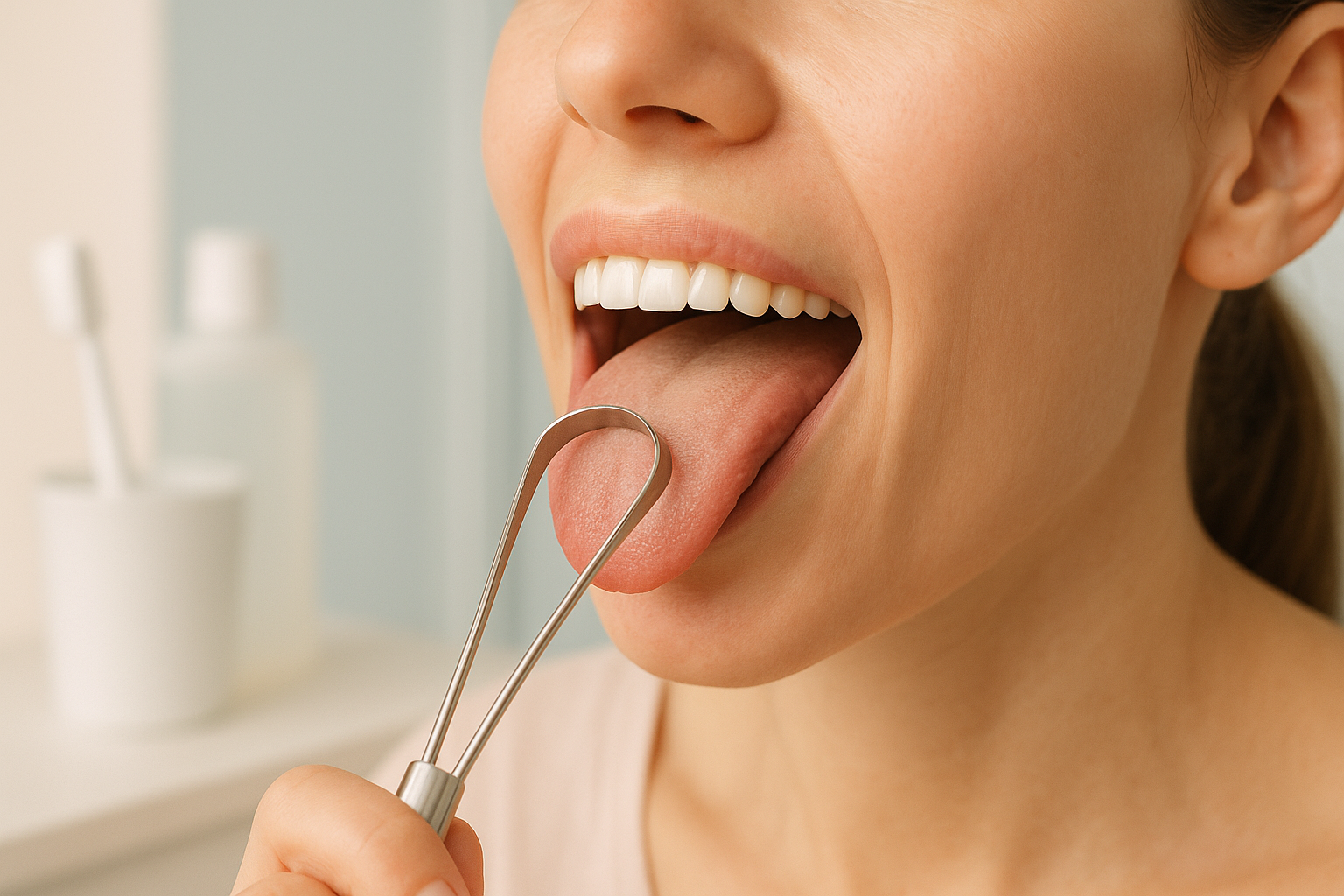
A scraper works mechanically. Its thin, smooth edge glides over the papillae and gathers that surface layer forward in a single pass — a different action from a toothbrush, whose bristles tend to stir and compress the coating rather than lift it away. The Cleveland Clinic notes that the large majority of bad breath starts inside the mouth, and the coating on the tongue is one of its most common sources — so removing the coating removes a reservoir, not just a smell.
One framing worth keeping: scraping subtracts. It doesn't add an ingredient, kill anything on contact, or change your mouth's chemistry. It physically takes away material that would otherwise sit there — which is exactly why it works best as a small daily habit rather than a dramatic weekly scrub.
Do tongue scrapers really work? What the research shows
Tongue scraping attracts more hype than its evidence base supports, so here is the plain version.
The best-known evaluation is a Cochrane systematic review of tongue-cleaning trials, which compared scrapers against toothbrushes for reducing volatile sulfur compounds — the gases behind the classic stale-mouth smell. Two findings matter. First, scrapers won: they produced a small but statistically significant reduction in those compounds compared with brushing the tongue. Second, the benefit faded quickly. The review's own caveat is that the effect is short-lived — which is why tongue cleaning earns its keep as a daily habit, not a one-off fix.
What about the bigger claims — that scraping rebalances your microbiome, improves digestion, or pulls toxins from the body? The small studies behind some of those headlines are preliminary, and the wellness framing runs far ahead of them. We'd rather undersell: scraping reliably makes your tongue cleaner and your mouth feel and smell fresher for a while. Treat anything beyond that as unproven.
One boundary worth drawing early. If your real question is "why does my breath smell even though I brush and floss?", the tongue is only one of several suspects — the gum line, a dry mouth, the tonsils, the sinuses, and reflux all make odor a scraper never touches. We've mapped every one of those sources in our guide to breath that survives brushing and flossing; this article stays with the tool itself.
Is a scraper better than brushing your tongue?
Both help — they just move material differently, and the practical differences decide which one you'll actually use every day.
| Approach | What it does well | Keep in mind |
|---|---|---|
| Dedicated tongue scraper | Lifts the coating evenly in a few light passes; takes 10–20 seconds; the slim edge reaches farther back without crowding the mouth | Use feather-light pressure and rinse the edge between strokes |
| Toothbrush on the tongue | No extra tool to buy; fine for travel or occasional use | Bristles can push coating into the grooves instead of lifting it, so it takes more passes; the bulkier head tends to wake the gag reflex sooner |
| Scrape, then a light brush finish | Bulk removal plus a gentle polish, for the cleanest feel of the three | Keep both steps gentle — extra force adds tenderness, not freshness |
The Cochrane finding above gives the scraper a modest edge on odor, and most people find it faster and easier to tolerate near the back of the tongue. But the honest summary is simpler: the method you'll repeat every day is the right one.
How do you use a tongue scraper without gagging?
Gagging is the main reason people abandon tongue scraping, and it's almost always a positioning problem: too far back, too soon, too hard. Start modestly and build.
- Rinse the scraper and stick out your tongue. Good light and a mirror help you see where the coating actually is.
- Exhale slowly through your mouth as you place the edge — mid-tongue at first, not the far back. Breathing out as you position the scraper quiets the gag reflex for most people.
- Draw the edge forward with light, even pressure. The coating should come away without scrape marks, soreness, or any urge to press harder.
- Rinse the scraper and repeat — 5–10 light strokes total is plenty.
- Work farther back gradually. Move the starting point back a small step every few days as your tolerance builds; the back third is where the coating is thickest.
- Rinse your mouth and carry on with brushing and cleaning between teeth as usual.
Morning is the natural slot. Saliva flow drops while you sleep — part of the long list of quiet jobs saliva does, per the American Dental Association's consumer site — so the coating is thickest when you wake, and clearing it then gives the day a fresh start. If your mouth runs dry around the clock rather than just overnight, that's its own problem with its own fixes — our dry-mouth guide walks through the causes you can change. And if your mouth feels stale again by evening, a second brief pass before bed is reasonable. Stop for a few days if you notice pain or sores, and come back gentler.
How do you choose a tongue scraper — and keep it clean?
This is one purchase where the cheap, simple option is usually the right one. Look for a smooth working edge with no burrs, seams, or molding lines that could scratch; a shape that feels stable in your hand, whether that's a U-shaped loop, a flat paddle, or a handled design; and a width that covers most of your tongue in one or two passes without digging into the sides. Stainless steel, copper, and rigid plastic all work when used lightly — the material matters far less than the pressure.
Care is simple: rinse it under warm water after each use, wash it with mild soap every few days, dry it fully, and store it somewhere clean and dry. Replace it when the edge picks up a nick or the surface starts to degrade — a damaged edge is how a gentle tool becomes a harsh one.
What a tongue scraper won't do
A scraper is good at exactly one thing — clearing the tongue's surface — and the fastest way to be disappointed by it is to expect more. A few boundaries, stated plainly:
It won't fix breath coming from the gum line. Inflamed gums harbor odor-producing bacteria in the crevice where gum meets tooth, a zone no tongue tool reaches. If your gums bleed when you brush or floss and the smell keeps returning, work through the full source map and let a dentist look at the gums themselves.
It won't fix a dry mouth. A mouth that's stopped rinsing itself re-coats quickly no matter how well you scrape. Hydration, nasal breathing, bedroom humidity, and a look at your medicine cabinet do the real work there — covered here.
It won't replace brushing and flossing. Scraping cleans soft tissue; plaque on teeth and between them still needs the core routine doing daily.
It won't whiten teeth or clear every smell. A cleaner tongue can make the whole mouth feel brighter by contrast, but it changes nothing about tooth shade — and if odor survives a genuinely clean tongue, think tonsils (tonsil stones are famously missed), sinuses, or reflux. Since your own nose adapts and stops flagging your breath, test it properly before concluding anything.
When a coated tongue needs a dentist — not a harder scrape
A thin, pale coating that comes back every day is normal. Some changes are not, and the answer to them is an appointment rather than more pressure. Book a dental or medical visit if you notice white or red patches that don't resolve within two weeks, tongue pain or burning that persists, bleeding without an obvious cause, or a change in taste that doesn't settle. The same goes for a coating that stays thick and stubborn despite gentle daily care — and for bad breath that outlasts two weeks of good tongue cleaning, brushing, and flossing, which is worth a professional look to rule out gum disease and other causes the NIDCR describes. None of these are reasons to scrape harder; they're reasons to be seen.
The finishing step: a rinse that doesn't undo the scrape
Let's be clear about the order of operations: scraping is mechanical, and no rinse lifts the coating off your tongue — ours included. Where a rinse fits is the finish. And that's where many routines quietly work against themselves, because alcohol-based mouthwash delivers a minty blast and then leaves the mouth drier for hours — the opposite of what fresh breath needs (we've compared alcohol-free and regular mouthwash here).
DP7 Pro Rinse is built for that finishing step without the rebound: an alcohol-free botanical rinse — immortelle helichrysum, peppermint leaf, and white thyme — carried in the same water-free lipid base as Dental Pro 7, so the botanical freshness clings to the gum line instead of washing away the moment you spit. Because the formula is water-free, it needs no preservatives and contains no SLS foaming agents, which suits a mouth you've just cleaned thoroughly.
What it is and isn't: DP7 Pro Rinse is a cosmetic rinse. It supports the look and feel of a fresh mouth and healthy-looking gums; it doesn't clean your tongue for you, and it doesn't treat gum disease or any other condition. Scrape first, brush and clean between teeth, and let the rinse be the pleasant last word. It's rated 4.55/5 by 11 verified buyers and backed by a 90-day money-back guarantee.
FAQs: what people ask about tongue scraping
How often should you use a tongue scraper?
Once a day is plenty for most people — morning, when the overnight coating is thickest. If your mouth feels stale by evening, add a second brief pass. Consistency matters far more than pressure: the measured benefit fades within hours, so a light daily habit beats an occasional deep scrub.
Can children use a tongue scraper?
Generally yes, once they can handle a small tool with care — often around ages 8–10, with supervision. Choose a smooth, child-sized scraper, teach feather-light pressure, and pause if there's gagging or soreness. For younger children, a soft toothbrush used gently on the tongue is the simpler option.
Can mouthwash replace tongue scraping?
No. The coating is a physical layer sitting in the tongue's grooves, and liquid alone doesn't lift it — much as rinsing a pan doesn't remove baked-on food. A rinse is a finishing step, and an alcohol-free one at that, since alcohol's drying rebound works against the freshness you just created.
Will tongue scraping change my sense of taste?
Many people notice flavors seem clearer once a heavy coating is gone, simply because more of the tongue's surface is exposed. Gentle scraping shouldn't dull taste. If you notice a persistent taste change, soreness, or numbness, stop scraping and have a dentist or doctor take a look.
Why is my tongue still coated even though I scrape every day?
A thin coating that returns daily is normal — it varies with hydration, diet, and overnight mouth breathing. A coating that stays thick despite gentle daily cleaning, hurts, bleeds, or comes with patches that don't resolve within two weeks is a reason for a dental checkup, not a harder scrape.
Can DP7 Pro Rinse replace a tongue scraper?
No — and we make it. No rinse, ours included, lifts the physical coating off the tongue; that's a mechanical job for a scraper or brush. DP7 Pro Rinse is the finishing step: an alcohol-free botanical rinse that freshens without the drying rebound of alcohol mouthwash. Scrape first, rinse after.
This article is educational information about tongue cleaning and everyday freshness habits — it is not medical or dental advice, and it does not diagnose any condition. DP7 Pro Rinse is a cosmetic product: it supports the look and feel of a fresh mouth and healthy-looking gums, and it does not treat, cure, or prevent bad breath, gum disease, or any other condition. If a coated tongue, persistent odor, or other mouth changes concern you, see a dentist or doctor.