Why Is My Scar Still Red — and How Long Does Scar Redness Last?
Last updated: 7 July 2026
Quick answer
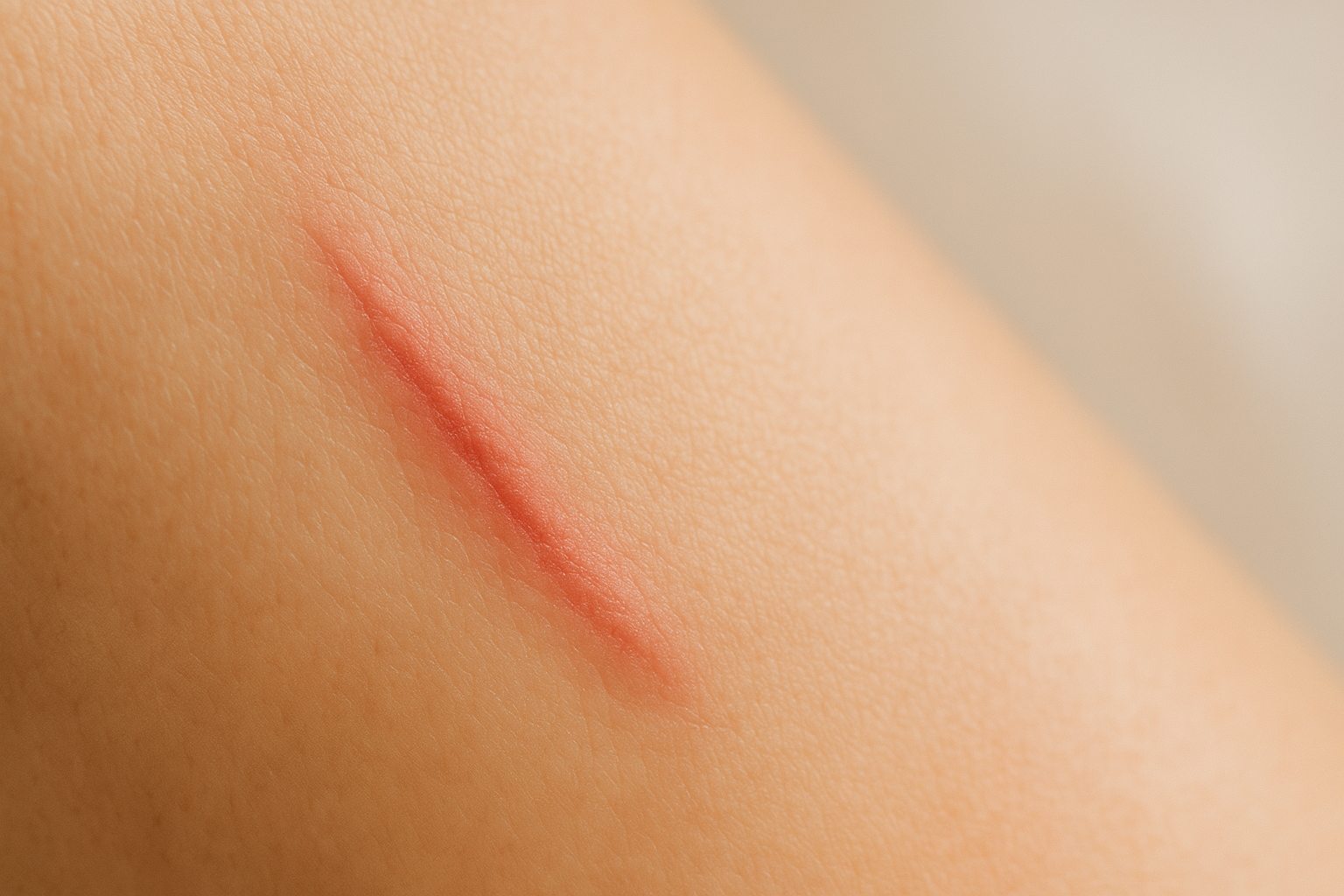
A red scar is almost always normal healing, not a problem. The redness comes from a dense network of tiny new blood vessels that form as your skin rebuilds — and it fades on its own as the scar matures. In a landmark study of untreated scars, redness faded at an average of about 7 months, but a normal range runs from roughly 3 months to 12–18 months, and longer for thicker (hypertrophic) or keloid scars. Redness lingers longer on the body than the face, on fair or younger skin, and where the wound was under tension.
You can help redness settle faster by protecting the scar from the sun (broad-spectrum SPF 30+ once it has healed), keeping it moisturised, and using silicone and gentle massage once the wound is fully closed. A water-free lipid concentrate such as ScarDerma Pro is one example of a leave-on product designed to keep a maturing scar conditioned and supported while it fades — but if a scar is getting redder, thicker, or more raised over time, see a doctor or dermatologist.
First, the reassuring part: red usually means "still healing"
If your scar is pink or red, your body is doing exactly what it's supposed to do. During the remodelling phase of wound healing, the skin lays down new collagen and grows a temporary web of tiny blood vessels (a process called angiogenesis) to feed the rebuilding tissue. Those vessels sit close to the surface and carry oxygen-rich blood, which is what gives a young scar its red or pink colour. As remodelling finishes, most of those extra vessels are no longer needed and regress, and the redness fades toward your normal skin tone.
The American Academy of Dermatology describes this maturation as a slow process that can take many months, which is why a scar that's still pink at three or six months is rarely a cause for alarm on its own (American Academy of Dermatology, "Scars: Overview").
How long does scar redness actually last?
The best single data point comes from a 2008 study in Plastic and Reconstructive Surgery. Researchers followed 103 volunteers with standardised incisional and excisional wounds on the inner upper arm and had a review panel judge, from monthly photographs, the month each scar's redness faded. On average, redness faded at 7 months — and, importantly, month-12 tissue samples showed no ongoing inflammation in any of the scars, confirming that persistent redness at that point is a colour and blood-vessel phenomenon, not active injury (Bond et al., Plast Reconstr Surg, 2008, PubMed 18300967).
That same study found two things that explain why your scar might be redder for longer than a friend's:
- Wound type matters. Thin surgical incisions lost their redness significantly faster than wider excisional wounds (where tissue was removed and the edges pulled together under more tension).
- Location matters. Redness faded at different rates depending on where on the body the scar sat, with a statistically significant front-versus-back difference.
Layer on the factors clinicians see repeatedly — fair or younger skin shows redness more vividly and holds it longer, and thickened hypertrophic scars and keloids stay red the longest — and you get the realistic timeline below.
Information-gain asset: a realistic scar-redness timeline
Most articles give you a single vague number. Here's a more honest, side-by-side view of when redness typically fades, based on the evidence above and standard dermatology guidance. Individual healing varies — treat this as a map, not a promise.
| Scar type / situation | Typical redness duration | Why |
|---|---|---|
| Fine surgical incision (e.g. keyhole, small excision) | ~3–7 months | Minimal tissue loss, edges close cleanly, less new vasculature |
| Wider excision or wound under tension | ~7–12 months | More remodelling and tension; redness fades significantly slower than incisions |
| Scars on the body (chest, shoulders, back, limbs) | Longer than facial scars | Higher skin tension and slower turnover than the well-vascularised face |
| Fair or younger skin | More visible, often longer | Redness contrasts more and vessels can stay active longer |
| Hypertrophic (raised, thick) scar | 12–18+ months | Prolonged, overactive remodelling keeps vessels and collagen turnover high |
| Keloid | Can persist for years | Scar tissue overgrows the original wound; needs professional management |
When redness is worth getting checked
Redness that's slowly, steadily fading is normal. Book a review with a doctor or dermatologist if instead you notice a scar that is getting redder, thicker, raised, or larger over time, spreading beyond the original wound edges, hot, increasingly painful, weeping or crusting, or intensely itchy. Those can signal a hypertrophic scar, keloid, or infection — all of which are far easier to manage early. This article is general information about the appearance of scars and isn't a substitute for a professional assessment.
What actually helps redness fade faster
You can't rush biology, but a few evidence-backed habits genuinely support a scar as it matures. Here's the short, honest version of what the research supports.
1. Protect it from the sun — this is the big one
Ultraviolet light is the single most avoidable thing that makes scar discolouration worse and last longer. The AAD advises shielding a healing wound from the sun and, once it's healed, applying a broad-spectrum sunscreen of SPF 30 or higher, noting that sun protection may help reduce red or brown discolouration and help a scar fade faster (AAD, "Proper wound care: How to minimize a scar"). Reapply every two hours outdoors, and remember scars on the chest, shoulders and forearms catch sun on ordinary days, not just at the beach.
2. Use silicone once the wound has closed
Silicone gel or sheeting is one of the most consistently recommended at-home options for maturing scars. A Cochrane review found silicone gel sheeting reduced the incidence of hypertrophic scarring in people prone to it, while cautioning that the overall certainty of the evidence is low — a fair, honest read is "reasonable to try, especially if you scar easily, but not a miracle" (O'Brien & Jones, Cochrane Database Syst Rev, 2013). Mayo Clinic similarly frames silicone and sunscreen together as the practical core of scar care (Mayo Clinic, "The Role of Silicone and Sunscreen in Scar Treatment").
3. Massage it — gently, consistently, and only once fully healed
Scar massage is widely recommended by rehabilitation and surgical teams to keep a scar supple and comfortable. Guidance from the National Kidney Foundation is to start once the wound is fully closed — no scabs, staples or steri-strips left — and to massage daily at first, tapering to a few times a week after about six months — the key word being consistency (National Kidney Foundation, "Scar Massage — How to Promote Healing"). Never massage an open, scabbed or inflamed wound.
4. Keep it conditioned and moisturised
A well-hydrated scar looks and feels better and is more comfortable to massage. Keeping the area supple with a lipid-rich, leave-on product supports the daily habits above and helps the surface look smoother and more even while colour settles over the months.
Simple 4-step daily protocol
- Morning: apply broad-spectrum SPF 30+ over the healed scar; reapply through the day if it's exposed.
- Twice daily: once fully closed, massage the scar for 5–10 minutes with a conditioning lipid product.
- Daily (if you scar easily): use silicone gel or sheeting as directed, ideally 12+ hours a day for several months.
- Ongoing: be patient and take monthly photos in the same light — progress is slow and photos show it better than memory.
Where a leave-on lipid concentrate fits in
Two of the reliably "helpful" habits above — daily conditioning and consistent massage — both need a good leave-on product to hang the routine on. That's the niche a scar-focused lipid formula fills.
ScarDerma Pro — a water-free botanical lipid concentrate for maturing scars
ScarDerma Pro is a 100% water-free (anhydrous) botanical lipid concentrate created to support the appearance of flatter, smoother, more even-toned scars and stretch marks. Because it contains no water, there's nothing to flash off the surface — the lipids stay in contact with the outer skin layers, which is the whole point of a leave-on conditioning step. That anhydrous, lipid-affinity delivery is its headline difference from typical water-based creams that largely evaporate.
The blend is built around scar-focused botanical lipids including rosehip seed — a natural source of trans-retinoic acid (sometimes called "natural tretinoin"), which small studies have linked to modest improvement in the look of skin texture — alongside pomegranate seed, whose extract has been shown to stimulate keratinocyte renewal in the epidermis (Aslam et al., J Ethnopharmacol, 2006), plus immortelle helichrysum and tamanu in a soothing lipid base. It's free from harsh acids, drying agents, artificial fragrance and parabens, and is vegan and non-GMO.
It's formulated by S. C. Aris, holds a real 4.91/5 rating from 34 verified buyers, and is backed by a 90-day guarantee, so you can trial it across a meaningful stretch of a scar's remodelling window. Use it as your twice-daily massage and conditioning step once the wound is fully closed.
Cosmetic product intended to support the appearance of skin and scars. It does not treat, heal or cure any medical condition. For a scar that is worsening, raised, painful or infected, see a doctor or dermatologist.
Frequently asked questions
Is a red scar a bad sign?
Usually no. Redness reflects the new blood vessels that form while your skin rebuilds, and it typically fades as the scar matures. It's worth a professional check only if the scar is getting redder, thicker, raised, painful, or is spreading beyond the original wound.
How long does it take for a scar to stop being red?
On average around 7 months in one well-known study of untreated scars, with a realistic range of about 3 to 12–18 months. Thicker hypertrophic scars and keloids can stay red considerably longer.
Why is my scar still red after a year?
That can still be within normal range, especially for a wider or higher-tension wound, a scar on the body rather than the face, fair or younger skin, or a raised hypertrophic scar. If it's slowly fading, it's likely fine; if it's thickening or intensifying, have it assessed.
Does sunscreen really help scar redness?
Yes — sun protection is one of the most effective things you can control. Dermatology guidance is to use broad-spectrum SPF 30+ on a healed scar, because UV exposure can deepen and prolong red or brown discolouration.
Can I make scar redness fade faster?
You can support it: protect from sun, keep it moisturised and conditioned, use silicone once the wound has closed, and massage gently and consistently. None of these are instant, but together they give a maturing scar the best chance to settle.
Related reading
If you're weighing up longer-term results, see Do old scars ever fade? for what's realistic with older marks, and How to reduce the appearance of a C-section scar for a step-by-step routine on one of the most common surgical scars.
The bottom line
A red scar is your skin mid-repair, not a mistake. Most redness fades within roughly 3 to 12 months — around 7 on average — and longer for raised or high-tension scars. You can't fast-forward the biology, but sun protection, silicone, gentle massage and daily conditioning genuinely help it along, and a leave-on lipid concentrate like ScarDerma Pro gives you something practical to build that routine around. Be patient, take monthly photos, and check in with a professional if anything is heading the wrong way.