Why Is My Scar Shiny? The 3 Sources of Scar Shine — and the One You Can Actually Change
Last updated: 8 September 2026
Quick answer
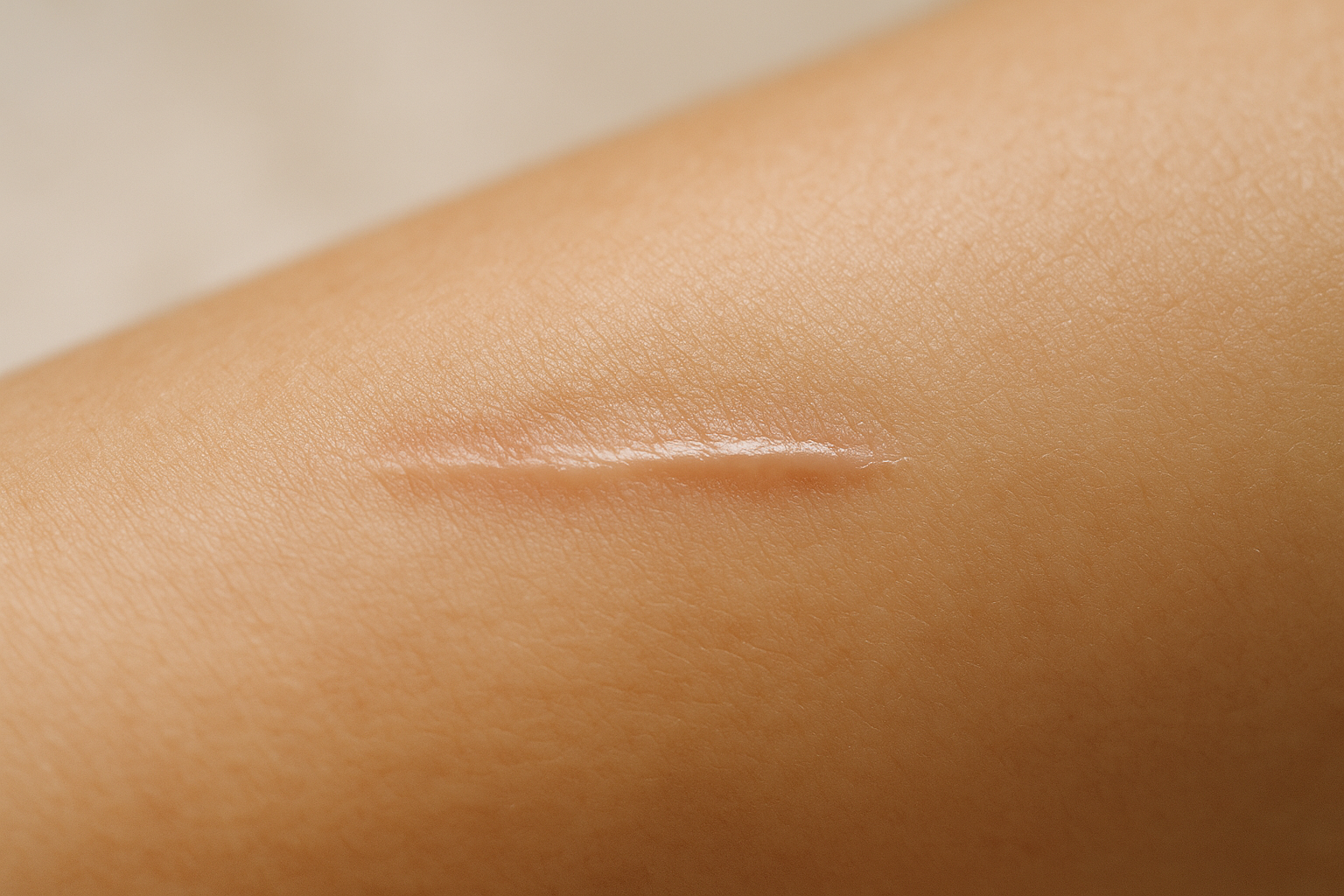
A scar looks shiny because it is missing the things that make normal skin look matte. When a deep wound closes, the body fills it with collagen laid down “in dense parallel bundles” rather than rebuilding the original skin — and, as the open-access Textbook on Scar Management puts it, in adults that process “results in scar formation,” whereas only fetal skin achieves “complete regeneration of the skin, including the formation of skin appendices such as hairs and sebaceous and sweat glands.” So a mature scar has no pores, no hair follicles and no oil glands. The Burn Model System's patient guidance says it plainly: “Scar tissue and skin grafts do not have the same oil or sweat glands found in normal skin. This makes the scar feel dry and itchy.” A flat, tight, gland-free surface reflects light in one direction instead of scattering it — that is the shine.
Some of that shine is structural and permanent (the missing follicles and glands), some is immaturity that fades over 12–18 months as the scar flattens and loses its redness, and some is surface dryness you can change today. The dryness part is the one worth working on: because a scar makes no sebum of its own, the lipids it would normally get from oil glands have to come from outside. A water-free botanical lipid concentrate such as ScarDerma Pro is one example of that category — a way of supporting the look and feel of a scar that cannot condition itself.
The 20-second version
- Scars are patches, not rebuilds. Collagen fills the gap; hair follicles, sweat glands and oil glands do not come back.
- No oil glands means no sebum. Sebaceous glands supply about 90% of the skin's surface lipids in normal skin. A scar gets none.
- Three things make a scar shine: the structure it is built from, how immature it is, and how dry its surface is. Only the last two change.
- Shine and redness fade on the same clock. Scarring peaks around six months and matures over 12–18 months; the glassy, stretched look eases as the scar flattens.
- Moisturising is the standard of care for dry scars — but a 2023 study found that 28 days of three common scar moisturisers did not significantly change objective scar measurements. Expect softer and more comfortable, not transformed.
- Use the moisturiser test below to find out how much of your scar's shine is dryness — and therefore how much you can realistically change.
What a scar is actually made of — and what it is missing
Normal skin is not smooth. Its surface is interrupted every fraction of a millimetre by pores, hairs and the openings of sweat ducts, and it sits on a dermis that is, in the words of the Textbook on Scar Management, “composed mainly of a dense extracellular matrix network of collagen fibers supporting the specific dermal appendages, including hair follicles, sebaceous glands, and sweat glands.” That surface texture scatters light. It is why healthy skin reads as matte even when it is well hydrated.
A scar is built from a different blueprint. After a deep wound, the body's priority is to close the gap, and the remodelling phase that follows “is characterized by a decrease in cellularity and vascularity by apoptosis and an increase of synthesis and deposition of the components of the extracellular matrix.” The result is a plug of collagen. Three things are different about it:
- The collagen is arranged differently. In adult wound healing “the collagen fibers are arranged in dense parallel bundles,” compared with the loose, basket-like network of unwounded skin. Mature scar collagen is also stiffer and, per Thomas Mustoe's international classification, goes “in multiple directions giving the scar stiffer biomechanical properties.”
- The appendages do not regenerate. Only early fetal skin can heal with “the regeneration of skin appendages such as hair follicles and sebaceous and sweat glands.” Adult skin cannot. Human fetuses lose that ability around 22 weeks of gestation — long before birth. So a mature scar has no hair, no pores and no oil glands, whatever its age.
- The elastic recoil is incomplete. In deep human wounds, elastin fibres “do not show complete regeneration after wound healing being both deficient and not showing normal structural organization.” That is part of why a scar can look stretched and taut rather than springy.
Put those together and you have a surface that is flatter, tighter, unbroken by pores, and — crucially — unconditioned. Light hitting it bounces back in a more coherent direction instead of scattering. That coherent reflection is what your eye reads as gloss.
The sebum point most articles get backwards
It sounds paradoxical: surely less oil should mean less shine? But sebum is not sitting on top of healthy skin as a slick. According to the physiology reference on sebaceous glands in StatPearls, the sebaceous gland provides about “90% of the skin's surface lipids,” and sebum “helps seal in moisture and prevent skin desiccation.” It keeps the outer layer supple and slightly textured. Take it away and the surface dries, tightens and flattens. The Model Systems Knowledge Translation Center's burn scar factsheet lists exactly this among what survivors notice as scars mature: they “can be dry, leading to cracking or breakdowns of the skin.”
A dry, tight film is more reflective than a supple, conditioned one. That is the part of scar shine you can actually influence — and it is why the rest of this article separates the three sources of shine before talking about what to do.
The three sources of scar shine
This is the distinction the top-ranking pages for this question do not make, and it changes what you should expect from any product or routine. The framework is our synthesis of the cited sources, not a clinical classification.
| Source of shine | What is causing it | How to recognise it | Does it change? |
|---|---|---|---|
| 1. Structural shine | No pores, no hair follicles, no oil glands; collagen in parallel bundles; incomplete elastin. The scar is built from different material. | The scar is fully mature — pale or white, flat, soft, no redness — and still catches the light. Look closely: no pores, no hair, no fine skin lines crossing it. | No. It is permanent. Resurfacing procedures can roughen the surface, but nothing brings back follicles or glands. |
| 2. Immaturity shine | The scar is still raised, slightly swollen and red, with the thin epidermis stretched over it. In Mustoe's classification an immature scar is pink, slightly raised by fluid, collagen and cellularity, and its redness has not yet resolved. | Under 12–18 months old. Pink or red as well as glossy. May feel firm, tight, itchy or warm. Often the whole scar looks “polished.” | Yes, with time. As the scar flattens and its redness resolves, the stretched, glassy look eases. Scars “fade in color and become flatter, softer, and generally less sensitive” as they mature. |
| 3. Dryness shine | With no sebum, the surface loses water faster than normal skin and dries into a tight, reflective film. Scarred tissue “typically… loses more transepidermal water than healthy skin does.” | The shine varies through the day — worse after showers, in winter, in dry air. The scar may feel tight, itchy or flaky. The shine softens when the scar is conditioned and creeps back as it dries. | Yes, daily. This is the one that responds to routine: replacing the lipid layer the scar cannot make for itself. |
Most shiny scars are a mix. A two-year-old surgical scar on the forearm is mostly source 1 with some source 3. A six-month-old scar on the shoulder is all three. The point of separating them is honesty: a routine can fix the dryness component completely, take the edge off an immature scar's glassiness while time does the rest, and do nothing whatsoever about the structural component. Anyone promising to make a mature scar “matte like normal skin” is promising to grow oil glands.
The moisturiser test: how much of your scar's shine is dryness?
You can estimate the changeable share of your scar's shine at home in about half an hour. This is a simple observation, not a diagnostic test — it is our practical adaptation of the principle that scar shine has separable causes.
- Start with the scar clean and dry, in daylight. Note how glossy it looks compared with the skin around it. If you want to be rigorous, photograph it in the same spot, same light, phone held at the same angle.
- Apply a plain, fragrance-free emollient — or your usual lipid product — to half the scar only, leaving the other half bare. Massage it in gently for a minute; do not leave a visible slick.
- Wait 20–30 minutes for any surface film to settle, then compare the two halves.
- Read the result. If the conditioned half looks noticeably less glassy and more like the surrounding skin, a meaningful part of your scar's shine is dryness shine — and daily conditioning will keep it that way. If both halves look identical, what you are seeing is mostly structural (and, if the scar is still red, immaturity) shine, and your expectations should follow.
- Repeat in a few hours. Dryness shine comes back as the emollient wears off. That return is the tell — and it is why conditioning a scar is a daily habit rather than a one-off.
Do not run this on an open wound, a scab, or a scar that is weeping, blistered or newly painful. Scar care in general starts only once the wound is fully closed — most surgical patients can begin about four weeks after surgery, after checking with their surgeon.
Why a deep cut goes shiny but a graze usually doesn't
Ever noticed that a shallow scrape heals back to ordinary-looking skin, while a deeper cut of the same length leaves a permanent glossy line? The fetal-healing chapter of the Textbook on Scar Management gives the reason: hair follicles contain stem-cell niches, and “in partial-thickness wounds in which part of the hair follicle is still intact, healing can occur without scar formation.” If the injury stops above the base of the follicles, the skin can re-cover itself from those reserves and keeps its appendages. If the wound goes through them, the follicles — and the sebaceous glands attached to them — are gone, the gap is filled with collagen, and the surface that results has nothing to give it texture.
This is also why burns and skin grafts are the shiniest and driest scars of all. The MSKTC infographic on choosing a moisturiser after burn injury notes that scar tissue and skin grafts alike lack the oil and sweat glands of normal skin. The deeper the injury, the fewer appendages survive, the more sebum-free the healed surface.
Does the shine fade? The honest timeline
Partly. Here is what changes, and what does not, using the maturation timelines published by burn-rehabilitation and cancer-surgery centres.
| Time since injury | What the scar is doing | What happens to the shine |
|---|---|---|
| 0–6 months | Scarring “usually develops within the first few months after the burn, peaks around 6 months.” The scar is raised, red, firm, often itchy. | Peak shine. Immaturity shine and dryness shine both at their worst. Structural shine already fixed. |
| 6–18 months | Scars “may improve or mature in 12–18 months.” Memorial Sloan Kettering counts scars as continuing to change for 12–18 months: harder and raised at first, “then becomes softer, smoother, less red.” | Falling. As the scar flattens and the redness fades, the stretched, polished look settles. This is the period when people notice their scar “calming down.” |
| Beyond 18 months | Mature. Mustoe's classification: redness resolved, flat, colour white (absence of melanocytes) or hyperpigmented. In one volunteer study a third of superficial scars took over a year to lose their redness entirely. | Whatever is left is structural plus dryness. The structural share is permanent; the dryness share is yours to manage for the life of the scar. |
Two practical consequences. First, if your scar is under a year old and shiny, a good part of the shine is going to ease on its own — pair a conditioning routine with patience rather than escalating to procedures. Second, if your scar is several years old, pale and still glossy, the shine is not going anywhere by itself; a daily lipid routine is what keeps the surface from looking dry and tight, and resurfacing is a conversation for a dermatologist. We cover the colour side of this clock in why is my scar still red and the long tail in do old scars ever fade.
What the moisturiser evidence actually shows
Every burn unit and plastic-surgery service tells patients to moisturise scars. Cambridge University Hospitals' scar massage guidance recommends “an oil-based cream” as best for massage; the MSKTC burn factsheet says to keep scars “clean and well moisturized for the best outcome” and to reapply after every shower because “hot showers remove the natural oils from the skin.” The rationale is exactly the missing-gland problem above. What is rarely quoted is the measured evidence — so here it is.
In 2023, a burn-centre team in Cologne (Bagheri, Werres, Schiefer and colleagues, published in Medicina) compared three commonly used scar moisturisers — an aloe vera gel-cream, a dexpanthenol cream and a plant-oil product — applied daily for at least 28 days by 30 skin-healthy volunteers and 12 patients with mature burn scars, each person using all three on different areas. They measured water loss, elasticity, surface texture and blood flow with instruments, and scar quality with the Patient and Observer Scar Assessment Scale.
| What was measured | Result on scars after 28+ days | What it means for a shiny scar |
|---|---|---|
| Water loss through the scar (TEWL) | Untreated scars averaged 13.5 g/h/m². The aloe product produced a non-significant 30% improvement (p = 0.094); the others changed little. No moisturiser significantly changed TEWL. | Confirms scars leak water faster than normal skin (the paper: scarred tissue “typically… loses more transepidermal water than healthy skin does”) — but a month of moisturising did not measurably fix that. |
| Firmness / elasticity (Cutometer) | The dexpanthenol cream significantly improved the baseline firmness parameter on scars by about 15% (p = 0.007). Other elasticity parameters did not change. | One measurable softening signal — modest, and from one product. |
| Surface texture (Visioscan) | All three products significantly improved scaliness, roughness or smoothness on healthy skin — but showed no significant changes on scars. | The surface of a scar is harder to change than the surface of normal skin. Manage expectations accordingly. |
| Patient- and observer-rated scar quality (POSAS) | No significant change in any category. | A month of moisturiser did not visibly transform the scars, to either the patients or the examiner. |
| Tolerance and preference | All three well tolerated. Asked to pick the “best of three,” 58% of scar patients chose the aloe product, 25% the dexpanthenol cream, 17% the plant-oil product. | People can feel a difference in comfort that instruments do not capture in 28 days. |
The authors' own summary is worth quoting: “Skin moisturizers constitute the central pillar of scar management and therapy. A uniform recommendation for one specific moisturizer or quantitative data concerning its effects is scarce in the literature.” Twelve scar patients is a small group, the products were used once daily, and the study ran for roughly five weeks — so absence of a significant change is not proof of no effect. But it sets an honest baseline: conditioning a scar is the standard of care because it makes the scar more comfortable, less itchy and less prone to cracking, not because a month of it re-engineers the surface.
How a lipid layer works on a gland-free surface
The mechanism is occlusion. A 2018 review of topical plant oils in the International Journal of Molecular Sciences describes it directly: plant-oil application “may act as a protective barrier to the skin by an occlusive effect, allowing the skin to retain moisture, resulting in decreased TEWL values” — and this happens “even without penetrating deeper into the epidermis.” Silicone gels and sheets, the other standard scar topical, work the same way: the scar-prevention chapter of the Textbook on Scar Management is explicit that silicone “is not absorbed into the skin and covers intact epithelium” and that its benefit comes from occlusion and reduced water loss. Both are doing, from the outside, the job sebum does in normal skin. That is the whole logic of putting lipids on a scar: not to change what it is made of, but to give a surface with no oil glands the conditioned layer it cannot produce.
A daily routine for a dry, shiny scar
Assembled from the burn-rehabilitation and NHS guidance cited in this article. Adapt it to what your own surgeon or burn team has told you — their advice for your scar overrides a general routine.
- Only once the wound is closed. No scabs, staples or strips. Most people can start around four weeks after surgery, after checking with their surgeon.
- Wash off yesterday's product first. Cambridge's scar guidance says to “wash and dry the area with soap to rinse off any previous moisturiser” before reapplying, so the surface does not clog.
- Lukewarm, not hot. “Lukewarm water is best and tends to dry out skin the least” — and hot showers strip what little surface lipid a scar has. Re-condition straight after bathing, every time.
- Choose a product with no added alcohol and no synthetic fragrance. The MSKTC advice for healed burn skin: look for products “that do not include alcohol,” because alcohol dries the skin (cetyl alcohol, a waxy emollient, is the exception and is fine), and avoid fragrances. If your scar is a healed burn or graft, follow your burn team's product list literally — some burn services also advise against mineral oil and petroleum jelly on healed grafts, which differs from the petroleum-jelly advice dermatologists give for fresh, closed surgical wounds.
- Thin layers, massaged in. Apply “in thin layers and massaged in gently while the scars are more fragile,” adding pressure only as the scar matures. Cambridge's protocol is 5 minutes, 2–3 times a day, for around 6 months. Stop if the scar goes sore, blistered, red or breaks down — and see can you massage a scar too much for the blanch test.
- Lipids under, silicone over. If you also use a silicone gel or sheet, condition first, let it settle, then apply the silicone. The order is explained in can you use scar oil and silicone gel together.
- SPF every day the scar is exposed. Broad-spectrum SPF 30 or higher, reapplied every two hours outdoors. Immature scars “burn easily,” and sun exposure can darken them — a shiny and dark scar is far more noticeable than a shiny pale one.
- Reapply through the day. A scar has no glands to top itself up. The MSKTC guidance is to apply “frequently throughout the day” — in practice, morning, after any wash, and at bedtime is the minimum for a dry scar.
Stretch marks: the same physics, thinner
Stretch marks are a form of scar, and their shine has the same explanation with one extra ingredient. StatPearls describes the histology of mature (white) striae as “epidermal atrophy, loss of rete ridges, reduced vascularity, densely packed thin horizontal collagen bundles” — findings that “resemble mature atrophic scars.” The rete ridges are the wavy, interlocking junction between the epidermis and dermis; losing them flattens the surface further, which is why old stretch marks often look almost glassy in raking light. If yours are the silvery-white, shiny kind, they are mature, and the same three-source logic applies: the structure is permanent, and the conditioned-versus-dry surface is what you control. We go into why they behave differently in the sun in why don't my stretch marks tan.
Five things that will not make a scar matte
- Exfoliating or scrubbing it. There is no dead-skin layer hiding a matte scar underneath. Scars only reach around 70–80% of normal skin strength and injure easily; scrubbing risks breakdown, not texture.
- Powdering or mattifying it. Cosmetic camouflage can hide shine for an evening, and green-tinted makeup is a legitimate way to soften redness — but it does nothing for the dryness underneath, and some products dry the scar further.
- Tanning it to blend in. Mature scars have no melanocytes to tan with, and immature scars burn easily and can darken permanently.
- Hot compresses or hot showers “to open it up.” Heat strips surface lipid from a surface that cannot replace it.
- Waiting for oil glands to return. They will not. Human skin loses the ability to regenerate appendages before birth.
When shine is worth a professional look
- The scar is cracking, splitting or breaking down — dry scars can do this, and open areas need proper wound care.
- It is growing, thickening or spreading beyond the original wound rather than settling.
- It is painful, intensely itchy, or warmer than the skin around it.
- It has changed in colour or texture in a way you cannot account for. Any lump or patch that is changing deserves a skin check.
- You want the structural share reduced. Resurfacing procedures exist for mature scars; a dermatologist or plastic surgeon can tell you what is realistic for your scar type and skin tone.
Where a lipid concentrate fits: ScarDerma Pro
Let's be precise about the job. No topical restores hair follicles, sweat glands or oil glands to a scar, and no topical changes how its collagen is arranged. What a well-designed one can do is address the one source of shine that is genuinely open to daily influence: the dry, unconditioned surface of a scar that makes no sebum of its own.
ScarDerma Pro is a 100% water-free botanical lipid concentrate formulated for the appearance of scars and stretch marks. The logic of the anhydrous format follows directly from this article. A scar has no oil glands, so the lipids its surface would normally receive from sebum have to be supplied from outside. Most scar creams are mostly water; water evaporates from a surface that already loses water faster than normal skin. A lipid concentrate with no water in it has nothing to evaporate — it stays lipid-compatible with the skin's own surface layers rather than flashing off, which is the same delivery reasoning behind our SD7 Lipid Serum.
The blend. Four scar-focused actives — Immortelle Helichrysum, Rosehip seed, Tamanu and Pomegranate seed — alongside soothing Japanese Camellia, Geranium, English Lavender and Hemp seed, on a base of Sea Buckthorn, Calendula, Jojoba, Hazelnut and Vitamin E. Rosehip seed is a natural source of trans-retinoic acid, sometimes called “natural tretinoin,” at trace levels far below prescription strength; small studies suggest modest improvement in the look of texture. Pomegranate seed has been studied for keratinocyte renewal, and its polyphenols are researched for inhibiting collagenase and elastase, the enzymes that break down collagen and elastin. Jojoba, notably, is a wax ester that is stable against oxidation — a sensible base for a product meant to sit on a surface all day.
What's not in it. No harsh acids or peels, no drying agents, no artificial fragrance or parabens, no fillers. Vegan and non-GMO. Being anhydrous, it needs no preservative system. It does contain aromatic botanicals — geranium and lavender among them — so it is scented by its own ingredients rather than fragrance-free. If your scar is a healed burn or graft and your burn team has asked you to avoid all scented products, follow them, and patch-test any new product on a small area of scar first.
The trust stack. Formulated by S. C. Aris. Rated 4.91 out of 5 from 34 verified buyers, 20 ml, with a 90-day guarantee — long enough to run the moisturiser test above properly, more than once, and see how your scar's surface looks with and without a daily lipid layer. In our own customer survey, 91% reported flatter, smoother-looking scars within six weeks, 9 in 10 reported more even-looking tone, and 94% said they would recommend it. Those are customer-survey figures, not clinical-trial results, and we label them that way deliberately.
How to use it on a shiny scar. Once the wound is fully closed and your surgeon is happy, apply a small amount to the clean scar once or twice daily — after bathing is the moment that matters most, because that is when a scar's surface is at its driest. Massage in gently with the pads of two fingers until it disappears; you want a conditioned surface, not a slick, which would only look shinier. If you use silicone, this goes on first and the silicone over the top.
ScarDerma Pro is a cosmetic product. It supports the appearance of scars and stretch marks. It does not treat, heal or prevent any medical condition, and it is not a substitute for surgical or dermatological care.
Frequently asked questions
Why are scars shiny?
Because scar tissue is missing what makes normal skin matte. Adult wounds heal by filling the gap with collagen in dense parallel bundles rather than regenerating skin; hair follicles, sweat glands and sebaceous (oil) glands do not come back. Without pores to break up the surface and without sebum to condition it, the scar is flatter, tighter and drier, and it reflects light in one direction instead of scattering it.
Will my shiny scar ever look normal?
It will look better, but not identical to unscarred skin. The immature, stretched gloss of a young scar fades as it flattens and loses its redness over 12–18 months. The dryness component can be managed every day with a lipid layer. The structural component — no follicles, no glands, parallel collagen — is permanent, though resurfacing procedures can soften it.
Why is my scar shiny and tight?
Tightness and shine usually travel together because both come from a dry, unconditioned surface with reduced elastic recoil. Scars have no oil glands, lose water faster than normal skin, and in deep wounds the elastin fibres do not fully regenerate. Regular conditioning after bathing tends to ease the tight feeling and the glassy look together.
Does moisturising a scar reduce the shine?
It reduces the dryness part of it. Moisturising is the standard advice from burn and plastic-surgery services because scars make no sebum of their own. A 2023 comparison of three scar moisturisers found people preferred and tolerated them well, but 28 days of use did not significantly change instrument measurements of scar surface or water loss — so expect a more comfortable, less tight, less glassy-looking surface, not a transformed scar.
Why is my scar shiny and red?
That combination means the scar is still immature. Immature scars are slightly raised, with the epidermis stretched over them and their blood supply not yet settled; the combination of stretch and redness looks polished. Both ease as the scar matures. If the scar is also growing, thickening, painful or warm, have it checked.
Are shiny scars permanent?
Some degree of shine is, because the missing appendages never regenerate. But the shine you see in the first year is at its peak and will fall as the scar matures, and the day-to-day glossiness of a dry scar is controllable with a lipid routine.
Why don't scars have pores or hair?
Hair follicles, sebaceous glands and sweat glands develop during fetal life, and only early fetal skin can regenerate them after injury. Human skin loses that ability around 22 weeks of gestation. After birth, a deep wound is repaired with collagen, not rebuilt, so the appendages that would have created pores and hairs are never re-formed.
The bottom line
A shiny scar is a scar without oil glands, without pores and with its collagen laid in parallel — that part is permanent and no product changes it. On top of that permanent base sit two layers of shine that do change: the stretched gloss of an immature scar, which fades over 12–18 months, and the tight, reflective film of a dry surface that cannot condition itself, which is yours to manage every day. Run the moisturiser test to see how much of your scar's shine is dryness. Then treat conditioning as the maintenance job it is: lukewarm water, lipids after every wash, SPF outdoors, and patience for the rest.
Related reading
- Why is my scar still red — and how long does scar redness last?
- Do old scars ever fade?
- How to soften old hard scar tissue
- Can you massage a scar too much? The blanch test
- Can you use scar oil and silicone gel together?
- Do silicone scar sheets work on old scars?
- Why don't my stretch marks tan?
- Why is my scar getting wider?
Sources
- Ulrich MMW. Fetal Wound Healing. In: Téot L, Mustoe TA, Middelkoop E, et al., eds. Textbook on Scar Management. Springer; 2020, ch. 1.
- Desmoulière A. Scar Formation: Cellular Mechanisms. Textbook on Scar Management. Springer; 2020, ch. 3.
- Mustoe TA. International Scar Classification in 2019. Textbook on Scar Management. Springer; 2020, ch. 9.
- Mustoe TA. Silicone Gel for Scar Prevention. Textbook on Scar Management. Springer; 2020, ch. 23.
- Hoover E, Aslam S, Krishnamurthy K. Physiology, Sebaceous Glands. StatPearls; 2022.
- Shepler LJ, Deng H, Friedstat JS, Schneider JC. Scar Management After Burn Injury. Model Systems Knowledge Translation Center; 2024.
- Model Systems Knowledge Translation Center. How To Select a Moisturizer for Itchy Skin After Burn Injury.
- Shepler L, Mehta A, Ryan CM, Schneider JC. Itchy Skin After Burn Injury. Model Systems Knowledge Translation Center; 2024.
- Bagheri M, Werres M, et al.; Schiefer JL. Which Moisturizer to Use in Scar Therapy after Burn Injuries? A Subjective and Objective Skin and Scar Evaluation after Topical Treatment with Dexpanthenol, Aloe Vera, and Plant Oil. Medicina. 2023;59(10):1874.
- Lin TK, Zhong L, Santiago JL. Anti-Inflammatory and Skin Barrier Repair Effects of Topical Application of Some Plant Oils. Int J Mol Sci. 2018;19(1):70.
- Cambridge University Hospitals NHS Foundation Trust. Scar massage information.
- Memorial Sloan Kettering Cancer Center. Caring for Your Scars After Skin Surgery.
- Mikes BA, Oakley AM, Patel BC. Striae Distensae. StatPearls; 2025.
- Walker M, PT, DPT. Scar Massage — How to Promote Healing. National Kidney Foundation; 2024.
This article is general information about the appearance of skin and scars, not medical advice. If your scar is cracking, growing, painful, or changing in a way you cannot explain, see a doctor, dermatologist or plastic surgeon.