Why Is My Mouthwash Staining My Teeth Brown? How to Tell Which Ingredient Is Doing It
Quick Answer
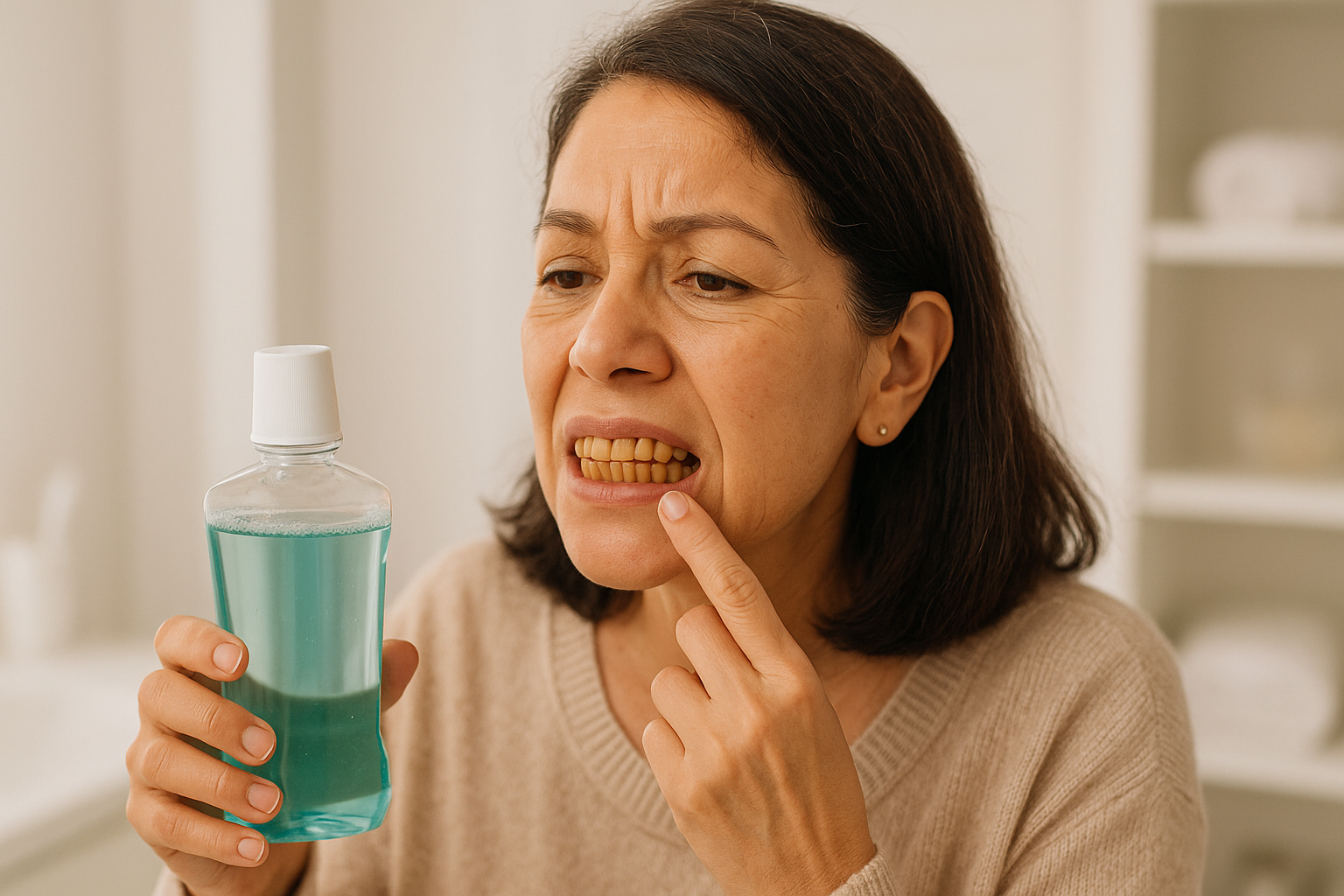
Two mouthwash ingredients are documented causes of brown tooth staining: chlorhexidine gluconate and cetylpyridinium chloride (CPC). The American Dental Association states plainly that "cetylpyridinium chloride and chlorhexidine may cause brown staining of teeth, tongue, and/or restorations." Chlorhexidine is the heavier stainer and is prescription-only in the US; CPC is the one hiding in ordinary supermarket rinses. The stain is extrinsic — it sits on the enamel surface rather than inside the tooth — so a hygienist can polish it off. Two things decide how bad it gets: how long you rinse for, and how much plaque you leave behind, because the stain binds to plaque. If your label has neither ingredient, your mouthwash almost certainly isn't the culprit and you should be looking at stannous fluoride toothpaste, coffee, tobacco or early decay instead.
If you'd rather not run the risk at all, an anhydrous botanical concentrate such as Dental Pro 7 is one example of a routine built without either compound — but the first job is simply working out which ingredient you're actually reacting to, and the table below does that.
Last updated: 15 August 2026
First: check that it really is the mouthwash
Brown staining on teeth is common and mouthwash is only one of its causes. Before you blame the bottle, run through this quickly.
Cleveland Clinic's guidance on tooth discolouration separates stains into two families. Extrinsic discolouration "affects the outer surface of your teeth (enamel)" and usually comes from what touches them — food, drink, tobacco, plaque. Intrinsic discolouration "starts inside your tooth and affects your dentin," and is caused by things like dental trauma, childhood tetracycline or a dead nerve. Mouthwash staining is firmly in the extrinsic camp, which is good news: extrinsic stain is the kind that comes off.
Cleveland Clinic also gives a useful colour key. Brown teeth "usually relate to smoking or using chewing tobacco," and — this is the one worth taking seriously — "brown stains and small holes in your teeth probably mean you have untreated tooth decay." If your brown marks have any depth, catch on a fingernail, or sit in a pit rather than as a film, that is a dentist appointment, not a mouthwash problem. (Source: Cleveland Clinic, "Tooth Discoloration," updated 3 July 2025.)
The 4-question triage
- Is it on the teeth, or on the tongue? A brown or black furry coating on the tongue is a different condition entirely — see the black hairy tongue section below.
- Is it a film, or a hole? Film that follows the gum line and the gaps between teeth = plaque-bound stain. A defined brown spot with texture or a small cavity = see a dentist.
- Did it start within about a month of a new rinse? Chlorhexidine staining is measurable within four weeks. If your rinse hasn't changed in years, look elsewhere.
- Read the label. If neither chlorhexidine nor cetylpyridinium chloride appears in the actives, the rinse is very unlikely to be responsible.
The ingredient table: which one is doing it?
This is the part most articles on this question skip. Here is every common mouthwash active, what the evidence actually says about staining, and how to spot it on a label.
| Active ingredient | Where you'll find it | Stains teeth brown? | What the evidence says |
|---|---|---|---|
| Chlorhexidine gluconate (0.12% / 0.2%) | Prescription only in the US; over the counter in many other countries. Brand names include Peridex and PerioGard. | Yes — the heaviest stainer | Cochrane found "a large increase in extrinsic tooth staining" at 4–6 weeks. The FDA-approved label reports 56% of users showed a measurable stain increase at six months, versus 35% on control. |
| Cetylpyridinium chloride (CPC) | Everyday over-the-counter rinses, especially breath-focused ones. Often listed at 0.05–0.075%. | Yes | The ADA states that "cetylpyridinium chloride and chlorhexidine may cause brown staining of teeth, tongue, and/or restorations." This is the one most people don't realise they're using. |
| Chlorhexidine + CPC + zinc lactate (combination) | Specialist halitosis rinses. | Yes — notably | Per the ADA, this combination has been shown to significantly reduce bad breath, but "also may significantly contribute to tooth staining." |
| Essential oils (eucalyptol, menthol, thymol, methyl salicylate) | Classic amber over-the-counter antiseptic rinses. | Not listed by the ADA as a staining agent | The ADA discusses essential-oil rinses for plaque and gingivitis control without attaching the brown-staining caution it attaches to CPC and chlorhexidine. |
| Hydrogen or carbamide peroxide | Whitening rinses (typically 1.5–2% hydrogen peroxide). | No — these reduce extrinsic stain | But peroxide rinses carry a different problem: Cleveland Clinic lists "mouthwashes that contain peroxide" among the causes of black hairy tongue. |
| Fluoride (sodium fluoride rinses) | Anti-cavity rinses. | No | A Cochrane review found regular fluoride mouthrinse reduced tooth decay in children. Staining is not an associated effect. |
| Alcohol | Very common as a solvent, often 11–27%. | No, not directly | But it dries the mouth, and the ADA notes that because alcohol can be drying "it may be prudent to recommend an alcohol-free mouthrinse" for people managing dry mouth. Less saliva means more plaque, and plaque is what stain sticks to. |
Ingredient positions drawn from the ADA Oral Health Topics entry on Mouthrinse (Mouthwash), last updated 7 August 2026.
Chlorhexidine: the numbers nobody quotes
If you've been prescribed a chlorhexidine rinse after gum treatment or an extraction, the staining isn't a surprise to your dentist — it's on the label, with numbers attached. The FDA-approved prescribing information for Peridex (chlorhexidine gluconate 0.12% oral rinse) states:
"Peridex can cause staining of oral surfaces, such as tooth surfaces, restorations, and the dorsum of the tongue. Not all patients will experience a visually significant increase in toothstaining. In clinical testing, 56% of Peridex users exhibited a measurable increase in facial anterior stain, compared to 35% of control users after six months; 15% of Peridex users developed what was judged to be heavy stain, compared to 1% of control users after six months."
Read that carefully, because two things in it are more useful than the headline. First, 35% of the control group also stained — so a good chunk of what people blame on chlorhexidine would have happened anyway. Second, and more actionable:
"Stain will be more pronounced in patients who have heavier accumulations of unremoved plaque."
That single sentence is the most practical fact in this entire article. The stain binds to plaque. Two people can use the identical rinse and get very different results depending on how thoroughly they brush and clean between their teeth. The label's own advice reflects this: "To minimize discoloration, you should brush and floss daily, emphasizing areas which begin to discolor."
The independent evidence agrees on the effect. The Cochrane review by James and colleagues pooled 51 studies and 5,345 participants, and concluded: "Rinsing with chlorhexidine mouthrinse for 4 weeks or longer causes extrinsic tooth staining." The effect size at 4–6 weeks was a standardised mean difference of 1.07 (95% CI 0.80 to 1.34) across eight trials and 415 participants — a large increase, on moderate-quality evidence. The same review found a large reduction in plaque and, in people with mild gingival inflammation, a reduction in gingivitis that the authors judged not clinically important. (Sources: Peridex label via DailyMed, NLM; James P et al., Cochrane Database of Systematic Reviews 2017, CD008676.)
Other things the chlorhexidine label warns about
- Tartar. "An increase in supragingival calculus was noted in clinical testing in Peridex users compared with control users." Calculus deposits should be professionally removed at intervals no greater than six months.
- Taste. Altered taste perception is common, and the label notes "rare instances of permanent taste alteration" in post-marketing reports.
- Front fillings. This one matters. "Peridex may cause permanent discoloration of some front-tooth fillings." The label advises discretion when prescribing to patients with anterior facial restorations with rough surfaces or margins — on rare occasions the discolouration "may necessitate replacement of these restorations."
If you have white composite fillings on your front teeth and you've been handed a chlorhexidine rinse, that's worth raising before you start the bottle.
CPC: the one you didn't know you were using
Chlorhexidine at least comes with a dentist's warning. Cetylpyridinium chloride doesn't — it's in ordinary rinses off the supermarket shelf, and the ADA carries the same brown-staining caution for it that it carries for chlorhexidine.
The ADA notes CPC "may be added to reduce bad breath," and that as a preprocedural rinse it performs comparably to chlorhexidine at reducing bacterial load in dental aerosols. It's a genuinely useful ingredient. But the staining caution appears three separate times in the ADA's entry, and it's the same wording each time: brown staining of teeth, tongue, and/or restorations.
The practical upshot: if you've developed brown film and you're not on a prescription rinse, turn the bottle round and look for "cetylpyridinium chloride" in the active ingredients panel. It's the single most likely explanation, and it's the one almost nobody checks.
If it's your tongue, not your teeth
A brown or black coating on the tongue that looks furry is not tooth stain — it's most likely black hairy tongue, and its relationship to mouthwash runs the opposite way.
Cleveland Clinic describes it as overgrown papillae: "the little bumps on your tongue that contain your taste buds." Normally they shed; when they don't, they can grow up to 18 millimetres and "trap food, bacteria and dead skin cells. This is where the color comes from." Despite the name it "can be brown, green, white or other colors," and it's harmless and temporary, usually clearing in one to two weeks.
The listed causes include poor oral hygiene, a soft-food diet, dry mouth, tobacco, heavy coffee and tea, certain medications — and "mouthwashes that contain peroxide." Asked directly whether hydrogen peroxide can cause it, Cleveland Clinic answers: "It can. Mouthwashes that contain oxidizing agents like peroxide are linked to this condition." Their prevention advice is explicit: "Use a mouthwash that doesn't use peroxide or another oxidizing agent," and brush or scrape the tongue daily, since the papillae need friction to shed. (Source: Cleveland Clinic, "Black Hairy Tongue," updated 12 November 2025.)
Note the irony: the whitening rinse that's helping your enamel may be the thing discolouring your tongue.
Not the mouthwash? Check the toothpaste
If your rinse is clean, the other oral-care product with a documented brown-stain association is stannous fluoride toothpaste.
The framing of the literature tells the story: a 2019 randomised controlled trial in the Journal of the American Dental Association is titled, without euphemism, "Solving the problem with stannous fluoride: Extrinsic stain." The paper reports that a stabilised stannous fluoride formulation achieved extrinsic tooth stain reductions of 17.5% at three weeks and 27.8% at six weeks compared with a regular fluoride toothpaste.
Two honest caveats. The study is authored by researchers affiliated with the manufacturer of the product it tests, so treat the size of the benefit with appropriate scepticism. And we were only able to open the abstract, not the full paper — so we've quoted the reported figures exactly and drawn nothing further from them. What the title and the trial's existence establish beyond dispute is that extrinsic stain is a recognised, well-documented issue with stannous fluoride formulas, which is precisely the point if you're auditing your bathroom shelf. (Source: Li Y et al., J Am Dent Assoc 2019;150(4S):S38–S46, PMID 30797258.)
We've written separately on what abrasives in toothpaste actually do to enamel, and on the wider question of what's in your toothpaste and mouthwash.
Will the stain come off?
Almost always, yes. Three tiers, from the Peridex label and Cochrane:
| Surface | Outlook |
|---|---|
| Natural enamel | "Stain can be removed from most tooth surfaces by conventional professional prophylactic techniques" — i.e. a scale and polish. "Additional time may be required to complete the prophylaxis," so mention it when you book. |
| Smooth, well-finished restorations | Usually cleanable, same as enamel. |
| Rough or marginated front-tooth fillings | The label warns discolouration may be permanent and "on rare occasions may necessitate replacement of these restorations." |
Reassuringly, the label also states that "stain resulting from use of Peridex does not adversely affect health of the gingivae or other oral tissues." It's a cosmetic problem, not a clinical one.
The stain-minimising protocol
If you need to stay on a staining rinse — and after periodontal treatment or an extraction, you often do — this is how to keep the discolouration down. Every step here is drawn from the product label or the ADA.
- Attack the plaque first. Stain is "more pronounced in patients who have heavier accumulations of unremoved plaque." Brushing and interdental cleaning are not optional extras while you're on the rinse; they're the variable that decides your outcome.
- Target the areas that are already going. The label's wording: brush and floss daily, "emphasizing areas which begin to discolor."
- Don't chase it with water. Counter-intuitively, chlorhexidine's own instructions say not to rinse with water or other mouthwashes immediately after — that's to preserve the effect and avoid a bitter aftertaste, not to increase stain.
- Book the hygienist at six months or sooner. The label sets a hard ceiling: calculus deposits removed "at intervals not greater than six months."
- Treat it as a course, not a habit. Chlorhexidine is a prescription product for a defined period. Cochrane's staining finding kicks in specifically at "4 weeks or longer."
- Raise front-tooth fillings before you start. If you have anterior composites, ask whether an alternative is appropriate.
The question underneath the question
Most people who arrive at "why is my mouthwash staining my teeth" are using an antiseptic rinse daily, indefinitely, because it feels like the responsible thing to do. It's worth asking whether that's what the rinse is for.
The ADA divides mouthrinses into cosmetic and therapeutic. Cosmetic rinses "may temporarily control bad breath and leave behind a pleasant taste, but have no chemical or biological application beyond their temporary benefit." Therapeutic rinses have actives aimed at plaque, gingivitis, bad breath or decay. And on the whole category, the ADA is clear that "use of a mouthrinse is not a substitute for mechanical oral hygiene" — brushing and cleaning between the teeth.
The ADA's consumer arm puts it more bluntly still on the breath question: over-the-counter mouthwashes temporarily mask bad breath, and "it's only a temporary solution." It also flags the thing that actually matters: "Bad breath that just won't go away or a constant bad taste in your mouth can be a warning sign of advanced gum disease." If you're rinsing daily to manage breath or bleeding, the rinse is treating a symptom. We've covered what's usually underneath it in why you have bad breath and why your gums bleed, and why the rinse itself so often disappoints in why your mouthwash fails.
One more piece worth holding onto, from the National Institute of Dental and Craniofacial Research: saliva "washes food particles away from teeth and gums," and dry mouth raises the risk of decay because saliva keeps harmful germs in check. High-alcohol rinses work against that. If your mouth is dry, an alcohol-free formula is the sensible default — which is also the ADA's position. (Sources: ADA, Mouthrinse (Mouthwash); ADA MouthHealthy, "Bad Breath: 6 Causes (and 6 Solutions)"; NIDCR, "Dry Mouth".)
A gum-line routine built without either compound
If you've worked through the table above and decided you'd rather not have chlorhexidine or CPC in your daily routine at all, here is one alternative and, more usefully, the reasoning behind its design.
Dental Pro 7 is a 100% water-free botanical lipid concentrate used in place of toothpaste, brushed on dry and left against the gum line rather than rinsed away — no chlorhexidine and no cetylpyridinium chloride in it, and no water, fillers, SLS or other foaming agents, preservatives, parabens or fluoride.
The design logic — "Lipid-Lock." Water-based rinses and pastes are diluted by saliva and washed away within seconds of use, which is a large part of why conventional rinses rely on strongly binding cationic actives to stay put — and that same binding chemistry is bound up with the staining problem. Dental Pro 7 takes the opposite route: because it's anhydrous, it stays in contact with the gum line for hours rather than seconds, supporting the appearance of firmer, pinker, healthier-looking gums and a cleaner-feeling mouth. It's formulated by S. C. Aris.
If you want a rinse step as well, DP7 Pro Rinse is the paired product — and unlike the concentrate, it is diluted in water before rinsing. The two are used in opposite ways, so it's worth reading the instructions on each rather than assuming.
The numbers: Dental Pro 7 is rated 4.81 out of 5 from 190 verified buyers, with over 500,000 bottles sold, and comes with a 90-day money-back guarantee — long enough to judge it against a full hygienist cycle rather than a week.
Dental Pro 7 is a cosmetic product. It supports the appearance of healthy-looking gums and teeth and is not a treatment for any dental or medical condition. Persistent bleeding gums, bad breath, brown marks with any depth or texture, or a sudden change in tooth colour should be assessed by a dentist. Nothing here replaces professional dental advice.
Frequently asked questions
Does all mouthwash stain your teeth?
No. The ADA attaches the brown-staining caution specifically to cetylpyridinium chloride and chlorhexidine. Fluoride rinses, essential-oil rinses and peroxide whitening rinses are not identified as brown-staining agents — although peroxide rinses are linked to a separate issue, black hairy tongue.
How long does it take chlorhexidine to stain teeth?
Cochrane's finding is that "rinsing with chlorhexidine mouthrinse for 4 weeks or longer causes extrinsic tooth staining," with a large increase measurable at 4 to 6 weeks and again at 7 to 12 weeks and 6 months. Short prescribed courses of under four weeks are much less likely to leave visible marks.
Will the brown stain from mouthwash go away on its own?
Not usually on its own, but it is removable. The Peridex label states stain "can be removed from most tooth surfaces by conventional professional prophylactic techniques" — a scale and polish. Rough or marginated front-tooth fillings are the exception, where discolouration can be permanent.
Can I whiten mouthwash stains away at home?
Extrinsic stain is the type professional whitening works best on, but for chlorhexidine or CPC film, a hygienist appointment is the more direct route. Cleveland Clinic specifically advises avoiding activated charcoal and citric acid in home whitening products, and looking for the ADA Seal of Acceptance.
Is cetylpyridinium chloride bad for you?
There's no suggestion of that. The ADA describes CPC as an active that may be added to reduce bad breath, and notes it performs comparably to chlorhexidine at reducing bacterial load in dental aerosols. The staining is a cosmetic side effect, not a safety concern — the Peridex label notes that chlorhexidine stain "does not adversely affect health of the gingivae or other oral tissues."
Why did my teeth stain when my partner used the same rinse and didn't?
Most likely plaque. The chlorhexidine label is explicit that "stain will be more pronounced in patients who have heavier accumulations of unremoved plaque." In the six-month clinical testing, 56% of users showed a measurable stain increase — meaning 44% did not. Individual response varies considerably.
Should I stop my prescribed chlorhexidine because of the staining?
Don't stop a prescribed course without asking the dentist who prescribed it — it was almost certainly prescribed for a defined reason and a defined period. Staining is an expected, documented and largely removable side effect. Raise it at your next appointment, particularly if you have composite fillings on your front teeth.
The short version
- Two ingredients cause it: chlorhexidine gluconate and cetylpyridinium chloride. Check the actives panel.
- Chlorhexidine is the heavy one — 56% of users showed measurable stain at six months on the label's own clinical testing, and Cochrane confirms a large effect from four weeks.
- CPC is the sneaky one — it's in ordinary over-the-counter rinses and carries the same ADA caution.
- Plaque is the multiplier. The stain binds to plaque, so how well you brush and clean between your teeth largely decides how bad it gets.
- It comes off a scale and polish, with rough front-tooth fillings as the notable exception.
- If the label is clean, look at stannous fluoride toothpaste, coffee, tea, tobacco — or, if the marks have depth, at decay.