Can You Use Glycolic Acid on Stretch Marks? The Red-vs-White Rule, the 10%/pH 3.5 Safety Line — and When a Peel Is Worth It
Last updated: 13 September 2026
What Glycolic Acid Actually Does to a Stretch Mark
Start with what a stretch mark is, because that decides what any ingredient can do to it. The American Academy of Dermatology describes a stretch mark as a type of scar that forms when skin stretches or shrinks quickly enough to rupture the collagen and elastin that support it. The damage is in the dermis — the living, structural layer — not in the surface you can touch. And, as the AAD puts it, "like any scar, stretch marks are permanent, but treatment may make them less noticeable."
Now what glycolic acid does. According to the FDA's alpha hydroxy acid page, "AHA-containing products cause exfoliation, or shedding of the surface skin. The extent of exfoliation depends on the type and concentration of the AHA, its pH, and other ingredients in the product." That is the whole mechanism of a leave-on glycolic lotion or serum: it loosens the outermost dead cells so they shed faster, which can make skin feel smoother and look brighter. Useful. But it is a surface effect, and a stretch mark is not a surface problem.
So how does glycolic acid end up in every stretch-mark article? Two routes. At professional strengths, delivered as a peel, the acid injures the skin deeply enough to provoke a healing response. The 2019 review in the Indian Dermatology Online Journal explains that chemical peels "are thought to induce inflammatory response, with subsequent neocollagenosis" — new collagen laid down as the skin repairs. That is a controlled wound, not a moisturiser. And at cosmetic strengths, glycolic acid is often bundled with tretinoin or vitamin C in study formulas, so it rides along in the citation even when it was not the active doing the work.
Keep those two routes separate and the rest of this article gets much simpler: a leave-on glycolic product is a surface exfoliant; a glycolic peel is a supervised injury. They are different tools with different risks, and the marketing usually blurs them.
The Red-vs-White Rule Comes Before Any Ingredient
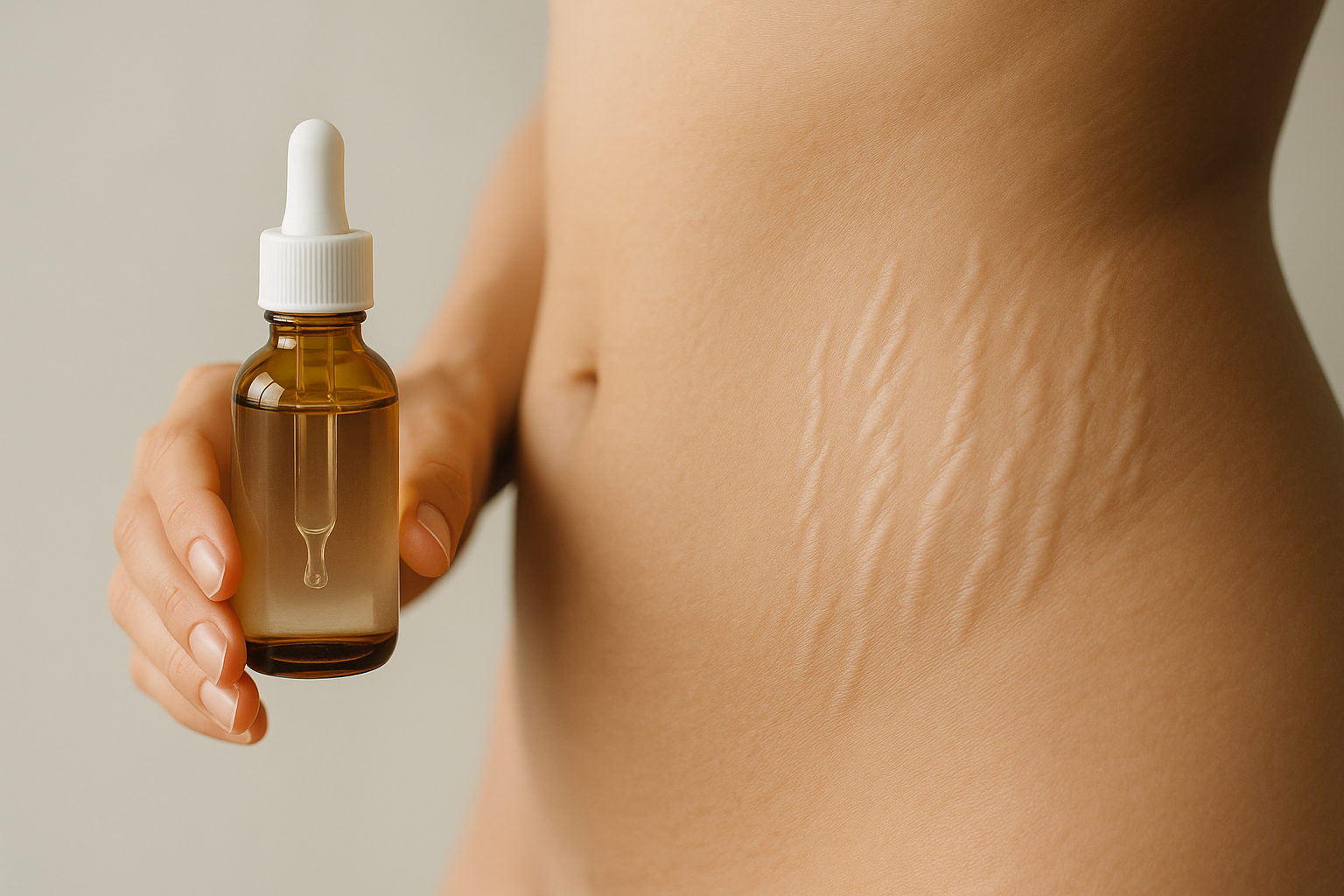
Before choosing between acids, lipids, lasers or nothing, look at the colour of the mark. Fresh stretch marks — striae rubrae — are red, purple, pink or brown, sometimes slightly raised and itchy. Over months they fade and sink into flat, pale lines — striae albae. DermNet describes the mature white stage as resembling scar tissue on biopsy: epidermal atrophy, loss of skin appendages, and "densely packed collagen bundles parallel to the skin surface." StatPearls' review of striae distensae adds reduced blood supply and lost rete ridges to that picture.
This is the single most useful fact in the whole topic, and the AAD states it without hedging: "Use the product on early stretch marks. Treatment seems to have little effect on mature stretch marks." Ud-Din, McGeorge and Bayat's review in the Journal of the European Academy of Dermatology and Venereology frames the same point as a window: the red phase is when topical management has a realistic chance; the white phase is largely beyond it.
| What you see | Stage | Is glycolic acid a reasonable candidate? |
|---|---|---|
| Red, purple, pink or brown lines; may feel slightly raised or itchy | Early (striae rubrae) | Possibly — this is the only stage where any topical, acids included, has shown an effect. Daily use for weeks; pair with massage. |
| Faded, flat or slightly sunken, pale or silvery lines | Mature (striae albae) | Unlikely to help at leave-on strengths. Professional procedures (fractional laser, microneedling, radiofrequency) are what the evidence points to; even those improve rather than remove. |
| Marks on brown or black skin, any stage | Any | Exfoliating acids and peels carry a higher risk of dark or light patches that can be lasting. Start gentler, or get a dermatologist's assessment first. |
| Marks that appeared during pregnancy, and you are pregnant or breastfeeding | Early | Ask your doctor or midwife before using any active over a large area of the body; peels are usually deferred. |
Reading the table honestly: glycolic acid is a maybe for one row. Every other row has a better first move.
Two Very Different Doses: the Bottle at Home and the Peel in the Clinic
"Glycolic acid for stretch marks" describes two products that have almost nothing in common except the molecule.
At home: the 10%/pH 3.5 line
The FDA's page reports the safe-use conclusion of the Cosmetic Ingredient Review Expert Panel for consumer products containing glycolic or lactic acid: they are considered safe if "the AHA concentration is 10 percent or less," "the final product has a pH of 3.5 or greater," and the product either protects against sun sensitivity or tells you to use daily sun protection. Those three conditions are the sensible ceiling for anything you apply to your own stomach, hips or thighs and leave on. Higher percentages sold for home use are stepping into "skin peeler" territory — and the FDA notes that "the more serious adverse reactions appear to occur most often with products that cause the greatest degree of exfoliation, such as 'skin peelers.'"
In clinic: superficial, medium and deep
A professional peel is a different animal. DermNet's chemical-peel page describes the three tiers: superficial peels using glycolic acid, salicylic acid or Jessner solution — the well-tolerated "lunchtime peel," where "the result of the first peel may be disappointing, but after repeated peels, significant improvement is usually evident"; medium-depth peels, most commonly trichloroacetic acid at 20–35%, which are painful and leave the area swollen, red and crusted for about a week; and deep phenol peels, now rarely used because of scarring risk and toxicity. Mayo Clinic gives the recovery arithmetic: a light peel recovers in about one to seven days and can be repeated every two to five weeks; a medium peel takes seven to fourteen days, and its redness can last for months.
Two caveats matter specifically for stretch marks. First, both DermNet and Mayo note that peels are usually done on the face; stretch marks cover large, often thin-skinned areas of the body, which changes both the tolerability and the cost. The Indian Dermatology Online Journal review makes the same trade-off explicit: fractional laser and microneedle radiofrequency look like the first-line options on the evidence, but their cost across "the large areas usually involved in stretch marks" is limiting, so "peels or derma rollers with PRP may be a cheaper alternative." Second, Mayo is blunt about the ceiling: "chemical peels can't remove deep scars," and the AAD lists chemical peels among the procedures dermatologists use "to make stretch marks less noticeable, but none of these can get rid of stretch marks."
| Format | Typical acid and strength | What it does | Downtime | Who applies it |
|---|---|---|---|---|
| Leave-on lotion or serum (home) | Glycolic or lactic acid, ≤10%, pH ≥3.5 (CIR safe-use conditions) | Surface exfoliation; smoother feel, brighter tone; no reach into the dermis | None, but UV sensitivity rises for the duration of use plus about a week | You |
| Superficial ("lunchtime") peel | Glycolic, salicylic or Jessner solution | Removes thin surface layers; results build over repeated sessions | Redness and mild swelling, usually settling within 48 hours (DermNet); 1–7 days to recover (Mayo) | Nurse, aesthetician or dermatologist |
| Medium-depth peel | Trichloroacetic acid 20–35%, sometimes with glycolic | Reaches the upper dermis; intended to trigger new collagen | Swollen, red, crusted for about a week; redness can persist for months | Dermatologist or plastic surgeon |
| Deep (phenol) peel | Carbolic acid | Deep injury; face only; cardiac, kidney and liver risks | Weeks; not used for stretch marks | Specialist, with monitoring |
What the FDA's Adverse-Event Data Says About AHAs
Most articles say "AHAs can irritate." The FDA published the actual breakdown. Between 1992 and February 2004 it received 114 adverse dermatologic reports for AHA-containing skin-care products. The reported experiences were burning (45), dermatitis or rash (35), swelling (29), pigmentary changes (15), blisters or welts (14), skin peeling (13), itching (12), irritation or tenderness (8), chemical burns (6) and increased sunburn (3). Reports fell "considerably" in later years, and the serious ones clustered around high-exfoliation "skin peelers."
Two lines in that list deserve attention from anyone planning to cover an abdomen or both thighs. Burning is the single most common complaint — and applying an acid over a large area multiplies the surface exposed. Pigmentary changes are fifteen of the 114, which brings us to sun.
The sunburn week
The FDA's own study (Kaidbey and colleagues, Photodermatology, Photoimmunology and Photomedicine, 2003) found that after four weeks of AHA application, "volunteers' sensitivity to skin reddening produced by UV increased by 18 percent," and their sensitivity to UV-induced cellular damage "doubled, on average, with considerable differences among individuals." The good news is that the effect is temporary: one week after stopping, the researchers found "no significant differences in UV sensitivity." That is why the FDA recommends a label statement telling you to use sunscreen, wear protective clothing and limit sun exposure "while using this product and for a week afterwards."
For stretch marks this interacts badly with a fact covered in why stretch marks don't tan: mature marks carry less pigment and stand out more against tanned skin. Exfoliating the skin around them, then getting sun, is a recipe for making the contrast worse, not better.
Who Should Not Reach for an Acid
Brown or black skin. This is the biggest under-reported point in the "glycolic for stretch marks" genre. DermNet states that patients with Fitzpatrick skin types IV to VI "have increased risk of dyspigmentation, hypertrophic, and keloid scarring" from chemical peels, which "must be performed cautiously with full patient informed consent." Mayo Clinic notes that peel-related colour changes "are more common in people with brown or black skin and can sometimes be permanent." The Indian Dermatology Online Journal review lists post-inflammatory pigmentary changes as the most common adverse event of peels for stretch marks specifically. Even at leave-on strength, an acid that irritates skin of colour can leave a darker patch that outlasts the stretch mark it was meant to help.
Pregnancy and breastfeeding. Mayo lists pregnancy among the reasons a doctor may caution against a chemical peel, and the AAD advises checking with your doctor before treating stretch marks at all if you are pregnant or breastfeeding. Stretch-mark application is large-surface-area application, which is a different exposure than a dab on the face. The retinoid side of that question has its own page: can you use retinol on stretch marks while pregnant?
Recent isotretinoin, keloid history, frequent cold sores. Mayo's caution list for peels: oral isotretinoin in the past six months, a personal or family history of keloids, and frequent or severe cold-sore outbreaks. If any of those is you, a peel is a conversation with a dermatologist, not a booking.
Anyone whose skin is already stinging. DermNet's page on sensitive skin names lactic acid as a common cause of sensory irritation — stinging or burning with no visible rash. Glycolic acid behaves the same way for many people. A sting that fades in minutes is not damage, but it is a sign you are at your threshold; the different kinds of sting are decoded in why does my serum sting?
What the Evidence Actually Shows (It Is Thin)
It is worth being precise here, because the sales pages are not. The 2022 narrative review in Healthcare by Mendes and colleagues opens its conclusion with: "To date, no fully effective treatment has emerged." It lists glycolic acid among the most common topicals alongside tretinoin, ascorbic acid, hyaluronic acid and Centella asiatica — and then notes that the available topical methods "generally do not have evidence from rigorous and well-designed controlled trials."
The Indian Dermatology Online Journal review is harsher on topicals as a class: "the reported efficacy is modest and the drugs need to be used for prolonged periods of time. Therefore, efficacy of topicals in prevention and treatment of SD is questionable." It also carries the direct comparison most relevant to this question: monthly fractional CO2 laser was compared with a nightly regimen of 10% glycolic acid plus 0.05% tretinoin cream, and the laser "was found to reduce the mean surface area of SD more effectively as compared to the topical therapy." Note what that regimen was — glycolic acid paired with a prescription retinoid, not glycolic acid alone. There is no clean trial of a cosmetic-strength glycolic product by itself on stretch marks that either review could point to.
For prevention the picture is clearer, and not in favour of creams: the Cochrane review by Brennan, Young and Devane, summarised in the Healthcare paper, covered six trials and about 800 women and found no statistically significant difference in stretch-mark development between women using topical preparations with active ingredients and those using placebo or nothing.
Where does that leave glycolic acid? As DermNet's stretch-mark page phrases it, chemical peels sit on the list of treatments that "can be tried, but have not been proven to be effective." Reasonable to try on early marks with eyes open; unreasonable to expect removal.
If You Try It: a Six-Week At-Home Protocol
This is our synthesis of the authorities above, not a clinical guideline, and it assumes intact skin, no pregnancy, and no history of keloids. Stop and see a dermatologist if anything below goes wrong.
Week 0 — choose and patch-test. Pick a leave-on glycolic or lactic product at 10% or less with a stated pH of 3.5 or higher (if the brand will not tell you the pH, that is your answer). Then run the repeat open application test DermNet describes: apply the product to a 5 cm by 5 cm patch of clear skin — the inner forearm works — twice a day for a week. Immediate stinging suggests irritation; redness, dryness or itching that arrives days later suggests allergy. Either way, stop. Skip the test if you are on oral antihistamines or steroids, which can mask a reaction.
Weeks 1–2 — every other night, red marks only. Apply a thin layer to the early marks after washing, then massage for a minute or two with the pads of your fingers. The AAD's two evidence-backed "hacks" for any stretch-mark topical are massage and daily consistency: "taking time to massage the product gently into your skin may make it more effective," and "if you see results, they take weeks to appear." Broad-spectrum SPF 30+ on any of those areas that see daylight, every day.
Weeks 3–6 — nightly if tolerated. Move to nightly use only if the skin is calm. A brief sting on application is your threshold; burning that lingers, rash, blistering or any patch going darker than the surrounding skin means stop, and stop for good if you have brown or black skin. Keep the sunscreen going for the whole period and for a week after your last application — the FDA's sunburn-alert window.
Week 6 — assess honestly. Photograph the marks in the same light at week 0 and week 6. Smoother texture and a slightly more even tone are realistic wins. Marks that are still clearly visible are not a failure of effort; they are the biology the AAD, DermNet and both reviews describe. At that point the question becomes whether an in-office procedure is worth it — and the AAD's view is that "the in-office procedures have proven more effective than the creams, lotions, and gels."
What to expect either way. Mayo Clinic notes stretch marks often fade over time with or without treatment, but may never disappear completely. The Indian review adds two comforting specifics: stretch marks from a teenage growth spurt become less conspicuous with time, and pregnancy stretch marks tend to improve to some extent after delivery. Some of what a six-week protocol appears to achieve is simply the mark maturing on its own schedule — which is a reason to be generous with yourself, not a reason to buy the next thing.
Reading the Label: "Removes Stretch Marks" Is a Drug Claim
One more thing the FDA page settles. It notes that some AHA products "have been marketed for uses such as treating acne, removing scars, and lightening discolorations," and that products intended to affect the structure or function of the body "are drugs under the law." A cosmetic can claim to exfoliate and to improve the look and feel of skin; it cannot lawfully claim to remove a scar, and the FDA has issued warning letters citing "stretch mark reduction" among the drug claims it has found on products sold as cosmetics. So when a glycolic product promises to erase stretch marks, it is either overclaiming or misclassified — neither is a reason to buy. The wider decoder for these labels is in what "FDA-cleared" means on a scar cream.
Where an Acid-Free Lipid Approach Fits: ScarDerma Pro
Everything above points to the same conclusion: for early stretch marks, the ingredients matter less than daily application, massage and patience — and for a large area of body skin, the gentlest formula you will actually use every day beats the strongest one you will abandon after it stings. That is the design brief behind ScarDerma Pro, formulated by S. C. Aris with no harsh acids or peels, no drying agents, no artificial fragrance or parabens, and no fillers.
It is a 100% water-free botanical lipid concentrate — anhydrous, which means there is no water phase to preserve and therefore no preservative system. Where an acid works by taking surface cells off, a lipid concentrate works by moving into the deeper stratum corneum, where lipid-compatible ingredients naturally belong, to support the look of smoother, more even-toned skin over the mark. The four actives are immortelle helichrysum, rosehip seed, tamanu and pomegranate seed; they sit over soothers including Japanese camellia, geranium, English lavender and hemp seed, on a lipid base of sea buckthorn, calendula, jojoba, hazelnut and vitamin E.
On evidence, we hold ourselves to the same standard as the rest of this article. Pomegranate seed is the best-supported of the actives for this use: a plant-lipid review in the International Journal of Molecular Sciences reports that a cream containing pomegranate seed and C. lechleri resin extract "can be helpful in the prevention or improvement of skin changes associated with striae," and that pomegranate seed lipid is around 63% unsaturated fatty acids. Rosehip seed carries trace amounts of trans-retinoic acid — sometimes called "natural tretinoin" — at levels far below anything prescription, with small studies suggesting only modest improvement in the look of wrinkles. That is honest, modest, and enough of a reason to prefer a daily lipid over a daily acid on skin that has already been through enough.
In a customer survey, 91% reported flatter, smoother-looking marks within six weeks, 9 in 10 reported more even-looking tone, and 94% would recommend it. ScarDerma Pro is rated 4.91/5 from 34 verified buyers, comes with a 90-day money-back guarantee, and is vegan and non-GMO. Two honest notes: it contains aromatic botanicals — helichrysum, geranium and lavender carry natural fragrance compounds — so patch-test it exactly as you would an acid; and it is a cosmetic that supports the appearance of skin, not a treatment for stretch marks or any medical condition. If you are pregnant or breastfeeding, check with your doctor or midwife before using any product over a large area.
Frequently Asked Questions
Does glycolic acid remove stretch marks?
No. Glycolic acid exfoliates the skin's surface, while a stretch mark is a scar in the dermis beneath it. Dermatology reviews describe topical treatments for stretch marks, glycolic acid included, as having modest and questionable efficacy, and the American Academy of Dermatology states that no procedure, chemical peels included, can get rid of stretch marks. At best, daily use on early red marks may make them slightly less noticeable.
What percentage of glycolic acid is safe to use at home on stretch marks?
The Cosmetic Ingredient Review's safe-use conditions, as reported by the FDA, are 10% or less, a product pH of 3.5 or higher, and daily sun protection. Higher strengths sold for home use fall into "skin peeler" territory, where the FDA notes the more serious adverse reactions cluster. If a brand will not disclose the pH, choose another product.
Can I use glycolic acid on white, old stretch marks?
You can, but the evidence says it is unlikely to help. Mature white stretch marks show thinned epidermis, lost skin appendages and densely packed parallel collagen — the structure of an old scar — and the AAD notes treatment seems to have little effect on them. For old marks, in-office procedures such as fractional laser or microneedling are what the research points to, and even those improve rather than erase.
Is a glycolic peel good for stretch marks?
Professional peels are listed among stretch-mark procedures, and one review notes they are a cost-effective option for large areas. But the same review reports that fractional CO2 laser outperformed nightly glycolic acid plus tretinoin, and post-inflammatory pigmentary changes are the most common adverse event of peels, especially on brown or black skin. Discuss depth, skin type and expectations with a dermatologist before booking.
Why does my skin sting when I put glycolic acid on my stretch marks?
A brief sting that fades within minutes is usually sensory irritation, a nerve response without visible damage; DermNet names lactic acid, a closely related hydroxy acid, among the common causes. It means you are at your threshold. Burning that lingers, rash, blistering or darkening of the treated skin is a different signal: stop, and see a dermatologist if it does not settle within days.
Is glycolic acid safe for stretch marks during pregnancy?
Ask your doctor or midwife first. The AAD advises checking with your doctor before treating stretch marks while pregnant or breastfeeding, Mayo Clinic lists pregnancy among reasons to caution against a chemical peel, and stretch-mark application means covering a large area of skin. Gentle massage with a bland moisturiser or lipid, cleared with your clinician, is the routine most midwives are comfortable with.
Related Reading
- Can You Use Retinol on Stretch Marks While Pregnant? What the Evidence Actually Says
- Why Don't My Stretch Marks Tan? (And Why the Sun Makes Them Show More)
- Why Do My Stretch Marks Itch When I'm Losing Weight?
- Why Do I Get Stretch Marks on My Shoulders From Working Out?
- What Does "FDA-Cleared" Mean on a Scar Cream? The Label-Claim Decoder
- Why Does My Serum Sting? The 4 Kinds of Sting
Sources
U.S. Food and Drug Administration, Alpha Hydroxy Acids (content current 22 Nov 2022) · American Academy of Dermatology, Stretch marks: Why they appear and how to get rid of them · DermNet, Stretch marks (striae) · DermNet, Chemical peels · Mayo Clinic, Chemical peel · Mayo Clinic, Stretch marks · Mysore V & Lokhande AJ, "Striae distensae treatment review and update," Indian Dermatol Online J 2019;10:380–395 · Mendes N, Alves PJ, Barros M, Rodrigues JM & Machado J, "A Narrative Review of Current Striae Treatments," Healthcare 2022;10(12):2565 · Mikes, Oakley & Patel, StatPearls: Striae Distensae · Ud-Din S, McGeorge D & Bayat A, JEADV 2016;30(2):211–22 · DermNet, Sensitive skin · DermNet, Open application test · Lin TK, Zhong L & Santiago JL, Int J Mol Sci 2018;19(1):70
This article is general information about skincare ingredients and stretch marks, not medical advice. Decisions about chemical peels, acids during pregnancy, or treating skin of colour belong with a board-certified dermatologist or your own clinician. ScarDerma Pro is a cosmetic product that supports the appearance of skin; it does not treat, prevent or remove stretch marks or any condition.