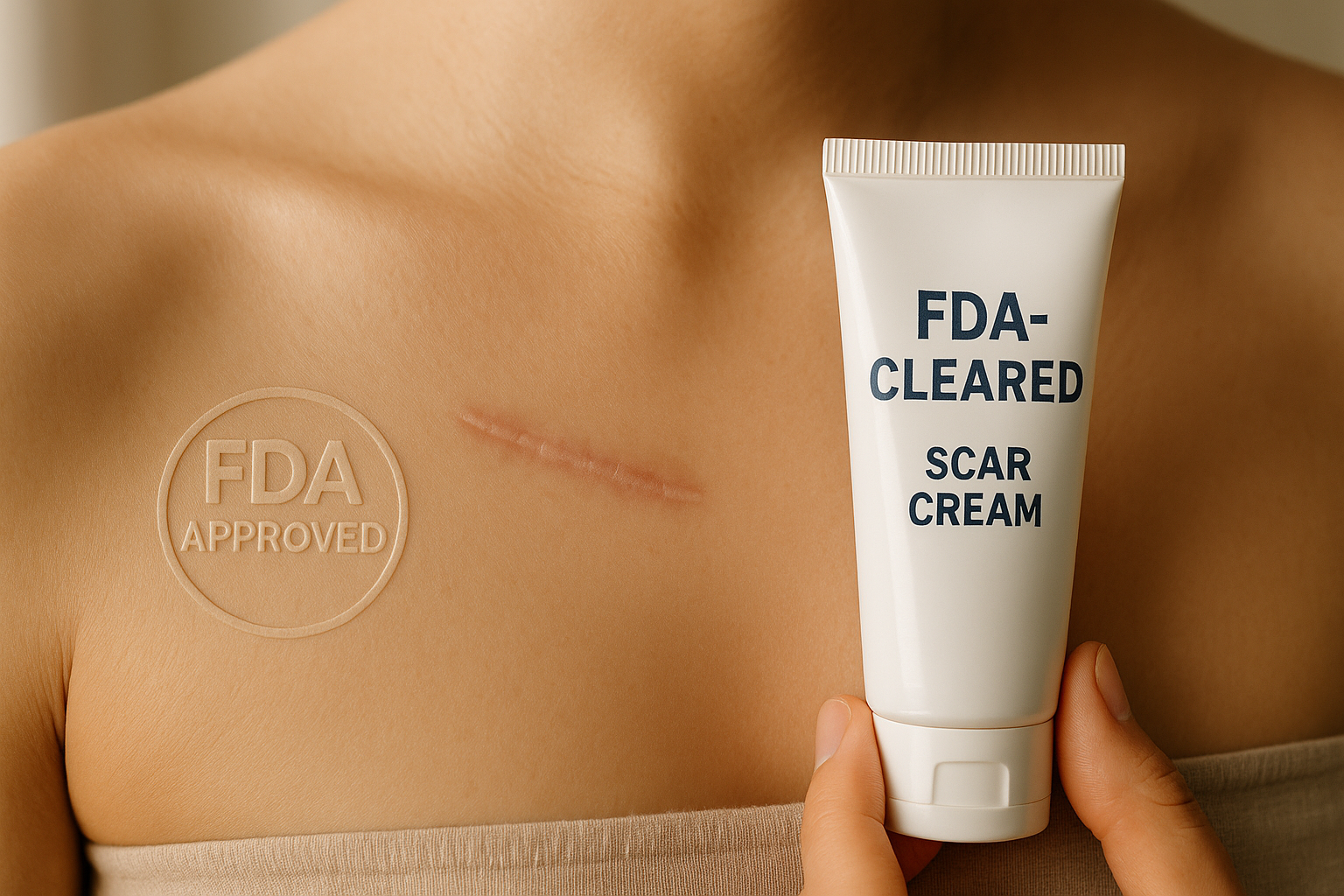
What Does “FDA-Cleared” Mean on a Scar Cream? The Label-Claim Decoder
Last updated: August 30, 2026
Quick answer
“FDA-cleared” is a medical-device term, not a quality score — and on scar products it is often not even true. Since 2004, silicone sheeting for closed hypertrophic and keloid scars has been a Class I device that is exempt from premarket notification, which means the manufacturer never has to file a 510(k) at all. Where clearance is genuinely held, it means the FDA agreed the product is “substantially equivalent” to something already on the market — not that it was proven to work. “FDA-approved” is a far higher bar that essentially no topical scar product meets. And a botanical scar cream or lipid concentrate sits in a third bucket entirely: it is a cosmetic, which the FDA does not approve before sale and which is legally limited to appearance claims. That last bucket is where honest products such as ScarDerma Pro sit — and knowing which of the three buckets a product is in tells you more than any badge on the box.
Why this question is so hard to answer online
Search “FDA-cleared scar gel” and you will get two kinds of page. The first kind is a brand selling a scar product, using the badge as a trust signal without explaining it. The second kind is a generic regulatory explainer about medical devices in the abstract — accurate, but written for people launching a device, not for someone standing in a pharmacy aisle holding two tubes.
Nobody puts the two together and answers the question you actually have: this tube in my hand says FDA-cleared, that one doesn’t — does it matter?
This article does that, using only primary regulatory sources: the FDA’s own cosmetic-versus-drug guidance, its 510(k) programme description, the 2004 Federal Register rule that classified silicone scar sheeting, the FDA’s cosmetic labelling-claims policy, and the Federal Trade Commission’s substantiation standard for health claims. Every quotation below is from one of those documents.
Three buckets, three completely different levels of scrutiny
Every scar product sold in the United States falls into one of three regulatory buckets. The bucket is decided not by what is inside the tube, but by what the maker claims it does. The FDA is explicit about this: whether a product is a cosmetic or a drug “is determined by a product’s intended use” — and intended use is established by the claims made “on the product labeling, in advertising, on the Internet, or in other promotional materials.”
Two identical jars of the same botanical blend can therefore end up in different buckets purely because of the words on the label.
| Bucket 1: Cosmetic | Bucket 2: Class I exempt device | Bucket 3: Cleared or approved | |
|---|---|---|---|
| Typical products | Scar creams, butters, botanical lipid concentrates, stretch-mark formulas, most “scar serums” | Most silicone scar sheets and silicone gels for closed hypertrophic and keloid scars | Prescription topicals; silicone marketed for a different intended use; scar devices with novel technology |
| What the FDA reviewed before sale | Nothing. Cosmetics and their ingredients, other than colour additives, “do not require FDA approval before they go on the market” | Nothing. The device is “exempt from the premarket notification procedures” — no 510(k) is filed | A submission. For clearance, evidence of substantial equivalence to a predicate; for approval, evidence of safety and effectiveness |
| Evidence bar | No efficacy evidence required to sell; claims must still be truthful and not misleading | No efficacy evidence required to sell | Cleared: as safe and effective as an existing product. Approved: proven safe and effective |
| Claims legally allowed | Appearance only — “smoother-looking,” “the look of,” “less noticeable” | The classified intended use only — here, management of closed hypertrophic and keloid scars | The specific indication granted |
| Badge you may see | None legitimate (see the decoder below) | Often still marketed as “FDA-cleared” or “medical grade” | “FDA-cleared” (accurate) or “FDA-approved” (rare, and usually inaccurate) |
Bucket 2 is the twist: most silicone scar products were never “cleared” at all
This is the single most useful fact in this article, and almost nobody writing about scar products mentions it.
On 9 August 2004 the FDA published a final rule (69 FR 48146, now codified at 21 CFR 878.4025) classifying silicone sheeting “intended for use in the management of closed hyperproliferative (hypertrophic and keloid) scars” into Class I (general controls). The rule states plainly that “the device is exempt from the premarket notification procedures.”
Exempt means exactly what it sounds like. For that intended use, a manufacturer can put a silicone scar sheet on the market without ever submitting a 510(k), without receiving a clearance letter, and without the FDA reviewing the product at all. So when a silicone sheet or gel is advertised as “FDA-cleared,” the honest possibilities are that the company holds an older clearance from before the exemption, that it obtained one voluntarily, that it is cleared for a different intended use, or that the phrase is being used loosely.
Three further details from that rule are worth knowing, because they cut in both directions:
- The advisory panel wanted stricter treatment — and the FDA overrode it. The rule records that the General and Plastic Surgery Devices Panel recommended Class I including premarket notification. But when the panel was asked the two statutory questions — is the device “of substantial importance in preventing impairment of human health,” and does it “present a potential unreasonable risk of illness or injury” — it answered no to both, which under the law makes a Class I device presumptively exempt. The FDA noted it “is not required to follow the Panel’s recommendations.”
- The FDA agreed the evidence was thin. Responding to a comment, the agency wrote that the literature “does not demonstrate that silicone sheeting alone alleviates the symptoms or improves the appearance of hypertrophic or keloid scars,” and that it “does not focus on the performance of the device in specific ethnic or racial groups.” The classification was justified on low risk, not on proven benefit.
- The safety record really is excellent. The same rule notes the panel “did not identify any risks to health associated with its use,” and that there had been “only two medical device adverse event reports for this device over a span of several decades of use.”
So the correct reading of a silicone scar sheet is: very safe, cheap to bring to market, and never required to prove it works. That is not an argument against using one — the independent evidence for silicone on new scars is the best evidence in this category, and we have gone through it in detail in do silicone scar sheets work on old scars? — but it is an argument against reading the badge as proof.
What “FDA-cleared” means when a product genuinely does hold it
Clearance comes from the 510(k) pathway. The FDA’s own description is unusually clear about what is being demonstrated: a 510(k) is a submission “to demonstrate that the device to be marketed is as safe and effective, that is, substantially equivalent, to a legally marketed device.”
The comparison product is called the predicate. To be substantially equivalent, a device must have the same intended use as its predicate and either the same technological characteristics, or different characteristics that “do not raise different questions of safety and effectiveness.” Crucially, the FDA states that “a claim of substantial equivalence does not mean the new and predicate devices needs to be identical.”
Three consequences follow, and they are the reason the badge means less than shoppers assume:
- Clearance is comparative, not absolute. The question answered is “is this as safe and effective as that?” If the predicate itself was never proven effective — and for a preamendments device such as silicone sheeting, it wasn’t — the chain never touches proof of benefit.
- It is fast. The FDA notes the substantial-equivalence determination “is usually made within 90 days,” and that it “does not typically perform 510(k) pre-clearance facility inspections.”
- It is not approval. The FDA reserves the word approval for products that had to show safety and effectiveness on their own evidence. Its cosmetics guidance puts the hierarchy in one sentence: “the law does not require cosmetics to be approved by FDA before they go on the market. Drugs, however, must have FDA approval for both safety and effectiveness before they go on the market. Similarly, medical devices must go through FDA’s clearance process.”
One nuance worth keeping: the 2004 exemption is use-specific. The rule warns that “silicone sheeting for other intended uses would be subject to a limitations of exemptions analysis,” and that some uses “could require a premarket approval application.” So a silicone product marketed for something other than closed hypertrophic and keloid scars — flat stretch marks, for instance — is a genuinely different regulatory case from the one the exemption covers.
The label-claim decoder
Here is the asset the top results for this question are missing: a phrase-by-phrase translation of what actually appears on scar-product packaging and websites.
| What the label says | What it legally means | What it does not mean |
|---|---|---|
| FDA-approved | For a topical scar product, almost always incorrect. Approval applies to drugs and to high-risk devices that submitted their own safety-and-effectiveness evidence. | Treat it as a red flag rather than a reassurance. The FDA has issued warning letters over exactly this kind of overreach. |
| FDA-cleared | A 510(k) was submitted and the FDA agreed the device is substantially equivalent to an existing product. | Not proof of effectiveness. Not an FDA endorsement. Not a comparison against placebo. |
| FDA-registered / made in an FDA-registered facility | The facility filed a registration. Registration is an administrative listing. | No review, no inspection outcome, no judgement on the product whatsoever. |
| Medical grade / medical-grade silicone | A marketing phrase describing material quality. | Not a regulatory status. There is no FDA category called “medical grade.” |
| Cosmeceutical | Nothing. The FDA states the FD&C Act “does not recognize any such category” and that the term “has no meaning under the law.” | Not a middle tier between cosmetic and drug. There is no middle tier. |
| Clinically proven | Not defined or pre-approved by the FDA for cosmetics. Policed after the fact by the FTC as an advertising claim. | Not verified by anyone before you see it. Ask: proven by whom, in how many people, against what comparison? |
| Dermatologist tested | A dermatologist was involved in some testing. | Says nothing about what was tested, how many people, or what the result was — including whether it was favourable. |
| 9 out of 10 users reported… | A consumer survey or user panel. | Not clinical evidence. Under FTC guidance, testimonials “don’t constitute substantiation.” |
| Reduces stretch marks / removes scars | A drug claim. The FDA lists “stretch mark reduction” and “wrinkle removal” among the drug claims it has issued warning letters over. | If the product is sold as a cosmetic, this wording is outside what the law permits — a sign the brand is not being careful. |
| Improves the appearance of scars | A legitimate cosmetic claim, and the strongest one a cosmetic may lawfully make. | Deliberately modest wording is a sign of compliance, not of weakness. |
“Clinically proven”: the phrase the FDA doesn’t pre-check — and the FTC does
The FDA is blunt about the limits of its own reach over cosmetic claims: “The law does not require cosmetic labeling to have FDA approval before cosmetic products go on the market, and FDA does not have a list of approved or accepted claims for cosmetics.” It adds, candidly, that “because FDA does not have the authority to approve claims before cosmetics go on the market, you may see cosmetics with claims that go beyond what the law permits” — and that while the FDA regulates labelling, “the Federal Trade Commission regulates advertising claims.”
So the meaningful standard for “clinically proven” is the FTC’s. Its Health Products Compliance Guidance defines the required substantiation as “competent and reliable scientific evidence,” specifically:
“tests, analyses, research, or studies that (1) have been conducted and evaluated in an objective manner by experts in the relevant disease, condition, or function to which the representation relates; and (2) are generally accepted in the profession to yield accurate and reliable results.”
Four points from that guidance are worth carrying into a shopping decision:
- Randomised controlled human trials are the expected form. “As a general matter, substantiation of health-related benefits will need to be in the form of randomized, controlled human clinical testing.”
- Testimonials are not evidence. Advertisers “should not make claims through consumer testimonials or expert endorsements that would be deceptive or couldn’t be substantiated if the advertiser made them directly,” and the guidance illustrates with a worked example concluding flatly that testimonials “don’t constitute substantiation.”
- An ingredient study is not a product study. The guidance’s example about a “clinically tested ingredient” notes that where a product contains other ingredients too, experts may require a clinical test of the finished product rather than the isolated ingredient.
- Lab and animal work doesn’t carry a human claim. Animal and in vitro studies “may provide useful supporting or background information, but, without confirmation by human RCTs, they aren’t sufficient to substantiate health-related claims.”
Hold the scar-product aisle to that yardstick and very little survives. Even the best-studied option in the category illustrates the point. The 2013 Cochrane review of silicone gel sheeting by O’Brien and Jones pooled 20 trials and 873 people. It found that in people prone to scarring, silicone sheeting reduced the incidence of hypertrophic scarring (risk ratio 0.46, 95% CI 0.21 to 0.98), and that in treatment trials it produced a statistically significant reduction in scar thickness and improvement in colour. And then the authors’ own conclusion: “There is weak evidence of a benefit… but the poor quality of research means a great deal of uncertainty prevails,” with the trials “of poor quality and highly susceptible to bias.”
That is the most-studied product type in the category, and it still lands on “weak evidence.” A cream with no published trials at all, wearing a “clinically proven” flash on the front, is asking you to believe more on less.
The 60-second label test
Run any scar or stretch-mark product through these five questions before you buy. It takes about a minute and it works on a website, a box, or an online listing.
- Which bucket is it in? Read the strongest claim on the front. Does it describe an appearance (“the look of,” “smoother-looking,” “less noticeable”)? That is a cosmetic. Does it claim to remove, reduce, heal, or treat scars or stretch marks? That is a drug claim, and if the product is sold as a cosmetic, it is one the FDA has issued warning letters over.
- If it says “FDA-cleared,” cleared for what? The intended use is the whole substance of a clearance. Silicone sheeting’s classified use is closed hypertrophic and keloid scars — raised scar types. A badge waved over flat stretch marks is being stretched beyond its own indication.
- If it says “FDA-approved,” stop and reconsider. For a topical scar product this is almost always wrong, and a brand that gets its own regulatory status wrong on the front of the box is not a brand to trust with the fine print.
- Chase the study. “Clinically proven” should lead somewhere. How many participants? Was there a control group? Was the finished product tested, or one ingredient? Was it published where anyone can read it? If the trail ends at a marketing page, treat the phrase as decoration.
- Check that the numbers are labelled honestly. A brand that says “in a customer survey, 91% said…” is telling you what kind of evidence it has. A brand that presents the same survey as a clinical result is not.
So which bucket should you actually want?
Not necessarily the most regulated one. The buckets answer different questions.
If you have a new, raised, red scar — especially after surgery or a burn, or if you scar heavily — the silicone evidence, weak as Cochrane judged it, is still the best-supported first move in this category, and it is remarkably safe. Wear it properly (at least 12 hours a day, kept clean), and know that irritation under an occlusive sheet is a recognised pattern with known fixes, covered in why does my silicone scar sheet itch?
If your scar is mature, flat, and pale, the job has changed. There is no longer an active healing process for occlusion to influence, and the realistic goal becomes cosmetic: keeping the scar and the skin around it supple, conditioned, and even-looking, alongside daily massage and diligent sun protection. That is a cosmetic job, and a well-made cosmetic is the right tool for it — provided it says so.
And if you are pregnant or breastfeeding, the bucket question becomes a safety question as well as a marketing one, because some actives sold for stretch marks are not appropriate in pregnancy. We have covered that separately in can you use retinol on stretch marks while pregnant?
Where ScarDerma Pro sits — stated plainly
Since this article is about reading labels honestly, here is ours, in the same terms.
ScarDerma Pro is a cosmetic. It is not FDA-approved, it is not FDA-cleared, and it is not a medical device — because it does not claim to be one. It is formulated to smooth and refine the appearance of scars and stretch marks, and that is the strongest claim a product in this bucket may lawfully make.
What it does differently is delivery. It is a 100% water-free botanical lipid concentrate — the opposite approach to a silicone sheet, which works by sitting on top of the skin and slowing water loss. Skin-compatible lipids move into the outer layers of the skin, the stratum corneum, rather than forming a film above it, which is also why it doubles as the slip layer for a daily massage routine. Because there is no water in the formula, it needs no preservatives.
Formulated by S. C. Aris, it combines four scar-focused actives — Immortelle Helichrysum, Rosehip seed, Tamanu and Pomegranate seed — with soothing Japanese Camellia, Geranium, English Lavender and Hemp seed, in a base of Sea Buckthorn, Calendula, Jojoba, Hazelnut and Vitamin E. No harsh acids or peels, no drying agents, no artificial fragrance, no parabens, no fillers; vegan and non-GMO. (It does contain aromatic botanicals, so it is not a fragrance-free product — if you have a known fragrance or essential-oil sensitivity, patch test first.)
On the numbers, labelled the way this article argues they should be: it holds a 4.91/5 rating from 34 verified buyers. In a customer survey — not a clinical trial — 91% reported their scar looked flatter and smoother within 6 weeks, 9 in 10 reported more even-looking skin tone, and 94% said they would recommend it. Those are self-reported user outcomes, and under the FTC standard quoted above they are not substantiation for a clinical claim; we present them as what they are. Every order carries a 90-day money-back guarantee, which is the honest version of a proof claim: try it for three months and decide for yourself.
If you are already using silicone alongside a topical, the sequence matters — see can you use scar oil and silicone gel together? And if you are adding massage, there is a real ceiling on how much is helpful: can you massage a scar too much?
Frequently asked questions
Is “FDA-cleared” the same as “FDA-approved”?
No, and the gap is large. Clearance comes from the 510(k) pathway, where a manufacturer demonstrates its device is “substantially equivalent” to a product already legally on the market; the FDA says that determination is usually made within 90 days and does not normally involve a pre-clearance facility inspection. Approval is reserved for products that submitted their own evidence of safety and effectiveness. For a topical scar product, “FDA-approved” is almost always an inaccurate claim.
Are silicone scar sheets FDA-cleared?
Usually they don’t need to be. Since the FDA’s 2004 final rule (21 CFR 878.4025), silicone sheeting intended for the management of closed hypertrophic and keloid scars is a Class I device that is expressly exempt from premarket notification — so no 510(k) is required for that use. Some products hold clearances for other reasons or other intended uses, but the badge is not evidence that the product works.
Does “FDA-cleared” mean a scar product is proven to work?
No. Clearance establishes equivalence to an existing product, not effectiveness against a control. In the very rule that classified silicone sheeting, the FDA acknowledged that the literature “does not demonstrate that silicone sheeting alone alleviates the symptoms or improves the appearance” of hypertrophic or keloid scars — the classification rested on the device’s low risk, with only two adverse event reports across several decades of use.
Can a scar cream legally say it “reduces” scars or stretch marks?
Not as a cosmetic. Under the FD&C Act, a product intended to affect the structure or function of the body is a drug even if it affects appearance. The FDA specifically lists “stretch mark reduction” and “wrinkle removal” among the drug claims it has cited in warning letters to companies marketing products as cosmetics. Lawful cosmetic wording stays with appearance: “smoother-looking,” “the look of,” “less noticeable.”
What about “cosmeceutical” scar products?
There is no such regulatory category. The FDA states that the FD&C Act “does not recognize any such category as cosmeceuticals” and that the term “has no meaning under the law.” A product is a cosmetic, a drug, or both. Treat the word as branding.
Who checks “clinically proven” before it goes on a box?
Nobody, in advance. The FDA does not pre-approve cosmetic claims and keeps no list of accepted ones. Advertising claims fall to the Federal Trade Commission, which requires “competent and reliable scientific evidence” — generally randomised, controlled human trials — and which is explicit that consumer testimonials do not constitute substantiation. Enforcement happens after the claim is already in front of you, so the checking is effectively yours to do.
ScarDerma Pro is a cosmetic product: it cares for the appearance and feel of skin and scars, and does not treat, heal, or prevent any medical condition. This article explains United States labelling and marketing rules and is not legal advice. For a scar that is growing, painful, or changing in a way that concerns you — and for keloids in particular — please see a dermatologist or plastic surgeon.