Can You Use Retinol on Stretch Marks While Pregnant? What the Evidence Actually Says
Last updated: August 9, 2026
Quick Answer
The standard advice is to avoid it, and that advice is reasonable — but the reasoning is more nuanced than "retinol causes birth defects." According to the MotherToBaby fact sheet on topical tretinoin, produced by the Organization of Teratology Information Specialists, studies of topical tretinoin "have not found a greater chance for birth defects with proper application of tretinoin to the skin." What drives the caution is a handful of case reports describing defects resembling those seen with oral isotretinoin, combined with the fact that this is an elective cosmetic use. Their conclusion is measured: because some absorption is possible, "the safest approach may be to avoid use of tretinoin during pregnancy." Since stretch marks are cosmetic rather than medical, there's no reason to accept even a small unknown — which is why retinoid-free formulas like ScarDerma Pro exist for this window. This article is general information, not medical advice: check anything you plan to use on your skin with your doctor or midwife.
Why retinoids come up at all
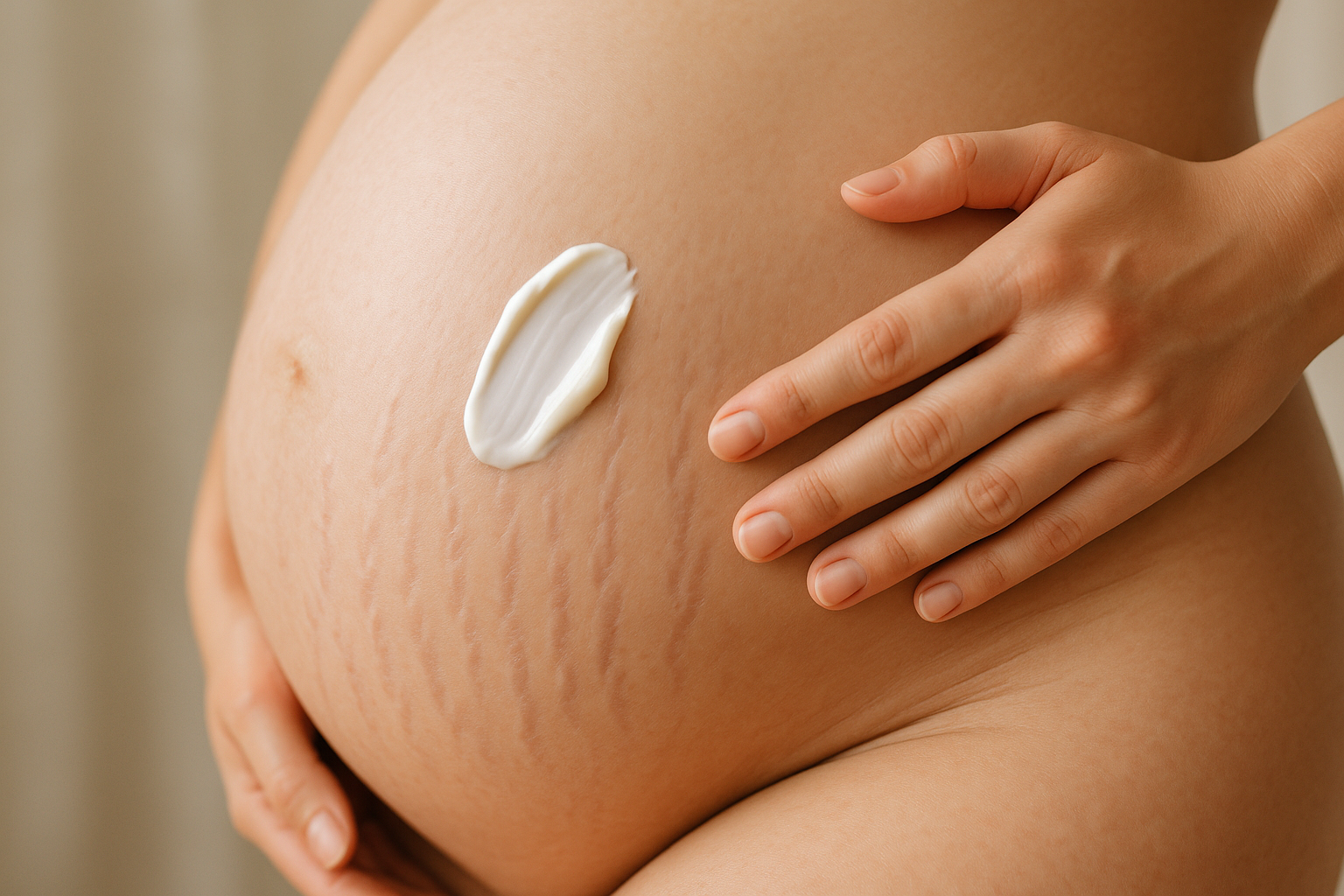
Because they're the one topical category with reasonable evidence behind them. Stretch marks — striae distensae — are, as StatPearls describes them, linear dermal scars. Mature white ones (striae albae) show epidermal atrophy, loss of rete ridges, reduced vascularity and densely packed thin horizontal collagen bundles; histologically they "resemble mature atrophic scars." StatPearls is blunt about the wider category: topical treatments are widely used on thin, low-quality evidence.
Retinoids are the least thin part of that evidence base, which is exactly why they show up in every "best stretch mark cream" list — and exactly why the pregnancy conflict is so frustrating. The moment most people go looking for stretch mark treatment is the moment the best-evidenced option is off the table.
What the actual pregnancy data says
Worth being precise, because the internet flattens this into scaremongering in one direction and dismissal in the other.
Tretinoin belongs to the retinoid family, related to isotretinoin (Accutane) — a drug known to cause birth defects of the face, heart and brain. But MotherToBaby draws the distinction clearly: isotretinoin is taken by mouth and "easily enters a person's bloodstream at higher levels than with topical use of tretinoin." Skin, they note, "serves as a good barrier," so only a small amount is likely absorbed when a topical is used as directed.
On outcomes, the fact sheet reports that several studies have looked and "have not found a greater chance for birth defects with proper application of tretinoin to the skin," and that studies have not reported a greater chance of preterm delivery or miscarriage. Against that: there have been case reports of babies born with birth defects after topical use, and the defects described resembled those seen with oral isotretinoin. Their honest summary is that "because many individuals have used tretinoin during pregnancy and have not had babies with a birth defect, the chance for birth defects is probably low. However, it has generally been recommended not to use tretinoin in pregnancy."
Three practical points follow from the same source, and they rarely make it into consumer articles:
Absorption isn't fixed. More tretinoin can enter the bloodstream if it's applied to broken or irritated skin, used more heavily than directed, or used over a large area of the body. Stretch mark application is precisely the large-surface-area case — abdomen, hips, thighs, breasts — which is a meaningfully different exposure profile from a pea-sized amount on the face.
Second and third trimesters are lower risk, but the advice doesn't change. Organs form in the first three months; MotherToBaby notes use later in pregnancy "is less likely to cause a birth defect," but concludes that "until more information is available, avoiding this product throughout pregnancy might be the best course of action."
If you used it before you knew. This is the question people are usually too anxious to ask. The data is reassuring: the studies did not find increased risk, and the chance is described as probably low. Tell your doctor or midwife, but don't spiral over it. In healthy non-pregnant adults it takes up to a day on average for most tretinoin to clear the body; the one-month-before-conception suggestion is extrapolated from isotretinoin guidance, not from topical data.
On breastfeeding, the fact sheet says use during breastfeeding has not been studied, but that since very little passes into the body when applied to skin, the amount in breast milk would probably be small.
The pregnancy-safety table nobody publishes
Here is what's actually in stretch mark products, sorted by both pregnancy status and evidence quality — because most articles give you one axis and not the other:
| Ingredient / approach | Evidence for stretch marks | In pregnancy |
|---|---|---|
| Topical retinoids (tretinoin, retinol, adapalene) | Best-evidenced topical category | Generally advised against; MotherToBaby says the safest approach may be to avoid throughout pregnancy. Large surface area raises absorption |
| Hydroxy acids / chemical peels | Limited | Generally avoided over large areas; also thin the skin surface at a time when it's already stretched. Ask your clinician |
| Laser & light therapy | Fractional lasers may promote repigmentation in white striae (StatPearls); 308-nm excimer produced ~68% visual pigment correction in striae alba but declined toward baseline within 6 months | Deferred until after pregnancy in practice |
| Silicone gels & sheets | Occlusion-based; Cochrane found reduced thickness and colour amelioration across 20 trials but rated all "of poor quality and highly susceptible to bias" | Not absorbed into the skin — mechanism is occlusion and reduced water loss, not penetration |
| Massage with an emollient | Standard clinical scar practice; the Cambridge University Hospitals NHS protocol recommends 2–3× daily, 5 minutes, for around 6 months on healed scars | Widely used; the routine most midwives are comfortable with |
| Botanical lipids (rosehip seed, pomegranate seed, tamanu, helichrysum) | Modest. A cream containing pomegranate seed and C. lechleri resin extract "can be helpful in the prevention or improvement of skin changes associated with striae" (Lin et al. 2018) | No retinoid or acid load; still worth clearing with your clinician, as with anything |
| Sun protection | Underrated. Sun exposure may cause hyperpigmentation of scars (Cambridge NHS); white striae also show decreased melanization, so they don't tan and become more visible against tanned skin (StatPearls) | Entirely safe and probably the highest-value habit on this list |
The timing point that matters more than the ingredient
If you take one thing away, make it this. Striae have a responsive phase and an unresponsive one. Early stretch marks — striae rubrae, the red or purple ones — are the window in which topical management has any real chance; mature white striae albae are far less responsive, a framing supported by Ud-Din, McGeorge and Bayat's review in JEADV. StatPearls' histology explains why: by the albae stage you're looking at atrophy, lost rete ridges and reduced vascularity.
The practical implication is slightly counterintuitive. Pregnancy is when you can't use the strongest topical, but it's also when your stretch marks are at their most responsive. Something gentle used consistently during the red phase is a better use of that window than waiting nine months to start something stronger on marks that have already turned white.
It's also worth setting expectations honestly. Mayo Clinic notes that stretch marks often fade over time with or without treatment, but may never disappear completely. Anything promising removal is overpromising. For more on that, see our guides to why stretch marks don't tan and why stretch marks itch.
A routine that works within the constraints
Adapted from the Cambridge University Hospitals NHS scar-massage protocol and standard dermatology guidance, for use on intact, unbroken skin:
Clean first. The NHS protocol specifically says to wash and dry the area to rinse off any previous moisturiser, so you're not massaging old product into pores. Use a small amount of an emollient — the protocol notes an oil-based cream works best. Massage with the pads of two fingers in slow circles so the skin moves over the tissue beneath, then side to side, then along the line of the mark. Build pressure gradually, light to firmer as tolerated. Five minutes, two to three times daily, sustained over months rather than weeks. Stop if the skin becomes sore, inflamed or blistered, and never work over broken skin. Protect from sun — SPF 30+ and covering clothing.
One pregnancy-specific caveat: abdominal massage in pregnancy is something to raise with your midwife or doctor first, particularly in later trimesters. The protocol above comes from post-surgical scar care, not from obstetrics.
Built without the ingredients you're being told to avoid: ScarDerma Pro
ScarDerma Pro was formulated by S. C. Aris around a simple constraint: no retinoids, no harsh acids or peels, no drying agents, no artificial fragrance or parabens, no fillers. It's a 100% water-free botanical lipid concentrate — which also means it is preservative-free by design, because there's no water phase to preserve.
The delivery idea is what separates it from a silicone patch. Silicone works by sitting on the surface and reducing water loss; it is not absorbed into the skin. ScarDerma takes the lipid route instead, moving into the deeper stratum corneum where lipid-compatible ingredients naturally belong, to smooth and refine the appearance of scars and stretch marks.
The blend leads with four actives — immortelle helichrysum, rosehip seed, tamanu and pomegranate seed — over soothers including Japanese camellia, geranium, English lavender and hemp seed, on a lipid base of sea buckthorn, calendula, jojoba, hazelnut and vitamin E. Pomegranate seed is the best-evidenced of these for this specific use: a plant-lipid review in the International Journal of Molecular Sciences notes that a cream containing pomegranate seed and C. lechleri resin extract can be helpful in the prevention or improvement of skin changes associated with striae, and separate laboratory work found pomegranate seed stimulated keratinocyte renewal. Rosehip seed is a natural source of trans-retinoic acid — sometimes called "natural tretinoin" — though at trace levels far below anything prescription, and small studies suggest only modest improvement in the look of wrinkles.
In a customer survey, 91% reported flatter, smoother-looking marks within 6 weeks, 9 in 10 reported more even-looking tone, and 94% would recommend it. ScarDerma Pro is rated 4.91/5 from 34 verified buyers and comes with a 90-day money-back guarantee. It's vegan and non-GMO.
Please note: ScarDerma Pro is a cosmetic product that supports the appearance of smoother, more even-looking skin. It does not treat, heal or remove scars or stretch marks, and it is not a medicine. As with any product used during pregnancy or breastfeeding, check with your doctor or midwife before use, and patch test on a small area first.
FAQ
I used retinol before I knew I was pregnant — should I worry?
Speak to your doctor or midwife, but the data is reassuring. MotherToBaby reports that studies of topical tretinoin have not found a greater chance of birth defects with proper application to the skin, and describes the chance as probably low. Stop using it and mention it at your next appointment.
Is retinol different from tretinoin for this?
They're in the same family — retinol converts to retinoic acid in the skin, and tretinoin is retinoic acid. The published pregnancy data is on tretinoin; cosmetic retinol is weaker, but the caution is generally applied across the retinoid category, especially over large body areas.
When can I start using retinoids again after birth?
That's a conversation for your doctor, particularly if you're breastfeeding. MotherToBaby notes tretinoin use during breastfeeding hasn't been studied, though the amount reaching breast milk would probably be small given how little is absorbed through skin.
Is there any point treating stretch marks during pregnancy at all?
Arguably it's the best time. Early red or purple striae are the responsive phase; mature white ones are considerably less so. Gentle, consistent care during the window when marks are new makes more sense than waiting.
This article is general information about skincare ingredients in pregnancy, not medical advice. Decisions about retinoids during pregnancy belong with your midwife, obstetrician or dermatologist, who know your history — and if you used a retinoid before you knew you were pregnant, speak to them rather than acting on anything you read here. ScarDerma Pro is a cosmetic product for the appearance of skin; it does not treat, prevent or heal any condition.
Related reading
More from our scar and stretch-mark cluster: stretch marks from working out, reducing the appearance of a C-section scar, using scar oil and silicone gel together, and how long scar redness lasts.
Sources
MotherToBaby / OTIS, Topical Tretinoin fact sheet (July 2024) · Mikes, Oakley & Patel, StatPearls: Striae Distensae · Ud-Din, McGeorge & Bayat, JEADV 2016 · Alexiades-Armenakas et al., Arch Dermatol 2004 · O'Brien & Jones, Cochrane 2013, CD003826 · Cambridge University Hospitals NHS FT, Scar massage information · Mayo Clinic, Stretch marks · Lin TK, Zhong L, Santiago JL, Int J Mol Sci 2018 · Aslam MN, et al., J Ethnopharmacol 2006