Does Gua Sha Actually Get Rid of Wrinkles? What the 4 Studies Really Measured — and the Lines Massage Can’t Reach
Quick answer
No study has shown that gua sha gets rid of wrinkles. The best trial so far, an 8-week randomised study in the Journal of Cosmetic Dermatology (Ahn et al., 2025), found gua sha changed facial contour by about 2.2–2.4 mm and relaxed measured muscle tone, but it did not measure wrinkles at all, and it had no untreated comparison group. The one study that did grade wrinkles after facial massage (Caberlotto et al., PLoS One 2017) tested a vibrating sonic device, not a stone, used with an anti-ageing cream. And when a Northwestern University team tested 20 weeks of facial exercise, cheek fullness improved but not one of the ten line, fold and wrinkle scales they graded improved significantly. What gua sha can realistically give you is a few minutes to hours of depuffing and glow, possibly a subtly sharper contour with steady use, and a daily ritual that makes you apply your skincare properly. For the lines themselves, what moves the needle is daily sun protection, moisture and a proven active such as a retinoid or bakuchiol. If you do gua sha, use a slip layer that stays put for the whole massage; a water-free lipid serum such as SD7 Lipid Serum is one example.
Last updated: 23 September 2026
Gua sha videos promise a lot: a sculpted jaw, lifted cheeks, softened forehead lines, “natural Botox”. The before-and-after photos are persuasive. But if you want to know whether a flat stone scraped across your face will actually change your wrinkles, the answer lives in a very small number of studies, and almost every article on the subject cites them without saying what they measured. This one does. Below you will find each study laid out side by side, a breakdown of which kind of line massage could plausibly affect and which it cannot, and an evidence-matched routine if you want to keep your gua sha habit.
First: what gua sha is, and what it is not
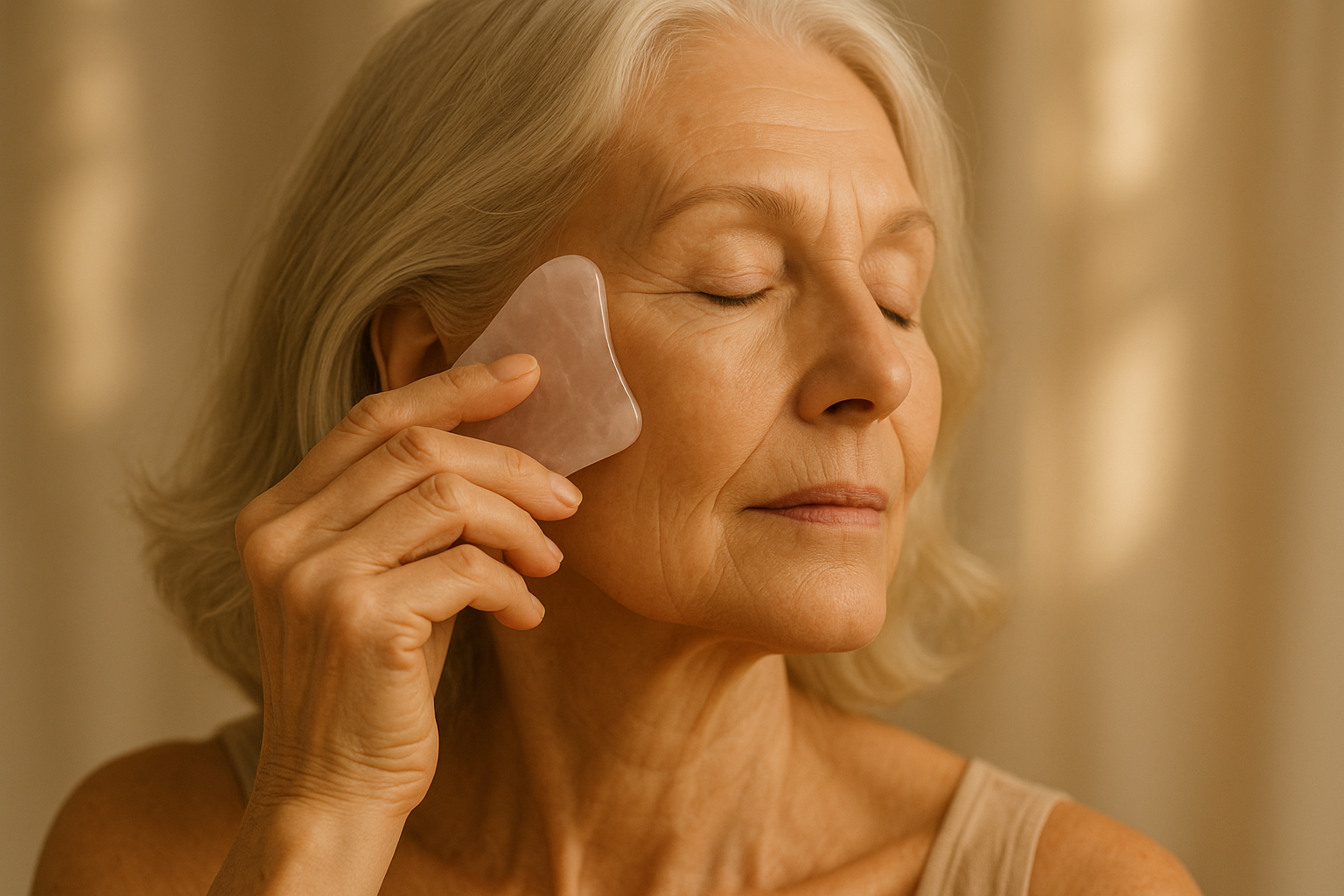
Gua sha comes from traditional Chinese medicine. Cleveland Clinic acupuncturist Tim Sobo, LAc, describes the term as loosely translating to “scraping, rubbing or pushing,” and calls it “essentially, a tool-assisted type of massage.” On the body, practitioners work with enough pressure to raise petechiae, small red-purple spots from broken capillaries. On the face it is a different technique: Cleveland Clinic stresses that facial gua sha is done “using very light pressure,” because facial tissue is thinner.
That distinction matters, because a lot of claims borrowed from body gua sha (breaking up “knots”, “releasing fascia”) do not transfer to a light facial glide. Facial gua sha is best understood as a form of facial massage. So the honest question is really: does facial massage change wrinkles?
The four studies behind every gua sha claim — and what each one actually measured
Most articles on this topic cite one or two of these papers in a single sentence. Here they are in full, with the questions that matter: was it gua sha, did it measure wrinkles, and was there a fair comparison?
| Study | What was tested | Who | Did it measure wrinkles? | Main result | Catches |
|---|---|---|---|---|---|
| Ahn et al. 2025, J Cosmet Dermatol (randomised trial) | Gua sha vs facial roller, 10 min, 5 days a week, 8 weeks | 34 women aged 20–50 (17 per group) | No. Measured facial surface distances (3D scan), muscle tone and stiffness, and skin elasticity | Gua sha: contour distances reduced 2.23–2.40 mm; muscle tone and stiffness fell. Roller: contour reduced 2.75–3.26 mm; elasticity up 7.5–8.6% | Two active groups, no “no massage” group; wrinkles not assessed |
| Caberlotto et al. 2017, PLoS One | Sonic vibrating massage device (65–85 Hz) + anti-ageing cream vs the same cream alone, twice daily, 8 weeks | 42 women aged 65–75 with moderate-to-severe wrinkles and sagging | Yes, by a blinded evaluator on a 10-point clinical scale | Cream alone improved some wrinkles and texture but not sagging; cream + device amplified the improvement and also reduced neck sagging | Not gua sha; funded entirely by L’Oréal, which had a related device in development |
| Alam et al. 2018, JAMA Dermatol | 32 facial exercises, 30 min daily for 8 weeks, then every other day to week 20 | 27 adults aged 40–65 enrolled; 16 women finished | Yes, ten line, fold and wrinkle scales graded by blinded physicians from photos | Upper and lower cheek fullness improved; estimated age fell from 50.8 to 48.1 years. No wrinkle scale improved significantly | No control group; high dropout; exercise, not massage |
| Miyaji et al. 2018, Complement Ther Med | Facial massage roller on one cheek: 5 min once, and daily for 5 weeks | 12 and 14 healthy adults | No. Measured skin blood flow | Blood flow rose in the massaged cheek only, for at least 10 minutes; after 5 weeks, the heat-triggered widening of blood vessels improved | Roller, not gua sha; young, mostly male volunteers; a roller manufacturer co-author |
Put together, the evidence says something more specific than “gua sha works” or “gua sha is a gimmick.” Massage of the face measurably changes blood flow, muscle tone and contour. The only study that tested massage against wrinkles used a machine, not a stone, and only showed an effect when the massage was delivering a cream. And the only study to test a muscle-based approach against wrinkles found it did nothing for them.
The detail most articles skip: gua sha relaxed the muscles
In the 2025 trial, the gua sha group showed significant reductions in muscle tone (oscillation frequency down 2.02 Hz) and stiffness (down 56.46 N/m). The authors concluded that gua sha improved contour “primarily through changes in muscle properties,” and suggested it for people with “increased facial muscle tension” or a bulky jaw muscle. The roller group, by contrast, mainly changed the skin: its elasticity measures rose, and the difference between the two groups was significant for both muscle tone and elasticity. So if you have a tense, clenched jaw, the jawline “snatch” people describe may be partly a relaxed masseter rather than lifted skin. That is a real, visible change. It is not the same thing as fewer lines.
The lab finding that gets over-quoted
Caberlotto’s team also massaged donated human skin samples in the lab and reported higher levels of several structural proteins, including decorin, fibrillin, tropoelastin and procollagen-1, with the strongest response at 75 Hz. That is the source of many “massage boosts collagen” claims. Two cautions. First, it was a precisely tuned vibration in isolated tissue, not a hand-held stone on a living face. Second, the US Food and Drug Administration is explicit that a product intended “to remove wrinkles or increase the skin’s production of collagen” is a drug or medical device, not a cosmetic. A gua sha stone sold with a “boosts collagen” promise is making a claim that has not been through that process.
Which lines could massage plausibly touch? A line-by-line sort
“Wrinkles” is several different problems with different causes. Cleveland Clinic distinguishes fine lines, which sit close to the surface, from wrinkles, which are deeper creases, and explains that lines on the forehead, between the brows and around the eyes develop from repeated small muscle contractions, while sun damage breaks down collagen and leads to abnormal elastin (solar elastosis). Match the line to its cause and the realistic role of gua sha becomes clear.
| What you see | Main driver | What gua sha or massage can realistically do | What has better support |
|---|---|---|---|
| Morning puffiness, especially under the eyes | Fluid | Most likely benefit. Cleveland Clinic says the gentle downward motion “may help get your lymphatic fluid moving,” while noting research doesn’t yet address facial puffiness directly | Nothing tool-specific; swelling that is persistent or one-sided is worth a doctor’s check |
| Dull, flat-looking skin | Circulation, dryness | Short-term glow. Blood flow rises for at least 10 minutes after massage (Miyaji 2018) | Daily moisturiser and sun protection |
| Fine, crepey lines that look worse by evening | Surface dryness | Indirect: the slip product you massage in does the work. Mayo Clinic notes moisturisers “temporarily plump the skin, which makes lines and wrinkles less visible” | Consistent moisturising; see why fine lines look worse at the end of the day |
| Expression lines only when you move (forehead, frown “11s”, crow’s feet) | Muscle contraction | Unproven. Gua sha lowered muscle tone in one trial, but no study has checked whether that changes dynamic lines. Facial exercise did not (Alam 2018) | Botulinum toxin, which Cleveland Clinic describes as blocking the signals that make muscles contract |
| Lines visible at rest | Collagen and elastin loss, sun damage | No evidence of improvement from gua sha alone | Daily broad-spectrum SPF 30+; retinoids or bakuchiol; laser resurfacing or peels |
| Softening jawline, jowls, marionette lines | Volume loss, laxity, gravity | Possibly a small contour change (≈2 mm in Ahn 2025), partly muscle relaxation. Facial exercise did not significantly change marionette lines or the jawline scale (Alam 2018) | Hyaluronic acid fillers or facelift surgery for marked laxity (Cleveland Clinic lists both) |
Why the before-and-after photos look so convincing
The research explains most of what you see on social media without needing a wrinkle effect at all.
- Timing. A photo taken straight after a session catches the blood-flow flush, which in the roller study lasted at least ten minutes, plus any moved fluid. Both fade.
- The product layer. Massage is always done over an oil, balm or serum. Freshly moisturised skin reflects more light and fine surface lines look shallower. Mayo Clinic is clear that this plumping is temporary.
- Muscle relaxation. A relaxed jaw and brow sit differently. In the 2025 trial this was gua sha’s main measured effect.
- Angle, light and expression. A slightly raised chin or a softer expression erases dynamic lines in a single frame.
None of this makes gua sha useless. It means the right test is a photo taken at the same time of day, in the same light, with a neutral face, before you start and again at eight weeks, not a same-session before-and-after.
What the evidence actually supports for fine lines
If your goal is fewer or softer lines, the evidence-backed foundation is short, and none of it involves a tool.
- Daily sun protection. Mayo Clinic advises a broad-spectrum sunscreen of SPF 30 or higher, reapplied every two hours outdoors, noting that even sun through a window can speed skin ageing. Cleveland Clinic lists daily sunscreen first among ways to reduce early wrinkling.
- Daily moisture. Mayo Clinic says a moisturiser can’t prevent wrinkles but can help trap water in the skin so small lines look less noticeable.
- A proven active. Mayo Clinic lists retinol as a milder retinoid used to smooth wrinkles (not for use in pregnancy), and bakuchiol as a plant ingredient that “may help smooth wrinkles” and is “gentler than retinol.” We compare the options in rosehip vs retinol and bakuchiol side effects.
- Realistic expectations. Mayo Clinic notes most over-the-counter products need daily use for up to six weeks before you notice a difference, and that skin tends to return to how it looked if you stop.
- Not smoking. Both Mayo Clinic and Cleveland Clinic link smoking to reduced collagen, sagging and wrinkles.
Where gua sha earns a place is as the delivery ritual for step 2 and 3: a few unhurried minutes that make sure your serum is spread evenly to the jaw, neck and around the eyes rather than rubbed in for five seconds. Caberlotto’s cream-alone group improved too; the massage amplified a product that was already working.
An evidence-matched gua sha routine (if you want to keep doing it)
This protocol borrows its dose from the 2025 trial and its technique rules from Cleveland Clinic. It is designed so that, at eight weeks, you can tell whether it is doing anything for you.
- Take a baseline. Photograph your face straight on and in profile, same window light, same time of day, neutral expression, no makeup. Do not photograph straight after a session.
- Clean the tool. Cleveland Clinic notes some tools can be sanitised in boiling water or a diluted bleach solution; follow your tool’s material guidance. Replace it if it chips or cracks.
- Apply a slip layer first. Cleveland Clinic advises applying moisturiser or serum so the tool glides. Choose something that stays on the surface for the whole massage; a water-based gel can drag as it dries. Use enough that the stone never pulls the skin.
- Use very light pressure. Per Cleveland Clinic, “a little redness should start to form, but not so much that it hurts.” If it hurts, you are doing body gua sha on your face.
- Work from the centre outward, in one direction. Start at the nose and move out towards the ears. Cleveland Clinic warns against rubbing back and forth, which “can stretch and aggravate your skin.”
- Dose it like the trial. About 10 minutes, five days a week, for eight weeks. That is what produced the 2–3 mm contour change.
- Keep everything else constant. Do not start a new active in the same eight weeks, or you will not know which one worked.
- Re-photograph at week 8. Compare like-for-like. Judge puffiness and contour separately from lines. If lines at rest are unchanged (the likely result), you now know the tool is a ritual and a depuffer, and your line strategy needs to live in steps 1–3 of the previous section.
Who should skip it, or check first
Cleveland Clinic says gua sha should never be done over irritated or inflamed skin such as rashes, wounds or sunburn, and lists situations where it may not be a fit: circulation problems, diabetes, a skin condition such as eczema or psoriasis, taking blood thinners, undergoing chemotherapy, or pregnancy. It also advises avoiding swollen areas, where you can “burst capillary beds and end up with bruises on your face.” If you have active acne, rosacea or broken capillaries, ask a dermatologist before adding any facial massage.
Choosing a slip layer that works with the massage, not against it
If you keep a gua sha habit, the product under the stone is doing more for your skin than the stone is. That is the logic behind SD7 Lipid Serum.
Why a lipid serum suits massage. SD7 is anhydrous, meaning it contains no water at all: a 100% botanical lipid serum. Water-based serums evaporate, which is why they can start to drag halfway through a massage. A lipid serum stays on and saturates the stratum corneum, the outer layer where the skin’s own lipids live, so the tool glides for the full ten minutes and the serum is worked evenly across face, jaw and neck. No water also means no need for the preservatives water-containing products rely on; SD7 contains no water, fillers, preservatives, parabens or synthetic retinols.
What is in it. Five youth actives: bakuchiol as 99.9% pure Sytenol® A, the plant ingredient Mayo Clinic describes as working like retinol but gentler; cacay (kahai) nut, a source of plant provitamin A compounds and barrier-supporting linoleic acid; triple-blend rosehip seed, a natural source of trans-retinoic acid; black cumin seed; and pomegranate seed. A radiance and defence group of Japanese camellia, virgin sea buckthorn, coriander seed, calendula and jojoba, and a lipid base of argan, sunflower, sweet orange and lavender. Formulated by S. C. Aris, with the fatty-acid ratios audited by the patent-pending Vouchly AI system (GB2603970.1).
What people report. In a customer survey, 93% said fine lines and texture looked smoother within 45 days, 89% said their skin looked brighter within four weeks, and 100% said it felt softer within the first week. These are survey results, not clinical-trial results. SD7 is rated 4.89/5 from 35 verified buyers and comes with a 90-day money-back guarantee, long enough to run the full eight-week photo test above.
Honest notes. SD7 contains sweet orange and lavender, so it is not fragrance-free; if your skin is sensitive, patch test first as described in why does my serum sting? SD7 is a cosmetic: it supports the look of smoother, plumper skin and a more radiant complexion. It is not a medicine and is not intended to treat any skin condition. Neither the serum nor a gua sha stone will do what a dermatologist’s procedures do for deep lines at rest.
See the full SD7 ingredient list →
Related reading
- Why do my fine lines look worse at the end of the day?
- Are sleep wrinkles permanent?
- Why does one side of my face have more wrinkles than the other?
- Crow’s feet: what they are and how to treat them
- Marionette lines: causes and what helps
- Do face oils actually absorb, or just sit on top?
- Why your serum evaporates before it works
- How do you choose an anti-aging serum?
Frequently asked questions
Does gua sha actually get rid of wrinkles?
There is no study showing that it does. The best gua sha trial (Ahn et al., 2025) measured facial contour, muscle tone and skin elasticity, not wrinkles. The only facial-massage study that graded wrinkles used a sonic vibrating device together with an anti-ageing cream, and a 20-week facial-exercise study found no significant improvement on any line or wrinkle scale.
What does gua sha do for your face, then?
In studies, facial massage temporarily increased skin blood flow for at least ten minutes, and eight weeks of gua sha changed facial contour by about 2.2–2.4 mm while lowering measured muscle tone. Many people also find it reduces morning puffiness and feels relaxing, though Cleveland Clinic notes research has not directly tested the puffiness effect.
How long does it take to see results from gua sha?
Glow and depuffing are visible straight after a session and fade within hours. The contour changes in the 2025 trial were measured after eight weeks of ten-minute sessions, five days a week. Judge any change with like-for-like photos at baseline and week eight, not a same-session before-and-after.
Is gua sha or a jade roller better for wrinkles?
Neither has been shown to reduce wrinkles. In the only head-to-head trial, both improved facial contour; the roller also improved skin elasticity by 7.5–8.6%, while gua sha mainly reduced muscle tone. Wrinkles were not measured, so neither can claim a wrinkle benefit.
Can gua sha make wrinkles or sagging worse?
No study has shown that, but technique matters. Cleveland Clinic advises very light pressure, moving in one direction only, never rubbing back and forth because that can stretch and aggravate skin, and always using a moisturiser or serum so the tool glides. Too much pressure can cause bruising or broken capillaries.
What should I put on my face before gua sha?
Something with enough slip to last the whole session without dragging. Cleveland Clinic suggests a moisturiser or serum. A water-free lipid serum, such as SD7 Lipid Serum, stays on the surface rather than evaporating, which keeps the glide consistent and means the massage is spreading a product that supports the look of smoother skin.
Sources
- Ahn S, Hwang U, Han HS, Kim J, Lee H, Jeon Y, Lee HH, Hwang A. “Comparative Effects of Facial Roller and Gua Sha Massage on Facial Contour, Muscle Tone, and Skin Elasticity: Randomized Controlled Trial.” J Cosmet Dermatol 2025;24(6):e70236. doi:10.1111/jocd.70236
- Caberlotto E, Ruiz L, Miller Z, Poletti M, Tadlock L. “Effects of a skin-massaging device on the ex-vivo expression of human dermis proteins and in-vivo facial wrinkles.” PLoS One 2017;12(3):e0172624. Open access. doi:10.1371/journal.pone.0172624
- Alam M, Walter AJ, Geisler A, et al. “Association of Facial Exercise With the Appearance of Aging.” JAMA Dermatol 2018;154(3):365–367. doi:10.1001/jamadermatol.2017.5142
- Miyaji A, Sugimori K, Hayashi N. “Short- and long-term effects of using a facial massage roller on facial skin blood flow and vascular reactivity.” Complement Ther Med 2018;41:271–276. doi:10.1016/j.ctim.2018.09.009
- Cleveland Clinic Health Essentials. “Gua Sha: What It Is and How To Do It” (with Tim Sobo, LAc; 18 Sep 2025). clevelandclinic.org
- Cleveland Clinic. “Wrinkles” (medically reviewed, 27 Jul 2022). clevelandclinic.org
- Mayo Clinic Staff. “Wrinkle creams: Your guide to younger looking skin” (13 Mar 2026). mayoclinic.org
- U.S. Food and Drug Administration. “Wrinkle Treatments and Other Anti-aging Products.” fda.gov
This article is for general information about cosmetic products and skin appearance. It is not medical advice. Cosmetic products support the appearance of skin and are not medicines. If you have a skin condition, take blood thinners, are pregnant, or notice bruising or irritation from facial massage, consult a dermatologist or physician.