What Does Dry Skin Look Like? How to Spot It on Every Skin Tone — and the 4 Checks That Confirm It
Last updated: 27 September 2026
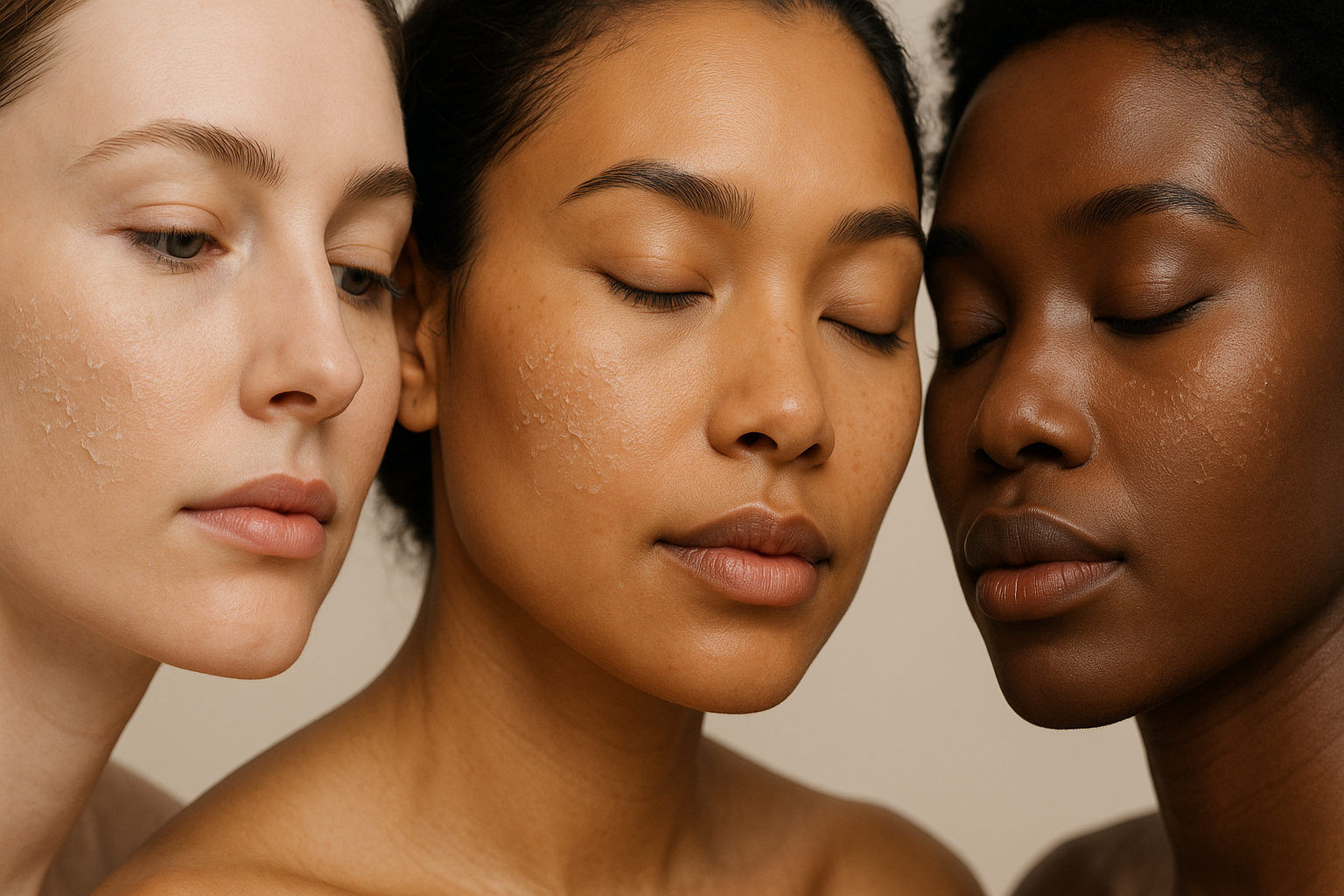
Why Dry Skin Looks Different on Different Skin Tones
The flakes themselves are the same on everyone. Your skin's outermost layer, the stratum corneum, is built like brickwork — dead skin cells as the bricks, a mortar of lipids holding them together. As StatPearls' review of moisturizers sets out, healthy stratum corneum holds only 10–30% water, compared with 75–85% in the living layer beneath it. When the surface loses water faster than it can hold onto it, the enzymes that normally dissolve the links between dead cells stop working. Instead of shedding invisibly, a few cells at a time, they pile up into tiny, whitish, plate-like flakes.
Those whitish flakes are why the same condition looks so different in the mirror. Against lighter skin there is little contrast, so dryness reads as a subtle change in finish: matte instead of softly reflective, powdery, slightly chalky in angled light. Against brown or black skin the contrast is high, so the very same flakes read as a gray film sitting over the surface — the look usually described as ashy. Ashiness is not a different condition and not a sign of anything worse. It is ordinary dryness with better visibility.
That visibility difference cuts both ways. Deeper skin tones often show body dryness sooner and more plainly, while on lighter tones it can hide until makeup starts clinging or fine lines look suddenly deeper. Knowing what dryness looks like on your skin is the first step to catching it early — and to not mistaking something else for it.
The Tone-by-Tone Guide: What You'll Actually See
On lighter skin tones
Look for a shift in finish rather than a color change. Dry areas turn matte and can look faintly powdery or chalky, especially along the sides of the nose, between the brows and around the mouth. Fine, plate-like flakes catch foundation and concealer, and because flaky skin scatters light instead of reflecting it evenly, fine lines and creases look more pronounced than they did a week ago. In angled light the texture becomes obvious: tiny specks and shadows across areas that looked smooth head-on.
On medium and deep skin tones
The signature is the gray or ashy cast — whitish flakes standing out against brown or black skin. It shows most on the shins, knees and elbows, and on the face around the mouth and between the brows. The area does not need to feel sore or tight to look ashy; visible flaking often arrives before any discomfort does. A light fingernail sweep across an ashy shin usually leaves fine pale lines and lifts loose flakes — a quick confirmation that what you are seeing is surface flaking, not a change in the skin itself.
The cues that hold on every skin tone
Up close, all skin shares the same three tells: small plate-like flakes; a subtle roughness or catching you can feel when clean fingertips glide across the surface; and uneven light reflection that appears when you tilt the area about 45 degrees to a light source. Clothing adds a fourth clue — dark fabrics collect pale specks at the shoulders, the collar and the front of the shins.
One caution about color: while flaking looks whitish-gray on every tone, inflammation does not follow the same rule. Patches that lean brown, purple or gray-toned from within — particularly if they itch first and keep returning to the same spots — belong to a different sorting job. Our guide to dry skin vs eczema covers how those patterns behave across skin tones.
The 4 At-Home Checks That Confirm It
You can settle the question in minutes with light, touch and movement. Use all four checks — each one catches what the others miss.
- The angled-light check. Stand beside a window and tilt your face about 45 degrees to the light, then repeat with a phone flash held off to the side. Micro-flakes cast tiny shadows in angled light, especially around the mouth, the sides of the nose and between the brows. Straight-on light flattens them; angled light exposes them.
- The fingertip glide. On freshly cleansed, fully dried skin, glide clean fingertips slowly across your cheeks, forehead and jawline. Note every spot where your fingers catch or drag slightly — those are your dryness zones, even if they look fine in the mirror.
- The gentle stretch. Lightly stretch the skin beside your mouth or across your forehead. If fine creases and pale specks appear immediately, that is consistent with surface flaking. Fine creasing without any specks leans toward dehydration rather than dryness — more on that distinction below.
- The fabric pass. Brush a black cotton T-shirt lightly over your shins or forearms. Pale specks left on the fabric mean surface flakes are lifting — the same clue dark bedsheets and leggings give you for free.
Run the checks at the same time of day for a week, and take photos of the same areas on day one and day seven in similar light. Patterns beat single snapshots: you will quickly learn which zones flake first in cold weather, after long showers or before makeup days.
Dry or Dehydrated? The Two Look-Alikes People Mix Up Most
These words get used interchangeably, but they describe different shortages. Dry skin is low on surface lipids — the mortar between the bricks — so it flakes, feels rough and looks matte or ashy. Dehydrated skin is low on water — it feels tight and looks faintly crinkled or papery, yet can still feel slightly slick by midday because the lipids are present. You can be both at once, and many people are in winter.
A quick sorting tool: gently pinch the skin on your cheek. If it wrinkles finely and rebounds more slowly than usual, water is likely low. If you can see or feel flakes no matter how much water you drink, lipids are low too.
| What to watch | Dry skin (low lipids) | Dehydrated skin (low water) |
|---|---|---|
| In angled light or flash | Micro-flakes casting fine shadows; matte, chalky or ashy cast | Fine crinkling or a papery look; few or no visible flakes |
| Under fingertips | Rough or catching; makeup clings to the same spots | May feel tight yet still glides smoothly |
| Pinch test | Flakes present regardless of rebound speed | Fine wrinkling with a slower rebound |
| Typical triggers | Winter heating, over-cleansing, harsh scrubs, long hot showers | Flights, illness, very dry air, too little fluid |
| What usually helps first | A steady lipid layer plus humectants | Humectants and a humidifier; then add lipids to seal |
One detail worth knowing from the StatPearls moisturizer review: humectant ingredients such as glycerin and hyaluronic acid pull water toward the surface, but some humectants can actually increase water loss if they are not paired with an occlusive or lipid layer on top. Order matters — water-binding step first, sealing step second.
Where Dryness Shows First
Face: the sides of the nose, between the brows and around the mouth are the usual first zones — they get cleansed hardest and have the thinnest product coverage. If your dryness concentrates specifically around the lips and chin, your toothpaste may be part of the story: see why the skin around your mouth gets so dry.
Body: shins, knees and elbows are the classic trio, because they have the fewest oil glands and the most fabric friction. This is where the ashy look shows first on deeper tones and where a chalky cast shows on lighter ones.
Hands: frequent washing strips surface lipids faster than anywhere else. The backs of the hands turn dull, and the natural lines look more etched by the end of the day.
Lips: fine vertical lines look more defined, and lip color skips or gathers along the border instead of sitting evenly.
When It's Not Just Dry Skin
Three patterns deserve their own sorting job rather than another layer of moisturizer.
Bump-shaped texture. If what you feel is distinct small bumps — on the upper arms, thighs or face — rather than flat flakes, you are in different territory: keratosis pilaris, folliculitis and milia all read as "dry skin bumps" at first touch. Our guide to what dry-skin bumps actually are walks through telling them apart.
Itch-first, returning patches. Ordinary dryness is mostly a look-and-feel problem with mild, occasional itch. Patches that itch intensely before they look different, keep coming back to the same spots, or thicken over time follow an eczema pattern — and on darker skin tones that pattern often shows as rough bumps or brown, purple or grayish areas rather than redness. The five behavior clues are covered in our dry skin vs eczema guide.
Stinging when products go on. Skin that burns or stings when you apply ordinary products is telling you something about its barrier — and about the product. How to read and time that reaction: why does my serum sting?
What to Do Once You've Confirmed It
Identification is the hard part; the fix is mostly consistency. The steps below follow the American Academy of Dermatology's published tips for relieving dry skin.
- Shower smart. Keep baths and showers to five to ten minutes with warm — not hot — water, then gently pat dry and apply moisturizer immediately, while skin is still damp. That timing traps the water your skin just absorbed.
- Choose a cream or ointment over a lotion. The AAD is direct: ointments and creams add more moisture and work better than lotions. Ingredients worth looking for on its list include jojoba, glycerin, hyaluronic acid, lactic acid, dimethicone, shea butter and petrolatum — the last of which reduces water loss through the skin by nearly 99%, per StatPearls.
- Go fragrance-free, not "unscented." Unscented products can contain masking chemicals that irritate dry, sensitive skin. What that label word actually hides: our guide to fragrance in skincare.
- Lift flakes gently, rarely. A soft polish once or twice a week is enough to clear visible buildup before makeup days. Scrubbing harder makes flaking worse, not better — follow any polish immediately with your humectant and lipid steps.
- Support the air. A humidifier in heated rooms, shorter showers and mild detergents all lower the daily load on your barrier.
- Add a lipid step where you need it. On zones that stay matte, chalky or ashy, a thin, consistent lipid layer is what changes the look over time. If you have wondered whether facial oils just sit on the surface, the evidence is more interesting: see do face oils actually absorb?
When to See a Doctor
Most dry-looking skin responds to two or three weeks of the routine above. See a doctor or dermatologist sooner if the area cracks deeply, bleeds or becomes properly sore; if scaling is thick and spreading; or if you see weeping, crusting or other signs of infection. The AAD's list of signs a rash needs medical attention adds the urgent flags: a rash that covers most of your body, blisters or turns into open sores, spreads rapidly, hurts, comes with fever, or involves the eyes, lips, mouth or genital skin.
And the quieter threshold matters just as much: the AAD advises that if dry skin continues after you have tried the measures dermatologists recommend, it is time to see a board-certified dermatologist — because persistent dryness can be driven by an underlying condition rather than weather or washing.
Where SD7 Lipid Serum Fits In
This is an identification article, so the honest order is: run the checks first, buy second. If your skin shows the bump, itch-first or recurring-patch patterns above, the right next step is the linked guides and, where the signs point that way, a doctor — not a serum.
Where the checks point to ordinary dryness — the matte, chalky or ashy look with fine flakes and no angry patches — a lipid step has a rational place, and the reasoning follows from the barrier science at the top of this page. The mortar between your skin cells is lipid, and that is precisely what SD7 replaces on the surface. SD7 Lipid Serum is 100% anhydrous: no water phase at all, so every drop is botanical lipid rather than the water that makes up the bulk of a conventional serum. Its base leans on jojoba wax esters — structurally close to the skin's own surface lipids, and the first ingredient on the AAD's own list of what to look for in dry-skin care — alongside argan, sunflower, triple-blend rosehip seed and seven more active botanicals.
Two honest caveats. SD7 is a cosmetic: it supports the look and feel of smoother, more supple-looking skin, and it does not treat eczema, keratosis pilaris or any other diagnosed condition. And it is not fragrance-free — it contains sweet orange and lavender as aromatic botanicals, which naturally carry limonene and linalool. If your skin is reactive, patch-test a small area first. It is rated 4.89 out of 5 across 35 verified buyers and backed by a 90-day money-back guarantee, which makes a cautious small-area trial a low-risk way to see what a consistent lipid step does for a stubborn ashy shin or a chalky patch. See the full SD7 Lipid Serum formula →
Frequently Asked Questions
Why does my skin look gray or ashy even when I moisturize?
Shins, knees and elbows flake faster than most moisturizers can smooth, especially in winter. Switch from lotion to a cream or ointment, apply it within minutes of showering while skin is still damp, and lift built-up flakes with a gentle polish once or twice a week. Give the routine a full week, then recheck in angled light — that is usually enough to see the cast fade.
How can I tell dry skin from dehydrated skin?
Dry skin is low on surface lipids, so it flakes and feels rough. Dehydrated skin is low on water, so it feels tight and shows fine crinkling with a slower rebound when you gently pinch it. Flakes that persist no matter how much water you drink point to dryness; tightness without flakes after a flight or illness points to dehydration. Many people have both at once.
Can drinking more water fix the look of dry skin?
Not on its own. Visible dryness is mainly a surface problem — low lipids and dead cells that are not shedding evenly — rather than a fluid-intake problem. Keep drinking water for overall health, but expect the visible change to come from moisturizing damp skin, sealing with a lipid step and cutting back on hot showers.
Why does makeup cling to the sides of my nose and my chin?
Those zones flake first, and foundation grabs onto micro-flakes as it sets, which is why skin can look fine for five minutes and patchy within the hour. Prep with a humectant and a thin lipid layer, let each settle for a minute, then press rather than rub your base in. A gentle polish the evening before helps on known dry zones.
Does dry skin look the same on Black and brown skin as on lighter skin?
The flakes are identical; the contrast is different. Whitish flakes blend into lighter skin and read as a matte or chalky finish, while against deeper skin tones they stand out as a gray or ashy cast. The up-close cues are the same on every tone: plate-like flakes, roughness under the fingertips and uneven light reflection at an angle.
When should I see a doctor about dry-looking skin?
See a doctor promptly for deep cracks, bleeding, real pain, thick or rapidly spreading scale, weeping or crusting, fever with a rash, or anything involving the eyes, lips, mouth or genital skin. Beyond the urgent signs, dryness that has not improved after a few weeks of consistent gentle care deserves a dermatologist's opinion, as does an itchy patch that keeps returning to the same spot.
This article is for general information and is not a substitute for professional medical advice, diagnosis or treatment. SD7 Lipid Serum is a cosmetic product; it supports the appearance of the skin and does not treat, cure or prevent any medical condition. If you are concerned about persistent dryness, itching, rashes or any other skin change, please consult a doctor or dermatologist.