Why Is the Skin Under My Eyes Crepey? Thin, Slack or Hollow — the 3-Check Mirror Test That Tells You Which
Quick answer
Under-eye skin turns crepey because it starts out unusually thin and then loses firmness faster than skin elsewhere on your face. Eyelid skin is the thinnest on the body — under 1 mm — with very little fat beneath it, and every blink, squint, smile and rub moves it. Add years of UV exposure, which breaks down collagen and elastin, and the surface starts to crinkle like crepe paper.
But “crepey” is only one of three things people mean by it. The skin can be thin and crinkled, slack and excess, or it can simply be sitting over lost volume that casts a shadow. A 60-second mirror check (below) tells you which you have, because they respond to different things. Daily broad-spectrum SPF and consistent moisture are the options with real evidence for the first; a water-free lipid serum such as SD7 Lipid Serum is one example of the surface-care half. Excess skin and lost volume are anatomy, not texture, and those are a conversation for an eyelid or dermatology specialist.
Last updated: 2 October 2026
Why this patch of skin goes first
Three anatomical facts explain most under-eye crepiness, and they come from eyelid-surgery references rather than skincare marketing.
- It is the thinnest skin you have. The eMedicine eyelid-anatomy reference puts it plainly: “The skin of the eyelids is the thinnest of the body (< 1 mm),” and notes that fat is “very sparse in preseptal and preorbital skin and is absent from pretarsal skin” (Patel, Medscape eyelid anatomy, updated 2016). A 2017 ophthalmology review agrees: eyelid skin “is the thinnest of all body skin and has no subcutaneous fat” (Kashkouli et al., Journal of Current Ophthalmology, 2017). With no cushion underneath, there is little to hide fine texture changes.
- The structure underneath changes too. The same review describes ageing across the whole periorbital region — skin, fat pads, muscle and the bone supporting them — including a fat pad that drifts forward and downward with age and a brow that loses its lateral arch. So what looks like a “skin” problem is often partly a scaffolding problem.
- Lids and the tissue holding them stretch. StatPearls’ lower-eyelid chapter describes excess lid skin (dermatochalasis) that “can become aggravated by repeated swelling and inflammation,” and notes that the supporting tendons usually lengthen with age (Labib, Patel & Milroy, StatPearls, 2023). Skin that has been stretched repeatedly does not spring back as well.
On top of that sits the cause you control. Cleveland Clinic dermatologist Dr Amy Kassouf describes crepey skin as skin that “becomes thin and develops wrinkles or fine lines” with “a crepe paper-like appearance,” and names sun damage as the primary cause: UV breaks down elastin fibres over time, so skin can’t fully repair itself after repeated exposure (Cleveland Clinic, Crepey Skin, 10 June 2024). Cleveland Clinic’s wrinkle page adds that UV “breaks down collagen fibers and leads to the production of abnormal elastin” (solar elastosis), that fine lines can begin after 25, and that smoking reduces new collagen production (Cleveland Clinic, Wrinkles).
“Crepey” can mean three different things
Most pages in the search results (judging by their titles) fold crepey skin, dark circles and hollows into one list of products. That is the wrong way round. A cream can change how skin looks at the surface; it cannot take up slack or refill a hollow. Sort yours first.
The 3-Check Under-Eye Mirror Test
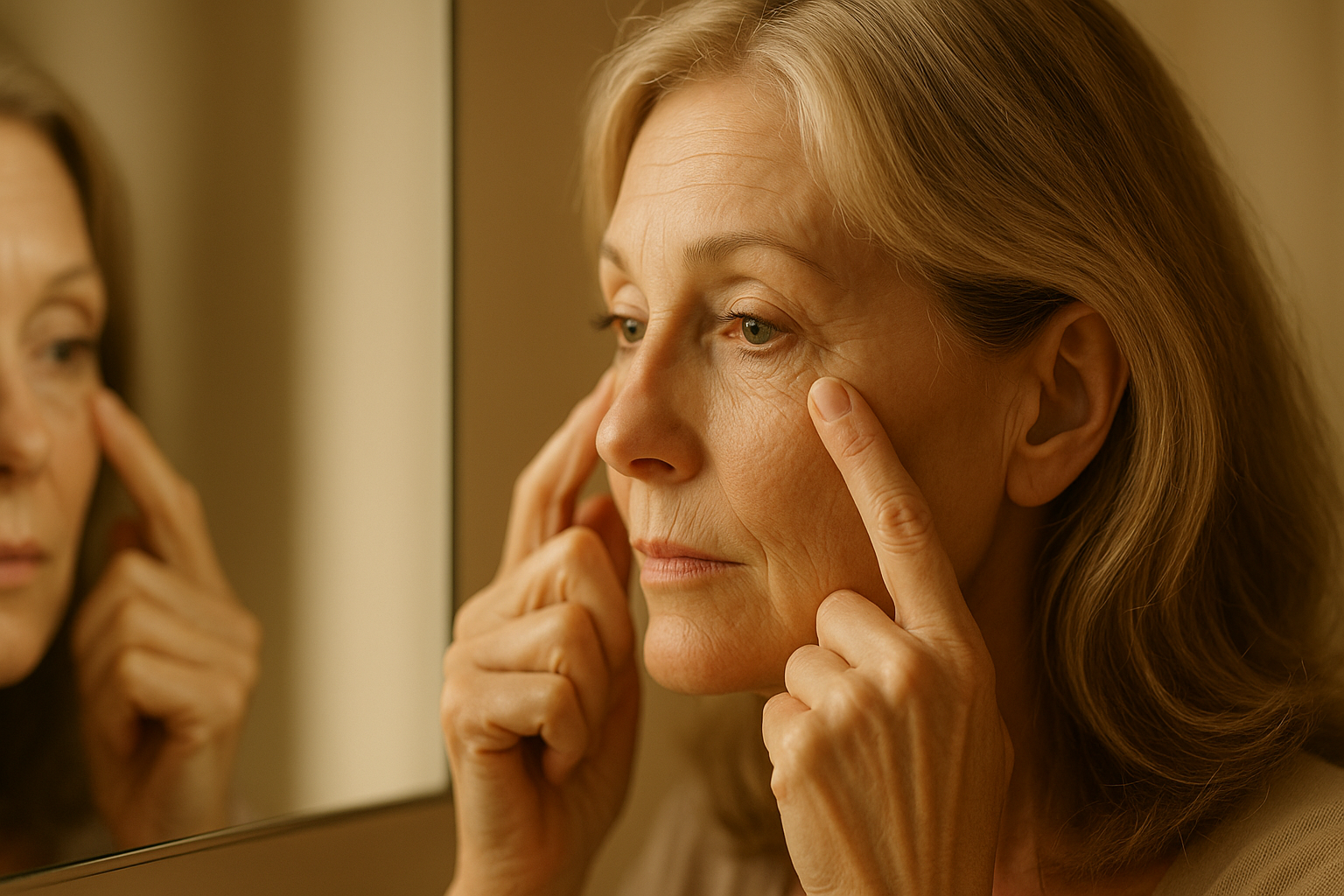
This is a self-check adapted from how clinicians think about the lower eyelid, not a diagnosis. You need a window or a lamp, a hand mirror and a minute. Do it bare-faced, ideally before applying anything.
- Check 1 — Rest vs smile (texture). Face a window and look straight ahead with your face relaxed. Note any fine crinkling under the eye. Now smile broadly and relax again. Crinkles that show only when you smile are movement lines from the muscle ringing the eye; crinkles that are still visible after you relax are static — the skin itself has lost some of its recoil. A fine, tissue-paper crinkle that covers a wide area is the classic “crepey” pattern.
- Check 2 — The recoil check (laxity). Clinicians test the lower lid with a “snapback” test: gently pulling the lid outward, where in normal lids “it should immediately spring back” (Labib et al.). That is for a clinician to do — do not pull your lower lid. At home, use a safer stand-in: with clean fingers, gently lift a tiny fold of skin on the cheekbone just below the under-eye area (not on the lid), release it and watch how quickly it flattens, then compare with the same pinch on the back of your hand. Skin that is much slower to settle than elsewhere suggests loss of elasticity. This is an informal comparison, not a validated measurement.
- Check 3 — Light and tilt (volume). Hold a lamp above your face and look into the mirror, then tilt the mirror and your chin so the light comes from below or the front. A shadow or groove that fades when the light changes is volume and contour, not skin quality. A puffy bulge that is bigger in the morning and eases through the day points to swelling rather than skin — and StatPearls notes swelling and inflammation can aggravate excess lid skin over time.
| What you see | Most likely | What can change how it looks |
|---|---|---|
| Fine crinkles, still there at rest, skin looks thin and papery, no bag or hollow | Thin, crinkled skin (true crepiness) | Daily broad-spectrum SPF, consistent moisture, gentle retinoid or bakuchiol use, surface lipid care; dermatologist procedures for stubborn texture |
| Crinkles only when you smile or squint; smooth at rest | Movement lines (early crow’s feet) | Prevention window: daily SPF, less squinting. See crow’s feet |
| Loose, draped skin that folds or overhangs; slow recoil | Slack skin (dermatochalasis / laxity) | Creams do not take up slack. A matter for a dermatologist or oculoplastic specialist (surgery is on Cleveland Clinic’s procedure list) |
| Smooth skin but a shadow or groove that changes with the light | Lost volume (hollow / tear-trough shadow) | Not a surface-texture problem; specialist advice if it bothers you |
| Puffiness that is worst on waking and eases | Swelling | Look at the cause (sleep, allergies, salt, skin reaction) before the skin |
Most people have a blend. The useful question is which row dominates, because that decides whether a skincare routine is the right tool at all. Re-run the check every four to six weeks under the same light, photographing the same expression.
What the evidence says helps — option by option
| Option | What it can change | What the evidence says |
|---|---|---|
| Daily broad-spectrum sunscreen | Slows further photoageing of the skin | In a randomised trial of 903 adults under 55 in Nambour, Australia, followed for 4.5 years, skin ageing (measured by skin microtopography, blind to group) was 24% less in the daily-sunscreen group than in the discretionary group (relative odds 0.76) (Hughes et al., Annals of Internal Medicine, 2013). Cleveland Clinic suggests at least SPF 30, ideally 50 or higher, broad-spectrum |
| Moisturiser / humectants + occlusives | Temporarily plumps the surface so fine lines catch less light | Mayo Clinic: moisturisers “temporarily plump the skin, which makes lines and wrinkles less visible” (Mayo Clinic, Wrinkle creams, 2026). StatPearls: occlusives reduce water loss through the epidermis, while humectants can pull water from deeper layers and, without an occlusive, may even increase water loss (Harwood et al., StatPearls, 2024) |
| Retinoids | The look of fine lines and texture over weeks | Cleveland Clinic’s dermatologist lists retinoids among options; Mayo notes retinol can irritate and should not be used in pregnancy, and that OTC products often need up to six weeks of daily use to show a difference — and skin will likely go back if you stop. The eye area is the most reactive place to try one: introduce slowly |
| Bakuchiol | The look of fine lines and pigmentation, with less irritation | A 12-week randomised trial of 44 people found bakuchiol comparable to retinol for wrinkles and pigmentation with less irritation (Dhaliwal et al., British Journal of Dermatology, 2019). Mayo describes it as working like retinol but gentler |
| Fillers, lasers, radiofrequency, ultrasound, eyelid surgery | Texture, volume or slack, depending on the tool | All appear on Cleveland Clinic’s list of crepey-skin procedures. Match the tool to your row in the table above, and choose a board-certified clinician |
| Eye-area “firming” gadgets and massage | Nothing measurable for lines in the best trial available | See does gua sha actually get rid of wrinkles? |
Five everyday habits that make thin skin look thinner
- Skipping SPF around the eyes. Hughes et al.’s result is about daily use. Mayo adds that even sun through a window can speed skin ageing.
- Dry skin on dry skin. Dryness exaggerates every crinkle. The morning-versus-evening difference is explained in why fine lines look worse at the end of the day.
- Smoking. Mayo: smoking “damages skin fibers, causing sagging and wrinkles”; Cleveland Clinic: it reduces new collagen.
- Introducing a strong active at full strength. Irritated, inflamed skin looks older, and swelling can aggravate eyelid laxity. If something stings, see why does my serum sting?
- Sleeping face-down. Compression lines are a separate story: are sleep wrinkles permanent?
When under-eye changes need an eye doctor
Crepey skin is cosmetic. Changes in how the eyelid works are not. StatPearls notes lid laxity can interfere with eye closure. If a lower lid turns outward or won’t sit against the eye, your eyes are watering, dry or irritated, or one eye has changed suddenly compared with the other, see a GP or eye specialist rather than a skincare counter.
Where SD7 Lipid Serum fits — and where it doesn’t
Scope first: no serum takes up slack skin or refills a hollow. What a serum can do is look after the surface layers of the skin around the eye — the part that decides how sharply fine crinkles catch the light. That is the first row of the mirror test, and it is where a routine shows most.
SD7 Lipid Serum is anhydrous — 0% water — and made entirely of botanical lipids, so there is no water phase to evaporate on contact; it saturates the stratum corneum and stays there. With no water there is also no preservative system: the formula contains no water, fillers, parabens, preservatives or synthetic retinols, and it is vegan and non-GMO. (Why that matters: why your serum evaporates before it works.)
Its actives take a retinol-free route to smoother, plumper-looking skin. Bakuchiol — used here as 99.9% pure Sytenol® A — is the ingredient Mayo Clinic describes as working like retinol while being gentler. It sits with cacay, triple-blend rosehip seed, black cumin seed and pomegranate seed, plus Japanese camellia, sea buckthorn, coriander, calendula and jojoba, on a base of argan, sunflower, sweet orange and lavender. In a 2015 study of 60 postmenopausal women, argan applied to the forearm for 60 days improved measured skin elasticity (Boucetta et al., Clinical Interventions in Aging, 2015).
Because a lipid serum is only as good as its lipid balance, SD7’s fatty-acid ratios are audited with Vouchly AI, a patent-pending system (GB2603970.1). SD7 is formulated by S. C. Aris, rated 4.89 out of 5 from 35 verified buyers, and backed by a 90-day guarantee — long enough to re-run the 3-Check Test twice. In a customer survey, 93% reported smoother-looking fine lines and texture within 45 days and 100% said their skin felt softer within the first week — survey feedback, not clinical-trial results.
Using it near the eyes: after cleansing, while skin is slightly damp, press a small amount onto the bony rim under each eye and the cheekbone, staying clear of the lash line and eyelids, then follow with broad-spectrum SPF in the morning. SD7 contains sweet orange and lavender, so it is not fragrance-free: patch-test on the inner forearm first, and keep it out of the eyes.
Related reading: crow’s feet · 11 lines between the eyebrows · marionette lines · bakuchiol side effects · rosehip vs retinol · how to choose an anti-aging serum
Frequently asked questions
Why is the skin under my eyes so crepey?
Eyelid skin is under 1 mm thick with little or no fat beneath it, so it shows ageing first. Sun damage breaks down elastin and collagen over time, and repeated movement and swelling add to it. Cleveland Clinic names sun damage as the primary cause.
Can you fix crepey skin under the eyes?
You can change how it looks, depending on the type. Thin, crinkled skin responds to daily SPF, moisture and retinoid or bakuchiol use over weeks. Slack skin and lost volume are structural and are matters for a specialist; creams cannot take up slack.
Does sunscreen really help under-eye ageing?
Daily sunscreen slowed measurable skin ageing: in a 4.5-year randomised trial of 903 adults, ageing was 24% less in daily users than in people who used sunscreen at their own discretion.
Is retinol safe around the eyes?
The eye area is among the most reactive places on the face. Mayo Clinic notes retinol can irritate and should not be used in pregnancy. Introduce any retinoid slowly, patch-test, and ask a dermatologist about eye-area use. Bakuchiol is a gentler alternative.
Is crepey skin the same as dark circles or eye bags?
No. Crepey skin is a surface-texture change. Dark circles, hollows and bags are about pigment, volume or swelling, and need different approaches.
Do eye creams work for crepey skin?
Moisturisers plump the surface temporarily, making lines less visible. Mayo Clinic says products often need up to six weeks of daily use, and the skin tends to go back if you stop.
When should I see a doctor about my under-eye skin?
If a lower lid turns outward, you have watering or dry, irritated eyes, or the change is sudden or one-sided, see a GP or eye specialist.
This article is general information about the appearance of skin, not medical advice. Eyelid changes that affect how the eye closes or feels should be checked by a doctor. SD7 Lipid Serum is a cosmetic product for the appearance and feel of skin; it does not change the structure of the skin.