Can Dry Skin Cause Acne? How a Stripped Barrier Clogs Pores — and the Routine That Helps Both
Last updated: 23 October 2026
Why "Dry Skin Can't Break Out" Is a Myth
Acne has a reputation as an oily-skin problem, so a breakout on tight, flaky skin feels like a contradiction. It isn't. A clogged pore needs two things: dead skin cells that stick around instead of shedding, and sebum for them to mix with. You need surprisingly little of the second. The first is where dry skin quietly does its damage.
Every visible blemish starts as a microcomedone — a microscopic plug of stuck-together dead cells inside a pore. A 2025 clinical review in JAAD Reviews describes the mechanism as abnormal keratinization: cells within the follicle shed abnormally and compact into a keratin plug that blocks the pore. If the blocked pore stays partly open to air, you get a blackhead; if it seals over, a whitehead; if the wall gets inflamed, a red bump.
Dryness works on exactly that first step — the shedding. So dry skin doesn't protect you from breakouts. In some ways it sets the stage for them, and because plugs form silently and mature slowly, the pimples that seem to arrive "out of nowhere" often trace back to a dry spell, a new heating season or a stripped-down routine from weeks earlier.
How a Dry Barrier Turns Into Clogged Pores
Your skin's outermost layer, the stratum corneum, is built like brickwork — dead cells as the bricks, lipids as the mortar. As StatPearls' review of moisturizers sets out, that layer normally holds only 10–30% water, compared with 75–85% in the living tissue beneath it — and the enzymes that dissolve the links between dead cells, letting them shed invisibly a few at a time, only work when enough of that water is present.
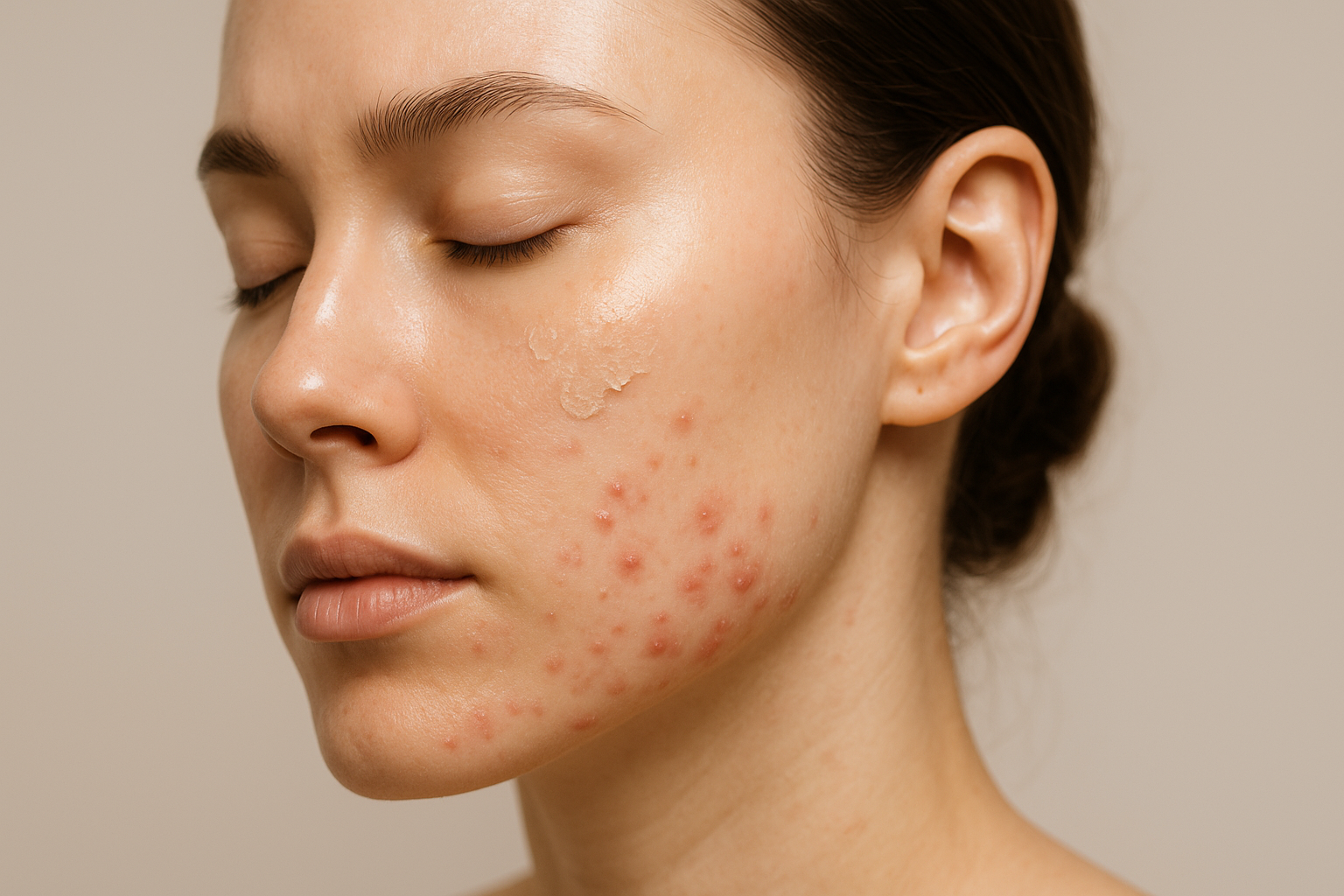
When the surface loses water faster than it can hold onto it, those enzymes slow down. Dead cells cling where they should release. On open skin, the pile-up shows as the flaking, roughness and ashy or chalky cast covered in our guide to what dry skin looks like. At a pore opening, the same pile-up has nowhere to flake off to — it collects, mixes with whatever sebum is there, and becomes the start of a plug. It is the same mechanism that roughens dry skin into small follicle bumps, just playing out inside the pore instead of on the surface.
Oil still matters — pores clog fastest where sticky cells and sebum meet, and some mixes of the two are stickier than others. But the shedding half of that equation is the half dryness controls, and it is enough to drive clogging on its own.
The "rebound oil" claim, honestly
You will see the "rebound oil" claim all over skincare content: strip your skin and it supposedly over-produces sebum to compensate. The honest answer is that the evidence behind it is thin. Oil glands respond mainly to hormones, not to how dry the surface above them feels. The reason to treat dryness on breakout-prone skin is the better-established one — a hydrated barrier sheds in an orderly way, so fewer dead cells are left behind to plug pores — not an expectation that moisturizer will switch your oil glands down.
The Stripped-Skin Spiral: How Treating Breakouts Can Feed Them
Here is the pattern that keeps dry skin and acne locked together. A breakout appears, so you wash more, scrub harder and add stronger products. The surface gets drier and more stripped, shedding gets more disordered, and a few weeks later there are more clogged pores than you started with — now on skin that also stings and flakes.
The American Academy of Dermatology's list of skin-care habits that worsen acne puts this instinct near the top: washing more than twice a day and scrubbing irritate acne-prone skin and can make breakouts worse, not better. Gentle washing twice daily, and after heavy sweating, is the ceiling — not the floor.
Product choices feed the same spiral. High-foam cleansers and alcohol-heavy toners strip the surface lipids that hold the barrier together — what alcohol denat actually does to skin is worth knowing before you buy another "mattifying" product — and fragrance is a common irritant on skin that is already compromised (what "parfum" on the label hides).
Then there are the acne actives themselves. Benzoyl peroxide, salicylic acid and retinoids all dry and irritate to some degree, especially in the first weeks. Dryness and peeling are side effects to manage, not proof the product is working harder — and unmanaged, they are the main reason people quit at week three, before the six to eight weeks the AAD says acne treatment needs to show improvement. Heavy flaking from an overused active also adds loose debris right where you least want it: at pore openings. If a leave-on product stings the moment it goes on, that is its own signal — our guide to the four kinds of sting covers how to read it.
First, Make Sure It's Actually Acne
Not every bump on dry skin is a clogged pore, and the fixes differ. Tender, pimple-like bumps clustered around hair follicles — especially on shaved or waxed areas, the back or the chest — fit folliculitis, which is usually an infected or irritated follicle rather than acne. Rough, skin-colored "goosebump" texture on the upper arms and thighs points to keratosis pilaris; firm white bumps near the eyes are usually milia. Our dry-skin bumps guide walks through telling all of these apart.
Two more sorting jobs are worth a minute. If patches itch intensely before they look different and keep returning to the same spots, that is an eczema pattern, not acne — here is how to tell dry skin from eczema. And if you are not certain the skin is genuinely dry rather than dehydrated or irritated, the four at-home checks in the identification guide settle it in minutes. (If the main thing your dry skin does is itch, that mechanism has its own explainer.)
What Sets Off the Dry-Skin Breakout Cycle
Environment does a lot of the damage. Low-humidity winter air, indoor heating, long hot showers and flights all pull water from the surface faster than it can be replaced. The AAD's dry-skin guidance is specific about the shower part: five to ten minutes, warm rather than hot, and moisturizer applied immediately while skin is still damp. Because pore plugs mature slowly, the breakout often lands days or weeks after the dry spell that seeded it — which is exactly why the connection gets missed.
Products can do the rest. Breakouts caused by cosmetics — acne cosmetica — classically show as many tiny bumps where the product goes, and the AAD notes they can take anywhere from a few days to six months to appear; it also warns that even non-comedogenic makeup can cause acne if you sleep in it. That long, noisy timeline is why ingredient-checker charts can't settle what a product will do on your face, and why the only test that counts is a one-product-at-a-time trial — both covered in our deep dive on the comedogenic scale.
A Barrier-First Routine for Dry, Breakout-Prone Skin
The goal is a calm, consistently hydrated surface that sheds in an orderly way — so fewer plugs form — while any acne active you use stays comfortable enough to continue. Fewer, better-chosen steps beat a cabinet of products.
- Cleanse gently, once or twice a day. A low-foam, fragrance-free cleanser with lukewarm water. In the morning, a lukewarm rinse is often enough for dry skin.
- Hydrate on damp skin, then seal. Apply a humectant layer (glycerin or hyaluronic-acid types) to damp skin, then lock it in with a light moisturizer or lipid layer. The order matters: StatPearls notes humectants can pull water out of skin in dry air unless something seals them from above.
- Do not skip moisturizer because you break out. Skipping it leaves shedding more disordered and makes actives harder to tolerate. Choose light textures and keep the formula short.
- Pace your actives. Start a retinoid or exfoliating acid two to three nights a week and build up only if skin stays comfortable. On dry zones, try the moisturizer sandwich: humectant, a thin sealing layer, then the active, then moisturizer on top. You trade a little speed for a routine you can actually sustain.
- Change one thing at a time. Introduce any new product as a single variable and judge it over four to eight weeks, the same window formal comedogenicity testing uses. Two new products at once means no way to tell which one caused what.
- Keep makeup off overnight, per the AAD — and keep hands off the bumps. Squeezing turns a two-week blemish into a months-long dark mark, and picked spots are how many acne scars start.
- Support the air. A humidifier in heated rooms lowers the daily load on your barrier through winter.
| Moisturizer format | Best for | Watch-outs |
|---|---|---|
| Hydrating gel-cream | Daytime comfort without shine; layers well under SPF | Often too light on its own in winter or very dry air |
| Light lotion or emulsion | All-over daily maintenance | Check for fragrance; very occlusive blends congest some people |
| Rich cream | Night use and stubborn dry patches | Apply thinly if you clog easily; patch-zones first |
| Lipid serum (face oil type) | Sealing tight, flaky zones on skin that is not actively broken out | Not oil-free, so not for active acne; introduce as a single variable |
When to See a Dermatologist
Home care has limits, and waiting too long has a cost of its own. See a dermatologist if breakouts persist after eight to twelve weeks of consistent, gentle care; if you have deep, painful nodules or cysts; or if blemishes are leaving scars or long-lasting dark marks behind — treating active acne early is what prevents scarring, and prescription options exist precisely for the skin that over-the-counter routines strip raw. If what you are looking at is painful, blistering, spreading fast, weeping or comes with fever, that pattern points away from acne altogether: the AAD's list of signs a rash needs medical attention covers the red flags that mean sooner rather than later.
Where SD7 Lipid Serum Fits — and Where It Doesn't
Honesty first, because this is a page about acne and we sell a face serum. SD7 Lipid Serum is not an acne product, and we don't recommend putting it on active breakouts. For active acne, the American Academy of Dermatology advises oil-free, non-comedogenic products — and a 100% botanical lipid serum is, by definition, not oil-free. Why we still don't print "non-comedogenic" on anything, and what that label legally means, is a story of its own: the comedogenic scale, honestly examined.
Where SD7 fits is the dry half of this article: ordinary tight, flaky, winter-worn zones on skin that is not actively broken out. It is anhydrous — no water phase at all — so every drop is botanical lipid: jojoba wax esters, which sit structurally close to skin's own surface lipids, with linoleic-rich sunflower, rosehip and argan among its eleven botanicals. Used thinly as the sealing step over a humectant, it does the "lock it in" job the routine above calls for. Two disclosures: it is a cosmetic, which supports the look and feel of skin and treats nothing; and it is not fragrance-free — sweet orange and lavender naturally carry limonene and linalool, so patch test first if you are reactive, and introduce it as a single variable like anything else. It is rated 4.92 out of 5 by 51 verified buyers and carries a 90-day money-back guarantee, which makes a cautious one-variable trial on a dry cheek or jawline a low-risk experiment.
Frequently Asked Questions
Can dry skin cause acne even if my skin isn't oily?
Yes. Breakouts begin when dead skin cells stop shedding evenly and plug a pore — and a dry, water-starved surface sheds unevenly almost by definition. Oil still plays a part, but you do not need an oily face to clog a pore. That is why flaky, tight-feeling skin and small breakouts so often show up together, especially in winter.
Does dry skin make your skin produce more oil?
The "rebound oil" claim is everywhere, but the evidence behind it is thin — oil glands answer mainly to hormones, not to how dry the surface feels. What is better established is the shedding problem: dryness makes dead cells cling and pile up at pore openings, which is enough to drive clogging on its own. Treat the dryness so your barrier sheds properly, not to switch off your oil glands.
Should I stop moisturizing if I'm breaking out?
No — on dry, breakout-prone skin that usually backfires. Skipping moisturizer leaves the surface drier, shedding gets more disordered, and acne actives become harder to tolerate, so people quit them before the six-to-eight-week mark where results show. Keep moisturizing with a light, short-ingredient-list formula, and change only one product at a time so you can tell what is causing what.
How do I know if a new product is purging or just breaking me out?
Purging happens only with actives that speed up cell turnover, shows up where you usually break out, and settles within roughly six to eight weeks. A product that is clogging or irritating tends to cause bumps in new places, or stinging, redness and itch, and it keeps getting worse rather than better. If a product with no exfoliating action is causing new bumps, stop it — there is nothing for it to purge.
Can I use a face oil or lipid serum on acne-prone skin?
Carefully, and not on active breakouts. For active acne, the American Academy of Dermatology advises oil-free, non-comedogenic products, and a lipid serum is by definition not oil-free. On skin that is dry and only occasionally congested, some people do well sealing dry zones with a thin lipid step — introduce it as a single variable, watch for four to eight weeks, and judge the finished product on your own skin rather than on an ingredient chart.
When should I see a dermatologist about breakouts on dry skin?
See a dermatologist if breakouts persist after eight to twelve weeks of consistent, gentle care, if you have deep painful nodules or cysts, or if blemishes are leaving scars or long-lasting dark marks — early treatment is what prevents scarring. Go sooner if the area is painful, blistering, spreading fast or comes with fever, because that pattern points away from acne and toward something that needs prompt medical attention.
This article is for general information and is not a substitute for professional medical advice, diagnosis or treatment. SD7 Lipid Serum is a cosmetic product; it supports the appearance of the skin and does not treat, cure or prevent acne or any other medical condition. If you are concerned about persistent breakouts, a rash or any other skin change, please consult a doctor or dermatologist.