Does Dry Skin Cause Itching? Why Dryness Lowers Your Itch Threshold — and How to Break the Itch-Scratch Cycle
Last updated: 7 October 2026
Does Dry Skin Actually Cause Itching?
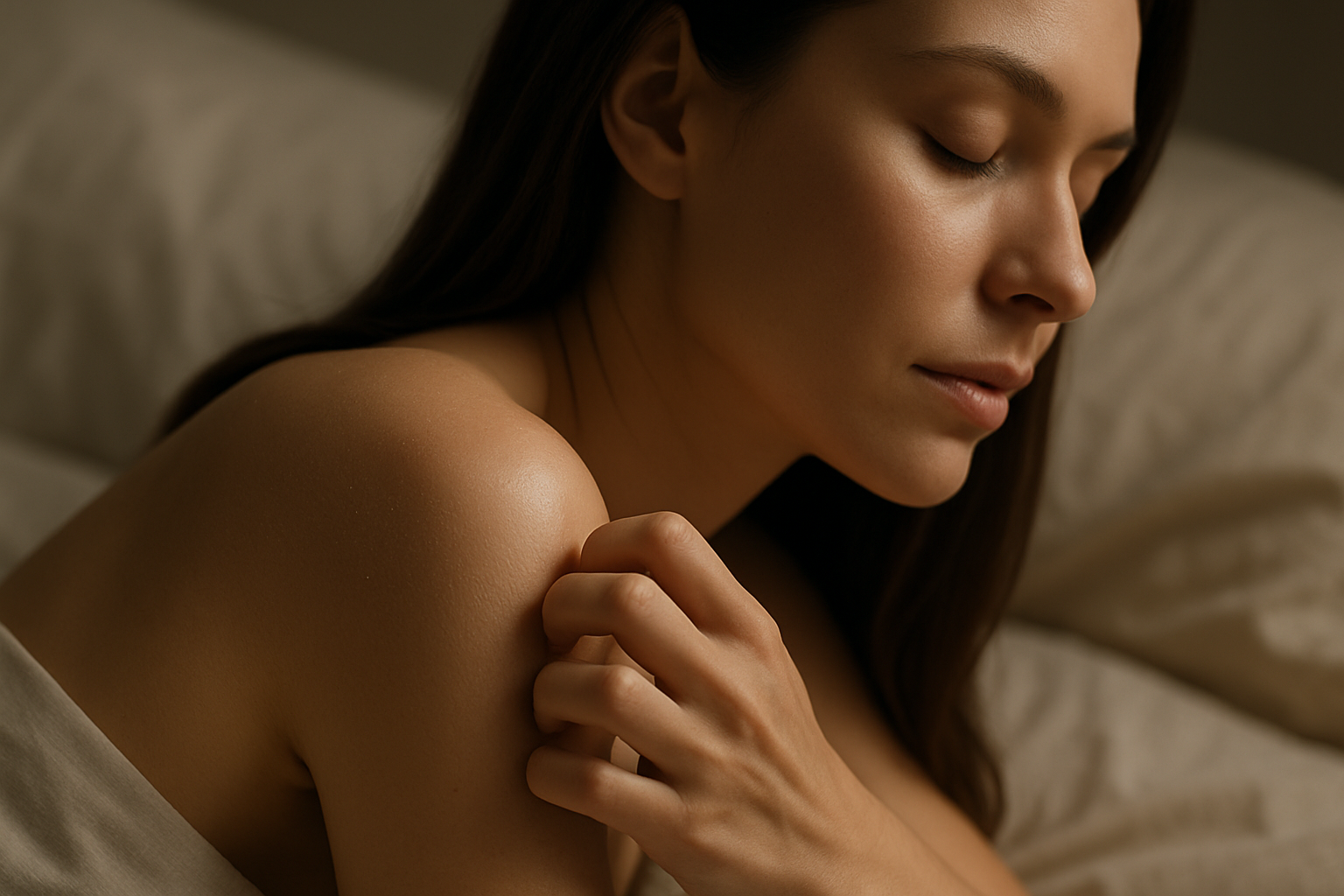
It does — and in winter, it is often the whole explanation. Itch is a symptom with many possible drivers: products, fabrics, insect bites, new medications, skin conditions, and occasionally things that have nothing to do with skin at all. But ordinary dryness sits near the top of the list because of how it makes skin itch: it does not inject anything or inflame anything. It simply lowers the threshold at which your nerves report itch, so everyday contact starts registering as something to scratch.
Dryness-driven itch has a recognizable signature. The look and feel usually arrive first — tightness after washing, fine flakes, a rough or ashy cast — and the itch is mild to moderate rather than maddening. It tracks your environment: hot showers, cold wind, heated indoor air. And it responds to consistent moisturizing within days, then stays better as long as you keep up the basics. Itch that behaves differently — intense, sleep-wrecking, returning to the same patches again and again — is following a different script, which we sort out below.
If you are not yet sure the problem is even dryness, settle that first: our guide to what dry skin looks like on every skin tone walks through four at-home checks — angled light, fingertip glide, gentle stretch, fabric pass — that confirm surface flaking in minutes.
Why a Dry Surface Itches: The Lowered Threshold — and the Itch-Scratch Cycle
Your skin's outermost layer, the stratum corneum, is built like brickwork — dead skin cells as the bricks, a mortar of lipids holding them together. As StatPearls' review of moisturizers sets out, that mortar is made of ceramides, cholesterol and free fatty acids, and a healthy stratum corneum holds only 10–30% water compared with 75–85% in the living layer beneath it. When the surface loses water faster than it can replace it, two things happen. The enzymes that normally dissolve the links between dead cells stop working, so cells pile up into visible flakes. And the sheet itself stiffens — a supple surface becomes a taut, micro-cracked one.
That change in texture is what changes the sensation. A soft, flexible, lipid-coated surface cushions everyday friction; a stiff, rough, depleted one transmits it. The fine nerve endings near the surface that report itch now sit under thinner protection, so light mechanical contact — fabric, hair, water drying off, the edge of a towel — gets read as itch when it used to register as nothing. Nothing new has attacked your skin. The alarm wiring is the same; the insulation around it is worn.
Then the cycle starts. Scratching works, briefly — it swaps the itch signal for a stronger sensation your brain prioritizes. But fingernails are exfoliators with no off switch: each pass scrapes away flakes and mortar, the surface loses water faster, the threshold drops further, and the itch returns sooner and stronger. Scratch long enough and you add scratch marks, soreness and broken skin to the original problem. This loop — the itch-scratch cycle — is why dry-skin itch tends to escalate across a week of doing nothing, and why the fix is aimed at the surface, not at willpower.
Why the Itch Gets Worse at Night
Almost everyone with dryness-driven itch reports the same pattern: barely noticeable all day, loud the moment the lights go off. Several ordinary things stack up in the evening. Skin warms under blankets, and warmth amplifies how strongly itch is felt. The distractions that crowded out the signal all day are gone. Whatever moisturizer you applied in the morning has been worn, washed and rubbed off by bedtime, so the surface is at its most depleted exactly when you are most aware of it. And you spend the next eight hours in continuous contact with fabric.
The practical response follows directly: make your richest moisturizing step the last thing you do before lights out, so the surface is best protected during the hours the itch is loudest. Keep the bedroom on the cool side, choose smooth, breathable bedding (cotton over wool or fleece against bare skin), and run a humidifier in heated rooms — moderate indoor humidity, roughly the 40–50% range, takes the edge off parched winter air. None of this is dramatic. It simply removes, one by one, the evening conditions the itch depends on.
Is It Dryness — or Something Else? How to Sort Your Itch
Dryness is a common cause of itch, not the only one. Three patterns cover most of the territory, and they behave differently enough to tell apart at home.
| What to watch | Dryness-linked itch | Contact reaction | Eczema pattern |
|---|---|---|---|
| How it starts | Builds with hot showers, cold wind, heated rooms; flakes and tightness come first | Follows contact with a specific product, metal or fabric — often within minutes to hours | Itch often arrives first, before anything shows; can be intense |
| What you see | Fine, even flaking over a wider area; matte, chalky or ashy cast; no sharp borders | A reaction confined to where the contact happened, often with defined edges | Patches that return to the same spots; may thicken, weep or crust; on darker skin tones, often brown, purple or grayish rather than red |
| Moisturizer response | Clear improvement within days; holds with basic care | Improves only once the trigger is gone; returns on re-exposure | Partial improvement; rebounds fast when the routine lapses |
| Your next step | The routine below | Find and drop the trigger | Run the one-week test, then a doctor if it fits |
The eczema pattern deserves the most respect, because it is the one a bigger tub of moisturizer will not fix. The American Academy of Dermatology calls atopic dermatitis “the itch that rashes” — it tends to start suddenly with very itchy skin, scratching then produces the rash, and trouble sleeping is common. If your itch is intense, reliably worse in the evening, or keeps returning to the same places, work through our guide to telling dry skin from eczema — it covers the five behavior clues and a structured one-week test.
The contact pattern is the most satisfying to solve, because removing the trigger removes the problem. Mayo Clinic notes that contact dermatitis shows up on skin that has been directly exposed to the substance causing the reaction, can develop within minutes to hours of exposure, and typically clears within two to four weeks once you identify and avoid the cause. New detergent, new jewelry, new skincare — the calendar is your best diagnostic tool.
A fourth pattern is worth naming because it is the one not to sit on: itch that is widespread and persistent with nothing to show on the skin — no flakes, no rash, no contact story — or that lines up with starting a new medication. That combination deserves a doctor's appointment rather than more skincare.
And a few special cases have their own guides. Dry, itchy skin in pregnancy follows its own rules and carries its own red flags — including the specific night-itch patterns your OB should hear about — covered in our pregnancy dry-skin guide. Stretch marks that itch while you are losing weight are a skin-tension story rather than a dryness one: see why stretch marks itch during weight loss. If what you feel is small bumps rather than flat flakes, that is a different sorting job: what dry-skin bumps actually are. And skin that stings or burns when products go on is giving you information about its barrier — and the product: why serums sting.
The Everyday Habits That Keep the Itch Going
Most stubborn dry-skin itch is being quietly refreshed every day by routines that feel harmless. The fixes below follow the American Academy of Dermatology's published tips for relieving dry skin.
- Long, hot showers. Hot water strips surface lipids — the exact mortar your threshold depends on. Keep showers and baths to five to ten minutes with warm, not hot, water, and use a gentle cleanser only where you need it.
- Towel-drying until squeaky. Rubbing dry irritates skin that is already on edge. Gently pat, leave skin slightly damp, and apply your moisturizer immediately — that timing traps the water your skin just absorbed instead of letting it evaporate off.
- Over-exfoliating. Scrubbing flakes off feels productive and makes the cycle worse — it is scratching with better branding. Pause scrubs, peels and strong actives entirely while skin is itchy; once things are calm, a gentle polish once or twice a week is plenty.
- Parched indoor air. Heated rooms in winter pull water from the surface all day and all night. A humidifier where you sleep is one of the few fixes that works on you while you do nothing.
- Rough fabric against bare skin. Wool and coarse synthetics lower the bar for friction-itch. Choose soft, breathable layers, put cotton between your skin and anything scratchy, and wash new clothes before wearing them to remove finishing residues.
What to Put on Itchy, Dry Skin — and in What Order
Moisturizers earn their keep against dryness-itch in three different ways, and the best routines use all three. Humectants — glycerin, hyaluronic acid — pull water toward the surface for immediate softness. Emollients — squalane, ceramides — smooth the rough edges between cells so the surface flexes instead of catching. Occlusives and lipids — petrolatum, shea butter, plant oils and waxes — sit on top and slow the water loss that created the problem. StatPearls adds a caveat worth building your routine around: some humectants can actually increase water loss when nothing seals them in. Order matters — water-binding step first, sealing step second, ideally onto damp skin.
Texture is the other lever. The AAD is direct that ointments and creams add more moisture and work better than lotions, and its list of ingredients worth looking for includes jojoba, glycerin, hyaluronic acid, lactic acid, dimethicone, shea butter and petrolatum. Lighter lotions have a place in the daytime because you will actually reapply them; the evening slot belongs to something richer. Two label rules protect itchy skin from friendly fire: choose fragrance-free rather than “unscented” — the two are not the same thing — and skip high-alcohol formulas while your skin is reactive (what alcohol denat does to skin). If you have wondered whether facial oils just sit uselessly on the surface, the evidence is more interesting: do face oils actually absorb?
Finally, give your hands something to do that is not scratching. Keep nails short. When an itch spikes, press a cool, damp washcloth onto the spot for a minute, then re-moisturize it — you get the circuit-breaking sensation without charging interest on tomorrow's itch. A cotton layer under rough clothing does the same job passively.
When Itching Means See a Doctor
Dryness-driven itch should respond to one to two weeks of the routine above — visibly and convincingly. Book an appointment if it does not, and go sooner if itch regularly disturbs your sleep, covers most of your body, or persists with nothing visible on the skin. The AAD's list of signs a rash needs medical attention covers the urgent flags: a rash over most of your body, blisters or open sores, fever alongside a rash, rapid spread, pain, or involvement of the eyes, lips, mouth or genital skin. Scratched-open patches that weep, crust or turn golden also need a professional look — broken skin is an invitation to infection.
None of this is cause for alarm; it is triage. Most itchy, flaky winter skin is exactly what it looks like. The point of the two-week threshold is that persistent itch is a useful signal, and the people best placed to read it are doctors, not moisturizer labels.
Where SD7 Lipid Serum Fits In — and Where It Doesn't
Honesty first, because itch is a symptom that cosmetics love to overpromise on: no cosmetic treats itching, and SD7 Lipid Serum is no exception. If your itch is intense, sleep-disturbing, patterned like eczema, or sitting on broken or inflamed skin, the right next step is the sorting guides above and, where the signs point that way, a doctor — with strictly fragrance-free basics in the meantime.
Where itch is mild and dryness is the whole story — flakes, tightness, a threshold that drops every winter — a lipid step has a rational place, and the reasoning follows from the mechanism at the top of this page. The mortar your itch threshold depends on is lipid, and that is what SD7 Lipid Serum replaces on the surface. It is 100% anhydrous: no water phase at all, so every drop is botanical lipid rather than the water that makes up the bulk of a conventional serum. Its base leans on jojoba wax esters — structurally close to the skin's own surface lipids, and the first ingredient on the AAD's own list of what to look for in dry-skin care — alongside argan, sunflower, triple-blend rosehip seed and seven more active botanicals. Used as the final, sealing step over your evening moisturizer, it is built for exactly the bedtime slot where dry-skin itch peaks.
Now the caveat that matters more on this page than anywhere else. The AAD advises people with dry, sensitive skin to avoid fragrance — and SD7 is not fragrance-free. It contains sweet orange and lavender as aromatic botanicals, which naturally carry limonene and linalool. If your skin is itch-reactive right now, that is a real consideration, not fine print: patch-test a small, calm area first, and if the itch is significant, stay fully fragrance-free until your skin settles and save SD7 for ordinary, mild-dryness days. It is rated 4.89 out of 5 across 35 verified buyers, is vegan and made to GMP standards, and carries a 90-day money-back guarantee — which, for a product you should be trialing cautiously on a small area first, is the part that actually matters. See the full SD7 Lipid Serum formula →
Frequently Asked Questions
Why does my skin itch more at night even when I moisturize?
Morning moisturizer has largely worn off by bedtime, skin warms under blankets, and the day's distractions disappear — so the itch is loudest exactly when the surface is least protected. Move your richest, fragrance-free moisturizing step to the last minutes before lights out, keep the bedroom cool, choose smooth cotton bedding, and run a humidifier in heated rooms. Most people feel the difference within a few nights.
Can dry skin itch without a visible rash?
Yes. Dryness itches by lowering the threshold at which nerves report itch, so skin can feel scratchy before much shows — often just faint flaking or a matte, ashy cast in angled light. Tilting the area about 45 degrees to a window or phone flash usually reveals the micro-flakes that straight-on light hides. Widespread, persistent itch with truly nothing visible is different: that pattern deserves a doctor rather than more moisturizer.
Does drinking more water stop dry-skin itch?
Not by itself. Dryness-itch is a surface problem — lost lipids and escaping water at the outermost layer — and drinking extra water does not rebuild that layer. Keep drinking water for overall health, but expect the itch to respond to the surface fixes: shorter, cooler showers, moisturizer on damp skin, a cream or ointment at night, a sealing lipid step, and a humidifier in dry rooms.
What should I do instead of scratching?
Keep your nails short so lapses do less damage. When an itch spikes, press a cool, damp washcloth onto the spot for about a minute, then re-apply moisturizer there — the cool contact interrupts the signal without scraping the surface the way nails do. A soft cotton layer between your skin and rough fabric prevents many spikes from starting. If you are scratching in your sleep most nights, treat that as a see-a-doctor signal rather than a willpower problem.
Is it okay to exfoliate when my skin is dry and itchy?
Pause it while the itch is active. Exfoliating an itchy, flaky surface removes more of the protective layer the itch already lacks — it is the scratch cycle with better branding. Once skin is calm, a gentle polish once or twice a week is enough to clear visible buildup, always followed immediately by a humectant and a sealing moisturizer.
When is itchy skin a sign of something serious?
See a doctor if itch regularly disturbs your sleep, covers most of your body, shows no real improvement after one to two weeks of consistent gentle care, or started around the time you began a new medication. Urgent flags include a rash that blisters or turns into open sores, spreads rapidly, hurts, comes with fever, or involves the eyes, lips, mouth or genital skin — and any scratched area that weeps, crusts or looks infected.
This article is for general information and is not a substitute for professional medical advice, diagnosis or treatment. SD7 Lipid Serum is a cosmetic product; it supports the appearance of the skin and does not treat, cure or prevent any medical condition, including itching, eczema or dermatitis. If you are concerned about persistent dryness, itching, rashes or any other skin change, please consult a doctor or dermatologist.