Why Are My Nails Yellow After Taking Off Nail Polish? The 2-Week Rule (and How to Tell Stain From Fungus)
Quick answer
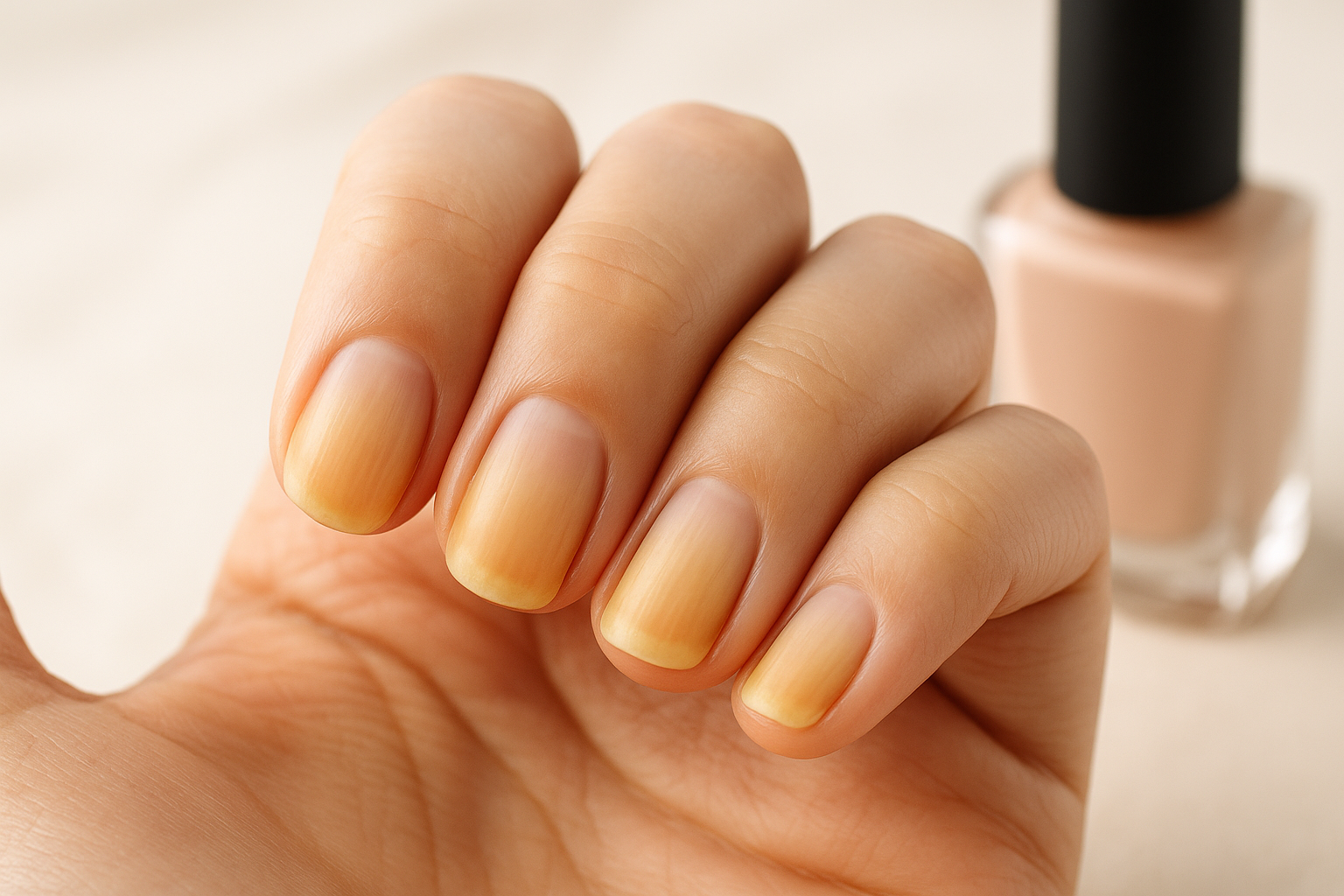
In most cases it is a stain, not damage and not a fungus. The pigments used in nail polish — particularly D&C Red No. 6, 7 and 34 and FD&C Yellow No. 5 Lake — bind to the keratin on the surface of the nail plate, from the cuticle to the tip. According to a peer-reviewed review of nail-product safety by nail specialist Professor Antonella Tosti, that discolouration usually resolves within about two weeks of taking the polish off, if the polish was worn for around a week. Wear it longer — or run back-to-back manicures with no break — and the dye penetrates deeper, at which point the colour will only clear as the nail grows out.
Three things change that answer: chalky white patches (surface keratin damage from repeated polish cycles), flaky white patches and pits on top of the plate (which can be a superficial fungal infection), and the combination of yellow + thickened + apparently stopped growing, which the American Academy of Dermatology says should be examined by a dermatologist. The tables below tell you which one you are looking at in under a minute.
Nothing you apply removes the stain — it has to grow out. What a nail treatment can do is look after the condition of the plate and nail folds while it does. A 100% lipid nail concentrate such as Provité Nail Elixir is one example of that category.
Last updated: 25 August 2026
You peel off a two-week manicure expecting clean nails underneath, and instead you get a set of yellow-orange fingernails that look worse than they did before you painted them. It is one of the most common and least-well-explained things that happens after polish comes off — and most of the advice online jumps straight to lemon juice and baking soda without ever answering the actual question.
So let’s answer it properly: what turned them yellow, how long it takes to go, and how to tell the harmless version from the two versions that are not harmless.
What actually turned your nails yellow
Nail polish is not one substance. It is a film former (usually nitrocellulose), a plasticiser, a thermoplastic resin, a solvent-extender and a pigment package — and it is the pigment package that does this.
In a review published in Cosmetics in 2017, Professor Antonella Tosti — one of the most-cited nail researchers in dermatology — sets it out directly. Nail polish use “has been linked to yellow-orange discoloration of the superficial nail.” The mechanism: due to dyes in the varnish, particularly D&C Red No. 6, 7 and 34 and FD&C Yellow No. 5 Lake, “the keratin in the surface of the nail from the cuticle to the tip may become stained.”
Two details in that sentence matter enormously and almost nobody repeats them:
- “the keratin in the surface” — the dye is sitting in the outermost layers of the nail plate. It is not in your nail bed, it is not under the nail, and it is not in your bloodstream.
- “from the cuticle to the tip” — which is why the yellowing is usually an even wash across the whole visible nail, not a patch, not a streak, and not concentrated at the free edge.
The other giveaway: the American Academy of Dermatology notes plainly that “wearing red nail polish without a base coat or smoking can turn your nails yellow.” Reds and dark shades carry the heaviest pigment load, and the base coat is the barrier between that pigment and your keratin. If you skipped it, that is very likely the whole story.
The two-week rule
This is the number the rest of the internet is missing. Tosti’s review gives a specific, testable timeline:
“This discoloration usually resolves within two weeks of removal of nail polish if the polish was left on for about a week. Longer use may lead to deeper penetration of the dye and discoloration that will only resolve with growing out of the nail.”
So there is a fork in the road, and which side of it you are on depends almost entirely on how long the polish sat there:
- Roughly a week of wear. Stain is shallow. Take the polish off, leave the nails bare, and expect it to fade over about a fortnight without doing anything clever.
- Weeks of continuous wear, or manicure straight onto manicure with no bare-nail gap. The dye has gone deeper into the plate. No amount of scrubbing reaches it — it leaves when that section of nail grows past your fingertip and gets clipped off.
The grow-out clock
If you are on the second branch, here is how to work out roughly when you will be free of it. These are the published figures — combine them with a ruler and you have a real answer rather than a guess.
| What you want to know | Published figure | Source |
|---|---|---|
| Shallow dye stain, after about a week of polish wear | Usually resolves within ~2 weeks of removal | Tosti, Cosmetics 2017 |
| Deeper dye stain, after prolonged wear | Clears only as the nail grows out | Tosti, Cosmetics 2017 |
| Fingernail growth rate | ~3 mm per month | StatPearls, Histology, Nail |
| Toenail growth rate | ~1 mm per month | StatPearls, Histology, Nail |
| Complete fingernail replacement | 6–9 months | Cleveland Clinic |
| Complete toenail replacement | 12–18 months | Cleveland Clinic |
How to use it: look at where the yellow starts — the edge nearest your cuticle. Measure from there to the end of your fingertip in millimetres. Divide by 3 for a fingernail (or by 1 for a toenail) and you have the number of months until the last of it can be clipped away. A stain that begins 9 mm from the free edge of a fingernail is roughly a three-month problem. Nobody enjoys that answer, but it beats spending three months wondering whether the lemon-juice soak is working.
Is it a stain, surface damage, or something else?
Here is where most people go wrong — and, according to Tosti’s review, where clinicians sometimes go wrong too. Repeated cycles of applying, bonding and removing polish can cause what she describes as keratin degranulation: the superficial layers of the plate exfoliate, producing “pseudo-leukonychia, with white patches and linear markings along the nail.” And critically: “this discoloration of the nail may be mistaken for superficial white onychomycosis” — a fungal infection of the top of the nail plate.
That is a genuine diagnostic trap: harmless polish wear-and-tear that looks like fungus, and fungus that looks like harmless polish wear-and-tear. Use this table.
| What you see | Where it sits | Typical trigger | After 2 polish-free weeks | What it is |
|---|---|---|---|---|
| Even yellow-orange wash, cuticle to tip, only on nails that were painted | Surface layers of the plate | Dark or red pigment, no base coat | Fades noticeably, often clears | Dye stain — harmless |
| Chalky white patches and fine linear white markings; surface feels rough | Superficial layers of the plate | Repeated apply–bond–remove cycles | Does not clear quickly; grows out | Keratin degranulation / pseudo-leukonychia — cosmetic |
| Flaky white patches and pits on top of the nail plate | Top of the plate | Fungal invasion of the plate surface | No improvement; may spread | Superficial white onychomycosis — needs a diagnosis |
| Distal end and sides lift, discolour and crumble; debris packed under the nail | Under the plate / nail bed | Fungal, most often the first toenail | No improvement | Distal & lateral subungual onychomycosis — needs a diagnosis |
| A single white spot that does not disappear when you press the nail | Within the plate | A knock, a bump, or manicure force weeks ago | Unchanged; grows out slowly | True punctate leukonychia — harmless |
| All nails yellow and thickened, and seemingly not growing | Whole nail unit | Not cosmetic | No improvement | Red flag — see the section below |
The 10-second blanch test
If part of the discolouration is white rather than yellow, press firmly on the nail plate and watch it. DermNet’s guidance on white nail is that true leukonychia does not blanch with pressure, because the change is inside the plate itself, whereas apparent leukonychia disappears under pressure, because it is the nail bed showing through. Anything that vanishes when you press is not a polish problem at all. We go deeper into this in our guide to white spots on nails.
When yellow nails are a red flag
The overwhelming majority of post-polish yellowing is cosmetic. But there is a specific pattern that is not, and it is worth knowing so you can rule it out and stop worrying.
The AAD’s list of nail changes a dermatologist should examine puts it this way: “If your nails turn yellow, thicken, and seem to stop growing, it could be a sign of something going on inside your body. Lung disease and rheumatoid arthritis can cause yellow nails. You may also have a serious nail infection, which requires treatment.”
Note the triad — yellow and thickened and apparently not growing. A polish stain does none of the last two. The rare condition behind that pattern is yellow nail syndrome, described by DermNet as usually starting in middle age, affecting all the nails, with nails that are “slow growing or appear to have stopped growing,” thickened, “pale yellow or greenish-yellow colour with edges slightly darker,” and often loss of the cuticles. It is accompanied by lymphoedema in about 80% of patients (most often in the legs) and pleural effusions in about 36%.
Two more from the same AAD list worth ruling out while you are looking: a nail turning greenish-black can indicate a bacterial nail infection, and redness and swelling around a nail suggests paronychia. Both want attention rather than a home remedy.
This article is general information about the appearance of nails, not medical advice. If a nail change is spreading, painful, affecting every nail, or you are not sure what it is, see a doctor, dermatologist or podiatrist — onychomycosis in particular needs laboratory confirmation before anyone treats it.
The 14-day polish-free reset
If the table above put you in the “dye stain” or “keratin degranulation” row, here is the protocol. It is deliberately unglamorous, because the two-week window does most of the work by itself.
- Take it all off and leave it off for a full 14 days. This is the single active ingredient in the whole plan. Tosti’s two-week window is measured from removal, and it only runs while the nails are bare.
- Use an acetone-free remover, and don’t soak longer than you need to. Mayo Clinic’s nail guidance is to limit your use of polish remover and choose acetone-free formulas; Cleveland Clinic notes that acetone-containing products dry out the skin around the fingernails.
- Do not buff the yellow off. The nail plate is roughly 196 rows of compacted cells; buffing removes plate, and the deeper dye is below where a buffer can reach. Cleveland Clinic’s advice on ridged nails is to use a buffer only to gently smooth the surface. More on this in why nail experts say don’t buff out ridges.
- Moisturise the nail and the cuticle daily. Cleveland Clinic lists applying moisturiser to nails and cuticles every day as first-line home care for the nail plate; Mayo Clinic specifically says to rub lotion into your fingernails and cuticles too, not just your hands.
- Leave the cuticle itself alone. Mayo Clinic is blunt: “Don’t let your cuticles be removed. They seal the skin to the nail plate. So removal can lead to nail infection.” Histologically, that seal is what protects the matrix where new nail is made.
- Wear gloves for washing up and cleaning. Repeated or prolonged water contact splits fingernails; cotton-lined rubber gloves are the standard recommendation.
- Photograph day 0 and day 14 in the same light. Fading this gradual is almost impossible to judge from memory, and the photo is what tells you whether you are in the two-week group or the grow-it-out group.
- When you go back to polish: base coat first, every time. The base coat exists to create the smooth, uniform layer the pigmented polish sits on — it is the barrier between D&C Red and your keratin. The AAD names going without one as a cause of yellow nails.
What doesn’t work — and what makes it worse
Search this question and you will be told to soak your nails in lemon juice, scrub them with baking soda, brush them with whitening toothpaste, or bleach them with hydrogen peroxide. It is worth being straight about the evidence: none of the major dermatology bodies recommend any of these for nail discolouration. They are folk remedies that have been copied from article to article, and the two things they have in common — acidity and abrasion — are the two things a stained, already-dehydrated nail plate needs least.
Three specific mistakes are worth calling out:
- Painting over it. Understandable, and the worst option available. Longer continuous wear is precisely what drives the dye deeper, converting a two-week problem into a grow-it-out problem.
- Aggressive buffing. You are sanding away nail plate to chase a pigment that has already sunk below the layer you can reach.
- Self-treating for fungus. Because polish-related keratin degranulation “may be mistaken for superficial white onychomycosis,” people start antifungals for something that was never fungal. DermNet stresses diagnostic confirmation precisely because so many nail conditions mimic each other — and antifungal courses for nails run for months.
Why some people stain and some don’t
Three variables explain most of the difference, and you control all three:
| Variable | Higher staining risk | Lower staining risk |
|---|---|---|
| Shade | Reds and dark, heavily pigmented shades | Sheers, pales, clear |
| Base coat | None — pigment meets keratin directly | Base coat under every colour |
| Wear time | Weeks of continuous or back-to-back wear | About a week, then a bare-nail gap |
Note what is not on that list: your general health, your diet, or a calcium deficiency. Whether nails need a “breathing” break between manicures is a separate and more interesting question — we cover the actual physiology in do nails really need to breathe?
Looking after the nail while the stain grows out
Let’s be honest about what a cosmetic product can and cannot do here. Nothing you apply to a nail lifts a dye stain out of the keratin. Anyone selling you a topical that “removes” polish staining is selling you a countdown you were already on. The stain leaves when the nail grows.
What is genuinely in your control during those weeks is the condition of the plate and the nail folds — which matters, because the same routine that stained the nail (long wear, acetone soaks, buffing, repeated apply-and-remove cycles) is also what leaves the plate dehydrated, chalky and prone to peeling at the free edge.
Provité Nail Elixir is a 100% lipid, formaldehyde-free nail concentrate built for exactly that gap. Most nail “strengtheners” work by cross-linking keratin into a harder plate — which trades flexibility for brittleness and gives you nails that snap rather than bend. Provité takes the opposite route: an anhydrous blend of 13 botanical lipids — hemp seed, grapeseed, sesame seed, jojoba, avocado, coconut, camellia tea, cucumber seed, lemon, carrot seed, lavender, geranium and vitamin E — formulated to saturate between the nail layers rather than sit on top of them. The aim is flexible strength: nails that look and feel smoother and more resilient, rather than harder and more brittle.
Because it contains no water, there is nothing in it to evaporate off the plate within a minute of application, and no preservative system is needed to keep it stable. It can be used over bare nails during a polish break, and around the nail folds and cuticle area that take the brunt of remover exposure.
What it does not do: it does not remove staining, it does not speed up nail growth, and it is not a treatment for any nail infection. If the table above pointed you toward fungus, see a clinician — not a cosmetic.
Provité Nail Elixir is formulated by S. C. Aris, rated 4.73/5 from 15 verified buyers, and carries a 90-day money-back guarantee. In a customer survey, 88% reported stronger, less brittle nails within four weeks and 91% said they were no longer self-conscious about their nails.
Related reading: repairing nails after gel or acrylic removal · why your nails are weak and brittle — and what helps · is “10-free” polish actually safer?
Frequently asked questions
How long does it take for yellow nails from nail polish to go away?
If the polish was worn for around a week, the discolouration usually resolves within about two weeks of taking it off. If it was worn for much longer, the dye penetrates deeper into the plate and only clears as the nail grows out — roughly 3 mm per month for a fingernail and 1 mm per month for a toenail, with complete replacement taking 6–9 months for a fingernail and 12–18 months for a toenail.
Are yellow nails after polish a sign of fungus?
Usually not. A polish stain is an even yellow-orange wash from cuticle to tip on the nails that were painted, and it fades once the nails are left bare. Fungal patterns look different: superficial white onychomycosis produces flaky white patches and pits on top of the plate, while the distal and lateral subungual type causes the end and sides of the nail to lift, discolour and crumble with debris underneath. Fungal changes do not improve during a two-week polish break. Diagnosis needs laboratory confirmation.
Does a base coat really prevent yellow nails?
It is the single most effective step. A base coat’s whole purpose is to create a smooth, uniform layer for the pigmented polish to sit on, which keeps the dye off the keratin. The American Academy of Dermatology specifically names wearing red polish without a base coat as a cause of yellow nails.
Can I scrub or buff yellow stains off my nails?
Not effectively, and it costs you nail plate. Shallow staining fades on its own within about two weeks; deeper staining sits below the layers a buffer can safely reach. Buffing should only ever be gentle surface smoothing.
Do lemon juice or whitening toothpaste get rid of yellow nails?
No dermatology body recommends them for nail discolouration. They are widely repeated online but unsupported, and their acidity and abrasiveness add to the wear a stained nail plate is already carrying.
When should I see a doctor about yellow nails?
If your nails turn yellow, thicken, and seem to have stopped growing, the AAD advises being examined by a board-certified dermatologist — that combination can reflect lung disease, rheumatoid arthritis, yellow nail syndrome or a significant nail infection. Also seek advice for a nail turning greenish-black, redness and swelling around a nail, a new or changing dark streak, or a nail lifting away from its bed.
Why are my toenails yellow but my fingernails aren’t?
The same dye mechanism applies, but toenails hold pedicures far longer and grow roughly three times more slowly, so the same stain takes proportionally much longer to disappear. Toenails are also the more common site for fungal infection, so if the colour survives a long polish-free stretch, get it checked rather than assuming pigment.
Sources
- Tosti A. “Safety and Efficacy of Nail Products.” Cosmetics 2017;4(3):24. doi:10.3390/cosmetics4030024 (open access)
- American Academy of Dermatology. “12 nail changes a dermatologist should examine.”
- DermNet. “Fungal nail infections.” Hillan A, 2022; reviewing dermatologist Dr Ian Coulson
- DermNet. “Yellow nail syndrome.”
- DermNet. “White nail — Leukonychia: An overview.”
- Brahs A, Bolla S. “Histology, Nail.” StatPearls, updated 2023
- Cleveland Clinic. “White Spots on Nails (Leukonychia).”
- Cleveland Clinic. “Ridges in Nails.”
- Mayo Clinic. “Fingernails: Do’s and don’ts for healthy nails.”