Why Do My Nails Curve Down at the Tips? Normal Curve, Ageing or Clubbing — the 3-Check Side-View Test
Last updated: 5 October 2026
Search for “why do my nails curve down” and the first page is mostly salon blogs and general-health magazines listing a dozen possible causes in no particular order. What almost none of them gives you is a way to sort your own nails — to tell the harmless curve from the one that deserves an appointment. That sorting job is exactly what clinicians do first, and the tools they use (a side-on look at the nail, a two-finger window test, a feel for the fingertip) are simple enough to try at home. This article walks through the anatomy that gives every nail a curve, the three-check test, a decoder for the other curved-nail shapes (spoon, pinched and ageing), what the medical sources say about when it matters, and what ordinary nail care can and cannot do for a curved nail.
One important caveat up front: this is general information, not a diagnosis. No home check can rule clubbing in or out, and a nail that is changing is worth a professional look whatever the cause turns out to be.
Why every nail has a curve in the first place
A nail plate is not flat to begin with. The Medscape nail-anatomy reference, by Benjamin Phillips, explains that nearly 90% of the nail plate is produced by the proximal half of the matrix, so more plate substance is made at the base than further along, “leading to a natural convex curvature of the nail from proximal to distal.” The Cleveland Clinic's nail-anatomy guide describes the plate in the same terms: the hard, slightly curved surface of your nail, stuck tightly to the nail bed underneath. A fingernail grows at about 3 mm a month, so the free edge you see today was built over several months.
In other words, a curve is the default. The medical question is never “does my nail curve?” but “is the curve new, changing, one-sided, or accompanied by changes in the fingertip?” That is also why the same dermatology sources that warn about curved nails also say a curve can be a harmless inherited trait. The University of Utah Health dermatology team puts it in a single sentence: nail curving “could be a harmless genetic trait, but it could also be a sign of lung, heart, liver, or stomach/intestinal disease.” The AAD's patient page says the same, noting that curved nails can indicate diseases of the lungs, heart, liver or intestines — or may be a harmless familial trait.
The 3-check side-view test
These three checks take about two minutes. They are not a substitute for an examination, but they turn a vague worry (“my nails look more curved”) into specific observations you can describe to a dermatologist or GP. Do them on the nails that worry you and on a nail you consider normal, so you have a comparison.
Check 1 — The side view (the Lovibond angle)
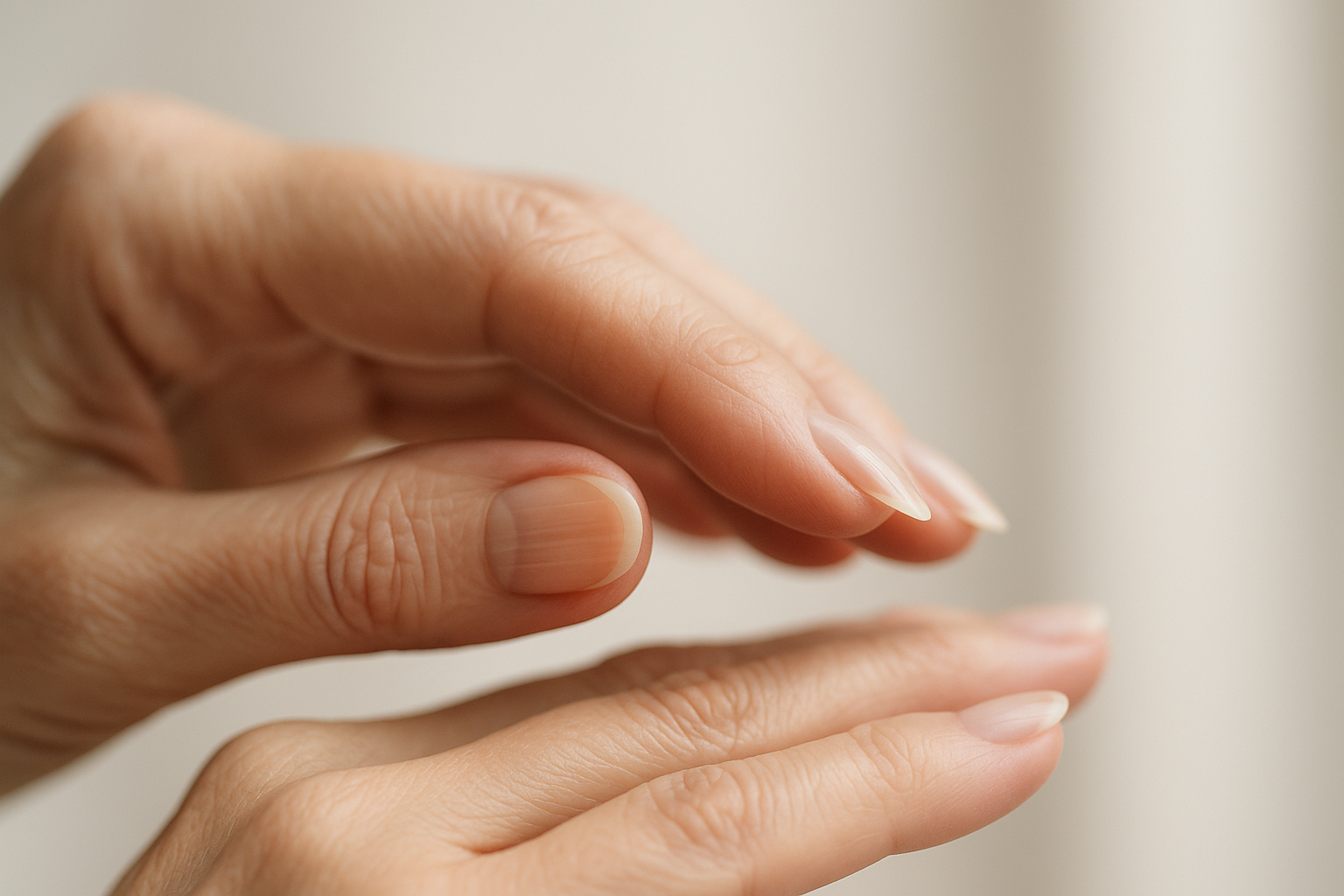
Hold the finger at eye level and look at the nail in profile, from the side. A healthy nail meets the skin at its base with a slight dent — the Cleveland Clinic describes normal nails as having “a slight dent at the base” before the plate curves gently upward. Clinicians call the angle between the nail plate and the proximal nail fold the Lovibond angle. The StatPearls chapter on nail clubbing (Burcovschii & Aboeed, updated September 2022) states that the normal angle is less than 180 degrees, and that when it exceeds 180 degrees the finding is true digital clubbing rather than simple nail curving. In practice that means the dent at the base has filled in and the nail runs in a straight, flat line into the skin — the Cleveland Clinic notes clubbed nails can look flat from the side in the early stages — or has bulged beyond it.
What to note: is there still a visible dent at the base? Does the nail rise away from the skin, or does it merge smoothly into a rounded, bulging fingertip?
Check 2 — The window (Schamroth’s sign)
Press the nails of the same finger on each hand together, back to back, so the nail surfaces face each other. In a healthy pair of fingers there is a small diamond-shaped gap at the base where the two nails meet. DermNet NZ describes the test directly: “A diamond space between them (Schamroth’s window) means the nails are not clubbed.” StatPearls describes the sign as the obliteration, in clubbed fingers, of that diamond-shaped window. The American Family Physician review of nail abnormalities (Fawcett, Linford & Stulberg, 2004) gives the same definition. If the diamond is gone and the nails touch all the way along, that is a reason to book an appointment rather than wait.
What to note: is the window present, narrowed, or gone? Is it the same on all ten fingers?
Check 3 — The pad and the sponge
Clubbing is not really a nail problem; it is a fingertip problem. StatPearls defines it as “soft tissue swelling of the terminal phalanx, resulting in the straightening of the angle between the nail bed and the nail.” The AAD describes the typical course: the curving can begin so gradually that many people are unaware it is happening, and as the nails continue to curve downward, fingertips often swell and the nails start to feel spongy when pressed. The Cleveland Clinic similarly describes clubbed nails that feel soft and sponge-like, with a rounded, bulging, upside-down-spoon shape, and an early stage in which the nail seems to float over the bed.
What to note: has the pad of the fingertip become fuller or bulbous? When you press gently on the nail near the base, does it feel firm and attached, or springy and floating? Have your rings, or the fit of your gloves, changed?
Reading your three checks together
| Your result | What it most often means | Next step |
|---|---|---|
| Dent at the base present, diamond window present, fingertip pad unchanged, curve the same for years or runs in the family | An ordinary or inherited curve (AAD and Utah Health both name “harmless familial trait”), or age-related change in nail contour (Canadian Family Physician) | No action needed beyond routine nail care; mention it at your next check-up if you wish. Re-check if it changes. |
| Curve is new, or has become more pronounced over months, but the window is still present and the pad looks normal | Could still be benign, but a change is the trigger the AAD says to act on | Book a dermatologist or GP appointment; bring dated side-view photos. |
| Dent at the base filled in, window narrowed or gone, fingertip pad fuller, or nail feels spongy | The pattern clinicians call clubbing (StatPearls, AAD, Cleveland Clinic) | See a doctor promptly. Sources link clubbing with heart, lung, liver, bowel and other conditions; only an examination can say whether yours is one of them. |
| Any of the above plus breathlessness, a persistent cough, chest pain, weight loss or unusual tiredness | Symptoms that, together with nail change, warrant medical assessment | Arrange medical review without delay; do not wait to see whether the nails settle. |
What clubbing actually is — and what the numbers do and don’t say
Because clubbing is the shape that matters most, it deserves accurate framing rather than alarm. The StatPearls chapter lists the cause categories: neoplastic, suppurative intrathoracic, diffuse pulmonary, cardiovascular, gastrointestinal, hepatobiliary and metabolic diseases, plus medication-induced cases. The American Family Physician review adds that it can accompany lung and pleural disease, bronchiectasis, pulmonary fibrosis, cystic fibrosis, celiac disease, cirrhosis, inflammatory bowel disease, congenital heart disease and endocarditis, and says a finding of clubbing without an obvious associated disease should prompt a search for an occult cause.
The StatPearls chapter also gives hospital figures — clubbing in roughly 1% of internal-medicine admissions, with serious disease associated in about 40% of those cases. Read those carefully: they describe people who were already hospital inpatients, not healthy adults noticing their nails. They are not your personal odds. What they show is why clinicians take real clubbing seriously, not that a curved nail means illness.
Three other points from the clinical sources are worth knowing:
- It is usually painless and gradual. The Cleveland Clinic says nail clubbing itself isn’t harmful and usually isn’t painful, and often occurs gradually and may be hard to spot at first. DermNet notes that the rare, hereditary primary form develops over a period of time and is essentially symptomless, whereas secondary cases can occur suddenly and progress rapidly. A quick change is therefore a stronger reason to hurry than a slow one.
- It may or may not go away. The Cleveland Clinic says that after treating the cause, nails may gradually return to normal, though clubbing isn’t always reversible. StatPearls likewise notes it can regress when the underlying condition is successfully treated.
- It is a clue, not a diagnosis. A nail change gets a clinician looking in the right direction; it does not by itself say what is wrong.
Curved the other way, or pinched: the rest of the curved-nail family
“Curved” covers more than one shape. The direction of the curve is itself a clue, which is why the decoder below sorts nails by shape. It draws on the sources named in each row.
| Shape | How it looks | Usual associations (per the sources) | Next step |
|---|---|---|---|
| Ordinary or inherited curve | Gentle convex curve base-to-tip; visible dent at the base; looks the same on most nails | Natural anatomy (Medscape); “harmless familial trait” (AAD, Utah Health) | Routine care |
| Age-related contour change | Less curvature along the nail’s length, more curvature across it; plate may be more fragile, striated or split | Canadian Family Physician: “a decrease in the longitudinal curvature and an increase in the transverse convexity”; growth slows about 0.5% a year from age 25 | Routine care; mention changes at check-ups |
| Clubbing | Dent at the base lost, nail bulging over a swollen fingertip like an upside-down spoon, spongy to the touch; diamond window gone | Heart, lung, liver, bowel and other conditions (StatPearls, Cleveland Clinic, AFP); rare hereditary form (DermNet) | Doctor, promptly |
| Pincer (“trumpet”) nail | Edges curl inward so the plate pinches the skin at the sides, with pain at the borders where the plate curves into the tip | MSD Manual: a transverse overcurvature “most often caused by onychomycosis, psoriasis, tumors of the nail apparatus, osteoarthritis, and poorly fitting shoes”; no established treatment of choice, though surgical techniques have been successful | Dermatologist or podiatrist, especially if painful |
| Spoon nail (koilonychia) | Curves up: a dip in the middle of a thin, soft nail that can hold a drop of water | Most often iron deficiency (Cleveland Clinic); also trauma, petroleum-solvent exposure and nail-patella syndrome (AFP); common in infants (about 1 in 3 in one study) | GP: AFP suggests a complete blood count and ferritin when no obvious cause is present |
Two details in that table are easy to miss. First, a nail that curves down and a nail that scoops up are opposites, and they point to different conversations; if yours scoops, the Cleveland Clinic says to see a provider, who treats the underlying cause — and notes it can take six to 18 months for koilonychia to go away as healthy nail grows out. Second, a pincer nail is about the sides of the nail closing in, not the tip bending down, and it is usually a single, localised nail problem with a recognisable local cause such as a fungal infection or ill-fitting shoes.
What about nails that only curve when they’re long?
If your nails are straight when short and curl over the fingertip once they pass a certain length, the Medscape anatomy gives the most plausible reading: the plate is already convex from base to tip, so a longer free edge simply shows more of that curve without the fingertip underneath to hold it flat. That is an inference from the anatomy, not a finding any of these sources states directly. It is also consistent with the sources’ reassurance that a curve on its own, unchanged and with a normal fingertip, may be a harmless trait. It is still worth running the three checks — length can hide a change in curvature that the same nail trimmed short would reveal. A useful trick: trim one nail short, then look at it in profile. If the short nail’s profile looks normal, the dent at the base is present, and the window test is clear, you have your answer for that finger.
The 8-week side-profile photo log
A single look cannot tell you whether a nail is changing, and change is the signal that matters most. A dated photo log is a simple, inexpensive way to turn a vague impression into evidence. (This is a practical suggestion rather than a published protocol.)
- Pick the same two fingers — the one you think is most curved and one you consider normal for comparison.
- Take a side-on photo at eye level, with the finger held against a plain background and the nail in profile, at the same distance and in the same light each time.
- Photograph the back-to-back window (the two nails pressed together) in the same session.
- Repeat every two weeks for eight weeks, and date every image.
- Add a one-line note: fingertip fuller or the same? Nail feels firm or springy?
- Book the appointment sooner if the dent at the base is disappearing, the window is closing, the fingertip is visibly swelling, or you develop breathlessness, cough or other new symptoms. Bring the photos either way.
When to see a doctor
The sources are consistent on this. The AAD says if you notice your fingernails start to curve, it’s time to see a board-certified dermatologist. The Cleveland Clinic says that if you notice nail clubbing or any changes in your nails, see a healthcare provider. Put practically, book an appointment if:
- the curve is new or getting more pronounced;
- the dent at the base has gone, the diamond window has closed, or the fingertip is swelling;
- the nails feel spongy or seem to float over the bed;
- the nails scoop upwards (a blood test for iron is the usual first step);
- the sides of a nail are pinching or painful;
- any of this comes with breathlessness, persistent cough, chest symptoms, weight loss or unusual fatigue.
If none of those apply and your nails have always looked like this, you very likely have a built-in curve. Nothing in the evidence suggests any product changes it, and nothing in these sources suggests it needs treating.
What ordinary nail care can — and can’t — do for a curved nail
This is where honesty matters. No cosmetic changes the shape of your nail plate. Curvature is set by how the matrix builds the nail, which is why the clinical advice is about finding any cause rather than reshaping the nail. What ordinary care can do is look after the practical consequences of a strongly curved nail — mainly tips that catch, split or peel, and the dryness that comes with frequent hand-washing:
- Trim straight across with sharp clippers, then round the tip gently (Mayo Clinic’s long-standing advice). A strongly curved free edge snags easily, so shorter is usually easier to live with.
- Cut down the wet-dry cycle. Cotton-lined gloves for washing up, and conditioning straight after washing or sanitiser, are covered in our articles on why nails go soft and bendy in water and hand sanitizer and nails.
- Condition the plate and cuticle daily. If the tips split, our guides to vertical splitting and weak, brittle nails cover the mechanics.
- Skip formaldehyde hardeners. A rigid curved nail is a snappy one — see why a nail strengthener can make nails worse.
- Be patient with growth. A fingernail takes around six months to grow out completely, so any change in care shows at the base first.
📋 Please note: The section below describes a daily-care cosmetic product. It supports the appearance of flexible, resilient-looking nails. It does not change nail shape, and is not medical advice or intended to diagnose, treat or prevent any condition. Nails that are changing shape, swelling at the fingertip or painful should be checked by a doctor.
Where Provité Nail Elixir fits — and where it doesn’t
If the three checks come back clear and the curve is simply how your nails are made, the thing that usually bothers people is not the curve but what it does to the tips: a strongly curved free edge catches on fabric, and a dry plate then splits or peels from there. That is the job a daily conditioner is aimed at. Provité Nail Elixir, formulated by S. C. Aris, is a 100% lipid, water-free, formaldehyde-free concentrate designed to saturate between the nail’s layers rather than sit on the surface — the “intra-keratin” approach behind its “flexible-strength” positioning: nails that bend and recover rather than nails that are merely hardened. Because it contains no water, it adds no extra evaporation cycle to a plate that is already short on moisture.
The blend carries thirteen botanical lipids — hemp seed, grapeseed, sesame seed, jojoba, avocado, coconut, camellia tea, cucumber seed, lemon, carrot seed, lavender, geranium and vitamin E — and works on bare nails or under gel and acrylic. In a customer survey, 88% reported nails that looked stronger and less brittle within four weeks and 94% said they would recommend it. It carries a 4.73/5 rating from 15 verified buyers and a 90-day money-back guarantee.
Two plain disclosures. First, Provité is a cosmetic: it supports the look and feel of nails and cuticles, does not alter nail shape, and has nothing to say about clubbing, spooning or any underlying condition — those belong with your doctor. Second, it is not fragrance-free: it contains aromatic botanicals including lavender, geranium and lemon, so patch-test a drop on the inner forearm first if your skin is reactive.
Frequently Asked Questions
Why are my fingernails curving down at the tips?
Every nail is naturally convex from base to tip, because most of the plate is made by the proximal half of the matrix. A stronger curve can be inherited, can be part of normal ageing, or can be clubbing — swelling of the fingertip that straightens the angle between nail and skin and then bulges the nail. The AAD advises seeing a board-certified dermatologist if your fingernails start to curve.
Is nail curving always a sign of a serious disease?
No. The AAD and the University of Utah Health both say curved nails may be a harmless familial trait. But because clubbing can accompany heart, lung, liver and bowel conditions, a new or changing curve is worth a professional look.
How can I tell clubbing from a normal curve at home?
Three checks: look at the nail in profile (a healthy nail has a slight dent at the base and the Lovibond angle is under 180 degrees); press two nails back to back to see the diamond-shaped window (Schamroth’s sign — the window disappears in clubbing); and note whether the fingertip pad has swollen or the nail feels spongy. These help you describe what you see, but they cannot rule clubbing in or out — only an examination can.
Does nail clubbing hurt?
Usually not. The Cleveland Clinic says clubbing itself isn’t harmful and usually isn’t painful, and that it often occurs gradually and may be hard to spot at first. That is why checking for change over time matters.
Can nail clubbing go away?
The Cleveland Clinic says that after the cause is treated, nails may gradually return to normal, but clubbing isn’t always reversible. StatPearls similarly notes it can regress when the underlying condition is successfully treated.
What is the difference between curved nails and spoon nails?
Direction. Clubbing and ordinary curving bend the nail down over the fingertip. Spoon nails (koilonychia) are thin and scooped up, with a dip in the middle. The Cleveland Clinic says iron-deficiency anaemia is the most common underlying condition, and the American Family Physician review suggests a complete blood count and ferritin level when spooning appears without an obvious cause.
Do nails curve more as you get older?
The contour changes. A Canadian Family Physician review describes a decrease in longitudinal curvature and an increase in transverse convexity as characteristic senile changes in the nail plate, alongside a tendency to become more friable, with fissuring, splitting and longitudinal striations. It also notes nail growth tends to slow by about 0.5% a year from age 25.
Can a nail product change my nail’s curve?
No. Nail shape is set by how the matrix builds the plate, and no cosmetic changes that. A water-free lipid conditioner such as Provité is aimed at how the nail and cuticle look and feel — supporting flexible, resilient-looking nails that are less prone to splitting at the tip — not at curvature or any underlying cause.
Sources
- Burcovschii S, Aboeed A. “Nail Clubbing.” StatPearls, updated 24 September 2022 — NCBI Bookshelf NBK539713
- Cleveland Clinic, “Nail Clubbing: What It Looks Like, Causes & Treatment” (last updated 23 November 2022) — my.clevelandclinic.org
- American Academy of Dermatology, “12 nail changes a dermatologist should examine” — aad.org
- DermNet NZ, “Hypertrophic osteoarthropathy and digital clubbing” (updated February 2016) — dermnetnz.org
- Fawcett RS, Linford S, Stulberg DL. “Nail Abnormalities: Clues to Systemic Disease.” American Family Physician 2004 — aafp.org
- Lipner SR (peer reviewed by Merola JF). “Nail Dystrophies.” MSD Manual Professional Edition, updated October 2025 — msdmanuals.com
- Cleveland Clinic, “Koilonychia (Spoon Nails)” (updated 26 November 2021) — my.clevelandclinic.org
- Abdullah L, Abbas O. “Common nail changes and disorders in older people.” Canadian Family Physician 2011;57(2):173 — cfp.ca
- Phillips BZ. “Nail Anatomy.” Medscape Drugs & Diseases, updated 12 September 2013 — emedicine.medscape.com
- Mansell G (PA-C). “10 Nail Changes that Should be Seen by a Dermatologist.” University of Utah Health, 14 March 2024 — healthcare.utah.edu
- Cleveland Clinic, “Nails: Fingernail & Toenail Anatomy” (updated 17 September 2025) — my.clevelandclinic.org
This article is for general information and reflects cosmetic nail care, not medical advice. A nail that is changing shape, a swelling fingertip, or nail changes alongside breathlessness, cough, weight loss or fatigue should be assessed by a doctor.