Why Do My Nails Split Vertically Instead of Peeling? Onychorrhexis Explained — and the 2-Direction Test
Last updated: 28 September 2026
Type “why do my nails split down the middle” into Google and most of what comes back is salon-blog guesswork: dehydration, ageing, “the layers separating,” a vague nod to biotin. What almost none of it does is answer the question a dermatologist would actually ask first — which direction is the split running? That single detail is the difference between a split caused months ago at the root of your nail and one caused by what your hands have been doing to the free edge this week, and dermatology researchers have built an entire classification system around exactly that distinction. This article walks through it: the two recognised mechanisms behind a splitting nail, a simple test that tells you which one you have, what is actually failing inside the nail plate at a structural level, who is more prone to it, when a split is worth a doctor’s opinion rather than a routine change, and the evidence behind what actually helps.
The two kinds of nail splitting dermatology actually recognises
Most consumer articles treat “splitting nails” as one problem. Dermatology treats it as at least two, with different causes and different starting points inside the nail. The clearest statement of this comes from a 2005 paper in the Journal of the American Academy of Dermatology by Van de Kerkhof and colleagues, which proposed a pathogenesis-based way of grading brittle nails. Their framing, in essence: brittle-nail complaints are driven either by factors that impair the intercellular adhesion of the corneocytes making up the nail plate, or by factors that cause a pathologic nail formation by involving the matrix — the site at the base of the nail where the plate is actually built. Those two mechanisms map onto two different-looking splits.
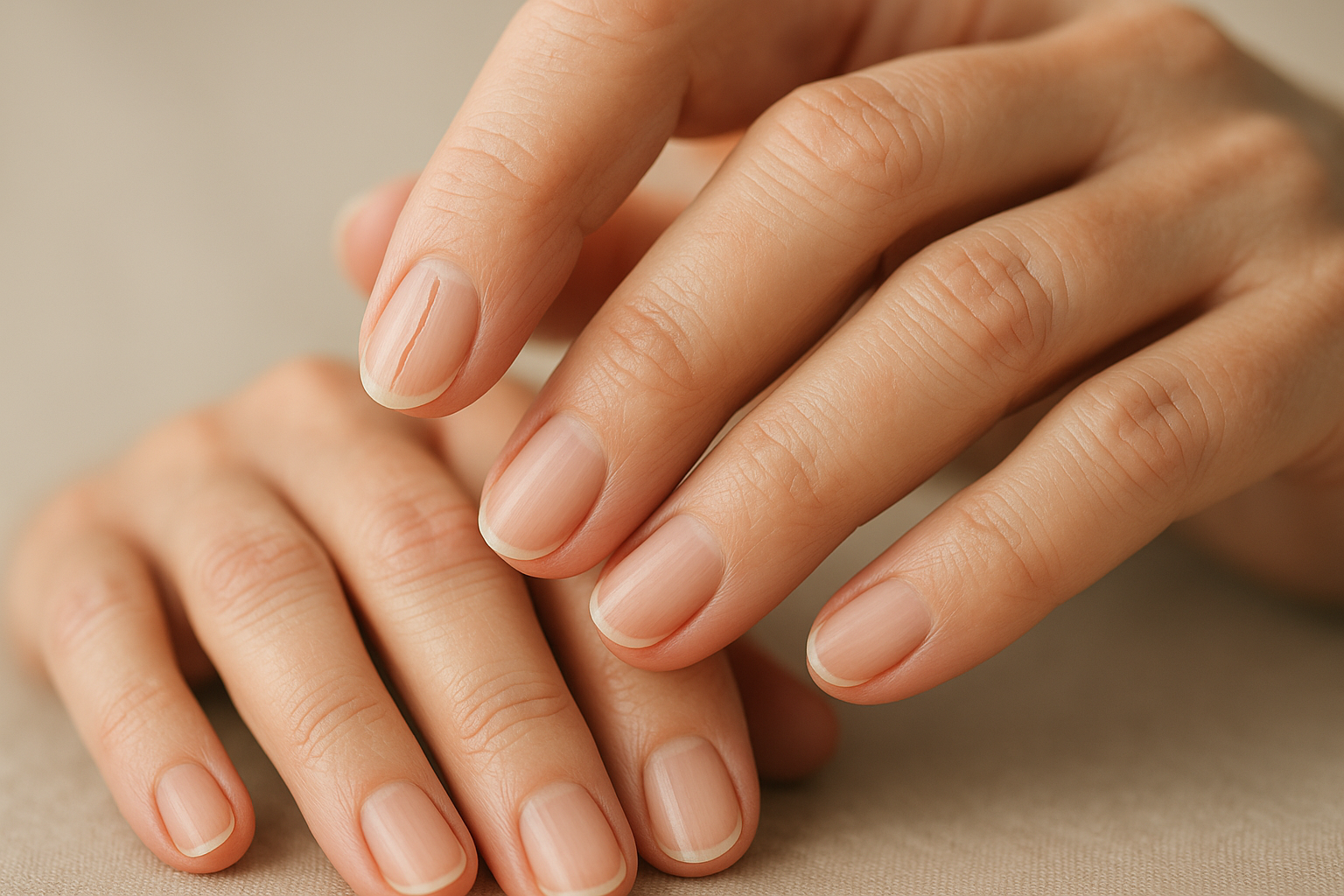
A 2019 open-access review in Dermatology and Therapy by Chessa and colleagues sets out the visible difference plainly. Onychorrhexis is described as “longitudinal splitting and shallow parallel furrows running on the superficial layer,” affecting fingernails primarily, with its severity tied to how much the matrix was disrupted. Onychoschizia (the lamellar form) is where “the nail plate exfoliates into fine horizontal layers” at the free margin, caused by impaired intercellular adhesion, and the review notes it is “almost exclusive to fingernails.” Put simply: a crack running up the nail, parallel to the sides, points back to how that section of plate was made; a nail that peels apart into paper-thin sheets at the very tip points to what has been breaking down the cement between the layers since it grew out.
Neither term is describing your nails as diseased. The 2005 grading paper notes brittle nails affect roughly a fifth of the population, and are around twice as common in women — common enough that most cases are a cosmetic nuisance with an identifiable everyday cause, not a symptom of illness. But knowing which of the two you have tells you where to direct the fix, which is the point of the test below.
The 2-direction test: which kind of nail line is this?
Look at one affected nail under good light and answer two questions: which way does the mark run, and does it go all the way across or only partway up from the tip? The table below sorts the four patterns people usually mean when they say a nail is “splitting” or has a “line” in it.
| Pattern | Direction & look | What it's called | What it usually means |
|---|---|---|---|
| Crack from the tip, running up | Vertical, parallel to the sides of the nail; often on more than one nail | Onychorrhexis | Matrix-related plate formation issue (Van de Kerkhof); commonly ageing, dryness or a mild nutrient gap (Cleveland Clinic, WebMD) |
| Peeling into thin sheets at the tip | Horizontal layers, flaking apart like paper, confined to the free edge | Onychoschizia (lamellar) | Impaired intercellular adhesion (Chessa 2019); water/detergent and chemical exposure — see our hand sanitizer and wet-dry cycle articles |
| A single groove down one thumbnail | Vertical, usually just the thumb, often with ridging either side | Habit-tic deformity | Repeated picking/pushing at the cuticle (DermNet) — see our ridge down the middle of my thumbnail article |
| A groove running the width of the nail | Horizontal, side to side, often on several nails at the same height | Beau's line | Growth briefly halted — fever, illness, injury, chemotherapy or major stress (Cleveland Clinic, AAD) |
The American Academy of Dermatology draws the same line-direction distinction in its patient guidance on nail changes worth a dermatologist's attention: “Lines that run the length of a nail are common and usually nothing to worry about,” while “deep grooves that run the width of your nail” are the ones that mean something — usually fever, injury, chemotherapy or stress — briefly stopped the nail growing. That single AAD sentence is worth remembering: lengthwise is usually the boring answer; widthwise is the one that means “something happened.” The Cleveland Clinic's guide to nail ridges backs this up from the clinical side, listing normal ageing, very dry skin or eczema, and hypothyroidism among the causes of vertical ridging, while filing horizontal ridges under Beau's lines caused by chemotherapy, long-term gel manicures or acrylics, injury, peripheral vascular disease, or a severe illness with high fever.
What's actually failing inside a splitting nail
To understand why a crack runs the way it does, it helps to know what a nail plate is actually made of — and it is not much like skin. A 2017 review of nail structure in the journal Mycoses, by Baswan and colleagues, measured the nail plate at just 0.1–1% lipid and 7–12% water, against roughly 10% lipid and 20–40% water in the skin's outer layer. The plate is built from an average of 196 tightly bound cell layers across three sub-layers (dorsal, intermediate and ventral), held together largely by disulphide bonds between cystine-rich keratin proteins rather than by any meaningful film of natural oil.
The Chessa 2019 review fills in the piece that actually explains splitting: nails hold roughly 5% lipid overall by their figures, and “adhesion between cells is facilitated by membrane-coating granules with linkage by lipids, such as acyl ceramides.” In other words, the small amount of lipid the nail does have is not there to make it shiny or waterproof — it is doing structural work, cementing one flattened cell layer to the next. When that intercellular cement is thin, dried out, or was laid down imperfectly at the matrix in the first place, the layers no longer hold together as one solid sheet, and the plate is left to fail along the path of least resistance: lengthwise, along the direction the cells were laid down, which is exactly what onychorrhexis looks like.
This is also why splitting and general brittleness are related but not identical questions — brittleness is the broader tendency for a nail to break or crack under normal use, which we cover in full in why are my nails so weak and brittle?; onychorrhexis is the specific visible pattern that a lot of brittle-nail cases eventually take.
Why it gets more common with age — and who else is more prone to it
Both the age link and the sex split are well documented. The Van de Kerkhof grading paper puts brittle-nail complaints at around 20% of the population, roughly twice as common in women as in men. The Chessa review attributes part of this to what it calls “physiological increased nail fragility” with age — nails simply become more fragile as a normal part of getting older, in the same way skin does, independent of any disease process. WebMD's clinical overview of onychorrhexis lists ageing as the single most common cause, ahead of every medical condition on its list.
The same sources point to a short list of everyday accelerants worth checking against your own routine before assuming anything more serious: frequent hand washing, wearing occlusive gloves for long stretches, and general dehydration of the hands all appear in the Chessa review's risk-factor list, alongside occupational chemical exposure. If you also spend a lot of time with your hands in water or hand sanitiser, it's worth reading how that specific mechanism works in does hand sanitizer damage your nails? and why do my nails go soft and bendy in water? — both describe the wet-dry cycling that wears down the same intercellular cement discussed above, just from the water side rather than the matrix side.
When it's worth a closer look
Most vertical splitting is exactly what it looks like: a cosmetic nuisance with a mundane cause. But the same sources that describe the everyday version are equally clear about when it isn't. WebMD's clinical list of onychorrhexis causes includes, alongside ageing: iron, protein or folic acid deficiency; hypothyroidism, liver disease and kidney disease; heart and circulatory disease; rheumatological conditions such as gout, rheumatoid arthritis, osteoarthritis and systemic sclerosis; and rarer causes including systemic amyloidosis and the genetic condition Witkop syndrome. None of that means a split nail is a diagnosis on its own — it means a split nail with company is worth mentioning to a doctor.
The AAD's guidance on nail changes gives a useful, non-alarmist way to sort this: a change in colour, texture, or shape “can be harmless, but it can also be a sign of disease,” and the pattern that matters most is whether the change is confined to one nail, is new or actively getting worse, or comes with other symptoms — thickening, colour change, pain, lifting from the nail bed, or swelling and redness of the skin around it. A dark, new or changing streak under one nail specifically warrants a dermatologist's skin-cancer check, per the AAD, and is a different situation entirely from the diffuse vertical splitting this article covers. If several fingernails split at roughly the same time and the rest of you feels off — unusual fatigue, cold intolerance, hair thinning — a thyroid or iron-deficiency check with your GP is a reasonable, low-effort step before assuming it's just ageing or dry hands.
What the evidence says actually helps
The honest starting point, per the Chessa review, is that a truly matrix-driven split has to grow out — nothing applied topically rebuilds the section of plate that was already formed imperfectly weeks ago. What the evidence supports is slowing new damage, supporting the nail as it grows out, and in some cases nutritional correction. The table below sets out what's actually been studied, separated from what's simply marketed.
| Approach | What the evidence shows | Source |
|---|---|---|
| Oral biotin | 5–10 mg/day for 3–6 months “usually recommended”; works via keratin synthesis and improving nail-plate ultrastructure. Evidence base is small older trials, not large RCTs. | Chessa 2019 review — see our full biotin deep-dive for the actual trial data |
| Occlusive moisturisers | Petrolatum/lanolin-based products plus humectants (glycerin, propylene glycol) are the standard recommendation for the surrounding skin and cuticle. | Chessa 2019 review |
| Film-forming nail lacquers | Silicon and hydroxypropyl chitosan formulations are designed to protect against everyday physical injury to the plate while it grows. | Chessa 2019 review |
| Daily lipid/humectant nail treatment (category evidence) | A 3-month clinical study of a different nail-strengthening formula (plant-derived Pistacia lentiscus + hyaluronic acid) found 15.9% and 26.7% improvement in a nail-hardness score at 28 and 84 days, with 80% of the 20 completing participants rating their nails “clear” or “very good” by the end. Untreated nails on the same hands showed no improvement. | Granger et al., Skin Appendage Disorders 2020 |
| Trimming & filing technique | Trim straight across with sharp clippers, then round the tip gently — reduces snagging that turns a small split into a bigger one. | Mayo Clinic |
| Formaldehyde nail hardeners | Cross-link keratin into a harder but more brittle plate; frequent use is linked to nails becoming more prone to breaking or peeling, not less — see our hard-vs-strong nail strengthener article. | FDA / our own #629 investigation |
The Granger 2020 trial is worth reading correctly: it studied a different, unrelated nail-strengthening formula, not Provité, and it is included here as evidence for the category — that a daily, purpose-built nail treatment applied consistently for months can move a measured hardness/splitting score, not as a claim about any specific product's results. Treat the percentages as a realistic timeline (weeks to a few months, not days) and a realistic ceiling (meaningful improvement, not a cure) for what this kind of daily routine can do for a plate that has to grow out anyway.
The 6-step routine for a nail that's actively splitting
- Stop the crack where it is. File the split smooth with a fine-grit file so it can't snag on fabric and run further up the nail — this is damage control, not a cure, but it buys the growing-out period time.
- Trim short and straight. Mayo Clinic's advice: sharp clippers, straight across, then a gentle rounded curve at the tip. Shorter nails have less unsupported free edge to catch and crack.
- Cut the wet-dry cycling. Cotton-lined rubber gloves for dishes and cleaning, and condition immediately after hand sanitiser or washing rather than hours later — the full mechanism is in our hand sanitizer article.
- Condition the nail itself, not just the surrounding skin. A water-free, alcohol-free lipid concentrate worked into the plate and cuticle — such as Provité — adds nothing that evaporates and dries the plate further between applications, unlike a water-based lotion.
- Leave hardeners and picking alone. Skip formaldehyde-based hardeners while a nail is actively splitting, and don't pick at the loose edge or the cuticle — both add new mechanical stress exactly where the plate is already weakest.
- Give it the real timeline. A fingernail grows at roughly 3 mm a month per the StatPearls histology chapter, so a split section has to be trimmed away or grown past — expect a couple of months before the visibly affected part is gone, not a couple of weeks.
📋 Please note: The section below describes a daily-care cosmetic product. It supports the appearance of flexible, resilient-looking nails; it is not medical advice and is not intended to diagnose, treat or prevent any condition. Nails that thicken, discolour, lift from the bed, or split on one nail only should be checked by a doctor.
Where Provité Nail Elixir fits a splitting nail
Given how little lipid a healthy nail plate holds to begin with — Baswan's review puts it at 0.1–1%, Chessa's at around 5% — and given that the small amount present is doing real structural work cementing cell layers together, a nail-specific concentrate aimed at that intercellular space is a more targeted approach than a generic hand cream worked over the top of the nail as an afterthought. Provité Nail Elixir was formulated by S. C. Aris as a 100% lipid, water-free, formaldehyde-free concentrate designed to saturate between the nail's layers rather than simply coat the surface — the “intra-keratin” approach behind its “flexible-strength” positioning: nails that bend and recover rather than nails that are merely hardened.
The formula carries thirteen botanical lipids: hemp seed, grapeseed and sesame seed for resilience; jojoba, avocado and coconut for suppleness at the free edge — the exact site where onychorrhexis starts; camellia tea, cucumber seed, lemon and carrot seed for a clean, glassy finish; and lavender, geranium and vitamin E to round out the blend. Because it is entirely lipid with no water or alcohol base, applying it doesn't add another evaporation cycle to a plate that is already short on the very thing (7–12% water, per Baswan) that governs its flexibility. It works on bare nails and under gel or acrylic. In a customer survey, 88% reported nails that looked stronger and less brittle within four weeks, and 94% said they would recommend it; it carries a 4.73/5 rating from 15 verified buyers and a 90-day money-back guarantee.
One disclosure in keeping with the evidence-first tone of this article: Provité is not a fragrance-free formula — it contains lavender, geranium and lemon among its thirteen lipids. If your skin reacts to fragranced products or the skin around a split is already broken, patch-test a drop on the inner forearm first, and keep a plain fragrance-free ointment for any raw skin, reserving the elixir for the nail plate and cuticle once healed.
Frequently Asked Questions
What causes a nail to split straight down the middle?
A vertical split running up from the free edge is called onychorrhexis, and dermatology research links it to how the nail plate was formed at the matrix weeks or months earlier, rather than to something currently happening at the tip. Ageing, dehydration and a mild nutrient gap are the most common everyday drivers.
Is onychorrhexis the same as onychoschizia?
No. Onychorrhexis is a vertical, lengthwise split tied to matrix-related plate formation. Onychoschizia is horizontal, lamellar peeling at the very tip of the nail, caused by impaired adhesion between cell layers — usually from repeated water and chemical exposure. They can occur in the same person but come from different mechanisms.
Does a vertical split mean I have a vitamin deficiency?
Not necessarily. Ageing is the single most common cause. But iron, protein or folic acid deficiency, thyroid disorders, and circulatory or rheumatological conditions are all documented causes, so a split that appears on several nails alongside other symptoms is worth mentioning to a doctor.
How is a vertical split different from a Beau's line?
Direction. A vertical split or ridge runs the length of the nail and is usually harmless. A Beau's line runs across the width of the nail and means growth was briefly interrupted by fever, illness, injury, chemotherapy or major stress — a different signal entirely.
Will my nail heal on its own, or do I need to do something?
The split section of plate can't repair itself in place — it has to be trimmed away or grown out, at roughly 3 mm a month for a fingernail. Filing the crack smooth, trimming short, cutting down on wet-dry cycling and conditioning the plate daily won't erase an existing split but can stop it running further and support how the new growth looks as it comes in.
Does biotin help with split nails?
Oral biotin at 5–10 mg a day for three to six months is a commonly recommended approach, working through keratin synthesis, though the supporting trials are small and older rather than large modern studies. See our full biotin article for the actual numbers behind that recommendation.
Should I worry if only one nail is splitting?
A change confined to a single nail is more often linked to a specific local cause — an old injury, an aggressive manicure, or a picking habit — than a systemic one, but any new dark streak, colour change, or pain in a single nail should still be checked by a dermatologist.