Does Nail Slugging Actually Work? What It Can Change — and What It Can’t
Quick answer
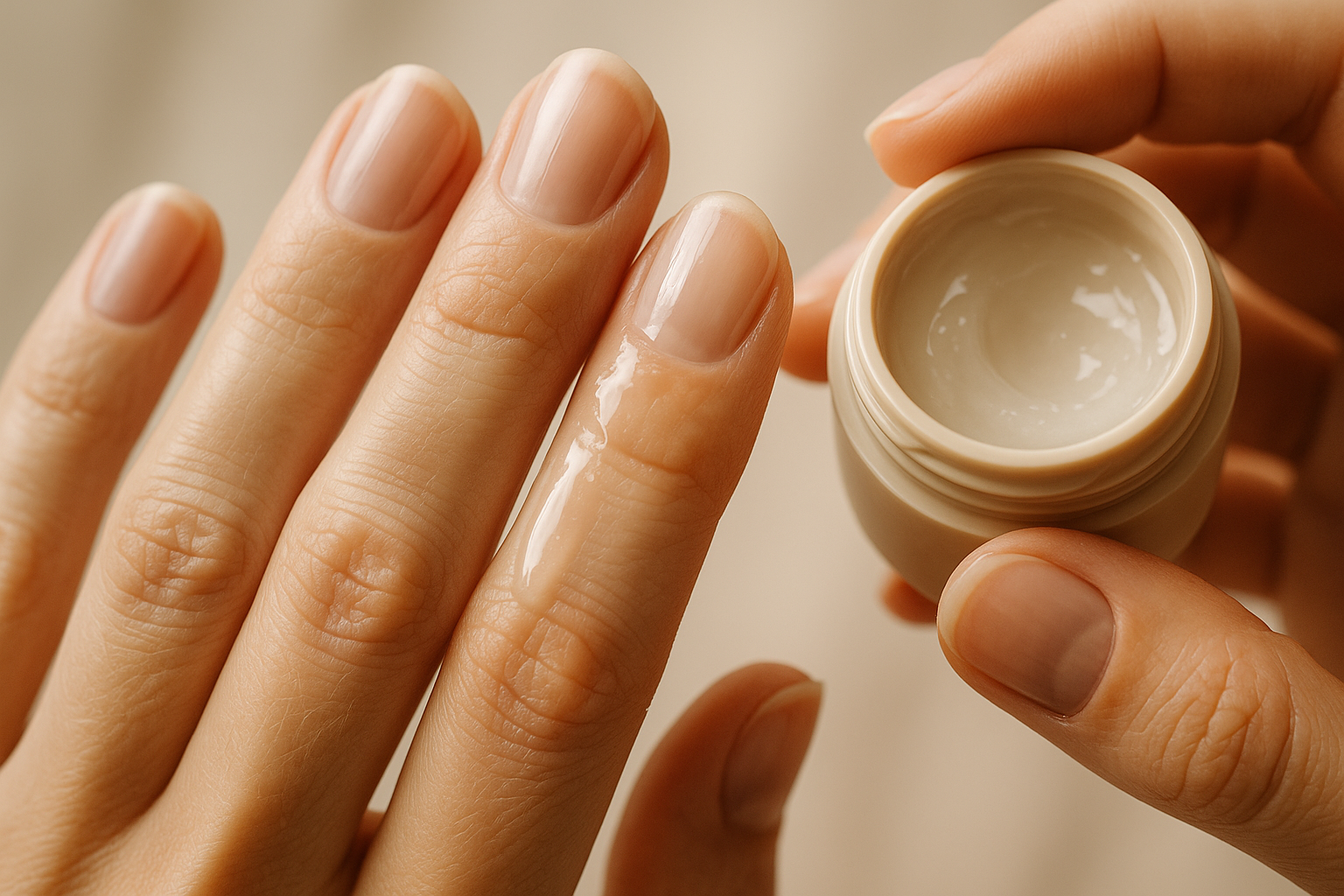
Yes — but not for the reason most people think, and not for everything. Nail slugging works by occlusion, not absorption. Sealing your nails and cuticles under a greasy layer overnight slows the water escaping from them; it does not push nutrients into the nail. That distinction sets your expectations precisely:
- It reliably improves the look and feel of dry cuticles, ragged nail folds and hangnails — often within a few nights.
- It plausibly helps the peeling, splitting free edge that comes from repeated wetting and drying — but only as new nail grows out, over weeks.
- It cannot change growth speed, ridges, dents, colour changes or anything driven by the nail matrix under your cuticle.
There is no clinical trial of “nail slugging” specifically. What exists is solid, boring dermatology: every major nail-care authority tells you to moisturise your nails and cuticles, and the American Academy of Dermatology explicitly recommends applying “a moisturizing product, such as petroleum jelly, to your nails and cuticles several times daily” between manicures. Slugging is that advice, concentrated into one overnight step. Anything designed for this job needs to be an occlusive or a lipid that stays put rather than a water-based lotion that evaporates — a 100% lipid concentrate such as Provité Nail Elixir is one example of that category.
Last updated: 31 August 2026
What nail slugging actually is
Slugging began as a face-care technique and migrated to hands. Cleveland Clinic describes the nail version plainly: “After applying skin care products, you cover your hands in a layer of petroleum jelly (or a similarly occlusive product, like an emollient) before going to sleep. The goop traps all that product on your skin.” Dermatologist Rosemary Keskinen, MD, lists it alongside hand cream and lanolin conditioners as a legitimate option for brittle nails — filed under “extreme moisturising,” not under miracle cures.
That last framing is the part the viral versions drop. Slugging is a delivery tactic, not an active ingredient. It makes whatever you put underneath stay in contact longer. If nothing useful is underneath, you have simply greased your hands.
The mechanism nobody explains: occlusion, not absorption
Here is the claim you will see repeated across beauty media — that slugging lets oils “seep into” and “feed” the nail. The regulator is blunt about why that is unlikely. Explaining why some nail ingredients are harmful if swallowed but safe on the nail, the U.S. Food and Drug Administration states that this is “because the nail is a barrier, which prevents absorption.”
The nail’s structure explains the barrier. Per StatPearls’ nail histology chapter, the nail plate is a rigid keratinised structure of around 196 rows of compact cells called onychocytes. It resembles a modified stratum corneum, but with a lower percentage of total fat and water and a much higher percentage of cysteine — meaning many strong disulfide bonds. It is built to keep things out.
So what is slugging doing? The same thing occlusives do on skin. In their review of topical plant oils in the International Journal of Molecular Sciences, Lin, Zhong and Santiago note that oils “may act as a protective barrier to the skin by an occlusive effect, allowing the skin to retain moisture, resulting in decreased TEWL values” — transepidermal water loss. They are explicit that this works regardless of penetration: “Even without penetrating deeper into the epidermis, the occlusive effect of the plant oil topical application decreases the loss of water.” They also found that almond, jojoba, soybean and avocado oils “mostly remain at the surface of skin, without deep penetration.”
Slugging is water-retention engineering. It is not feeding.
Why that still matters for nails. Cleveland Clinic notes that nails “lose water faster than skin does” — which is exactly why frequent handwashing and sanitiser leave them brittle. A technique that slows water loss is aimed at the right target. It just gets there by holding water in, not by putting anything in.
What slugging can and can’t change
Most articles on this topic promise everything. Here is the honest split, mapped to what each nail structure actually is.
| What you want fixed | Can slugging help? | Why — and how fast |
|---|---|---|
| Dry, tight, ragged cuticles and nail folds | Yes — best case | This is living skin, and it responds to occlusion the way any skin does. Expect a difference within a few nights. |
| Hangnails | Yes, preventively | Hangnails come from dry, damaged skin at the nail edge. Consistent moisture is the standard prevention. See why hangnails keep coming back. |
| Peeling, splitting free edge (onychoschizia) | Plausibly — but slowly | DermNet defines onychoschizia as “distal lamellar or splitting/brittle nails due to water/detergent damage.” Reducing that damage cycle helps — but only the nail that grows out afterwards benefits. |
| Nails that snap at a certain length | Partly | Dryness is one input, not the only one. Length, cosmetics and hardeners matter too — see the grow-versus-break equilibrium. |
| Nail growth speed | No | Growth rate is set at the matrix. StatPearls puts fingernails at roughly 3 mm per month and toenails at about 1 mm, modulated by age, sex, temperature and health — not by what you put on top. |
| Vertical ridges | No | DermNet lists longitudinal ridging (onychorrhexis) under ageing, lichen planus, psoriasis, fungal infection, Darier disease or a picking habit. Mayo Clinic notes vertical ridges are usually harmless and simply “tend to show more with age.” |
| Horizontal dents, colour changes, a dark streak | No — get these looked at | These point at the matrix or at something systemic. See the red-flag list below. |
The realistic timeline
The single most useful thing to know before you start is when to judge it. Because the nail plate is dead keratin, nothing you do tonight changes the nail you already have — only the nail that has yet to emerge. Working from the growth rate in StatPearls (~3 mm per month for fingernails):
| When | What can realistically have changed |
|---|---|
| Nights 1–3 | Cuticles and nail folds feel softer and look less ragged. This is skin, and skin responds fast. Nothing about the nail plate itself has changed yet. |
| Weeks 1–2 | Less catching and snagging at the free edge; the nail surface may look glossier. Still cosmetic and superficial. |
| Weeks 4–6 | Roughly 3–5 mm of nail formed during your new routine has emerged past the cuticle. This is the first honest test — compare the new growth near the base with the older nail near the tip. |
| Weeks 6–8 | Cleveland Clinic uses this same window when discussing biotin, noting you have to wait “about six to eight weeks for the entire nail bed to grow out” to see a difference. Same principle applies here. |
| Months 4–5 | At ~3 mm per month, a fingernail has been replaced end to end. If nothing has improved by now, the cause is not dryness — go back to the red-flag list. |
The month-by-month figures are arithmetic applied to the published growth rate, not a measured trial result. Individual growth varies with age, temperature, the dominant hand and health.
The three-layer method
Slugging done properly is layered: something that adds water, something that adds lipid, something that seals. Skipping the middle layer is the most common mistake — sealing dry nails just traps them dry.
- Start slightly damp, not wet. After washing, pat hands until barely damp. Occlusion holds in the water that is already there.
- Layer one — hand cream. Mayo Clinic’s instruction is specific: when you use hand lotion, “rub the lotion into your fingernails and cuticles too.” Most people moisturise the backs of their hands and stop.
- Layer two — a lipid, worked into the nail and folds. This is the layer that survives the night. Work it into the nail plate, the cuticle line and the side walls. Cleveland Clinic’s one caution here is worth repeating: “Avoid nail conditioners that contain alcohol, because that will further dry out your nails.”
- Layer three — the seal. A thin film of an occlusive over the fingertips. The AAD names petroleum jelly for exactly this use on nails and cuticles.
- Cover, optionally. Thin cotton gloves keep the layer on your hands rather than your sheets. Skip them if your hands run hot — see the cautions below.
- Do not push the cuticles. Softened cuticles are tempting. Both Mayo Clinic and the AAD are emphatic: “never cut or forcefully push back your cuticles.” Mayo explains why — “They seal the skin to the nail plate. So removal can lead to nail infection.” StatPearls says the same at tissue level: the cuticle “forms a seal to protect the matrix from toxins and microbes,” and removing it during manicures leaves nails vulnerable. Softening the cuticle is the benefit. Removing it undoes the point of the exercise.
Which base layer for which problem
| Layer type | What it does | Best for |
|---|---|---|
| Water-based hand cream | Adds water and humectants; largely evaporates without a seal on top | The daytime layer, reapplied after each handwash |
| Botanical lipid concentrate | Anhydrous, spreads into the nail folds and cuticle line, stays put overnight | The overnight middle layer — the one doing the work |
| Petrolatum / occlusive balm | Pure seal; adds nothing itself but slows water loss | The top layer only, over cream and lipid |
| Lanolin nail conditioner | Cleveland Clinic’s named alternative, usable a few times a day | People who want one product rather than a stack |
| Alcohol-based “strengthener” | Dries the nail further | Nothing here — Cleveland Clinic advises avoiding these |
When slugging backfires
Four situations where the technique is the wrong answer, or actively unhelpful:
- You are using it instead of gloves. Occlusion at night cannot outrun the damage of wet work all day. Mayo Clinic is direct: repeated or long contact with water can split fingernails, so “wear cotton-lined rubber gloves when washing dishes, cleaning, or using harsh chemicals.” Gloves first, slugging second.
- Your nail folds are already red, swollen or sore. That is paronychia territory, not a dryness problem. DermNet notes that loss of the cuticle results in paronychia — sealing an inflamed nail fold under an occlusive layer is not the move. See a clinician.
- You are hoping it will strengthen a nail that a hardener made worse. Different problem entirely. The AAD notes that “polishes that contain strengthening ingredients increase nail stiffness, which may make nails break more frequently,” and the FDA explains that formaldehyde-based hardeners bond with nail keratin so that “using these nail hardeners often, however, may make nails brittle and more likely to break or peel.” Read the hard-versus-strong trap first.
- You are slugging over a fresh gel or acrylic problem. Occlusion will not fix thinning from filing. The AAD’s advice is a polish holiday of one to two weeks or longer, plus moisturiser between polishes. Our guide to repairing nails after gel or acrylic removal covers the sequence.
Stop and see a professional if you notice
Mayo Clinic lists these as reasons to contact a healthcare professional or dermatologist rather than reach for a product: a colour change to the whole nail or a dark streak under the nail; a change in nail shape such as curling; nails getting thinner or thicker; pits or grooves; the nail pulling away from the skin; bleeding around the nails; swelling or pain around the nails; or failure of nails to grow. Cleveland Clinic adds grooving or separation of the nail plate, and redness, swelling or soreness of the skin folds.
The myths worth deleting
- “It feeds the nail.” The FDA says the nail is a barrier that prevents absorption. Slugging retains water; it does not deliver nutrition.
- “Drink more water for stronger nails.” Dr Keskinen: “Drinking water is essential to good health, but you can’t drink your way to more supple nails.”
- “Gelatin makes nails stronger.” The AAD states there is “no scientific evidence that immersing nails in gelatin makes them stronger.” Cleveland Clinic’s dermatologist adds a personal note that it did not work for her either.
- “Nails need to breathe, so slug instead of polish.” Nails are not respiratory tissue. The real argument for polish breaks is different — see the truth about polish breaks.
Choosing the lipid layer: Provité Nail Elixir
The middle layer is the one that decides whether slugging is a routine or a mess. It needs to be a lipid rather than a water-based lotion, it needs to spread into the cuticle line and side walls rather than bead on the plate, and — per Cleveland Clinic’s caution — it should not be built on drying alcohols.
Provité Nail Elixir was formulated for that job. It is a 100% lipid, water-free concentrate — no water means nothing to flash off, so the layer is still there in the morning rather than evaporated by midnight. That anhydrous approach is the same delivery principle behind the whole CallNature range, and it is why the formula carries no preservatives or parabens by design.
The blend is 13 botanical lipids: hemp seed, grapeseed, sesame seed, jojoba, avocado, coconut, camellia tea, cucumber seed, lemon, carrot seed, lavender, geranium and vitamin E. Jojoba and avocado are among the oils Lin and colleagues identified as remaining at the surface rather than penetrating deeply — which, for a technique whose entire mechanism is surface occlusion, is the behaviour you want.
It is formaldehyde-free, which matters given the FDA’s account of what formaldehyde hardeners do over time. Rather than cross-linking keratin into rigidity, Provité is designed around what the brand calls flexible strength — the difference between steel and glass. It can be used on bare nails or under polish, gel or acrylic.
In customer surveys, 88% reported stronger, less brittle nails within four weeks, 9 in 10 reported longer, more resilient nails, 91% said they were no longer self-conscious about their hands, and 94% would recommend it. These are customer-survey figures, not clinical-trial results — and they describe the appearance and feel of nails, which is what a cosmetic can address.
Provité is formulated by S. C. Aris and rated 4.73 out of 5 from 15 verified buyers. A 12 ml bottle is $37, and every order is covered by a 90-day money-back guarantee — which, set against the four-to-five-month replacement cycle above, gives you long enough to judge the new growth rather than the old nail.
Provité Nail Elixir is a cosmetic product intended to improve the appearance and feel of nails and the skin around them. It is not a medicine and is not intended to diagnose, treat, cure or prevent any condition. If you have nail changes such as discolouration, separation, pitting, pain or swelling, see a doctor or dermatologist.
Frequently asked questions
How often should you slug your nails?
Nightly is reasonable, and Cleveland Clinic describes it as a bedtime practice — you can technically do it during the day, but “most people would rather be greasy in the privacy of their own homes.” If you are only doing it occasionally, you are better off adding the AAD’s daytime habit instead: a moisturising product on nails and cuticles several times daily.
Does nail slugging make nails grow faster?
No. Growth speed is determined at the nail matrix, and StatPearls notes it is influenced by age, sex, temperature, the dominant hand, disease states and medications. Fingernails average about 3 mm a month regardless of what you apply on top. What slugging can change is how much of that new length survives instead of splitting off.
Can I slug over nail polish?
Yes, but most of the benefit is going to the cuticle and nail folds, since polish is already an occlusive film over the plate. The AAD’s stronger recommendation is to moisturise between polishes, during a one-to-two-week polish holiday.
Is petroleum jelly or oil better for nail slugging?
They do different jobs, so it is not either/or. Petrolatum is a pure seal that adds nothing itself; a botanical lipid spreads into the nail folds and cuticle and gives the seal something worth holding in. Used together in that order, the lipid is the treatment and the petrolatum is the lid.
How long before I see results from nail slugging?
Cuticles and nail folds within a few nights. The nail plate itself takes weeks: the first honest checkpoint is 4–6 weeks, when new nail formed during the routine has emerged past the cuticle, and a full fingernail replacement takes roughly four to five months.
Can nail slugging fix ridges in my nails?
No. DermNet attributes longitudinal ridging to ageing, lichen planus, psoriasis, fungal infection, Darier disease or a picking habit — none of which are moisture problems. Mayo Clinic notes vertical ridges are typically harmless and simply become more visible with age, but recommends having grooves, pits or shape changes examined.
The bottom line
Nail slugging is real, it is cheap, and it is endorsed in substance by every nail-care authority — just under a less exciting name: moisturise your nails and cuticles, and stop them losing water. What it is not is nutrition for the nail, and the FDA’s barrier statement is the reason. Judge it at six weeks on new growth, protect the cuticle rather than pushing it back, wear gloves for wet work, and take colour, shape or pain changes to a clinician instead of a jar.
Read next
- Why are my nails so weak and brittle — and what actually helps?
- Why did my nail strengthener make my nails worse?
- Why do I keep getting hangnails?
- Cuticle care and all-natural nail care
- Why are my nails yellow after taking off nail polish?
Sources
- Cleveland Clinic, “What Causes Brittle Nails and How To Treat Them” (Rosemary Keskinen, MD) — health.clevelandclinic.org
- U.S. Food and Drug Administration, “Nail Care Products” — fda.gov
- Brahs AB & Bolla SR, “Histology, Nail,” StatPearls (upd. 29 May 2023; PMID 30969555) — NCBI Bookshelf
- Lin TK, Zhong L & Santiago JL, “Anti-Inflammatory and Skin Barrier Repair Effects of Topical Application of Some Plant Oils,” Int J Mol Sci 2018;19(1):70 — MDPI
- American Academy of Dermatology, “Gel manicures: Tips for healthy nails” — aad.org
- American Academy of Dermatology, “Manicure and pedicure safety” — aad.org
- Mayo Clinic, “Fingernails: Do’s and don’ts for healthy nails” (22 Nov 2024) — mayoclinic.org
- DermNet, “Nail terminology” (Oakley; rev. Coulson, April 2023) — dermnetnz.org