Can You Massage a Scar Too Much? The Blanch Test — and the 5 Signs You're Overdoing It
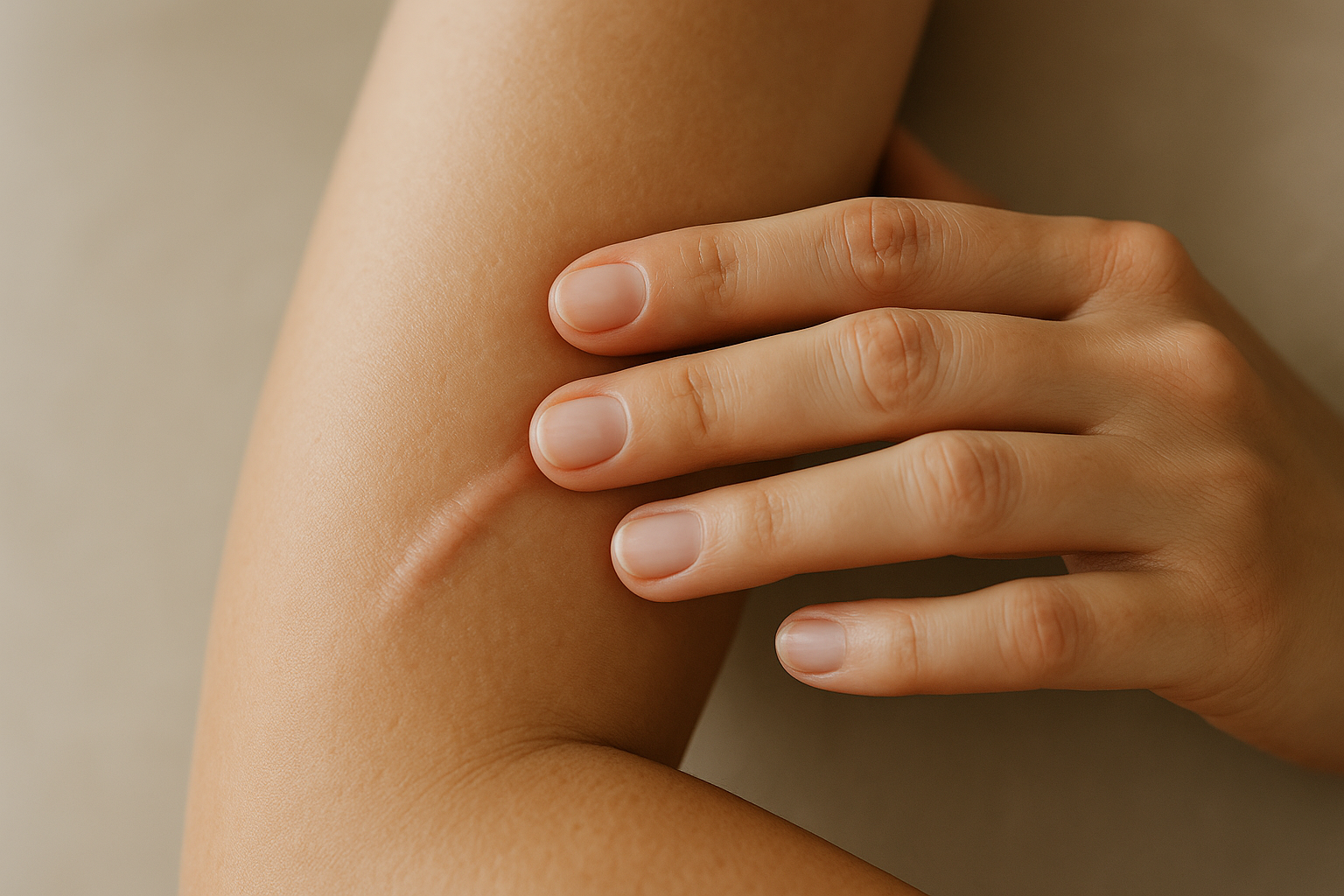
Last updated: 18 August 2026
Quick answer
Yes — a scar can be massaged too much, and there are three separate ways to overdo it. Too soon (on a scar that is still open, scabbed, stitched or hot and inflamed), too hard (past the point where the skin blanches and into pain), and too long (extended sessions on a scar that is still in its angry, red inflammatory phase).
The practical pressure ceiling is the blanch point: press with the pads of one or two fingers until the skin whitens under your fingertip and the scar moves with your finger rather than your finger sliding over it. Firm is correct. Painful is not.
Stop and get it checked if the scar blisters, opens, bleeds, develops a rash, feels warmer than the skin around it, or hurts more than usual afterwards.
What you rub with matters far less than how you rub — hospitals are clear that no product has been shown to beat a plain moisturiser for this. Its only job is to give slip so you do not drag the skin. A plain unperfumed cream does that; so does a water-free botanical lipid concentrate such as ScarDerma Pro, which stays put instead of flashing off mid-session.
Why “too much” is really three different questions
Almost everyone who searches this has already done the massage and is now looking at a scar that is redder, sorer or lumpier than it was yesterday — and wondering whether they caused it. The honest answer is that you might have, but not necessarily in the way you think. Over-massage has three distinct failure modes, and they have completely different fixes.
| Failure mode | What it looks like | The fix |
|---|---|---|
| Too soon — massaging a scar that is still in the inflammatory stage | Bright red, warm, raised, tender; gets angrier for hours after each session | Hands off the scar itself; work the skin around it, and wait |
| Too hard — pushing past the blanch point into pain | Blisters, grazes, a rash, bleeding, a scar that reopens | Stop that area completely, let it heal, restart at half the pressure |
| Too long — extended sessions on an immature scar | Persistent soreness; scar that thickens over weeks despite daily work | Shorter sessions, more often, rather than one long grind |
The clearest warning on record comes from the burn-rehabilitation specialists who wrote the manual-massage chapter of Springer's Textbook on Scar Management. They state plainly that “pathological scars can appear following strong massage movements or too long sessions during the inflammation stage”, and that massage is contraindicated altogether when the tissue is thin and hyper-inflammatory. That is the single most important sentence on this page: the risk of over-massage is highest precisely when a new scar looks like it most needs attention.
The blanch test: how to find your pressure ceiling in 10 seconds
“Firm but not painful” is useless advice because everyone's pain threshold differs. The blanch point is objective. Here is the ladder, from too little to too much.
| Rung | What is happening | Verdict |
|---|---|---|
| 1. Sliding | Your fingertip glides over the surface; the scar itself does not move | Too light — you are moisturising, not massaging |
| 2. Skin moves | The scar and the skin move together over the tissue underneath | The working minimum |
| 3. Blanch | The skin goes white under your fingertip and the scar moves with the finger | The ceiling — this is the target |
| 4. Pain, drag, sting | It hurts during, or stays sore after; skin feels dragged or scraped | Too much — back off immediately |
Physical therapist Martha Walker, writing for the National Kidney Foundation, describes rung 3 exactly: “You will know you are applying the correct pressure when the skin blanches, becomes white, under your finger and your fingers are not sliding over the scar but the scar is actually moving with the motion of your fingers.” The Royal Berkshire NHS Foundation Trust sets the same marker and the same limit in one sentence: the massage “needs to be deep and firm to the point that the skin blanches (goes white). However, it should not be overly painful.”
Two practical notes. First, apply your lubricant after you have found the pressure if you keep slipping — too much slip means your finger travels and the scar does not, which is rung 1 dressed up as rung 3. Second, Cambridge University Hospitals adds a precaution people routinely miss: “Do not rub skin to cause friction.” Pressure that moves tissue is the goal. Buffing the surface is not.
How much is enough? Six hospitals, six different answers
This is where most advice online quietly picks one number and presents it as the protocol. In reality, major centres disagree by more than tenfold on the daily dose — and seeing that spread is the fastest way to stop worrying that you are doing it “wrong.”
| Centre | Start when | How often | Per session | Keep going for | Pressure wording |
|---|---|---|---|---|---|
| Cambridge University Hospitals (plastic surgery) | Wound completely healed, usually ~4 weeks | 2–3× daily | 5 min | ~6 months | “As much pressure as you can tolerate”; light then deeper |
| Royal Berkshire NHS FT (skin surgery) | No oozing (~2 weeks); never over stitches or a scab | 2–3× daily | 2–3 min at first, then 5–10 min | Several months | Deep and firm to blanching, “not overly painful” |
| St George's NHS FT (hand therapy) | Wounds healed or stitches removed | Daily; number set by your therapist | Set by your therapist | At least 3–6 months | “As much pressure as you can without it hurting” |
| Chelsea and Westminster NHS FT (burns) | On healed skin | 4–5× daily | “Several minutes over each area” | Ongoing, therapist-guided | Start moderate, increase as skin heals |
| Memorial Sloan Kettering (after skin surgery) | Most people ~4 weeks after surgery | 1–3× daily | 1–2 min | Scar matures over 12–18 months | Massage to make the scar less hard |
| MD Anderson (plastic surgery) | 2–3 weeks post-op, once the wound has closed completely | 2× daily | At least 10 min | 6 months | Gentle fingertip pressure; stop only for infection or intolerable discomfort |
Run the arithmetic and the recommended daily dose ranges from roughly two minutes to twenty. Nobody is wrong; they are treating different scars in different places on different bodies. What matters is that every one of them agrees on the boundaries:
- Never on an open, scabbed or stitched wound. Royal Berkshire is explicit: no massage if you still have stitches or a scab.
- Pressure stops below pain. Every protocol caps at discomfort, not before it and not past it.
- The scar must move. If your finger slides and the tissue stays put, nothing useful is happening.
- Months, not weeks. Three to six months minimum, because that is how long remodelling takes.
- Stop and get it looked at if the skin breaks. Universal.
The 5 signs you are massaging too hard
These are the stop signs named by the units above. One is enough to justify stopping that area.
- Blistering, a graze, or an open area. The National Kidney Foundation guidance is blunt about the cause: “keep an eye out for blistering, open areas, or a rash. You may be applying too much pressure or being too rough. If this happens, stop massaging in this area and allow it to heal.” Scars, it notes, “generally only reach about 70 to 80% of skin's normal strength and therefore can easily be injured.”
- A rash, or redness that persists after you stop. Transient pinkness that fades within minutes is normal blood flow. Redness still sitting there an hour later is not.
- The scar feels warmer than the surrounding skin. Royal Berkshire lists this alongside bleeding and unusual pain as a reason to stop and contact your GP.
- Bleeding, or the scar reopening. Cambridge University Hospitals says to stop and seek advice if the skin “becomes sore or inflamed, blisters or reopens.”
- Pain that outlasts the session. MD Anderson's plastic surgery guidance says to continue for six months unless the scar shows signs of infection or you experience intolerable discomfort. Soreness that follows you into the evening is your answer.
There is a slower sixth sign worth watching for: a scar that steadily becomes thicker, redder or more raised over several weeks of diligent daily massage. That pattern points at the timing problem rather than the pressure problem — you are working an inflamed scar that is not ready.
Too soon is the bigger risk (and the “refill” test specialists use)
Wound healing runs in three phases: a short inflammatory phase of a few days, a proliferative phase in which the gap closes over roughly two to three weeks, then a remodelling phase that runs from six months up to two years. Scar massage belongs to the third phase. That is why protocols cluster around the two-to-four-week mark: they are waiting for closure.
Burn-rehabilitation therapists take this further with a bedside check called vitropression — press the scar until it blanches, release, and time how long the colour takes to return. The faster it refills, the more vascular and inflamed the scar. In the Springer textbook chapter, a refill time under about 1.2 seconds means the therapist massages only the tissue around the scar. Around 2 seconds, gentle skin-fold techniques become appropriate. Nearer 3 seconds, deeper mobilisation of adhesions is on the table.
You should not be diagnosing yourself with a stopwatch, and this is a clinician's test on burn scars specifically. But it explains something useful: “wait until it is less red” is not vague hand-waving. Redness is a proxy for blood flow, blood flow is a proxy for inflammation, and inflammation is the state in which strong massage can make a scar worse rather than better. The same chapter notes that during the inflammatory stage the techniques used are deliberately static — sustained pressure and stretch, “without practicing however of friction or lifting fingers.”
If you have already overdone it: a 7-day reset
This is a conservative way back in, built from the boundaries the protocols above agree on. If your surgical or therapy team has given you a plan, theirs overrides this.
| Days | What to do | Pressure rung |
|---|---|---|
| 0–3 | No massage on the affected area at all. Moisturise by patting only — no shear, no circles. Keep it out of the sun. | None |
| 4–7 | If the skin is intact and no longer sore, one session a day, 60 seconds, on the skin beside the scar rather than on it. | Rung 2 |
| 8–10 | Two sessions a day, 2 minutes, moving onto the scar. Skin should move; do not chase the blanch yet. | Rung 2 |
| 11–14 | Two to three sessions a day, 3–5 minutes, building to the blanch point and stopping there. | Rung 3 |
| Thereafter | Settle at a routine you can sustain for months — most people land near 5 minutes, 2–3× daily. | Rung 3 |
If any stop sign reappears at any step, drop back two rows. Recovery in scar tissue is measured in weeks, and there is no version of this where rushing wins.
Scars that need a different rulebook
Keloids. A keloid grows beyond the boundary of the original wound and, per the American Academy of Dermatology, does not fade with time; a growing keloid can also cause pain or discomfort. Hypertrophic scars, by contrast, appear one to two months after injury, stay within the wound, and often become less noticeable. If your scar is spreading past its original edges, this is a dermatology conversation, not a self-massage project.
Very old scars. Cambridge University Hospitals notes that scars can fade over a period of up to two years and are unlikely to fade further after that. MD Anderson's position is that it is never too late to start, but results are better when you begin two to three weeks after surgery. Realistic expectations on a ten-year-old scar: comfort, sensitivity and pliability may still improve; dramatic appearance change is unlikely. Our guide to softening old, hard scar tissue covers that case in detail.
Stretch marks. Striae are linear dermal scars, not surface marks, and the mature white form behaves like a settled atrophic scar. The stop signs above still apply, but pressure alone will not restore lost pigment — see why stretch marks do not tan.
Numb or hypersensitive scars. Both are common after surgery and both respond to gentle, consistent handling. Numbness is a reason to be more careful with pressure, not less — you cannot feel the feedback that would normally stop you.
What you massage with (the honest answer)
Hospitals are refreshingly direct here. Royal Berkshire: “There is no evidence to support the use of one product over another — the aim is for lubrication and to prevent dragging the scar under your fingers.” Chelsea and Westminster's burns service says much the same, adding that of the many products advertised as treating scarring, none has been shown to be more beneficial than simple moisturiser for hydration and massage. MD Anderson notes that studies have shown little to no additional benefit from vitamin E or cocoa butter, beyond making the massage easier to perform.
So the brief for a massage medium is narrow and physical: enough slip that you do not drag fragile skin, not so much that your finger skates while the scar stays still — and enough staying power that it is still working at minute five rather than absorbed at minute one. Cambridge's leaflet asks for an oil-based cream for exactly that reason, and adds a step most people skip: wash and dry the area first to rinse off the previous application, so pores do not clog.
Where ScarDerma Pro fits
ScarDerma Pro is a 100% water-free botanical lipid concentrate built for exactly this job. Because there is no water in it, nothing evaporates halfway through a session — the glide stays consistent from the first circle to the last, which is precisely what stops fingers dragging on fragile tissue. It is designed to support the appearance of smoother, more even-looking scars and stretch marks, and it contains no harsh acids, peels or drying agents that would irritate skin you are already working firmly.
The blend is scar-focused: immortelle helichrysum, rosehip seed, tamanu and pomegranate seed as the actives, with Japanese camellia, geranium, English lavender and hemp seed as soothers over a base of sea buckthorn, calendula, jojoba, hazelnut and vitamin E. Formulated by S. C. Aris, whose water-free lipid delivery approach runs through the whole CallNature range.
It is rated 4.91 out of 5 from 34 verified buyers and carries a 90-day guarantee. In a customer survey, 91% reported flatter, smoother-looking marks within six weeks and 94% said they would recommend it. A small amount is enough — the aim is a thin, even film that gives slip, not a puddle.
ScarDerma Pro is a cosmetic product intended to support the appearance of skin. It is not a medicine and does not treat, heal or cure any condition. If a scar is painful, spreading, opening or infected, speak to your GP, surgeon or dermatologist.
Related reading
- Can you use scar oil and silicone gel together? The order that actually works
- Do silicone scar sheets work on old scars? The redness test
- Why is my scar still red — and how long does redness last?
- How to reduce the appearance of a C-section scar
- Why does my silicone scar sheet itch?
Frequently asked questions
Can massaging a scar make it worse?
It can, in two situations. Massaging hard enough to blister, graze or reopen the skin creates fresh injury on tissue that only has around 70–80% of normal skin strength. And massaging strongly, or for long sessions, while a scar is still hot and inflamed is specifically flagged in the burn-rehabilitation literature as a route to a pathological scar. Massage at a sensible pressure on a healed, settled scar is not going to harm it.
How hard should scar massage be?
Firm enough that the skin blanches white under your fingertip and the scar moves with your finger — and no harder. Several NHS trusts phrase the ceiling as “as much pressure as you can tolerate” or “as much pressure as you can without it hurting.” Pain is the signal you have gone past useful.
How many minutes a day is right?
There is no single answer. Published protocols from major centres range from 1–2 minutes once to three times daily up to at least 10 minutes twice daily. Five minutes, two to three times a day, sits in the middle and is what several NHS plastic surgery units advise. Consistency over months matters more than length of any single session.
How do I know if it is too soon to start?
If there are stitches, a scab, any oozing or any open area, it is too soon. Most protocols start between two and four weeks after surgery, once the wound has fully closed. A scar that is bright red, warm and gets noticeably angrier for hours after you touch it is telling you to work the skin around it instead and wait.
Can you massage a keloid scar?
Get it assessed first. A keloid grows beyond the original wound boundary, does not fade with time and can be painful — it is not the same thing as a raised hypertrophic scar that will settle. Aggressive self-massage is not the right first move on a scar that is actively spreading.
Is it too late to massage an old scar?
Scars remodel for up to about two years and are unlikely to change much after that. Starting late is not harmful and can still help with tightness, sensitivity and pliability, but the appearance gains are far smaller than they would have been in the first few months.
What is the best cream or oil for scar massage?
By the evidence, no product has been shown to beat another for this purpose — lubrication is the job. Choose something unperfumed that gives lasting slip without dragging, and apply it thinly. A water-free lipid concentrate has a practical edge simply because it does not evaporate mid-session.
This article is general information, not medical advice. If your scar is painful, infected, spreading beyond the original wound, or you are unsure whether it has healed enough to massage, speak to your GP, surgeon or a hand or burns therapist.