Does Onion Extract Actually Work on Scars? Why It’s Listed as an “Inactive” Ingredient — and What 13 Trials Found
Last updated: October 4, 2026
Quick answer
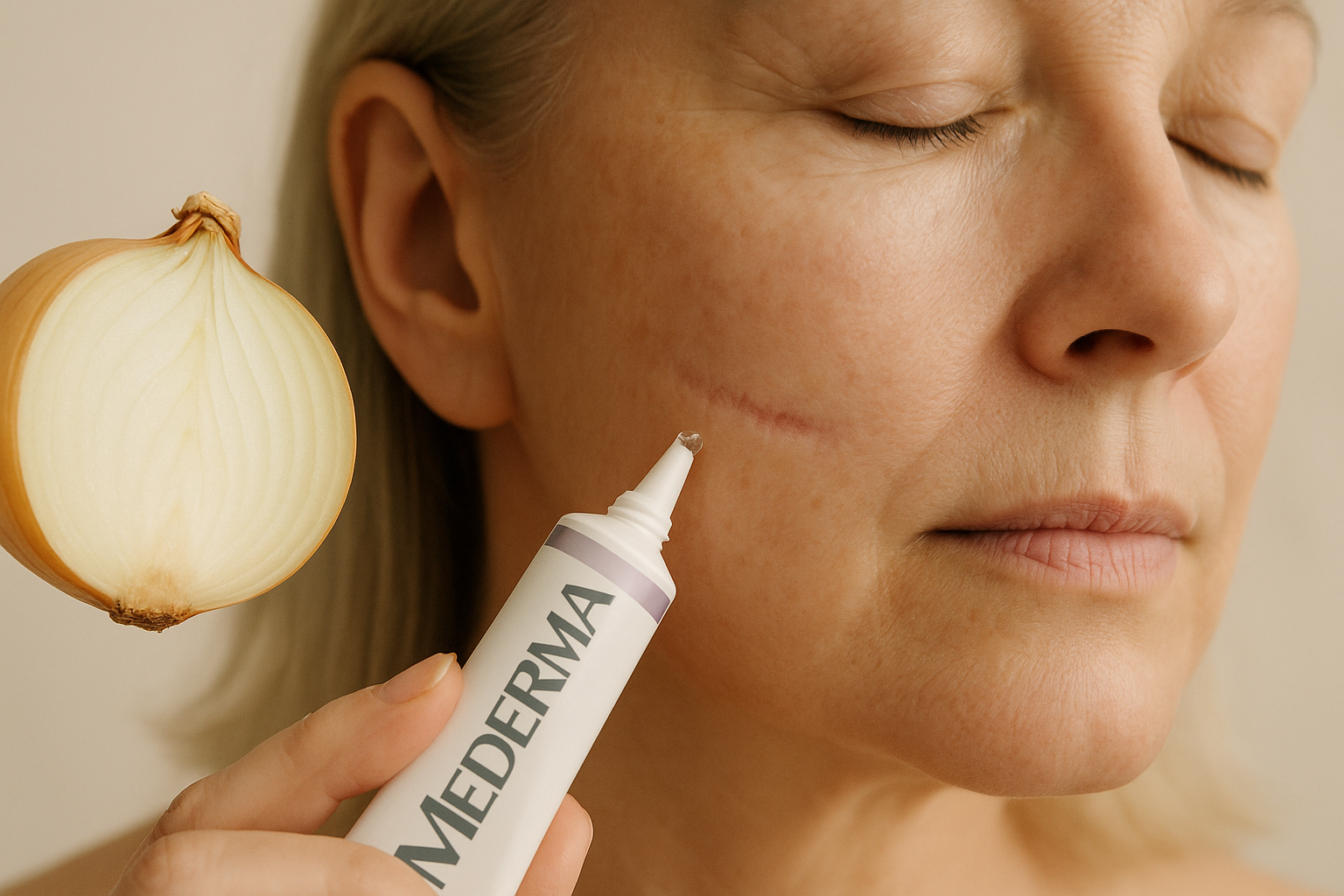
Onion extract gels look better than doing nothing in short trials, but the best pooled analysis found no advantage over other commonly used topicals — and the evidence is mostly company-funded, short and small. A 2021 meta-analysis of 13 randomised trials found onion extract gel beat no treatment, showed “no differences” against other topical products, and was linked to more adverse effects and drop-outs. The combination that came out best was onion extract inside a silicone gel. One more surprise: on the best-known product, Mederma Advanced Scar Gel, the FDA-regulated active ingredient is allantoin 0.5%, and onion extract is listed fifth among the inactive ingredients. If you want a cosmetic, water-free alternative for the look of mature scars, a botanical lipid concentrate such as ScarDerma Pro is one example — but it should be judged by the same standard this article applies to everyone else.
Why the answer is more confusing than it should be
Search this question and you will find two kinds of page. Brand pages explain that onion contains flavonoids such as quercetin and then stop. Roundup pages say “studies show it works” without saying what each study compared the gel against. That matters more than anything else in this topic, because a scar gel that beats nothing is a very different claim from a scar gel that beats a plain moisturiser.
This article does the part those pages skip. It lays out what the drug label actually says, what the US rules for the one regulated ingredient are, and then sorts every trial by the comparison it made. Every study below was opened and read in preparing this article; where a source could only be reached through a secondary summary, we say so.
Step 1: Read the label — the “onion extract” product has a different active ingredient
Mederma Advanced Scar Gel is registered with the FDA’s DailyMed database as an over-the-counter drug, with the title “MEDERMA ADVANCED SCAR — allantoin gel”. The record (label revision date shown as 16 July 2026) lists the following:
| Label field | What the DailyMed record says |
|---|---|
| Active ingredient | Allantoin 0.5% |
| Purpose | Skin protectant |
| Uses | “Temporarily protects and helps relieve chapped or cracked skin” — the Drug Facts text does not mention scars |
| Inactive ingredients, in order | Water, PEG-4, Alcohol, Xanthan Gum, Allium Cepa (Onion) Bulb Extract, Panthenol, Fragrance, Lecithin, Methylparaben, Sorbic Acid, Sodium Hyaluronate |
| Warnings (selected) | External use only; do not get into eyes; stop use if the condition worsens or symptoms persist beyond 7 days |
Two things follow. First, “inactive” here is a regulatory word: the drug rules only name allantoin as the active, because allantoin is one of the permitted skin-protectant ingredients. The FDA’s skin-protectant monograph, 21 CFR 347.10, lists “(a) Allantoin, 0.5 to 2 percent.” Onion extract is not on that list, so it cannot be the declared active. That says nothing, either way, about whether the onion contributes to results — it only means you should not assume the front-of-box story and the Drug Facts panel describe the same thing.
Second, the ingredient list tells you what kind of product this is: a water-based gel. Water is first, and a water-based product needs preservatives, which is why methylparaben and sorbic acid appear. It also lists alcohol (third) and fragrance (seventh). None of that is automatically a problem — our guides to parabens and fragrance explain why — but it matters if you are patch-testing a sensitive scar or already know you react to either.
Scope note: this table reflects one DailyMed record for one product. Mederma sells several formats, and formulas are revised, so check the box in your hand.
Step 2: Sort the trials by what they compared the gel against
This is the information the top-ranking pages leave out. Read the “compared with” column first — it decides how much a positive result is worth.
| Study | Who and what | Compared with | Length | Result as reported | Caveats |
|---|---|---|---|---|---|
| Draelos et al., J Clin Aesthet Dermatol 2012 | 44 enrolled, 42 completed; two 8 mm surgical-removal scars on the chest per person; onion extract gel (Mederma Advanced Scar Gel) | Nothing — the other scar was left untreated | 8 weeks, once daily | Gel scars rated significantly softer by week 2 (p=0.014); by week 8 mean improvement scores 2.59–2.61 (gel) vs 2.09–2.18 (untreated), p<0.01. 6 of 44 (13.6%) had itching, burning, stinging or contact dermatitis. | Funded by Merz Pharmaceuticals; no vehicle-only control; participants not blinded |
| Zakka Bajjani et al., Clin Res Trials 2023 | 30 people; atrophic acne scars; split-face; onion extract + allantoin gel | Nothing — untreated control scar | 12 weeks, once daily | Investigator overall-appearance score on day 85: 58.80 vs 50.30 (p<0.001); redness improved from day 15, texture from day 29 | Funded by HRA Pharma (three authors employed there); participants not blinded; one scar per person |
| Chanprapaph et al., Dermatol Res Pract 2012 | 20 enrolled, 16 completed; new Pfannenstiel (C-section) scars in Asian women; 12% onion extract gel | Placebo gel (double-blind, split-scar) | 12 weeks, three times daily, from day 7 | Scar height and symptoms improved at weeks 4 and 12 (p<0.05). No significant difference in redness, pliability or overall cosmetic appearance. | Very small; authors note earlier studies in Caucasians were “disappointing” |
| Chung et al., Dermatol Surg 2006 | New surgical scars; onion extract gel | Petrolatum emollient | — | “Specific effect of the ingredients could not be proven” (scar-management textbook); “no difference between the two treatments” (Sidgwick review) | ⚠ Abstract paywalled — reported only through those two secondary sources, so no numbers are given here |
| Karagoz et al., Burns 2009 | 45 post-burn scars in 32 patients; onion extract with heparin and allantoin (Contractubex) | Silicone gel and silicone sheet (15 scars each) | 6 months | All three groups improved on the Vancouver Scar Scale; silicone gel and sheet were superior to the onion extract product | Small; post-burn raised scars |
Look at the pattern. The two trials with the clearest wins both compared the gel to an untreated scar. When the comparison became a placebo gel, only height and symptoms moved. When it became petrolatum, the specific ingredient effect could not be shown. When it became silicone, silicone won. That is a recognisable shape for a product whose benefit may come largely from being a well-formulated, regularly applied topical — not necessarily from the onion.
Step 3: What the pooled evidence says
A 2021 meta-analysis by Yuan and colleagues in the International Wound Journal (published online 28 December 2020) pooled 13 randomised controlled trials from searches of Embase, PubMed, Medline and the Cochrane Library through August 2020. Its findings, reading the abstract directly:
- Versus no treatment: onion extract gel was superior in both investigator and patient assessments (P < .00001 for both).
- Versus other common topicals: “no differences” for evaluators (P = .56) or patients (P = .39).
- Onion extract combined with silicone gel significantly outperformed the alternative treatments.
- Safety signal: onion extract gel was associated with more adverse effects and more treatment discontinuation.
The authors’ conclusion, verbatim: “OE gel not only has no superiority to commonly used topical treatments, but also has the potential to increase the incidence of adverse effects on scar management; OE in silicone gel might be the optimal topical choice.”
An earlier broad review in Archives of Dermatological Research by Sidgwick, McGeorge and Bayat (2015) looked at 16 articles covering 2,703 patients on onion extract products. Eleven reported favourable results, three showed no benefit, and the review’s overall verdict on scar topicals was blunt: “There was limited clinical evidence to support their efficacy,” with most studies hampered by “low patient numbers, poor randomisation, blinding, and short follow-up periods.” The open-access Textbook on Scar Management chapter on onion extract agrees that study data “remains overall relatively poor.”
The “is it the onion?” question, in plain terms
Laboratory work proposes that onion flavonoids such as quercetin and kaempferol act on scar-forming cells. That is a reasonable hypothesis and it is why the ingredient was tested in the first place. But a lab mechanism is not a clinical result, and the clinical results above do not isolate the onion: most trials tested a finished gel containing water, hyaluronate, panthenol, allantoin and often heparin, against nothing. Only the placebo and petrolatum comparisons come close to isolating the extract — and those are the ones that came back with the weakest or null findings.
It is worth hearing the clinical voice too. MD Anderson plastic surgeon Dr Patrick Garvey says studies show “little to no additional benefit” from products with vitamin E or cocoa butter, while onion-extract quercetin products “do seem to improve itching and pigmentation” — a more specific and more modest claim than “fades scars.”
A scorecard for any scar gel with an ingredient story
| Comparison used | What a positive result proves | What it does not prove |
|---|---|---|
| Untreated scar | Applying something daily to a scar can improve how it looks or feels | That the headline ingredient did it — any moisturising gel might |
| Placebo (vehicle) gel | The active ingredient adds something beyond the base | That the effect is large; check which outcomes moved |
| Petrolatum / plain emollient | A genuinely specific ingredient effect, if it wins | Nothing if it ties — which is what was reported here |
| Silicone gel or sheet | How the product ranks against the best-studied standard | Not relevant to scar types silicone was not designed for |
| Silicone + the ingredient | Whether the ingredient adds value on top of the standard | That it works alone |
For the standard itself, the 2013 Cochrane review of silicone gel sheeting (O’Brien and Jones; 20 trials, 873 people) found a lower risk of abnormal scarring in people prone to it (risk ratio 0.46, 95% CI 0.21 to 0.98), while still concluding “there is weak evidence of a benefit” and that “a great deal of uncertainty prevails” because of poor-quality research. So even the best-supported option in this category carries a caveat — our silicone-on-old-scars guide and the FDA-cleared decoder cover that ground.
Who might reasonably use an onion extract gel
- People with a new, closed surgical scar who want a simple daily topical and are not sensitive to the ingredients listed above. The trials were overwhelmingly on new scars (our guide to when to start scar cream after surgery covers timing).
- People already using silicone gel may find a combined silicone-plus-onion product is the version the pooled data favoured.
- People who want itching or pigment support rather than flattening, given the clinician quote above.
Who should be more cautious: anyone with a known reaction to fragrance, alcohol or parabens; anyone whose scar is raised, growing, painful or spreading beyond the original wound (see a dermatologist or plastic surgeon — keloids in particular are a medical question); and anyone expecting a mature, flat, pale scar to change dramatically. Our guide to whether old scars ever fade sets realistic expectations for that case.
The 5-question test for any scar gel claim
- What is the declared active? Read the Drug Facts or ingredient list, not the front of the box. If the star ingredient is on the “inactive” list, ask why.
- Compared with what? Untreated, placebo, petrolatum, silicone? Use the scorecard above.
- Who paid? Manufacturer funding is not disqualifying, but two of the three onion trials above with the strongest wins were company-funded, with unblinded participants.
- How long and how many? 8–12 weeks and 16–44 people is a signal, not a settled answer.
- What is it made of? Water-based means preservatives; alcohol or fragrance may matter for your skin. Patch-test on the inner forearm first.
Where ScarDerma Pro fits — stated on the same terms
Since this article is about reading labels honestly, here is ours. ScarDerma Pro is a cosmetic, not a drug and not a device. It is formulated to smooth and refine the appearance of scars and stretch marks, and it makes no onion extract story because it contains no onion extract. It is a different kind of product: a 100% water-free botanical lipid concentrate. Skin-compatible lipids move into the outer layers of the skin — the stratum corneum — rather than forming a film above it, which is why it also works as the slip layer for a daily massage routine.
Because there is no water in the formula, it needs no preservatives, so there is no methylparaben or sorbic acid to look for on the label. It combines four scar-focused botanicals — Immortelle Helichrysum, Rosehip seed, Tamanu and Pomegranate seed — with soothing Japanese Camellia, Geranium, English Lavender and Hemp seed, in a base of Sea Buckthorn, Calendula, Jojoba, Hazelnut and Vitamin E. No harsh acids or peels, no drying agents, no artificial fragrance, no parabens, no fillers; vegan and non-GMO, formulated by S. C. Aris. It does contain aromatic botanicals, so it is not fragrance-free — patch test first if you have a known fragrance or essential-oil sensitivity.
The evidence, labelled honestly: ScarDerma Pro has no published clinical trial, so everything above about trial design applies to it too. What it has is a 4.91/5 rating from 34 verified buyers, and a customer survey — not a clinical study — in which 91% said their scar looked flatter and smoother within 6 weeks and 94% would recommend it. Every order carries a 90-day money-back guarantee, which is the practical way to test a claim for yourself. If you are layering it with silicone, the order matters — see can you use scar oil and silicone gel together?
Frequently asked questions
Is onion extract the active ingredient in Mederma?
Not in the regulatory sense. On the DailyMed record for Mederma Advanced Scar Gel, the declared active ingredient is allantoin 0.5% (a skin protectant), and Allium Cepa (Onion) Bulb Extract is the fifth inactive ingredient. Onion extract is the ingredient the product is known for, but the drug label does not list it as the active.
Does onion extract work on scars?
It looks better than no treatment in short trials, mostly company-funded and using untreated scars as the comparison. A 2021 meta-analysis of 13 randomised trials found no difference compared with other commonly used topical products, so the ingredient itself is not clearly the reason for the improvement.
Is onion extract better than silicone for scars?
The evidence points the other way. In a 6-month trial of post-burn scars, silicone gel and silicone sheet outperformed an onion extract product. The meta-analysis found the best outcome from onion extract combined with silicone gel.
Does onion extract work on old scars?
Most trials were on new scars, such as fresh surgical or burn scars. One 12-week study looked at atrophic acne scars. Mature, flat, pale scars have little data, and a clinician quoted above says onion-extract products “do seem to improve itching and pigmentation” rather than flattening scars.
Can onion extract scar gel cause irritation?
It can. In the 44-person Draelos trial, 6 people (13.6%) had itching, burning, stinging or contact dermatitis, and the 2021 meta-analysis linked onion extract gel to more adverse effects and treatment discontinuation. The Mederma label tells users to stop use if the condition worsens.
What else is in Mederma Advanced Scar Gel?
According to the DailyMed record: water, PEG-4, alcohol, xanthan gum, onion bulb extract, panthenol, fragrance, lecithin, methylparaben, sorbic acid and sodium hyaluronate. Check your own package, as formulas change.
ScarDerma Pro is a cosmetic product: it cares for the appearance and feel of skin and scars, and does not treat or prevent any medical condition. This article summarises published research and a public drug-label record for educational purposes and is not medical advice. For a scar that is raised, growing, painful, or changing — and for keloids in particular — please see a dermatologist or plastic surgeon.