When Can You Start Using Scar Cream After Surgery? Why the Answer Ranges From 2 to 6 Weeks — and the 5-Signal Closure Check That Beats the Calendar
Quick answer
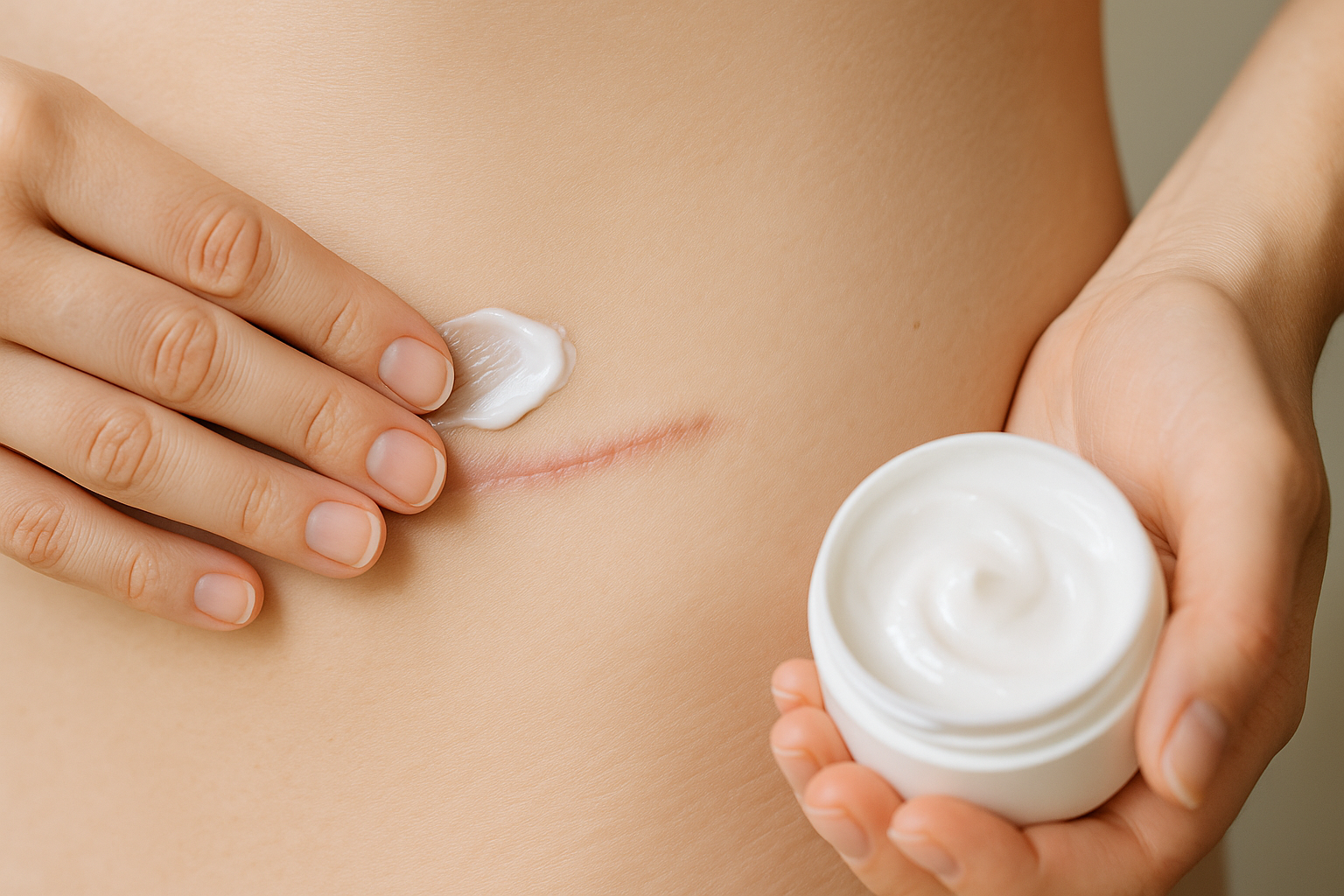
Start when the wound is closed — not on a date. Hospital and cancer-centre protocols put the start line for scar creams, oils and massage anywhere from about two weeks after skin surgery (once oozing has stopped and the stitches and scab are gone) to four weeks or more after plastic or larger surgery (once the incision is "fully healed and more stable"). The number moves because it tracks how the wound was closed and where it sits, not the calendar. The practical test is five signals: no stitches, staples or strips still in; no scab; no weeping; no tenderness; no signs of infection — plus your surgeon's go-ahead. Until you pass it, standard wound care applies: clean, kept moist with petroleum jelly, covered. After you pass it, what you rub in matters far less than the fact that you rub it in: NHS guidance states there is no evidence one product beats another, because the job is lubrication for massage. A 100% water-free botanical lipid concentrate such as ScarDerma Pro is one example of a product designed for exactly that post-closure slot — a cosmetic to support the look of a smoother, softer, more even scar while the scar matures on its own timetable.
Last updated: 15 September 2026
Why every answer you've read gives a different number
Search this question and the top results contradict each other with total confidence. One says 10 to 14 days. One says three to four weeks. One says six to eight. Most are written by clinics or by the companies selling the cream, and none of them explain why their number is different from the one above it in the results.
The numbers are different because they come from different kinds of surgery, different closure methods and different parts of the body — and because the authorities behind them are not actually counting days. Every one of them attaches a condition to the date, and the condition is the real instruction. Here is what the published protocols say, side by side, with the condition each one attaches.
| Source | Their start point | The condition they attach to it |
|---|---|---|
| Royal Berkshire NHS Foundation Trust, Dermatology — skin surgery leaflets (reviewed April 2026) | Moisturise "when there is no oozing from the wound (usually around 2 weeks)"; gentle massage "soon after" | "You should not massage your scar if you still have stitches or if the scar has a scab on it"; massage begins "once the scabbing has settled and the wound is no longer tender" |
| Cambridge University Hospitals, Occupational Therapy — "Care of your scar" (hand therapy) | "24–48 hours after your stitches have been removed"; with dissolvable stitches, "approximately 12–14 days after your surgery" | "if the wound is dry" / "providing the wound is healed and dry" |
| UT MD Anderson Cancer Center — Patrick Garvey MD, plastic surgeon | "about two to three weeks after surgery" | "once the wound has closed completely and the skin has fully healed" |
| National Kidney Foundation — Martha Walker PT, DPT (transplant incisions) | No date given at all | "when the wound is fully healed, when there are no surgical staples, steri-strips, or scabs" |
| Cambridge University Hospitals, Plastic Surgery — "Scar massage information" | "usually around 4 weeks post-injury or surgery" | "when your wound is completely healed"; "Do not massage open wounds" |
| Memorial Sloan Kettering Cancer Center — skin surgery | "about 4 weeks after surgery" | "Talk with your dermatology surgeon (skin doctor) before doing any of the things below" |
| University of Washington Medical Center, Center for Reconstructive Surgery (clinician review August 2025) | "about 4 weeks after your surgery" | "when your incision is fully healed and more stable" |
| Royal Berkshire NHS — wounds left open to heal from the base ("secondary intent") | After the dressings are finally removed — dressing changes can run "for up to 6 weeks" — and the scab has fallen off | Petroleum jelly daily first "to allow the scab to come off naturally"; massage only "once it has fallen off" |
Read down the right-hand column and the contradiction disappears. Nobody is telling you a date; they are telling you a state and then estimating when a typical patient in their clinic reaches it. A dermatology unit removing a small skin lesion from a forearm reaches that state in a fortnight. A plastic surgery unit closing a longer incision under tension, or a cancer centre managing a reconstruction, reaches it at four weeks or later. The same hospital can even give two numbers: Cambridge's hand therapists start a day or two after stitches come out, while Cambridge's plastic surgeons say around four weeks — different wounds, different departments, same underlying rule.
So the useful question is not "how many weeks" but "what is everyone waiting for, and how do I know I've got there?"
What the waiting is actually for
Three things are happening in a wound that make an early start pointless at best and damaging at worst.
The gap has to close first. The National Kidney Foundation's physical-therapy guidance describes three stages: an inflammatory phase of swelling, redness and pain that "only lasts a few days"; a regeneration phase in which "the body works on closing the gap between the edges of your incision," which "is complete when the wound is fully closed and takes 2–3 weeks"; and a remodelling phase that "starts when there are no open areas in the incision" and runs "from 6 months up to 2 years." Scar creams and massage belong to the third phase. Applying them during the second is applying them to a wound, not a scar.
The new tissue is weak for months. In the open-access Textbook on Scar Management, the plastic surgeon Rei Ogawa summarises the strength curve: "in general, wounded skin acquires 80% of the dermal strength of the surrounding normal skin by 3 months post-wounding." The NKF puts the ceiling even lower over the long run — "Scars generally only reach about 70 to 80% of skins normal strength and therefore can easily be injured." A two-week-old closure is a fraction of that. Firm massage, which is what the protocols eventually ask for, is a load the tissue has to be ready to carry.
Working an inflamed scar can make a worse one. This is the part the commercial pages leave out entirely. Frasson and colleagues, writing from a European burn rehabilitation centre in the same textbook, are blunt: "pathological scars can appear following strong massage movements or too long sessions during the inflammation stage." Their indication for starting is not a date but a tissue state — massage "can be started as soon as the scar tissue is epidermized and solid," and is "contraindicated when the tissue is thin and hyper-inflammatory." (Their therapists grade that with a bedside test of how quickly colour returns to pressed skin; it is a clinician's tool, not something to attempt at home, but the principle is the one your surgeon is applying when they say "not yet.") Ogawa's chapter explains the mechanism: mechanical force on a healing wound "provokes chronic inflammation of the dermis," which "blocks the conversion of the granulation tissue into dermis-like tissue" and produces "an immature hypertrophic scar that is red, elevated, hard, and painful." Early, enthusiastic rubbing is a mechanical force.
The 5-signal closure check
Pull the conditions out of the table above and they collapse into five observable signals. All five need to be true at once. This is our synthesis of the published criteria, not a clinical scoring system, and it sits underneath — never above — what your own surgical team tells you.
| # | Signal | What "yes" looks like | Who says so |
|---|---|---|---|
| 1 | Nothing is still holding the wound shut | Removable stitches are out; dissolvable stitches have gone (Royal Berkshire notes "it may take up to 4 weeks for them to all fall off"); staples and steri-strips or surgical tape have come away or been removed | Royal Berkshire; NKF; Cambridge OT |
| 2 | No scab | The crust has come off on its own. Not picked — every leaflet says "Do not pick the scab or force its removal" | Royal Berkshire; NKF; AAD |
| 3 | No weeping | Nothing is oozing onto a dressing; the surface is dry to look at and touch | Royal Berkshire ("no oozing"); Cambridge OT ("if the wound is dry") |
| 4 | No tenderness | Light fingertip pressure on and beside the line doesn't hurt | Royal Berkshire ("no longer tender") |
| 5 | No signs of infection | Not more painful than a few days ago; not red, inflamed or swollen; not leaking liquid, pus or blood; no unpleasant smell. Any of these means contact your GP or practice nurse, not your scar cream | Royal Berkshire; Guy's and St Thomas' |
Then the sixth item that isn't a signal but a step: ask. Memorial Sloan Kettering's instruction is to talk with your dermatology surgeon before starting any scar care, and the AAD's is that if your injury required stitches, "follow your doctor's advice on how to care for the wound and when to get the stitches removed." Your team has seen the inside of the closure. You have only seen the outside.
One caution that matters for signal 4: the skin around a fresh surgical wound is often numb. University Hospitals Sussex tells skin-surgery patients that "the area around the wound may be numb for many weeks," and MSKCC lists numbness among the normal early findings. A numb scar cannot report tenderness, so if the line is numb, weight the other four signals more heavily and be gentler for longer.
Why your closure type moves the date
The closure method is the biggest reason the published numbers differ, and it is the thing you can actually identify about your own wound. Royal Berkshire publishes four separate wound-care leaflets for four closure types; the differences between them are the differences between the answers you found online.
| How your wound was closed | What to expect, per the published guidance | Where the start line typically falls |
|---|---|---|
| Removable stitches (skin surgery) | Clean and dry for the first 48 hours; stitches removed at the interval your surgeon set; "After suture removal, the wound will look a little red and scabbed"; massage "once the scabbing has settled and the wound is no longer tender"; the scar "will take up to 3 months to settle down completely." If the scar is somewhere that stretches a lot, such as the back, Royal Berkshire suggests covering it with steri-strips "for a further fortnight" after the stitches come out | Shortly after stitch removal plus scab clearance — Cambridge OT's "24–48 hours after your stitches have been removed, if the wound is dry" |
| Dissolvable stitches | Surface dissolvable stitches: dressing off after 48 hours. Buried ones: leave the surgical tape, which "will start to come off a bit at a time when you start showering," dressing on for at least a week and no more than two. "After all the stitches have dissolved (it may take up to 4 weeks for them to all fall off), the wound may look a little red and scabbed" | Cambridge OT's estimate is "approximately 12–14 days after your surgery, providing the wound is healed and dry" — but the signal is the stitches being gone, which can take up to a month |
| No stitches (shave, curettage, punch) | Dressing off at 48 hours; if still wet, redress for another 48 hours until dry; "Once the wound is dry, it will start to scab. Do not pick this off"; petroleum jelly daily "to allow the scab to come off naturally"; massage "once it has fallen off." University Hospitals Sussex adds that these wounds "are slower to heal than wounds which require stitches, especially on the lower legs" | When the scab has come away on its own — later on shins and feet |
| Left open to heal from the base (secondary intent) | Regular dressing changes "for up to 6 weeks"; the finished scar is "circular or oval shape instead of a classical line"; petroleum jelly once dressings stop, massage once the scab is off; the scar "can take up to 12–18 months to heal completely" | Six weeks or later — this is where the "6–8 weeks" figure you may have read comes from |
| Larger, layered surgical closures (plastic surgery, abdominal, reconstructive, C-section) | MSKCC, Cambridge Plastic Surgery and UW Medicine all give around four weeks, each conditioned on the incision being completely healed; MD Anderson gives two to three weeks with the same condition | Around a month, and only with the surgeon's clearance |
Two site effects sit on top of closure type. Ogawa notes that wounds "on the major joints tend to develop hypertrophic scars because the joint movements place strong cyclical tension on the wound," and Royal Berkshire's back-of-the-body advice is the practical echo: stretching skin needs more protection for longer after the stitches go. And the lower leg heals slowly, as Sussex says. A shin wound and a forearm wound closed the same way on the same day will not pass the closure check on the same day.
Before the line and after it: two different products for two different jobs
The most common mistake is treating "scar cream" as something you start on day one. The protocols describe two phases with two different aims.
Before closure: keep it moist, keep it covered
The American Academy of Dermatology's wound-care guidance is to wash with mild soap and water, then "use petroleum jelly to keep the wound moist," because it "prevents the wound from drying out and forming a scab; wounds with scabs take longer to heal," and it "will also help prevent a scar from getting too large, deep or itchy." Cover with a bandage and change it daily. Royal Berkshire's no-stitch and open-wound leaflets say the same in NHS language: petroleum jelly daily to let the scab lift naturally. This phase is about the wound bed. It is not the moment for actives, botanicals, silicone or anything you'd have to massage in.
After closure: lubricate, then massage
Once you pass the check, the goal flips from protecting a wound to working a scar, and the product's job changes with it. Royal Berkshire's scar-massage leaflet is unusually candid: "Apply a non-scented moisturiser or oil to your scar. There is no evidence to support the use of one product over another – the aim is for lubrication and to prevent dragging the scar under your fingers." MD Anderson's plastic surgeon says "anything that promotes hydration will tend to improve healing and appearance," and adds that studies "have shown little to no additional benefit from using products that contain either vitamin E or cocoa butter. Those likely just make it easier to do the massage." Cambridge's plastic surgeons ask for "an oil-based cream" and its hand therapists for "a basic, un-perfumed moisturising cream." UW Medicine lists five acceptable ointments and then says the thing that matters: "Studies show that firm pressure may be the most important healing factor in scarring."
That is the honest hierarchy. Pressure and consistency first; a lubricating medium second; the specific medium a distant third. It also tells you what to look for in that medium: slip that lasts a full five-to-ten-minute session, no fragrance you might react to, nothing that stings on new skin, and enough left behind to keep the scar from drying out between sessions.
Silicone gels and sheets sit in this second phase too, and on the same side of the line. UW Medicine specifies that silicone "is used on closed, healed incisions," and Cambridge's protocol keeps them well apart from the massage medium: wash and dry the skin between the two. If you plan to run both, we've mapped the schedules in can you use scar oil and silicone gel together?
Too early versus too late: which mistake costs more
Too early is the one with a real downside. Frasson's warning about inflamed tissue, Ogawa's mechanobiology and the NKF's 70–80% strength figure all point the same way, and every NHS leaflet carries a stop list for a reason. Royal Berkshire: stop and contact your GP for "redness, bleeding, scar feels warmer than the skin around it, more pain than usual at the site of the scar." Cambridge: stop if the skin "becomes sore or inflamed, blisters or reopens, or your skin develops a rash." NKF: "blistering, open areas, or a rash" mean "you may be applying too much pressure or being too rough." If any of those appear in the first days after you start, you didn't pass the check — go back to wound care and wait.
Too late costs you a window but not your skin. MD Anderson: "It's never too late to do a scar massage, but you'll have better results if you start it two to three weeks after surgery." Cambridge: "Your scar may continue to change for up to 2 years, so early and regular scar massage will help reduce the chance of long-term problems." MSKCC's version of the same arc is that after several weeks the scar "may feel hard, tight, raised, or bumpy," then softens and pales over "12 to 18 months." So a month's delay while you wait for signals 1 to 5 is nothing against a maturation window measured in years; a week's head start on an open wound can cost you the whole window.
UW Medicine gives a neat endpoint for the other end of the routine, written for silicone but a fair guide to the whole programme: keep going "until your scar turns pale and no longer changes color when you apply and remove pressure."
Your first fortnight, once you've passed the check
This is the composite of the Royal Berkshire, Cambridge and MSKCC instructions, in the order they ask for it. Adjust to whatever your own surgeon has told you.
- Wash and dry. Cambridge: "Wash and dry the area with soap to rinse off any previous moisturiser. This is to stop the pores of the skin becoming clogged."
- A small amount of lubricant. Enough for slip, not a slick. NKF prefers lotion applied after the massage "to prevent your fingers slipping off the scar"; the NHS leaflets apply it before. Either way, your fingers should move the scar, not skate over it.
- Start light and short. Royal Berkshire: "2–3 minutes between 2–3 times daily. After a few days, increase to massaging for 5–10 minutes, 2–3 times daily." MSKCC's gentler version for skin surgery is one to two minutes, one to three times a day.
- Three directions. Small circles along the length, then along, then across — the sequence all three sources share.
- Build pressure over days, not minutes. Cambridge: "Begin with light pressure and progress to deeper and firmer pressure." The eventual target, per Royal Berkshire and the NKF, is pressure that blanches the skin white under your fingertip without being painful. Not in week one. If you want the full detail on that target and its warning signs, see can you massage a scar too much?
- Sun. AAD: broad-spectrum SPF 30 or higher on the healed wound, reapplied frequently. Cambridge: keep it out of the sun "for at least one year." UW Medicine's reason: "Sunlight can either darken or lighten a scar."
- Check the stop list daily. Redness, bleeding, warmth, new pain, blistering, rash, reopening. Any one of them ends the session and starts a phone call.
Keep it going for months, not weeks. Royal Berkshire's dermatology leaflets talk about the scar settling over three months; Cambridge asks for "approximately 6 months until the scar has fully matured"; MD Anderson's prescription is ten minutes twice a day for six months; NKF suggests daily for the first six months and then three to four days a week "until the scar is fully mature." Consistency is the dose. As MD Anderson puts it, "If you only do it occasionally, it's not going to have much of an effect."
A post-closure lipid for the massage slot: ScarDerma Pro
Everything above lands on the same practical need: once you pass the closure check, you need a lubricating, non-irritating medium you'll actually use two or three times a day for half a year. Petroleum jelly does the pre-closure job well but is heavy to massage with; a water-based lotion gives slip that fades before a five-minute session is over.
ScarDerma Pro is a 100% water-free (anhydrous) botanical lipid concentrate formulated by S. C. Aris for precisely this phase. Because it contains no water, nothing evaporates mid-session — the lipids stay put for the whole massage and remain afterwards as a leave-on conditioning layer, so the scar isn't drying out between sessions. Being anhydrous also means it needs no preservative system. It is designed to be applied only to a fully closed, healed scar, which is the same line the protocols above draw.
The formula leads with four actives — immortelle helichrysum, rosehip seed, tamanu and pomegranate seed — with Japanese camellia, geranium, English lavender and hemp seed as soothers, on a base of sea buckthorn, calendula, jojoba, hazelnut and vitamin E. Rosehip seed is a natural source of trans-retinoic acid, sometimes called "natural tretinoin," which small studies have linked to modest improvement in the look of skin texture; pomegranate seed has been studied for supporting epidermal cell renewal. There are no harsh acids or peels, no drying agents, no artificial fragrance, no parabens and no fillers; it is vegan and non-GMO. One honest note for new skin: helichrysum, geranium and lavender are aromatic botanicals, so this is not a fragrance-free product. If you have reactive skin, do a patch test on unbroken skin near — not on — the scar for a few days first (the method is in why does my serum sting?).
Its purpose is cosmetic: to support the appearance of smoother, softer, more even-looking scars and stretch marks while the scar matures. In a customer survey, 91% said their marks looked flatter and smoother within six weeks and 94% would recommend it. It is rated 4.91 out of 5 from 34 verified buyers and backed by a 90-day guarantee, which covers the first three-month block every protocol above asks you to commit to. See ScarDerma Pro →
An honest boundary: no topical, including this one, closes a wound, changes how fast it closes, or alters the tissue underneath a scar. It is the lubricant for the routine, not the routine.
More from our scar cluster: scar oil and silicone together · can you massage a scar too much? · C-section scar care · why is my scar still red? · why is my scar getting wider? · why is my scar shiny? · silicone sheets on old scars · do old scars ever fade?
Frequently asked questions
Can I put scar cream on before my stitches come out?
No. Royal Berkshire's instruction is explicit — "You should not massage your scar if you still have stitches or if the scar has a scab on it" — and the National Kidney Foundation's start point is a wound with "no surgical staples, steri-strips, or scabs." Until then the wound wants standard care: clean, kept moist with petroleum jelly, covered.
My stitches are dissolvable. When do I start?
When they have gone and the wound is dry, which is later than most people expect: Royal Berkshire notes "it may take up to 4 weeks for them to all fall off." Cambridge's hand therapists estimate around 12 to 14 days "providing the wound is healed and dry." Use the five-signal check rather than the estimate.
Is two weeks too early or four weeks too late?
Neither is a rule. Two weeks is a dermatology estimate for small skin-surgery wounds; four weeks is a plastic-surgery and cancer-centre estimate for larger closures. Both are conditioned on the wound being completely closed. If yours passes all five signals and your surgeon agrees, the date on the calendar is irrelevant.
Should I use petroleum jelly first, then switch?
Yes, that is the sequence the guidance describes. The AAD recommends petroleum jelly while the wound is healing so no scab forms; Royal Berkshire uses it to let a scab lift naturally. Once the wound is closed, any lubricating moisturiser or lipid does the massage job — there is, in Royal Berkshire's words, "no evidence to support the use of one product over another."
Does the brand of scar cream matter?
Less than the massage. MD Anderson says "anything that promotes hydration" helps and that vitamin E and cocoa butter products show "little to no additional benefit"; UW Medicine says firm pressure "may be the most important healing factor in scarring." Choose something un-perfumed that gives slip for a full session and doesn't sting.
How do I know I started too soon?
The stop lists tell you: redness, bleeding, the scar feeling warmer than surrounding skin, more pain than usual (Royal Berkshire); soreness, inflammation, blistering, reopening or a rash (Cambridge); "blistering, open areas, or a rash" (NKF). Stop, go back to wound care, and contact your GP or surgical team if it doesn't settle.
My scar is three months old and I never started. Is it worth it now?
Yes. MD Anderson: "It's never too late to do a scar massage." Scars keep changing for 12 to 18 months (MSKCC) and up to two years (Cambridge), so there is still a window — but your results are better the closer to closure you begin.
Can I start silicone gel or sheets at the same point?
Silicone is also for closed skin only — UW Medicine specifies "closed, healed incisions." It shouldn't be layered over a cream or lipid, so if you use both, put them in different parts of the day with a wash in between.
This article is general information, not medical advice, and does not replace your surgeon's, dermatologist's or nurse's instructions for your specific wound. ScarDerma Pro is a cosmetic product intended to support the appearance of healed skin; it is not intended to diagnose, treat, cure or prevent any condition, and it should only be applied to fully closed skin. If a wound is open, weeping, increasingly painful, red, swollen, hot or smells unpleasant, seek medical care.
Sources
- Royal Berkshire NHS Foundation Trust, Skin Cancer Clinical Nurse Specialists. Scar massage following skin surgery. May 2025. royalberkshire.nhs.uk (PDF)
- Royal Berkshire NHS Foundation Trust, Dermatology. Wound care after surgery (stitches). Reviewed April 2026. royalberkshire.nhs.uk (PDF)
- Royal Berkshire NHS Foundation Trust, Dermatology. Wound care after surgery (dissolving stitches). February 2025. royalberkshire.nhs.uk (PDF)
- Royal Berkshire NHS Foundation Trust, Dermatology. Wound care after surgery (no stitches). Reviewed April 2026. royalberkshire.nhs.uk (PDF)
- Royal Berkshire NHS Foundation Trust, Dermatology. Wound care after surgery (secondary intent healing). February 2025. royalberkshire.nhs.uk (PDF)
- Cambridge University Hospitals NHS Foundation Trust, Occupational Therapy. Care of your scar. Approved 30 November 2023. cuh.nhs.uk
- Cambridge University Hospitals NHS Foundation Trust, Plastic Surgery. Scar massage information. Approved 30 May 2023. cuh.nhs.uk
- Memorial Sloan Kettering Cancer Center. Caring for Your Scars After Skin Surgery. Last updated 28 June 2024. mskcc.org
- Garvey P. 6 things to know about scar massage. UT MD Anderson Cancer Center, Cancerwise, 4 November 2024. mdanderson.org
- Walker M. Scar Massage—How to Promote Healing. National Kidney Foundation, updated August 2024. kidney.org
- University of Washington Medical Center, Center for Reconstructive Surgery. Scars and Healing: How to care for your scar. Document PE0714, clinician review August 2025. healthonline.washington.edu (PDF)
- American Academy of Dermatology. Minimize a scar: Proper wound care tips from dermatologists. Last updated 2 July 2025. aad.org
- Ogawa R. Ideal Wound Closure Methods for Minimizing Scarring After Surgery. In: Téot L, Mustoe TA, Middelkoop E, et al., eds. Textbook on Scar Management. Springer; 2020, ch. 21. NCBI Bookshelf NBK586099
- Frasson N, Valange M, Almeras I, Izquierdo M, Ster G. Treatment of Immature Scars: Manual Massages. In: Téot L, Mustoe TA, Middelkoop E, et al., eds. Textbook on Scar Management. Springer; 2020, ch. 25. NCBI Bookshelf NBK586125
- University Hospitals Sussex NHS Foundation Trust, Dermatology. Wound care following minor surgery. Reviewed 29 October 2024. uhsussex.nhs.uk
- Guy's and St Thomas' NHS Foundation Trust. Stitches. Resource 0919/VER4, reviewed March 2025. guysandstthomas.nhs.uk