Why Are My Nails Thin and Peeling After Gel Polish? Where the Damage Really Comes From — and the 3-Question Triage
Last updated: 26 October 2026
Search for “why are my nails thin and peeling after gel” and the page-one answers are mostly salon blogs and brand pages: a list of “12 ways to repair your nails,” a nod to biotin, a product recommendation. What they rarely do is tell you where in the manicure cycle the damage actually happens, what the dermatology literature measured, where the dermatology sources contradict each other about safe removal, or how long your nails will realistically take to look normal. This article does those four things, and finishes with a three-question triage so you can tell ordinary post-gel damage from the signs that deserve a professional look.
When does gel polish damage actually show up?
The strongest evidence is a self-questionnaire study by Putek, Przybyla, Szepietowski, Baran and Batycka-Baran in Acta Dermato-Venereologica (2020; DOI 10.2340/00015555-3684), covering 2,118 female respondents. It asked about side-effects at three points: while the gel is being applied, while it is being worn, and after it is removed. The pattern is stark:
| Stage | Respondents reporting side-effects |
|---|---|
| While applying | 48.3% |
| While wearing | About 20% |
| After removal | More than 75% (n = 1,592) |
The authors report that changes to the nail plate were significantly more frequent after removal than during application or wear (p < 0.0001), and describe the nail-plate effects as “a long-lasting and slowly reversible process.” They also found nail-plate changes after removal were reported far more often by women who applied gel themselves (55.95%) than by those who had it applied by professionals (18.13%). Two honest caveats: this is a self-reported survey, so it shows an association, not proof of cause, and the study did not assess removal technique, so we cannot say from it which removal habits did the harm. Even so, it moves the question from “is the gel bad?” to “what happened at the end?”
What dermatology says causes the thinning and peeling
Three separate things happen to a nail across a gel cycle, and the sources we opened blame different ones:
- Removal itself. Rieder and Tosti, in Journal of Clinical and Aesthetic Dermatology (2016;9(4):39–44), describe gel polish as often firmly adhered and link its removal to generalized nail thinning, weakness and brittleness, listing onychoschizia (layered peeling) and pseudoleukonychia (white patches) among the removal-associated changes. They cite the first small clinical report on the subject: Chen and colleagues, in Journal of Cosmetic Dermatology (2012;11:27–29), described five women with weakness, brittleness and thinning after gel manicures, one of whom had ultrasound and confocal microscopy of the nail plate before and after a single gel manicure that showed thinning (reported via Rieder and Tosti and a university news release; we could not open the original abstract).
- Picking, scraping and filing the gel off. The American Academy of Dermatology states plainly that “picking or filing off gel nail polish can significantly damage your nails.” A mechanism for this is described by Tosti (Cosmetics 2017;4(3):24): “keratin degranulation may occur in the process of repeated application, binding, and removal of nail polish,” and the resulting exfoliation of the nail plate can look like pseudo-leukonychia — white patches and linear markings along the nail. In plain terms, gel bonds to the top keratin layers, so pulling it off can take those layers with it.
- The acetone soak. Gel needs 100% acetone for roughly 10–15 minutes to dissolve. The AAD notes that dip-powder removal with 100% acetone “peels off layers of nail and thins the nails over time” and irritates surrounding skin; Rieder and Tosti describe the same soak-then-debride step for gel. None of the sources we opened separates how much of the damage comes from the gel chemistry, the acetone, and the picking — so claims that it is “all the acetone” or “all the gel” go further than the evidence.
Cleveland Clinic dermatologist Dr. Chey Ranasinghe says the most common problems from careless removal are “cracking and peeling,” and that these issues “can take months to resolve as the damaged nail grows out.” Salon drills add one more route: a 2024 review in Skin Appendage Disorders (Wang and Lipner) notes that using a nail drill “without proper training or when overly aggressive may damage the nail bed or matrix,” and links over-filing to worn-down nail syndrome — thinning of the distal nail plate.
Why the peeling comes in layers
A fingernail plate is built from around 196 rows of flattened keratin cells, held together by a small amount of intercellular lipid “cement.” The 2020 review of brittle nails by Chessa and 16 other nail specialists (Dermatology and Therapy 2020;10(1):15–27) explains that onychoschizia — the layered, peeling form — is “caused by the impairment of intercellular adhesive factors of the NP,” and that the plate itself holds only a few per cent lipid. Strip the top layers off with a gel and then keep the exposed edge in repeated water and acetone cycles, and the layers beneath no longer have a sealed surface. They lift and peel at the free edge. This is our reading of the sources rather than a result any one of them measured, but it fits the pattern most people describe: smooth under the gel, then flaky the week after.
Where dermatologists disagree about safe removal
This is the part most guides skip. Both of the major US sources below are credible, and they do not give identical instructions. The table puts them side by side so you can choose deliberately.
| Step | AAD (home-removal guide, updated 2 Aug 2023) | Cleveland Clinic (Dr. Ranasinghe, 6 Apr 2023) |
|---|---|---|
| Peel or scrape it off? | No — picking and scraping can damage nails | No — ideally a manicurist removes it; don’t peel it |
| Roughen the top coat first? | Not mentioned | Yes — rough up the gel with an emery board so acetone can reach it |
| Wrap material | Plastic food wrap, not foil, for a tight seal (about 10 minutes) | Foil (10–15 minutes) |
| Orange stick for leftovers? | No — can injure the nail and cause white spots; use a warm wet washcloth | Acceptable if needed, with an orange stick or plastic cuticle pusher |
| Skin protection | Petroleum jelly on cuticles and surrounding skin before; again daily for seven days after | Keep acetone-soaked cotton off the surrounding skin |
| Frequency | “Take a nail polish holiday” of one to two weeks or longer between polishes (AAD gel-manicure guidance) | Gel a few times a year for special occasions rather than every two to three weeks |
The two points of full agreement are the ones that matter most: don’t peel it, and don’t force it. On the details where they differ — foil versus film, whether to roughen the shine, whether a gentle plastic stick is acceptable — the gap is small enough that either is defensible; the thing both are guarding against is mechanical trauma to a nail that is already softened by the soak.
The 3-question triage: ordinary post-gel damage or something else?
Look at the worst nail in good light and answer these three questions in order.
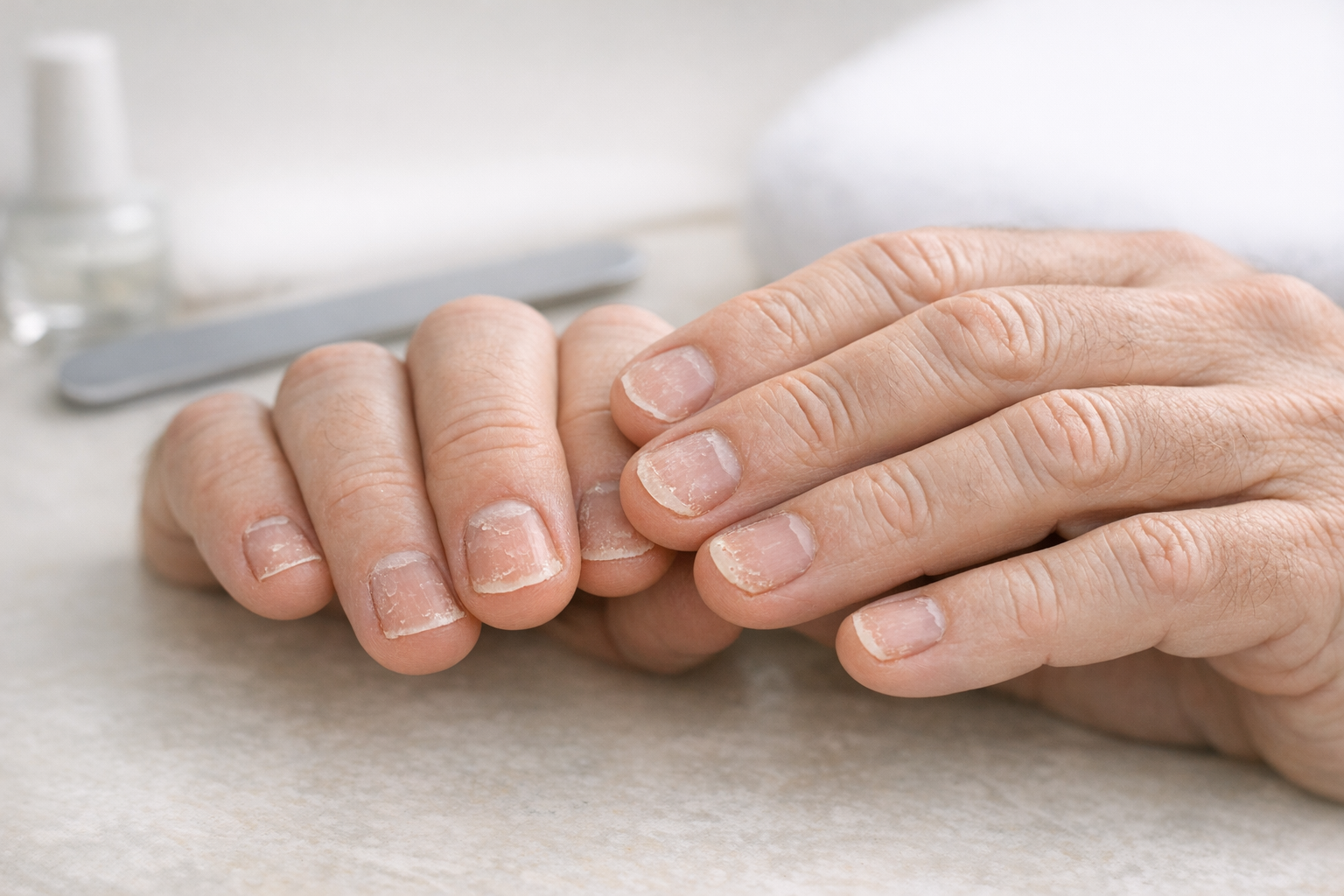
- Where is the peeling? Thin sheets flaking off the free edge, with a smooth, normal-coloured nail plate behind them, is the classic post-gel pattern (onychoschizia plus surface exfoliation). White flecks or patches scattered across the surface are the pseudo-leukonychia that Tosti (2017) and Rieder and Tosti (2016) both describe after repeated application and removal; they are surface damage, not a calcium problem, and they grow out.
- Is it the same on every nail, and did it start after a removal? Damage that appears on most of the nails you had done, within days of the soak-off, is almost always a removal story. Damage on one nail only, or that predates the gel, points elsewhere (an old injury, a habit, or a local condition).
- Is there anything beyond texture? Pain, swelling or redness around the nail, a nail lifting away from its bed (onycholysis), a new dark streak, thickening, or a colour change that is not a surface stain are not “gel damage” to wait out. Gel and acrylic can also cause allergic reactions, which look different — see our guide to sudden gel-nail allergy. A GP or dermatologist should look at any of these.
If you answered “edge peeling, most nails, started after removal, nothing else,” you are looking at ordinary post-gel damage, and the recovery plan below applies.
How long will recovery actually take?
The AAD gives the biological answer: “It takes about six months to grow out your fingernails” (toenails 12 to 18 months). Cleveland Clinic’s Dr. Ranasinghe says post-removal damage can take months to resolve as the damaged nail grows out. Putek and colleagues describe the nail-plate changes as slowly reversible. Nothing you apply to the surface will rebuild plate that has already formed, so the realistic goal is to stop adding damage and protect new growth while it emerges. The calendar below is our synthesis from those figures, not a clinical trial:
| When | What to expect | What to do |
|---|---|---|
| Days 1–7 | Dull, flexible, edges snagging; skin around the nail may be dry from the acetone | Petroleum jelly on cuticles and skin daily (AAD); smooth snags with a fine file rather than picking |
| Weeks 2–4 | Peeling at the tip is at its most visible; a clear band of untouched new plate starts at the cuticle | Keep the polish holiday going (AAD: one to two weeks or longer); trim short; gloves for water |
| Months 2–4 | At roughly 3 mm a month, the damaged zone moves toward the tip and gets trimmed away | Condition daily; if you go back to gel, protect the next removal |
| Months 5–6 | Most of the visibly affected plate has been replaced | Review: if damage is not clearly improving, see a dermatologist |
The 6-step recovery routine
- Stop picking and peeling. It is the one point on which every source agrees. Smooth loose edges with a fine file.
- Take a real polish holiday. The AAD suggests one to two weeks or longer; for visibly damaged nails, longer is the cautious reading.
- Moisturise the nails, not just the hands. The AAD advises applying a moisturiser such as petroleum jelly to nails and cuticles several times a day between polishes.
- Cut the wet-dry cycling. Cotton-lined rubber gloves for dishes and cleaning; condition soon after hand-washing. The mechanism is in our hand sanitizer and soft-and-bendy in water articles.
- Leave the cuticle alone. It forms the seal that protects the nail matrix, and cutting it leaves nails vulnerable (StatPearls); see why cuticles grow over nails.
- If you return to gel, plan the exit first. Book a professional soak-off, or follow the soak method above. Avoid stacking gel on gel, and consider the lamp question and how dip compares before choosing a system.
Oral biotin comes up in nearly every article on this topic. The dosing and evidence are covered in does biotin actually work for nails?; the short version is that the supporting trials are small, and it is not a fix for mechanical damage. For layer-splitting versus vertical splitting, see why nails split vertically.
📋 Please note: The section below describes a daily-care cosmetic product. It supports the appearance of flexible, resilient-looking nails; it is not medical advice and is not intended to diagnose, treat or prevent any condition. Pain, a nail lifting from the bed, a new dark streak, thickening or colour change should be checked by a doctor.
Where Provité Nail Elixir fits during recovery
A recovering nail has two jobs the routine above cannot do on its own: keep a conditioned film on the plate edge where layers are lifting, and do it without adding another round of water or alcohol. Provité Nail Elixir was formulated by S. C. Aris as a 100% lipid, water-free, formaldehyde-free concentrate designed to saturate between the nail’s layers rather than only coat the surface — the “intra-keratin” approach behind its “flexible-strength” positioning: nails that bend and recover rather than nails that are merely hardened. Because it contains no water, it adds no extra evaporation cycle to a plate that has just been through an acetone soak.
The blend carries thirteen botanical lipids — hemp seed, grapeseed and sesame seed, jojoba, avocado and coconut, camellia tea, cucumber seed, lemon and carrot seed, plus lavender, geranium and vitamin E. For recovery, it is best used on bare, polish-free nails and cuticles, which is exactly what a polish holiday gives you. In a customer survey, 88% reported nails that looked stronger and less brittle within four weeks and 94% said they would recommend it; it carries a 4.8/5 rating from 26 verified buyers and a 90-day money-back guarantee.
One disclosure: Provité is not a fragrance-free formula — it contains lavender, geranium and lemon. If the skin around your nails is cracked or sore from the acetone, keep a plain petroleum jelly for the skin (as the AAD suggests) and reserve the elixir for the nail plate and cuticle once the skin has settled; patch-test a drop on the inner forearm first if you react to fragranced products.
Frequently Asked Questions
Why are my nails so thin after taking off gel polish?
Dermatology sources link removal — peeling or scraping the gel and the long acetone soak — to nail thinning, weakness and peeling. In a 2,118-person survey, nail-plate changes were significantly more frequent after removal than during application or wear. The thinning is surface-level and grows out over months.
How long do nails take to recover after gel?
A fingernail takes about six months to grow out fully, according to the American Academy of Dermatology, and Cleveland Clinic says damage can take months to resolve as the damaged nail grows out. Expect gradual change rather than a quick turnaround.
Is it safe to peel gel polish off?
No. The AAD says picking or filing off gel polish can significantly damage the nails, and Cleveland Clinic advises against peeling it. Soak it off with acetone or have a professional remove it.
Should I use foil or plastic wrap to remove gel?
The AAD’s home-removal guide recommends plastic food wrap for a tight seal, while its gel-manicure guidance and Cleveland Clinic describe foil. Either approach works as long as the acetone stays on the nail, off the skin, and you do not scrape what is left.
How long should I wait between gel manicures?
The AAD suggests a nail polish holiday of one to two weeks or longer between polishes, and Cleveland Clinic’s dermatologist suggests reserving gel for a few special occasions a year rather than every two to three weeks.
Do white spots after gel mean a calcium deficiency?
Usually not. Tosti describes white patches and linear markings (pseudo-leukonychia) from keratin exfoliation during repeated polish application and removal, and the AAD warns that an orange stick can cause white spots. They are surface marks that grow out.
When should I see a doctor about nails damaged by gel?
If a nail is painful, swollen, lifting from the bed, has a new dark streak, is thickening or changing colour, or if only one nail is affected or the damage is not improving after several months.