Why Is My Scar Getting Wider? The Tension Rule — and the Window When Width Is Still Being Decided
Last updated: 1 September 2026
Quick answer
A scar that is spreading sideways is almost always a mechanical problem, not a healing failure. The final width of a scar is set largely by the tension pulling across it while it is still immature. As Thomas Mustoe puts it in the international scar classification, the collagen fibres of a mature scar are “of variable width depending on the genetics of the patient and the underlying tension placed on the healing immature scar.” Healing skin is also mechanically weak — it reaches roughly 80% of surrounding dermal strength only by about three months — so for the first several months the scar simply cannot resist being pulled apart. Widening is therefore commonest on the back, shoulders, chest and skin over joints, and it usually slows and stops as the scar matures.
Three things actually change the outcome: offloading tension (tape or a silicone strip running along the scar, plus avoiding the stretch positions that pull on it), time (width stabilises long before colour does), and, if the scar is already wide and mature, a surgical revision that re-orients or re-closes it under less tension. Topicals cannot change the mechanics — what a well-formulated one can do is support how the scar looks and feels: softer, smoother, more even in tone. A lipid concentrate such as ScarDerma Pro is one example of that category. It is not a substitute for tension control.
The 20-second version
- Width is decided early. Collagen accumulation peaks around three weeks after surgery, and scar strength is roughly maximal at about six months.
- Weak skin stretches. Scars generally reach only about 70–80% of normal skin strength — permanently.
- Flat and wide is different from raised and wide. One is a stretched scar; the other is hypertrophic. They respond to different things.
- Site beats effort. Back, shoulders, chest and joints widen most, because that is where skin tension is highest.
- Colour lags width. Redness can take more than a year to fade — so a scar that has stopped widening can still look angry.
- Use the ruler test below to find out whether yours is actively widening or has already stabilised. That single answer changes what you should do next.
First: is it actually widening, or is it changing in some other way?
“My scar is getting wider” covers at least four different things, and they are not treated the same way. The international scar classification, published as part of the open-access Textbook on Scar Management, separates them cleanly. Work out which row you are in before you do anything else.
The widening decoder
| What you see | What it is | The tell | What it responds to |
|---|---|---|---|
| Flat, pale, soft — but wider than the original line | A stretched (widened) scar. The collagen band itself simply set down broader, because the wound edges were being pulled apart while healing. | You can lay a fingertip across it and feel nothing raised. No itch, no pain. Often silvery or white. | Tension offloading while immature. Once mature, only surgical revision meaningfully narrows it. |
| Wider and raised, red, firm, itchy | A linear hypertrophic scar. Here collagen keeps accumulating: the scar “widens and becomes elevated or ropy in appearance and the erythema fails to resolve.” | It stays within the footprint of the original wound — even though it is wider than a normal scar. It stands proud of the skin. | Silicone, pressure, time; steroid injection or laser if persistent. See a clinician. |
| Growing out past where the original wound ever was | A keloid. It behaves “more like a tumour in that growth can occur even years after the original injury and extend far beyond the confines of the original scar.” | The edges have crossed onto skin that was never cut. Often a mushroom or cauliflower shape. Frequently painful or itchy. | Specialist management. Do not attempt to excise it casually — recurrence is high. |
| Sunken, thinned, dented | An atrophic scar. The opposite failure mode: collagen synthesis was depressed and inflammation lower than usual, so the tissue thinned rather than thickened. | It sits below the level of the surrounding skin. Stretch marks are the classic example. | Resurfacing and volume-based approaches, not tension control. |
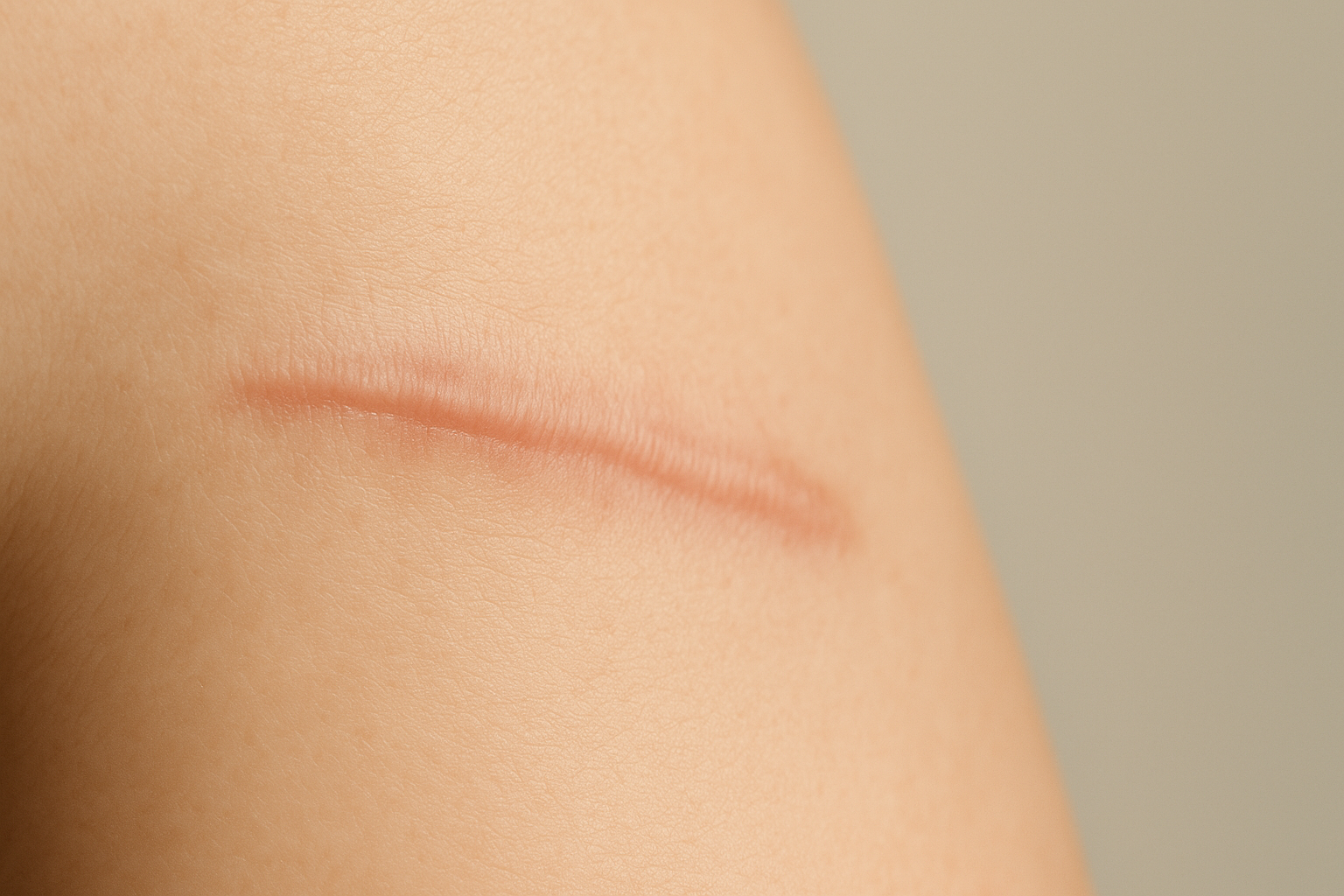
Most people searching this question are in row one or row two. The single most useful thing you can do is press a finger gently across the scar: if it is flat, tension has stretched it. If it is raised, collagen is still being laid down and the scar is still immature. That distinction determines everything below.
Why tension — not your aftercare — decides the width
This is the part almost every consumer article skips, and it is the whole mechanism.
Skin is not slack. It sits under permanent, directional tension. Dermatologists map this as skin tension lines — “a map of the direction in which the tension in the skin is maximal at different body sites.” That tension comes from inside the skin itself: passive pull from collagen fibrils aligned in parallel, plus active pull from the contraction of fibroblast cells. It varies from person to person, and it is modified by the bone, cartilage and muscle underneath and by the movement of nearby joints.
Cut across that tension and the two edges of the wound are permanently trying to move apart. This is exactly why surgeons plan incisions along relaxed tension lines wherever they can: as the tension-control chapter of the Textbook on Scar Management puts it, “surgeons strive to make incisions that follow the relaxed tension lines on the body… because tension is well known to increase scarring.” Aligning an incision with those lines “results in minimal tension across the closure… This leads to optimal scar formation and minimises wound contraction.”
When tension is present, two things happen at once:
- The edges physically separate, even slightly. Tension on the wound edges is documented as “a source of inflammation and potential complications, like local infection, scar enlargement when skin edges are, even minimally, separated.” The collagen simply fills a wider gap.
- The cells behave differently. This is the striking part. Mechanical tension actually changes fibroblast gene expression: three-dimensional modelling has “demonstrated that the induction of tension modifies the expression of the genes linked to the mechanical tension of the fibroblasts,” and that “an increased synthesis of collagen occurs in the scar via the fibroblasts when tension is exerted strongly on the edges.”
Rei Ogawa's chapter on wound closure describes the downstream consequence in scars that never settle: cyclical tension — from joint movement, for instance — “provokes chronic inflammation of the dermis… This chronic inflammation blocks the conversion of the granulation tissue into dermis-like tissue by the remodeling process and results in an immature hypertrophic scar that is red, elevated, hard, and painful.”
And it explains why the surgeon's technique matters far more than anything you can buy: in Ogawa's work, suturing the deep fascia — well below the skin — removed roughly 90% of the tension on the wound edge, with the superficial fascia accounting for the remaining 10%. Dermal stitches alone, he notes, “do not effectively reduce tension on the dermis.” If your scar is widening, a large part of the answer was decided in theatre before you ever saw it.
The tension map: why the same scar behaves differently on your shoulder and your eyelid
Two people can do identical aftercare and get very different scars, purely because of where the scar is. This is the table the top results for this question do not give you.
| Zone | Tension load | Why | Realistic expectation |
|---|---|---|---|
| Back, shoulders, upper arms | Very high | These are described in the surgical literature as “regions known for their dermal fragility and problematic scarring” where “maintaining a linear scar… is difficult.” Thick dermis, constant multidirectional pull. | Expect some spread. A narrow line here is the exception, not the rule. |
| Chest and sternum | Very high | Cleveland Clinic lists chest among the taut areas where raised scarring is most common; breathing and arm movement load it continuously. | High risk of both widening and raised scarring. Worth planning for in advance. |
| Over joints — knee, elbow, knuckle, shoulder | Very high, and cyclical | “Wounds on the major joints tend to develop hypertrophic scars because the joint movements place strong cyclical tension on the wound.” The AAD is blunt that scars “over joints like the knees and elbows are hard to avoid.” | Movement restriction matters more than cosmetics here. Follow your surgeon's activity limits literally. |
| Lower abdomen (including C-section) | Moderate to high | Usually well aligned with tension lines, but loaded by posture, coughing, lifting and weight change. | Often good if the closure was deep and activity was limited early. See our guide to reducing the appearance of a C-section scar. |
| Face — along creases and folds | Low, if planned well | Rich blood supply, and incisions can be hidden along relaxed tension lines. Note that on the face, Langer's cadaver lines and relaxed tension lines “often run at right angles to one another” — which is why the modern lines are used. | Usually the narrowest, fastest-fading scars on the body. |
If your widening scar is on your shoulder or back, this table is the reassurance: it is not that you did aftercare badly. It is that you were dealt the hardest site on the body.
The window: when is the width still being decided?
This is the question that actually matters, because it tells you whether effort now will change anything.
| Time since injury | What is happening structurally | Can width still change? |
|---|---|---|
| Days 0–21 | Inflammation, then closure. The regeneration stage “is complete when the wound is fully closed and takes 2–3 weeks.” Collagen accumulation peaks at around three weeks. | Yes — the most. This is the highest-leverage window, and the one most people spend doing nothing. |
| 3 weeks – 3 months | Remodelling begins. Wounded skin acquires roughly 80% of the dermal strength of surrounding normal skin by three months post-wounding. | Yes. The scar is still mechanically weak and still stretchable. Tension offloading is still worth doing. |
| 3–6 months | Collagen reorganises and cross-links. Strength gains come from better collagen organisation, not more collagen. Scar strength is roughly maximal at about six months. | Diminishing. Widening usually slows markedly here. |
| 6–18 months | Colour catches up. Erythema resolution — not width — is the marker of maturity. MSK counts scar healing as continuing “for 12 to 18 months.” | Mostly no for width. Yes for colour and softness. |
| Beyond 18 months | Slow refinement. In one human volunteer study, superficial scars took longer than a year for erythema to fully resolve in one-third of patients. Measured scar elasticity in burn patients continued to increase over five years. | No, not without surgery. But the scar can keep looking better for years. |
Two takeaways from that table. First, the window in which width is negotiable is roughly the first three to six months — far earlier than most people start caring about it. Second, width and colour run on different clocks. A scar that stopped widening at four months can still be bright red at fourteen months, which is why so many people believe their scar is “still getting worse” when only the colour is lagging. We cover that separately in why your scar is still red and how long redness lasts.
And the permanent constraint: a scar “is not as thick as normal skin. Scars generally only reach about 70 to 80% of skin's normal strength.” That is not a temporary state. It is why a scar on a high-tension site keeps a lifelong tendency to stretch under load.
The 30-day ruler test: find out whether yours is still widening
Almost nobody actually measures. They compare a memory of the scar to today's scar, which is unreliable in both directions — and then either panic or ignore a scar that is genuinely spreading. This is a simple tracking method, not a diagnostic test, and it takes two minutes a month.
- Pick one fixed landmark. Not “the middle” — that moves. Use something that cannot drift: the point where the scar crosses a mole, the exact end of the line, or a measured distance from a bony landmark (“7 cm below the collarbone notch”). Write it down.
- Photograph with a ruler in frame, laid flat against the skin beside the scar, in the same room and the same light. Same posture every time — if the scar is near a joint, same limb position, because skin tension changes with position.
- Record the width at that one landmark in millimetres. Measure the pale or coloured band itself, not the pinkness spreading around it.
- Repeat every 30 days for four months.
- Read the trend, not the reading. Two consecutive months with no measurable change means it has stabilised — you can stop worrying about width and shift your attention to colour and texture. Continued month-on-month increase past the six-month mark is worth showing to your surgeon, particularly alongside redness or firmness.
Do not measure before the wound is fully closed. Scar care generally starts once there are “no surgical staples, steri-strips, or scabs” — and MSK notes most people can begin home scar care about four weeks after surgery, after checking with their surgeon.
What actually helps — ranked honestly
Ranked by how much each one can plausibly influence the width of a scar, which is a different question from how much it influences redness or thickness.
| Intervention | Effect on width | The evidence, plainly |
|---|---|---|
| Surgical closure technique | Largest single factor | Deep fascial tension-reduction suturing removed about 90% of wound-edge tension in Ogawa's work. Z-plasty breaks a long line into segments that “mature faster than long linear scars.” This is decided before you leave theatre. |
| Activity limitation in the first weeks | High — and free | Follows directly from the mechanism: less stretch across a mechanically weak scar means less separation. The most under-used intervention there is. |
| Tension-offloading tape or strips over the scar | Moderate; best used early | Paper tapes “are placed over the skin edges to maintain a minimal pressure,” with low forces on the suture line; longitudinal placement along the scar has shown some superiority over transverse placement. Purpose-built mechanomodulating devices have gone further: in a randomised trial of 36 abdominoplasty patients with each patient acting as their own control, five weeks of a tension-shielding device produced significantly better scar appearance at 12 months on visual analogue (p = 0.027) and on both patient- and observer-rated POSAS scoring (p = 0.02 and p < 0.001). |
| Silicone sheets and gels | Low for width; useful for raised, red scars | MSK describes silicone as keeping the scar moisturised and potentially making it “softer and more flat” — height, not width. The AAD suggests hydrogel or silicone gel sheets “for large scrapes, sores, burns or persistent redness.” Worth doing; just aim it at the right target. See whether silicone sheets work on old scars. |
| Scar massage | Negligible for width; good for softness and mobility | Massage is used “to prevent the scar from becoming hard and raised, and to prevent it from sticking to the underlying tissues.” It will not narrow a stretched scar — and over-doing it has its own risks, covered in can you massage a scar too much. |
| Sun protection | None for width; large for how visible the width is | Sun exposure “can make the scar darker and more noticeable”; broad-spectrum SPF 30+ is the standard advice, and scars should be kept covered for at least the first year. A narrow dark scar reads worse than a wide pale one. |
| Topical lipid concentrates and scar creams | None for width; supports look and feel | No topical changes the mechanics of a wound edge. What a good one does is keep the scar supple and support its appearance — smoother, more even-looking — while the remodelling that is happening plays out. |
| Surgical scar revision | The only thing that narrows a mature wide scar | Re-excising and re-closing under lower tension, often with reorientation or Z-plasty. Discuss timing with a plastic surgeon — revising too early, into an inflamed scar, tends to disappoint. |
Six things that will not narrow your scar (whatever the packaging says)
- Vitamin E on its own. Popular, and not the answer to width.
- Massaging harder. More pressure does not equal more result — and blistering, open areas or a rash during massage mean you are being too rough and should stop and let it heal.
- Starting silicone late and expecting narrowing. Silicone is aimed at raised, red, immature scars.
- Waiting it out. Time fixes colour, not width.
- Anything applied over an open wound. Scar care starts after closure, not before.
- Tanning it to blend in. Scars are more susceptible to sunburn than surrounding skin, and sun makes them more noticeable, not less.
When to stop self-managing and see someone
- The scar is growing beyond the boundaries of the original wound — that points to a keloid rather than a stretched scar, and it needs specialist input.
- It is still measurably widening past six months, especially with ongoing redness, firmness or pain.
- It is crossing a joint and limiting movement.
- It is painful, intensely itchy, or changing in a way you can't account for. Cleveland Clinic notes raised scars are worth having checked, as they can occasionally conceal a skin cancer.
- You have a personal or family history of keloids and are considering elective surgery — raise it at consultation, not afterwards.
Where a topical genuinely fits: ScarDerma Pro
Let's be precise about the job. Nothing you rub on will change the tension across a wound edge, and any product implying otherwise is overselling. What a topical can do is work on the two things you look at every day: how the scar looks, and how it feels.
ScarDerma Pro is a 100% water-free botanical lipid concentrate, formulated for the appearance of scars and stretch marks. The reasoning behind the anhydrous format is straightforward: most scar creams are mostly water, and water evaporates. A water-free lipid concentrate has no water to lose, so it stays lipid-compatible with the skin's own surface layers rather than flashing off within minutes — the same delivery logic behind our SD7 Lipid Serum.
The blend. Four scar-focused actives — Immortelle Helichrysum, Rosehip seed, Tamanu and Pomegranate seed — sit alongside soothing Japanese Camellia, Geranium, English Lavender and Hemp seed, on a base of Sea Buckthorn, Calendula, Jojoba, Hazelnut and Vitamin E. Rosehip seed is a natural source of trans-retinoic acid, sometimes called “natural tretinoin”; small studies suggest modest improvement in the look of wrinkles and texture, and its content sits far below prescription strength. Pomegranate seed has been studied for its role in keratinocyte renewal, and its polyphenols researched for inhibiting collagenase and elastase — the enzymes that break down collagen and elastin.
What's not in it. No harsh acids or peels, no drying agents, no artificial fragrance or parabens, no fillers. Vegan and non-GMO. Because it is anhydrous, it needs no preservative system at all. Note that it does contain aromatic botanicals — geranium and lavender among them — so it is scented by its own ingredients, not fragrance-free.
The trust stack. Formulated by S. C. Aris. Rated 4.91 out of 5 from 34 verified buyers, 20 ml, with a 90-day guarantee — long enough to cover a realistic assessment period, given that scars change slowly. In our own customer survey, 91% reported flatter, smoother-looking scars within six weeks, 9 in 10 reported more even-looking tone, and 94% said they would recommend it. Those are customer-survey figures, not clinical trial results, and we label them that way deliberately.
How to use it on a scar you're tracking. Wait until the wound is fully closed — no staples, strips or scabs — and check with your surgeon first, which for most people is around four weeks. Apply a small amount to the closed scar once or twice daily. If you are also using silicone, apply the lipid concentrate first and let it settle, then the silicone over the top; the order matters, and we've explained why in using scar oil and silicone gel together. Keep taking your monthly ruler photographs regardless — a product is not a substitute for knowing what your scar is actually doing.
ScarDerma Pro is a cosmetic product. It supports the appearance of scars and stretch marks. It does not treat, heal or prevent any medical condition, and it is not a substitute for surgical or dermatological care.
Frequently asked questions
Is a widening scar a sign my wound is opening up?
Not usually, if the skin surface is intact and there is no drainage, warmth or increasing pain. A widening mature scar is a collagen band that set down broader than the original incision. A wound that is genuinely separating is a different, urgent situation — if the scar is bleeding, weeping, warmer than the skin around it, or newly painful, contact your surgeon rather than waiting.
How long does a scar keep widening?
Widening is largely confined to the period while the scar is mechanically weak and still remodelling. Wounded skin reaches around 80% of surrounding dermal strength by about three months, and scar strength is roughly maximal at about six months. Meaningful widening after that is uncommon, and if it continues it is worth a review.
My scar is wide but flat and pale. Can anything narrow it now?
Not without surgery. A flat, pale, soft, symptom-free wide scar is a mature stretched scar — the tissue has already organised at that width. Surgical revision that re-closes it under lower tension is the only approach that meaningfully narrows it. Topicals, massage and silicone can improve how it looks and feels, but they will not move the edges.
Why did my scar widen when I did everything right?
Because the two biggest determinants are outside your control: the tension at that body site, and how the wound was closed. The collagen fibres of a mature scar vary in width according to the patient's genetics and the tension placed on the healing immature scar. On the back, shoulders or over a joint, spreading is close to the default outcome.
Does taping actually work, or is it a myth?
The mechanism is real and it is the same one surgeons target. Paper tape over the skin edges maintains a minimal pressure with low forces on the suture line, and placement running longitudinally along the scar has shown some advantage over placing it across the scar. Purpose-built tension-shielding devices have produced significantly better scar appearance at 12 months in a randomised split-scar trial. Tape is the cheap, accessible version of that idea — but ask your surgeon first, particularly if you react to adhesives.
Will my wide scar fade even if it stays wide?
Almost certainly, yes. Colour and width are separate clocks. Erythema resolution is the marker of scar maturity, and it typically takes a year or longer — in one volunteer study, superficial scars took more than a year to fully lose their redness in a third of patients. Measured scar elasticity in burn patients kept improving over five years. A wide scar that has gone pale and soft is far less noticeable than a narrow one that is still red.
Should I be massaging a scar that is widening?
Massage is aimed at softness, mobility and preventing the scar sticking to underlying tissue — not at width. It is reasonable to do once the wound is fully closed, but watch for blistering, open areas or a rash, which mean too much pressure. Scars only ever reach about 70–80% of normal skin strength, so they injure more easily than you'd expect.
The bottom line
A scar that is getting wider is a scar that was pulled while it was weak. That is mechanics, not neglect — and it is largely determined by the site and the closure. Use the ruler test to establish whether yours is still moving. If it is, and you are inside the first few months, offloading tension is the highest-value thing you can do. If it has stabilised, shift your attention to the things that are still changeable for years: colour, softness and texture — where sun protection, patience and a well-formulated topical genuinely earn their place.
Related reading
- Why is my scar still red — and how long does scar redness last?
- Can you massage a scar too much? The blanch test
- Do silicone scar sheets work on old scars?
- Do old scars ever fade?
- How to soften old hard scar tissue
- How to reduce the appearance of a C-section scar
Sources
- Mustoe TA. International Scar Classification in 2019. In: Téot L, Mustoe TA, Middelkoop E, et al., eds. Textbook on Scar Management. Springer; 2020, ch. 9.
- Ogawa R. Ideal Wound Closure Methods for Minimizing Scarring After Surgery. Textbook on Scar Management. Springer; 2020, ch. 21.
- Téot L, Fluieraru S, Herlin C. Suture Edge Tension Control Technologies for Scar Improvement. Textbook on Scar Management. Springer; 2020, ch. 57.
- DermNet. Skin tension lines.
- Cleveland Clinic. Hypertrophic Scar.
- Memorial Sloan Kettering Cancer Center. Caring for Your Scars After Skin Surgery.
- American Academy of Dermatology. Minimize a scar: proper wound care tips from dermatologists.
- Walker M, PT, DPT. Scar Massage — How to Promote Healing. National Kidney Foundation.
This article is general information about the appearance of skin and scars, not medical advice. If your scar is painful, growing beyond the original wound, limiting movement, or you are worried about it, see a doctor, dermatologist or plastic surgeon.