Why Is My Scar Dark? Brown, Purple or Red — the Glass Test That Tells You, and the Sun Window That Decides It
Quick answer
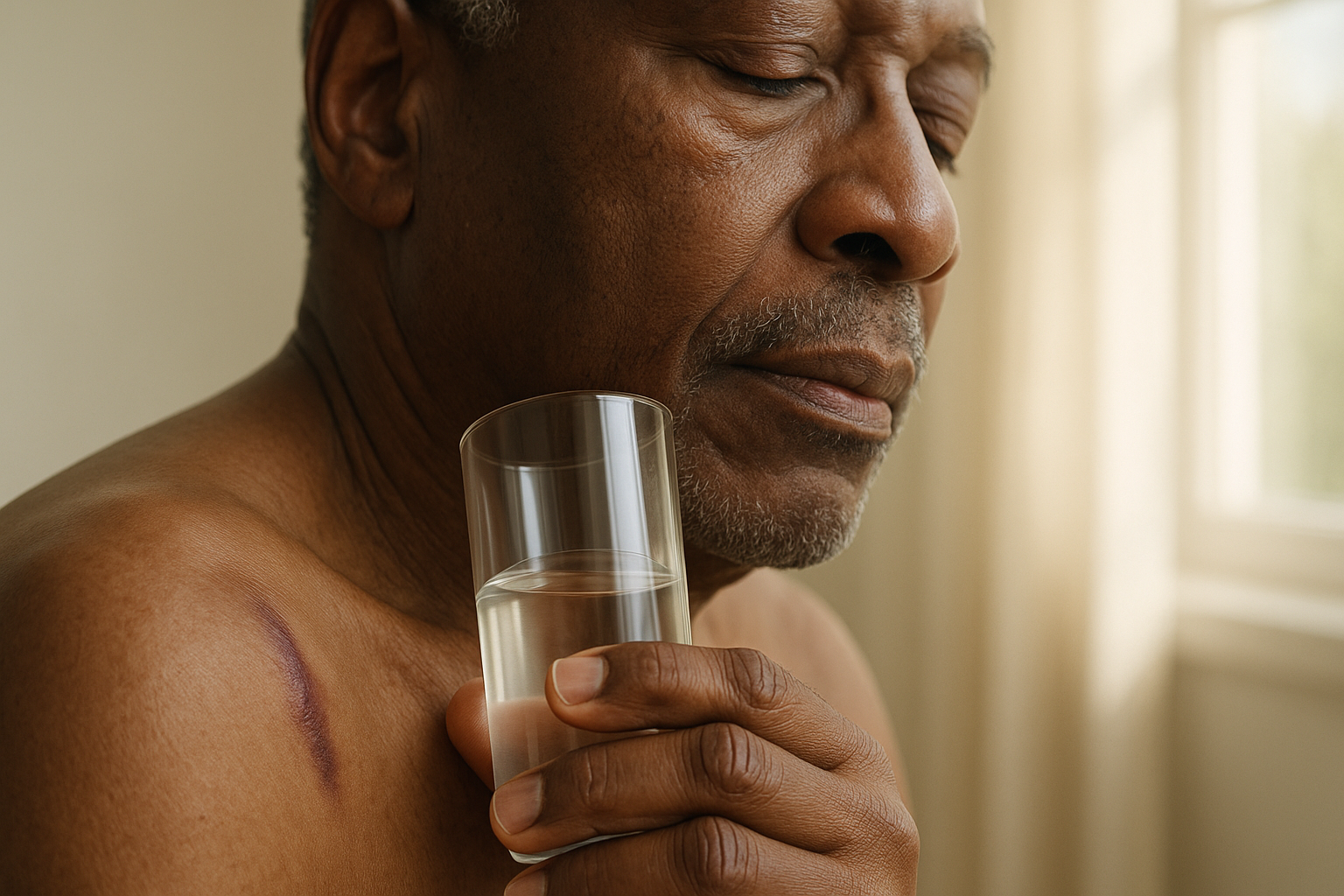
A scar looks dark for one of two unrelated reasons, and only one of them has anything to do with the sun. Either it is carrying extra pigment (brown: melanin, produced after the skin was injured) or it is carrying extra blood (red, pink or purple: small vessels still dilated while the scar matures). The quickest way to tell is the glass-press test: press a clear glass or slide firmly on the scar for a few seconds. If the colour drains away, it is vessels; if it stays, it is pigment. Brown pigment is the kind that UV light deepens — dermatologists describe post-inflammatory hyperpigmentation as something that “may become darker if exposed to sunlight,” and the American Academy of Dermatology advises broad-spectrum SPF 30 or higher on a scar once it has closed. Red-purple scars settle mostly with time. What a 100% water-free botanical lipid concentrate such as ScarDerma Pro is for is the surface of a fully closed scar — supporting the look of smoother, more even-toned skin — not switching pigment off.
Last updated: 29 September 2026
“Dark” is two different problems wearing the same word
Search for this question and nearly every page treats a dark scar as one thing — usually “hyperpigmentation” — and goes straight to a sunscreen recommendation. That is right for one kind of dark scar and irrelevant to the other. A scar that reads as dark can be:
- Brown (pigment). Melanin has accumulated in or beneath the skin’s surface. This is post-inflammatory hyperpigmentation, and it responds to sunlight.
- Red, pink, plum or purple (vessels). The colour is blood, not pigment. It is the vascular stage of a maturing scar and has its own clock.
- Dark only by contrast. On a very light or very deeply pigmented scar, the surrounding skin is what has changed. A scar that stays pale beside tanned skin looks “dark” only in the wrong direction; a tanned scar beside pale skin looks dark for real.
The distinction matters because the action differs: with brown you protect against UV and wait; with red you mostly wait, and sun protection is a supporting measure rather than the main lever. Guessing wrong means doing the wrong thing for months.
The glass-press test (30 seconds, no equipment)
Clinicians have a name for this — diascopy — and it is old, cheap and reliable. Priya Kadu’s review in the Indian Journal of Postgraduate Dermatology (2024) describes it as applying “firm pressure using a transparent instrument such as a glass slide or plastic spatula” over the lesion: the pressure displaces blood from the vessels, and what happens to the colour tells you what it is. Blanching — the colour going pale — indicates vascular lesions or erythema from dilated vessels; a colour that does not blanch suggests pigment, or blood that has leaked out of the vessels (purpura or haemosiderin) rather than blood still flowing in them.
The home version:
- Do it in daylight, on a scar that is fully closed — no scab, no weeping, no open area.
- Press a clear drinking glass or a clear ruler or plastic card flat against the scar. Look through the glass, pressing firmly enough to see the skin beneath go pale.
- Hold for two to three seconds, then compare the scar with the skin beside it.
| What you see while pressing | What it most likely is | What drives it | What tends to help |
|---|---|---|---|
| Colour drains to match the skin around it; returns within a second or two after release | Vascular (red, pink, purple) — dilated small vessels in an immature scar | Scar maturation. Mustoe notes that “the resolution of erythema is a useful marker of scar maturity” and that superficial scars took longer than a year for the redness to fully resolve in one-third of patients | Time; gentle care; sun protection as a supporting measure. Not a pigment problem |
| Colour stays — the brown does not change under the glass | Pigment — melanin in the epidermis and/or dermis (post-inflammatory hyperpigmentation) | Melanocytes stimulated by the injury and inflammation; UV exposure makes it darker | Consistent sun protection; time (months to years); dermatologist options if it persists |
| Colour stays and is dusky-purple or rust-brown, and the injury involved bruising | Blood that has left the vessels (bruising residue) rather than pigment made by melanocytes | Extravasated blood in the skin | Usually fades on its own; a new or spreading discolouration warrants a clinician’s look |
| Mixed — part drains, part stays | Both are present; common in scars in the first year | Maturation plus pigment | Treat the two clocks separately, below |
Two honest caveats. First, the press test is an orientation tool, not a diagnosis; a dermatologist with a dermatoscope sees more. Second, it is only a discriminator between “blood you can push away” and “colour you cannot,” which is exactly the split that matters here — it does not tell you how deep brown pigment sits.
Why a scar turns brown: the melanin mechanism
DermNet’s entry on post-inflammatory pigmentation defines it plainly: “Postinflammatory pigmentation is temporary pigmentation that follows injury (eg, a thermal burn) or inflammatory disorder of the skin.” The mechanism it gives is the useful part:
“Inflammation in the epidermis stimulates melanocytes to increase melanin synthesis and to transfer the pigment to surrounding keratinocytes (epidermal melanosis). If the basal layer is injured… melanin pigment is released and subsequently trapped by macrophages in the papillary dermis (dermal melanosis or pigment incontinence).”
Read that as two layers of the same event. In epidermal pigmentation, the pigment cells are simply over-producing and handing melanin to the skin cells around them — the colour sits high, and it is the kind that generally fades as the surface turns over. In dermal pigmentation, the injury broke the basal layer and pigment spilled into the dermis, where immune cells hold on to it — the colour sits deeper and lasts longer. A 2010 review by Erica Davis and Valerie Callender in the Journal of Clinical and Aesthetic Dermatology describes the same split: when it is confined to the epidermis there is “an increase in the production and transfer of melanin to surrounding keratinocytes,” whereas dermal involvement follows “inflammation-induced damage to basal keratinocytes, which release large amounts of melanin.” They add the practical consequence: it “may take months to years to resolve without treatment.”
Who gets it, and why some scars go dark and others go pale
DermNet is direct that “postinflammatory hyperpigmentation can occur in anyone but is more common in darker-skinned individuals,” and that it persists longer in darker skin. Davis and Callender make the same point: it tends to occur “more commonly among skin-of-color patients compared to Caucasian patients.”
The scar-classification chapter in the open-access Textbook on Scar Management (Thomas Mustoe, Springer 2020) puts the mature-scar version in one sentence: “The color of the scar ranges from white (absence of melanocytes) to hyperpigmented (often characteristic of ethnicities with increased melanocytes in the basal layer of the epidermis such as Asian, South Asian, Middle Eastern, Mediterranean, and Latin American or patients with brown skin).” So the same injury can end in a pale scar or a dark one depending largely on the pigment machinery in the skin it happened to. (If yours went the other way, the pale-scar question is a different article with a different answer.)
What the sun actually does to it
This is the one part every page agrees on, and it is worth being precise about the sources. DermNet: “The patches may become darker if exposed to sunlight (UV rays).” Davis and Callender: pigmentation “can worsen with ultraviolet (UV) irradiation or with persistent or recurrent inflammation.” Memorial Sloan Kettering’s patient guide for skin-surgery scars says it in ordinary language: exposing your scar to sunlight can “make the scar darker and more noticeable.”
Cambridge University Hospitals’ plastic surgery leaflet gives the version with a time limit attached: sun exposure “may cause your scars to hyper-pigment, or turn darker than the surrounding skin,” and the advice is SPF 30 or greater plus protective clothing, keeping the scar out of the sun “for at least one year following your surgery.”
The American Society of Plastic Surgeons’ 2026 consumer article on protecting scars quotes two surgeons in the same vein — one saying a fresh scar exposed to sun risks post-inflammatory hyperpigmentation, another that “if you tan and they become darker, they may remain hyperpigmented or dark permanently.” Treat the second as a surgeon’s clinical view rather than a measured outcome, but it is consistent with everything above. The article also makes a point most scar pages skip: a standard white cotton T-shirt has a UPF of only about 5, and thin wet fabric lets UV through — so “covered” is not the same as “protected.”
The AAD’s wound-care guidance is the shortest and the most useful: apply sunscreen “after it has healed. Sun protection may help reduce red or brown discoloration and help the scar fade faster. Always use a broad-spectrum sunscreen with an SPF of 30 or higher and reapply frequently.” Note the wording — red or brown — and note the timing: after it has closed, not on an open wound.
Two clocks: how long each kind of dark takes
Because the two causes run on different timelines, “how long will it stay dark?” has two answers. The figures below are the ones the sources actually give; nothing here is an invented average.
| Clock | What the sources say | What it means for you |
|---|---|---|
| Vascular redness / maturation | Memorial Sloan Kettering: the scar “will continue to heal for 12 to 18 months” and over time becomes “softer, smoother, and less red.” Cambridge: scars “may continue to change for up to 2 years.” Mustoe: redness outlasted a year in one-third of patients with superficial scars | A pink-purple scar at 6 months is not a failure — it is inside the normal window. Judge it at 12–18 months, not 12 weeks |
| Brown pigment | Davis & Callender: “months to years to resolve without treatment.” DermNet: temporary, and longer in darker skin. Both: worse with UV | Brown scars have no fixed date. The controllable variable is UV exposure during that period |
The practical reading: the maturation window (roughly 12 to 18 months, up to two years at the outer edge) and the sun-protection window line up. That is not a coincidence — it is the period in which the scar’s colour is still being decided, and therefore the period in which UV can move it in the wrong direction.
The 12-month sun protocol, by stage
None of the sources supplies a single “protocol,” which is the gap. This is our synthesis of what they do say, laid out in the order you will meet it. It assumes a routine, uncomplicated wound — follow your own surgeon’s instructions where they differ.
| Stage | Do | Source for the advice |
|---|---|---|
| Wound still open, scabbed or weeping | No sunscreen on the wound itself; keep it covered and out of direct sun, following your clinician’s dressing advice | AAD says apply sunscreen “after it has healed” |
| Closed and healed (roughly weeks 2–6, depending on wound type) | Start broad-spectrum SPF 30+ daily on exposed scars; add a wide-brimmed hat and clothing designed to block the sun. Reapply | AAD; MSKCC (“broad-spectrum sunscreen that’s SPF 30 or higher”, wide-brim hat, sun-protective clothing) |
| Months 3–12 | Keep it daily, not just for holidays. Choose fabric labelled with a UPF rating rather than assuming a thin T-shirt is enough | Cambridge (“at least one year”); ASPS (UPF of ordinary cotton about 5) |
| Beyond 12 months, still brown | Continue the sun protection and get it looked at — a dermatologist has options a consumer routine does not | DermNet lists topical agents, chemical peels, laser and IPL as clinical options for post-inflammatory hyperpigmentation |
One caution belongs here. The lightening routes are not casual DIY. DermNet’s peel guidance is explicit that “patients with Fitzpatrick skin types IV to VI have increased risk of dyspigmentation, hypertrophic, and keloid scarring and chemical peels must be performed cautiously,” and Mayo Clinic notes that after a peel, new skin “might temporarily be lighter or darker than normal.” Aggressive at-home acids on a scar can create exactly the problem you are trying to fix. (Our related piece on acids and stretch marks covers the pH and strength lines: can you use glycolic acid on stretch marks?)
What if it is red-purple rather than brown?
Then the sun is a supporting player, not the lead. The colour is vascular and is running on the maturation clock above. Memorial Sloan Kettering notes that a scar “may be very red, swollen” early on and gets “less red” over time, and mentions green-tinted makeup as a way to neutralise a red scar while it settles. Keep sun protection on anyway — a red scar that is also being tanned is heading toward the brown problem — but do not expect it to hasten the vascular fade. For the full redness timeline, see why is my scar still red?
When to have a clinician look
- The colour is changing quickly, spreading, or has an irregular edge. A scar that is darkening unevenly is different from one settling steadily.
- Anything new appears on or beside it. Cleveland Clinic is direct: “if you notice a mole, freckle or growth on or near the scar, call your provider right away,” because skin cancer can arise in a scar, particularly a burn scar.
- It is painful, itchy, tender or looks infected. Colour is not the concern then.
- It is still brown well beyond a year and bothers you. That is a reasonable point to ask about clinical options.
Where a water-free lipid concentrate fits: ScarDerma Pro
Given what the sources say, the honest job for a topical on a dark scar is narrow: look after the surface of skin that has fully closed, and support the look of an even-toned finish while the scar matures. It does not replace sun protection — nothing on this page does — and it is not a pigment switch.
ScarDerma Pro is a 100% water-free (anhydrous) botanical lipid concentrate, formulated by S. C. Aris. Because it contains no water, it needs no preservative system, and its lipids are chosen to sit in the outer layers of the skin rather than evaporating away. The formula leads with four actives — immortelle helichrysum, rosehip seed, tamanu and pomegranate seed — with Japanese camellia, geranium, English lavender and hemp seed as soothers, on a lipid base of sea buckthorn, calendula, jojoba, hazelnut and vitamin E. There are no harsh acids or peels, no drying agents, no artificial fragrance, no parabens and no fillers; it is vegan and non-GMO. One honest caveat: helichrysum, geranium and lavender are aromatic botanicals, so this is not a fragrance-free product — patch test on unbroken skin near the scar first (method in why does my serum sting?).
Its purpose is cosmetic — supporting the appearance of smoother, softer, more even-looking scars and stretch marks once the skin is fully closed. In a customer survey, 91% said their marks looked flatter and smoother within six weeks, 9 in 10 reported more even-looking tone, and 94% would recommend it. It is rated 4.91 out of 5 from 34 verified buyers and carries a 90-day guarantee. See ScarDerma Pro →
The boundary, stated plainly: use it on fully closed skin, and keep the SPF 30+ and clothing routine above running alongside it. If a scar is darkening unevenly, changing shape, or has anything new growing on or near it, the next step is a dermatologist, not a bottle.
More from our scar cluster: why is my scar still red? · why is my scar indented? · why is my scar shiny? · why is my scar getting wider? · when can you start scar cream? · do old scars ever fade? · C-section scar care
Frequently asked questions
Why is my scar darker than the skin around it?
Usually because the injury and its inflammation stimulated the pigment cells in that spot to make more melanin. DermNet describes this as inflammation that “stimulates melanocytes to increase melanin synthesis and to transfer the pigment to surrounding keratinocytes.” The other possibility is that the colour is red-purple from blood vessels rather than brown from pigment. A glass pressed on the scar tells them apart: vascular colour drains away, pigment does not.
Will a dark scar go back to my normal skin colour?
Often it lightens, but there is no fixed date. Davis and Callender describe post-inflammatory hyperpigmentation as something that “may take months to years to resolve without treatment,” and DermNet notes it lasts longer in darker skin. Scars as a whole keep changing for 12 to 18 months according to Memorial Sloan Kettering and up to two years according to Cambridge University Hospitals.
Does sun make a scar darker?
Yes, for the brown kind. DermNet says the patches “may become darker if exposed to sunlight (UV rays),” Memorial Sloan Kettering says sun can make a scar “darker and more noticeable,” and Cambridge University Hospitals advises SPF 30 or greater plus protective clothing for at least a year after surgery.
How long should I protect a scar from the sun?
Cambridge University Hospitals’ plastic surgery leaflet says at least one year following surgery. The AAD advises starting sunscreen once the wound has healed, with a broad-spectrum SPF of 30 or higher applied frequently. Because scars keep changing for 12 to 18 months, the year-long window matches the period when colour is still being decided.
What is the difference between a red scar and a brown scar?
Red, pink or purple is blood in dilated vessels and belongs to scar maturation; brown is melanin. Mustoe notes that the resolution of redness is “a useful marker of scar maturity,” and that redness can outlast a year in one-third of patients with superficial scars. Brown pigment is the kind UV light deepens.
Does the glass-press test really work on a scar?
It is a standard dermatology technique called diascopy. Pressure from a clear slide or plastic spatula empties the vessels, so vascular redness blanches, while pigment and blood that has leaked out of vessels do not. It is an orientation check rather than a diagnosis, and it works on healed, closed skin only.
Why do some scars turn pale instead of dark?
Because the pigment cells did not recover. Mustoe gives the range of mature scar colour as running from white, from an absence of melanocytes, to hyperpigmented, more characteristic of people with more melanocytes in the basal layer, such as those of Asian, South Asian, Middle Eastern, Mediterranean or Latin American background, or with brown skin.
Can I use a peel or acid to lighten a dark scar?
Take care. DermNet warns that people with Fitzpatrick skin types IV to VI have increased risk of dyspigmentation, hypertrophic and keloid scarring from peels, which must be performed cautiously, and Mayo Clinic notes new skin after a peel might temporarily be lighter or darker than normal. Peels and other pigment-lightening options are dermatologist decisions.
Does a T-shirt protect my scar from the sun?
Less than most people assume. The American Society of Plastic Surgeons’ scar-protection article cites a surgeon noting that a standard white cotton T-shirt has a UPF of only about 5 and that thin, wet fabric lets UV through, which is why sun-protective clothing with a UPF rating is worth choosing for scars in exposed areas.
This article is general information, not medical advice, and does not replace your surgeon’s, dermatologist’s or nurse’s instructions for your own scar. The glass-press check is an orientation aid, not a diagnostic test. ScarDerma Pro is a cosmetic product intended to support the appearance of healed skin; it is not intended to diagnose, treat, cure or prevent any condition, and it should only be applied to fully closed skin. See a doctor if a scar is darkening unevenly, changing shape, painful, or if any new mole, freckle or growth appears on or near it.
Sources
- Ngan V, Oakley A. Postinflammatory hyperpigmentation. DermNet (2005; updated December 2015). dermnetnz.org
- Davis EC, Callender VD. Postinflammatory Hyperpigmentation: A Review of the Epidemiology, Clinical Features, and Treatment Options in Skin of Color. J Clin Aesthet Dermatol. 2010;3(7):20–31. jcadonline.com
- Mustoe TA. International Scar Classification in 2019. In: Téot L, Mustoe TA, Middelkoop E, et al., eds. Textbook on Scar Management. Springer; 2020, ch. 9. NCBI Bookshelf NBK586057
- Kadu PP. Diascopy Revisited: ‘Slide’ Your Way to Diagnosis. Indian J Postgrad Dermatol. 2024;2(1). DOI 10.25259/IJPGD_71_2023. ijpgderma.org
- Memorial Sloan Kettering Cancer Center. Caring for Your Scars After Skin Surgery. Last updated 28 June 2024. mskcc.org
- American Academy of Dermatology. Minimize a scar: Proper wound care tips from dermatologists. Updated 2 July 2025. aad.org
- Cambridge University Hospitals NHS Foundation Trust, Plastic Surgery. Scar massage information. Approved 30 May 2023. cuh.nhs.uk
- Willson A. Fun in the sun: Protecting your plastic surgery scars. American Society of Plastic Surgeons, 29 May 2026. plasticsurgery.org
- DermNet. Chemical peels (face peels). Modified 23 May 2024. dermnetnz.org · Mayo Clinic. Chemical peel. mayoclinic.org
- Cleveland Clinic. Scars: Treatment and Cause. Last updated 15 March 2021. my.clevelandclinic.org