Why Is My Scar Indented? The 3 Causes — and the Stretch Test That Tells Them Apart
Quick answer
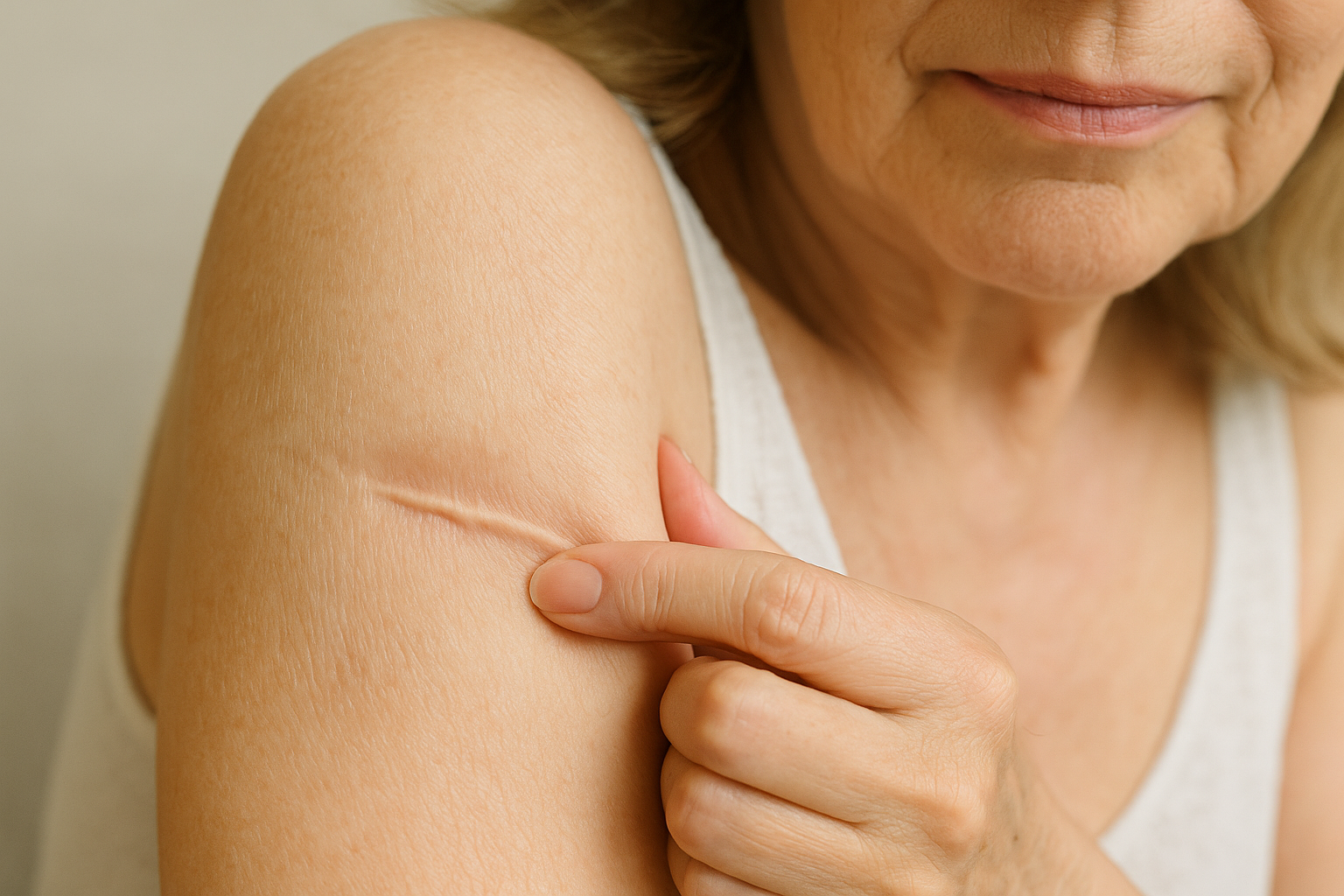
A scar sits below the skin around it for one of three reasons, and they are not interchangeable. Either the repair laid down less matrix than the skin it replaced (a true atrophic scar), or fibrous strands underneath are tethering the surface down to deeper tissue, or tissue below the skin — fat, or deeper structure — was lost in the injury or the surgery and the skin has nothing left to sit on. The fastest way to tell which one you have is to stretch the skin taut either side of the scar and watch what the dent does. That is not a home invention: the scar-grading system dermatologists publish draws its line between moderate and severe atrophic scarring on exactly this — whether a depression is "still able to be flattened by manual stretching of the skin." A dent that vanishes under stretch is shallow and distensile. One that stays put is bound down, short of volume, or both — and those three answers lead to three different interventions. What no topical does is refill a depression. What a 100% water-free botanical lipid concentrate such as ScarDerma Pro is for is the surface of the scar: supporting the look of smoother, softer, more even-toned skin, and providing the slip that every published massage protocol asks for.
Last updated: 22 September 2026
The word for it is "atrophic" — and that word is the whole explanation
Most people arrive at this question having already been told the obvious: the scar is indented because there is less tissue there. True, and useless. The question worth answering is why there is less tissue there, because the answer decides whether anything can be done about it.
Cleveland Clinic's scar classification lists depressed scars under their clinical name: "Depressed (atrophic): These sunken scars often result from chickenpox or acne. They look like rounded pits or small indentations in the skin." That covers the commonest cause but not the mechanism. For that, the best source is the open-access Textbook on Scar Management, where the plastic surgeon Thomas Mustoe sets out the international scar classification. His definition of the atrophic scar is one sentence long and worth reading twice:
"In some cases, a scar will become depressed or thinned as it transitions from an immature scar. This can occur when collagen synthesis is depressed and inflammation is less than usual."
Note what that says. The dent is not a failure that happened at the moment of injury. It is something that develops during maturation — as the scar transitions from its immature, pink, slightly-raised phase to its mature one. And the cause is not too much scarring. It is too little.
Rei Ogawa, writing in the same textbook, gives the cleanest statement of the underlying balance. During the remodelling phase, he explains, fibroblasts both build the extracellular matrix and secrete collagenase to break it down again, and "this repeated synthesis and enzymatic breakdown of ECM proteins remodels the three-dimensional structure of the ECM." Then the line that explains every scar you have ever seen:
"For proper remodeling, the synthesis and degradation processes must be carefully balanced: if there is too much ECM synthesis, scars can become hypertrophic. Conversely, if there is excessive ECM degradation, the scar can become atrophic."
Raised and indented scars are the same process failing in opposite directions. A keloid or hypertrophic scar is the build side winning; an atrophic scar is the breakdown side winning. That is why the advice for one is useless for the other, and why silicone sheeting — which is aimed squarely at overgrowth — is not the answer to a dent. (If your scar is doing the opposite thing, see why is my scar getting wider?)
DermNet describes the same imbalance from the acne end: the majority of acne scars "result from an overall inflammatory response causing net destruction of collagen fibres in the dermis in an atrophic scar." Net destruction. The inflammation ate more than the repair rebuilt.
The three causes of an indented scar
Mustoe's definition covers one mechanism — a genuine shortfall of matrix. But a scar can also sit low without any shortfall at all, simply because something is pulling it down or because the padding beneath it is gone. These are the three, and telling them apart is the point of everything that follows.
| What is actually happening | Typical history | How it behaves | |
|---|---|---|---|
| 1. Matrix shortfall (true atrophic scar) |
The remodelling balance tipped toward breakdown — "excessive ECM degradation" (Ogawa) or "collagen synthesis is depressed and inflammation is less than usual" (Mustoe). The dermis at the scar is genuinely thinner than the dermis beside it | Acne, chickenpox, a shallow injury; also striae and some post-radiotherapy scars, which Mustoe gives as his worked examples of atrophic scarring | Shallow, often with a sloping or soft edge; skin over it looks thin and may be paler. Frequently flattens when the skin is stretched |
| 2. Tethering (bound-down scar) |
There is no shortage of tissue at the surface — fibrous strands beneath are holding it down. DermNet's description of what subcision cuts is exact: "fibrous strands that are tethering the scar to the underlying tissue." Cambridge University Hospitals calls the same thing adhesions: "Scarring below the skin can adhere to underlying structures such as muscles and joints" | Surgery, deeper trauma, anything that scarred through more than one tissue layer; classically abdominal and C-section incisions | Often a sharper, puckered, drawn-in look. Does not flatten easily on stretch. The giveaway: the skin will not glide independently over the tissue beneath, and the dent may deepen when you tense the muscle underneath |
| 3. Volume loss below | Subcutaneous fat or deeper soft tissue was removed or destroyed. The dermis may be fine; there is simply nothing supporting it. DermNet groups the remedy for this under "lifting procedures… with volumetric filling of underlying soft tissue loss" | Excision of a lump or lesion with the fat beneath it, deep abscess, significant trauma, some injections | A broad, smooth, saucer-like hollow rather than a line. Stretching the skin does little, because the skin is not the problem |
Real scars are often mixtures — a surgical dent can be both tethered and short of fat. But one usually dominates, and there is a sequence of home checks that will tell you which.
The stretch test, and two checks to run with it
Here is the piece almost every page on this topic leaves out. Dermatologists already grade depressed scars by whether stretching flattens them, and they have done so since Goodman and Baron published their scarring grades. DermNet reproduces the criteria, and the difference between grade 3 and grade 4 is precisely this:
- Grade 3, moderate atrophic scarring: obvious at a social distance of 50 cm or more and not easily covered by makeup, "but is still able to be flattened by manual stretching of the skin (if atrophic)."
- Grade 4, severe atrophic scarring: evident beyond 50 cm, not easily covered, "and is not able to be flattened by manual stretching of the skin."
DermNet's description of rolling scars says the same from the other direction: they are "wide, with a sloping edge that can be smoothed out if stretched." The stretch response is a real clinical discriminator, not a folk test.
What follows is our practical three-step version for use at home. The stretch step is the published criterion; the glide and tense steps are our synthesis, built from how the same distinction is drawn in the clinical literature. It is an orientation tool to help you have a better conversation with a clinician — it is not a diagnosis, and it will not tell you what a dermatologist's fingers and raking light would.
Step 1 — Stretch
Get good side-lighting; a lamp low and off to one side will show a contour that overhead light erases. (Clinicians do the same thing deliberately — DermNet's subcision procedure includes "adjusting overhead lighting to delineate depressions.") Place a finger either side of the scar and draw the skin gently but firmly apart, across the line of the dent. Watch the base of the depression.
- The dent disappears or nearly disappears → distensile. The surface has enough skin; it is slack or thin rather than anchored. This is the more responsive kind.
- The dent stays, or the edges stay sharp while the middle holds → not distensile. Go on to steps 2 and 3.
Step 2 — Glide
Put a fingertip flat on the scar with light pressure and try to move the skin in small circles over the tissue beneath, the way Cambridge's scar-massage instructions describe — "so that the skin moves on the underlying scar tissue." Compare it with a patch of uninvolved skin a few centimetres away.
- Skin glides much less than next door, or not at all → tethering is likely. Cambridge notes that adhesions "effect the flexibility and mobility of the structures in all the layers affected," which is what you are feeling.
- Skin glides normally but the hollow remains → points toward volume loss underneath rather than adhesion.
Step 3 — Tense
If the scar sits over a muscle you can contract — abdomen, chest, thigh, upper arm — tighten that muscle and watch the dent.
- The dent deepens or puckers on contraction → strongly suggests the scar is anchored to something deeper that moves when the muscle moves.
- No change → the attachment, if any, is shallow.
Do all three in daylight, on relaxed skin, and photograph the result with the same lighting each time so you can compare months apart rather than trusting memory. Scars change slowly enough that memory is a poor instrument.
What your answer actually means
This is where the three causes stop being an academic distinction. The interventions that work on one do very little for the others.
| What you found | Most likely | What clinicians use for it | What home care realistically does |
|---|---|---|---|
| Flattens on stretch; glides normally | Distensile / matrix shortfall, shallow | Resurfacing approaches — DermNet lists chemical peels, dermabrasion, laser resurfacing and skin needling, which "aim to blend acne scars into the surrounding skin by removing epidermis to smooth out scar edges" and are "best used for more superficial acne scars" | Supports surface condition, softness and tone; sun protection prevents the contrast getting worse. Does not change depth |
| Does not flatten; poor glide; deepens when you tense | Tethered / bound down | Subcision — a needle is passed under the scar and moved "back and forth in a fan-like motion" so fibrous bands are transected, letting the skin lift. DermNet notes 3 to 6 visits suffice for most moderate scarring, at intervals of at least a month | Scar massage and mobilisation are the one home measure with a plausible mechanism here: Cambridge describes massage as "reducing the adhesions between the different layers of the tissue, making the scar tissue more flexible." Most useful while the scar is still maturing |
| Broad smooth hollow; glides normally; stretch does nothing | Volume loss beneath | Lifting procedures — DermNet lists dermal fillers "injected directly under depressed atrophic scars," including hyaluronic acid implants, collagen replacement and fat grafting | Little. Nothing applied to the surface replaces subcutaneous volume, and it is honest to say so |
| Mixed picture | Commonly tethering plus some volume loss | Combination — DermNet notes subcision "can be effectively combined with" microneedling, peels, TCA CROSS and fractional laser, and that more than one modality is often used "to correct scar colour, texture, and volume" | Massage, sun protection and surface conditioning as the baseline, with a dermatology opinion on the rest |
Two cautions about the procedural column, because this article is not a referral. Subcision is not for everyone: DermNet lists a history of hypertrophic or keloid scarring, current or recent oral retinoid use within 12 months, bleeding disorders and active infection among the contraindications, and puts the risk of a hypertrophic reaction at 5 to 10% in higher-risk facial sites. And Cleveland Clinic's framing of all scar treatment is the one to keep: treatments "can reduce a scar's size or appearance, but the scar will never completely go away."
Is the dent still changing, or is this it?
This matters, because an indent at six weeks and an indent at six years are different problems.
Mustoe's timeline for a normal scar: collagen accumulation "typically peaks about 3 weeks after surgery and then goes through about 6 months of remodeling," and the gains in strength over that period "are due to improvement in collagen organization and cross-linking rather than an increase in collagen." Ogawa adds the strength figure — "wounded skin acquires 80% of the dermal strength of the surrounding normal skin by 3 months post-wounding." Memorial Sloan Kettering tells skin-surgery patients their scar "will continue to heal for 12 to 18 months," and Cambridge extends the outside edge: a scar "may continue to change for up to 2 years," and is unlikely to fade further after that.
Read against those, an indent that appears in the first few months is appearing during the window when remodelling is still active — which is exactly what Mustoe describes when he says the scar becomes depressed "as it transitions from an immature scar." That is also the window in which massage and mobilisation are most often recommended, and in which the surrounding contour can still settle. A dent that has looked the same for three years is a mature scar, and the honest expectation is that it will stay that way without a procedure. As DermNet puts it for acne scars: they "are usually permanent, although may improve spontaneously over time or with treatment."
One useful marker of where you are: colour. Mustoe treats the resolution of redness as the practical signal of maturity — "the resolution of erythema is a useful marker of scar maturity" — while noting it commonly takes a year or longer, and that in a volunteer study "superficial scars took longer than a year for the erythema to fully resolve in one-third of patients." If your indented scar is still pink, it is still immature, and still moving. (More on that clock in why is my scar still red?)
The honest limits of anything you rub on
This is the section the commercial pages on this topic will not write, so here it is plainly.
A topical does not refill a depression. Not a cream, not a lipid, not an oil, not ours. Depth is a function of how much dermis and subcutaneous tissue is present, and nothing applied to the surface adds either. When DermNet wants to raise a depressed scar it reaches for fillers or subcision — injections under the scar and a needle to cut the bands — not for a bottle.
Silicone is the wrong tool for this particular job. Silicone sheeting is aimed at hyperproliferative scars, the ones that overgrow. Applying it to a scar that is already short of matrix is aiming an intervention at the opposite problem. (For where silicone does earn its place, see do silicone scar sheets work on old scars?)
Energy devices can do something topicals cannot. Cleveland Clinic's description of laser treatment includes a detail worth noticing: a laser may help a scar "flatten if it's too thick or thicken if it is too thin," and fractional devices "vaporize small columns of tissue within the scar to break up the collagen fibers and allow the scar to remodel and become more flexible." Re-entering the remodelling process is something a device can attempt and a moisturiser cannot.
So what is left for home care? Three things, and they are not nothing:
- Mobilisation, for the tethered kind. The one home intervention with a mechanism that matches one of the three causes.
- Sun protection, for the contrast. A dent is visible because of the shadow it casts and because its colour differs from the skin around it. Cambridge is unambiguous: sun exposure "may cause your scars to hyper-pigment, or turn darker than the surrounding skin," and asks for SPF 30 or greater plus protective clothing, keeping scars out of the sun "for at least one year following your surgery." MSKCC adds that sun makes a scar "darker and more noticeable." Letting a scar tan is the easiest way to make a shallow dent look deeper than it is.
- Surface condition. Scar skin is often drier and rougher than the skin around it, and dry, flaky skin scatters light unevenly and reads as more textured. Keeping the surface supple will not lift a dent but it changes how it reads.
The mobilisation routine, as the hospitals write it
If your scar failed the glide test, this is the part to actually do. It is Cambridge University Hospitals' plastic surgery protocol, with Memorial Sloan Kettering's gentler variant noted where they differ. Clear it with your own surgeon or dermatologist first — both sources say so, and MSKCC's instruction is to "talk with your dermatology surgeon… before doing any of the things below."
- Wait until the wound is completely healed — Cambridge says "usually around 4 weeks post-injury or surgery," and MSKCC likewise says most people can start about four weeks after surgery. Do not massage open wounds. (The full closure criteria are in when can you start using scar cream after surgery?)
- Wash and dry first. Cambridge: "Wash and dry the area with soap to rinse off any previous moisturiser. This is to stop the pores of the skin becoming clogged."
- Apply a small amount of lubricant — Cambridge specifies "an oil-based cream is best." Enough for slip, not a slick. The job is to stop your fingers dragging the scar.
- Move the skin, do not skate over it. Use the pads of two fingers or a thumb in a slow, circular motion "so that the skin moves on the underlying scar tissue." Then side to side across the scar, then up and down its length. For a tethered scar this is the whole point — you are working the interface, not the surface.
- Build pressure gradually. "Begin with light pressure and progress to deeper and firmer pressure," applying as much as you can tolerate. MSKCC's version for smaller skin-surgery scars is gentler: one to two minutes, one to three times a day.
- Dose it properly. Cambridge asks for at least 2–3 times daily, 5 minutes at a time, "for approximately 6 months until the scar has fully matured." Occasional massage does very little; consistency is the dose.
- Stop if it objects. Cambridge's precautions: do not massage open wounds, do not rub to cause friction, and stop if the skin "becomes sore or inflamed, blisters or reopens, or your skin develops a rash." (The detail on how hard is too hard is in can you massage a scar too much?)
Set expectations honestly. Massage is described by Cambridge as softening and flattening scars and reducing adhesions — it is a mobility intervention. It will not restore dermal thickness in a scar that never built it.
When to have someone look at it
- It is deepening, not settling — particularly beyond the first year, when a scar should be stabilising rather than changing.
- It restricts movement — Cambridge notes adhesions affect "the flexibility and mobility of the structures in all the layers affected," and a scar that tugs when you move needs assessment rather than a cream.
- It hurts, itches persistently, or has changed in texture or colour. Cleveland Clinic advises seeing a provider if a scar "changes or is painful, tender, itchy or infected."
- Anything new appears on or beside it. Cleveland Clinic is direct: "if you notice a mole, freckle or growth on or near the scar, call your provider right away," because skin cancer can arise in a scar, especially a burn scar.
- The appearance bothers you. That is a sufficient reason on its own, and the procedures described above exist for it.
Where a water-free lipid concentrate fits: ScarDerma Pro
Given everything above, the honest job description for a topical on an indented scar is narrow but real: keep the surface in good condition, and be the medium that makes a six-month massage routine tolerable enough that you actually complete it.
ScarDerma Pro is a 100% water-free (anhydrous) botanical lipid concentrate, formulated by S. C. Aris. Because it contains no water, nothing evaporates part-way through a session — the lipids stay put for a full five minutes of mobilisation and remain afterwards as a leave-on conditioning layer, which matters on scar skin that tends to run dry between sessions. Being anhydrous also means it needs no preservative system at all.
The formula leads with four actives — immortelle helichrysum, rosehip seed, tamanu and pomegranate seed — with Japanese camellia, geranium, English lavender and hemp seed as soothers, on a lipid base of sea buckthorn, calendula, jojoba, hazelnut and vitamin E. Rosehip seed is a natural source of trans-retinoic acid, sometimes called "natural tretinoin," which small studies have linked to modest improvement in the look of skin texture; pomegranate seed has been studied for its role in keratinocyte renewal. There are no harsh acids or peels, no drying agents, no artificial fragrance, no parabens and no fillers; it is vegan and non-GMO. One honest caveat: helichrysum, geranium and lavender are aromatic botanicals, so this is not a fragrance-free product — if your skin is reactive, patch test on unbroken skin near the scar first (method in why does my serum sting?).
Its purpose is cosmetic — supporting the appearance of smoother, softer, more even-looking scars and stretch marks as the scar matures. In a customer survey, 91% said their marks looked flatter and smoother within six weeks, 9 in 10 reported more even-looking tone, and 94% would recommend it. It is rated 4.91 out of 5 from 34 verified buyers and carries a 90-day guarantee — which covers the first three-month block of the six-month routine described above. See ScarDerma Pro →
The boundary, stated plainly: no topical — including this one — refills a depressed scar, cuts a tethering band, or replaces lost subcutaneous volume. If your scar failed the stretch test and the glide test, the thing that lifts it is a procedure, and the right next step is a dermatologist. This is for the surface, and for making the routine one you will finish.
More from our scar cluster: why is my scar getting wider? · why is my scar shiny? · can you massage a scar too much? · when can you start scar cream? · C-section scar care · do old scars ever fade? · glycolic acid on stretch marks
Frequently asked questions
Why is my scar indented instead of raised?
Because the remodelling balance tipped the other way. Rei Ogawa's summary in the Textbook on Scar Management is that "if there is too much ECM synthesis, scars can become hypertrophic. Conversely, if there is excessive ECM degradation, the scar can become atrophic." Raised and indented scars are the same repair process failing in opposite directions — which is why treatments for one do little for the other.
Will an indented scar fill in on its own?
Sometimes partially, and only while the scar is still maturing. Scars continue to change for 12 to 18 months after surgery according to Memorial Sloan Kettering and up to two years according to Cambridge University Hospitals, and DermNet notes atrophic acne scars "are usually permanent, although may improve spontaneously over time or with treatment." A dent that has been unchanged for years is unlikely to fill without a procedure.
How do I know whether my scar is tethered or just thin?
Stretch it, then try to glide the skin over the tissue beneath. The published Goodman and Baron grading separates moderate from severe atrophic scarring on whether the scar "is still able to be flattened by manual stretching of the skin." If it flattens on stretch it is distensile; if it does not flatten and the skin will not glide independently — or the dent deepens when you tense the muscle under it — tethering is more likely. This is an orientation check, not a diagnosis.
Does scar massage help an indented scar?
It helps one of the three causes. Cambridge University Hospitals describes massage as "softening and flattening scars and reducing the adhesions between the different layers of the tissue, making the scar tissue more flexible," which is directly relevant to a tethered scar. It does not add dermal thickness to a scar that never built it, and it does not replace lost fat beneath one.
Can a cream or oil fill in a depressed scar?
No. Depth depends on how much dermis and subcutaneous tissue is present, and nothing applied to the skin surface adds either. DermNet's remedies for a depressed scar are lifting procedures — dermal fillers injected under the scar, or subcision — not topicals. Surface products can support condition, softness and tone, which affects how a dent reads, but not how deep it is.
What is subcision and would it work on my scar?
It is a minor procedure in which a needle is inserted beside the scar and moved in a fan-like motion so that the fibrous strands tethering the scar to underlying tissue are cut, allowing the skin to lift. DermNet indicates it for depressed distensile and bound-down scars from acne, chickenpox, trauma and surgery, typically over three to six visits at least a month apart. It is not suitable for everyone — contraindications include a history of keloid or hypertrophic scarring, recent oral retinoid use, bleeding disorders and active infection — so it is a dermatologist's decision.
Are stretch marks the same thing as indented scars?
They are a form of atrophic scar. Mustoe gives striae as one of his worked examples of atrophic scarring, alongside some post-radiotherapy scars, and Cleveland Clinic lists stretch marks among scar types, caused when "skin expands or shrinks quickly" and the connective tissue underneath is damaged. The same principle applies: the mark is a shortfall, not an overgrowth.
Why does my indented scar look worse in some lighting?
Because you are seeing a shadow, not a colour. A depression is most visible under light raking across it from the side and least visible under flat, even light — which is why DermNet's subcision procedure involves "adjusting overhead lighting to delineate depressions" before marking a scar. It also means bathroom downlights are the harshest possible verdict on a scar, and not a fair one.
Does sun exposure make an indented scar more noticeable?
Yes, by increasing the colour contrast. Cambridge University Hospitals warns that sun exposure "may cause your scars to hyper-pigment, or turn darker than the surrounding skin," and asks for SPF 30 or greater with protective clothing, keeping scars out of the sun for at least a year after surgery. MSKCC adds that sun makes a scar "darker and more noticeable." Protecting it is the cheapest thing on this page.
This article is general information, not medical advice, and does not replace your surgeon's, dermatologist's or nurse's instructions for your own scar. The stretch, glide and tense checks described here are an orientation aid, not a diagnostic test. ScarDerma Pro is a cosmetic product intended to support the appearance of healed skin; it is not intended to diagnose, treat, cure or prevent any condition, and it should only be applied to fully closed skin. See a doctor if a scar is deepening, restricting movement, painful, or if any new mole, freckle or growth appears on or near it.
Sources
- Mustoe TA. International Scar Classification in 2019. In: Téot L, Mustoe TA, Middelkoop E, et al., eds. Textbook on Scar Management: State of the Art Management and Emerging Technologies. Springer; 2020, ch. 9. NCBI Bookshelf NBK586057
- Ogawa R. Ideal Wound Closure Methods for Minimizing Scarring After Surgery. In: Téot L, Mustoe TA, Middelkoop E, et al., eds. Textbook on Scar Management. Springer; 2020, ch. 21. NCBI Bookshelf NBK586099
- Logan I (author), Oakley A (chief editor). Subcision. DermNet, November 2015; modified 23 May 2024. dermnetnz.org
- Wong V (author), Coulson I (reviewing dermatologist). Acne scarring. DermNet, last reviewed August 2023. dermnetnz.org
- Cleveland Clinic. Scars: Treatment and Cause. Medically reviewed; last updated 15 March 2021. my.clevelandclinic.org
- Cambridge University Hospitals NHS Foundation Trust, Plastic Surgery. Scar massage information. Approved 30 May 2023. cuh.nhs.uk
- Memorial Sloan Kettering Cancer Center. Caring for Your Scars After Skin Surgery. Last updated 28 June 2024. mskcc.org